
Disclosure: VPNFin is reader-supported. If you buy a VPN through links on this page, we may earn a commission at no extra cost to you. This never affects our ratings — here’s how we research.
These two occupy the same corner of the market: unlimited devices, budget pricing, and a base inside an intelligence-sharing alliance. Surfshark operates from the Netherlands, inside 9 Eyes. IPVanish from the United States, inside Five Eyes.
The device count doesn’t separate them. Neither does price by much. What separates them is streaming access, what each publishes about its own logging — and a speed result that testers cannot agree on.
Full detail on each: our Surfshark review and our IPVanish review.
The Short Answer
Choose Surfshark if streaming is the point, if you want audits you can read, or if you use browser extensions.
Choose IPVanish if you need SOCKS5, want the widest country coverage, or connect from somewhere unusual.
On speed, honestly: published results contradict each other, and we explain why below rather than picking the convenient one.
Devices: A Genuine Tie
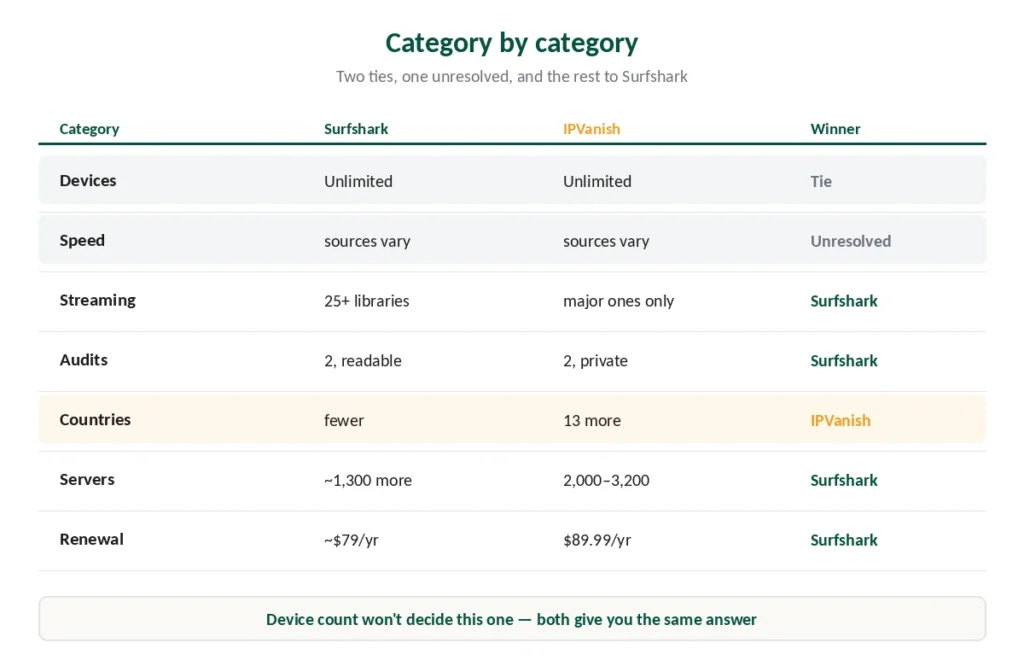
Both allow unlimited simultaneous connections on every plan, with no cap written into either set of terms.
That places them together against NordVPN’s 10, ExpressVPN’s tiered 10 to 14, and CyberGhost’s seven — and it’s why both keep appearing in household recommendations.
No winner. If device count is what brought you here, this comparison won’t settle it and you should decide on something else.
Speed: The Sources Disagree
This is the category where honest reporting requires admitting confusion.
One 2026 comparison found IPVanish faster, describing better retention on both download and upload, and calling speed IPVanish’s clearest win. It noted that WireGuard performance has never been Surfshark’s strength.
Several others reached the opposite conclusion, crediting Surfshark with faster speeds and better WireGuard implementation.
And CNET’s separate testing measured Surfshark at 21% average download loss — mid-table rather than fast. IPVanish doesn’t appear in that round at all.
⚠️ What we think explains it. Both providers mix physical and virtual servers, and both perform differently depending on which location you land on. A tester in Europe hitting a nearby physical server gets a different picture than one routed through a virtual endpoint. Neither result is wrong; they measured different things.
Practical takeaway: neither is slow, both are behind NordVPN, and your own experience will depend more on which server you pick than on which provider you choose. Our speed guide covers how to test that yourself.
No winner, and any comparison claiming a decisive one is over-reading its own data.
Streaming: Surfshark, Clearly
Here the evidence points one way.
Surfshark opened 25 or more Netflix libraries in published 2026 testing, with nothing holding out. Its browser extension also spoofs location separately, which helps with services that check twice.
IPVanish improved sharply — Sky Go, ITVX, BBC iPlayer, Disney+, Hulu and Netflix in both US and UK opened without argument, where several had refused a year earlier.
But smaller regional libraries stay inconsistent for IPVanish, and there are no dedicated streaming servers, so expect occasional server swaps.
⚠️ Note the discrepancy with our NordVPN comparison. Different testing found IPVanish failing on Netflix US. Access shifts month to month, which is exactly why both providers offer 30 days to check your own libraries — our streaming guide explains why no snapshot lasts.
Winner: Surfshark, on breadth and consistency.
Privacy: Same Count, Different Openness
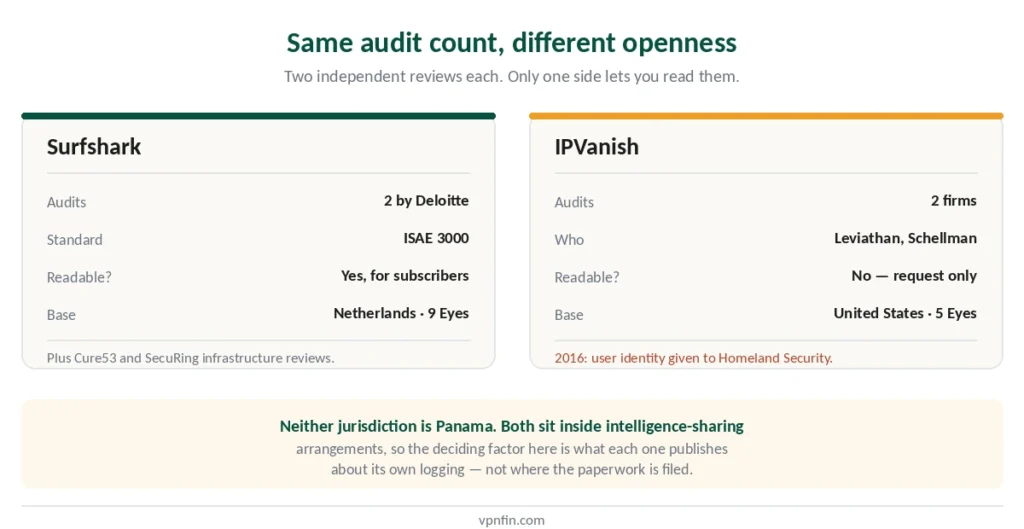
Both have two independent no-logs audits. The difference is what happens next.
Surfshark: two Deloitte assurance reports under ISAE 3000, in 2023 and June 2025, with documents available inside a subscriber account. Plus separate Cure53 infrastructure audits and a SecuRing review in December 2025.
IPVanish: Leviathan Security Group in 2022 and Schellman Compliance in February 2025, both examining infrastructure directly. Neither report is published — access requires a paid account or an email request.
And the histories differ. IPVanish handed the Department of Homeland Security a user’s identity and connection timestamps in 2016, under previous ownership, while advertising a no-logs policy. Surfshark has no comparable incident.
Jurisdiction is a wash. Netherlands sits inside 9 Eyes, the US founded Five Eyes. Neither is Panama.
Winner: Surfshark, on transparency and on the absence of a documented failure.
Network: A Reversal Worth Noting
IPVanish expanded hard through 2024 and 2025 and now reaches roughly 13 more countries than Surfshark — a reversal from previous comparisons.
Surfshark counters with about 1,300 more servers, plus dedicated and static IP options and MultiHop routing.
And Surfshark mixes physical with virtual servers deliberately, which lets it issue addresses from countries where hosting hardware isn’t practical.
⚠️ Server counts are among the least reliable figures in this industry. Published sources cite IPVanish anywhere from 2,000 to 3,200 servers. Treat both numbers as indicative.
Winner: split. IPVanish on countries, Surfshark on server density and variety.
Features and Apps
Surfshark carries more: CleanWeb ad and tracker blocking, MultiHop, Alternative ID for signup privacy, Bypasser split tunnelling, plus antivirus and Incogni on higher tiers.
IPVanish carries fewer, with two specifics: a SOCKS5 proxy that pairs neatly with torrent clients, and 1 TB of cloud backup plus phone support on the Advanced plan.
On platforms: Surfshark ships browser extensions for Chrome, Firefox and Edge. IPVanish has none. Surfshark also offers a proper graphical Linux client where IPVanish provides setup instructions — our Linux guide covers why that distinction matters.
IPVanish’s Fire TV app is well regarded, including a built-in kill switch that several competitors omit on that platform.
Winner: Surfshark on breadth, IPVanish on two specific tools.
Price: Closer Than Either Would Admit
First term: Surfshark from about $1.99–2.49 a month, IPVanish from $2.19. Effectively level.
Renewal is where it separates: Surfshark’s Starter converts to roughly $79 a year, IPVanish’s Essential to $89.99.
Refund windows: 30 days for both, with a caveat — IPVanish excludes monthly plans entirely, Surfshark doesn’t.
Mobile trials: both offer seven days through the app stores.
⚠️ Across four years the gap runs about $40 in Surfshark’s favour. Real, but smaller than most comparisons imply — our cheap VPN guide sets out the full arithmetic.
Winner: Surfshark, narrowly.
Which Should You Buy?
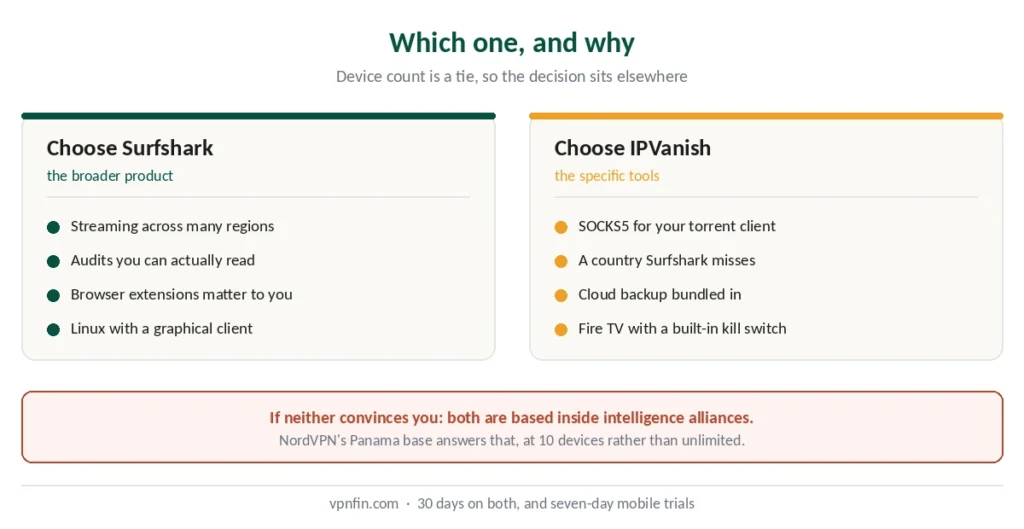
Surfshark if you stream widely, want your provider’s audits readable, use browser extensions, or run Linux with a graphical client.
IPVanish if you torrent with SOCKS5, need a country Surfshark doesn’t cover, or want the cloud backup bundled.
And if neither convinces you — both sit inside intelligence alliances, and NordVPN’s Panama base is the answer to that specific concern, at 10 devices rather than unlimited. We compare it against IPVanish here.
How We Research
This comparison draws on published testing from named sources including Gizmodo, Cybernews, Cloudwards, CyberInsider, AllAboutCookies and CNET, alongside our own full reviews of both providers — cross-checked and verified at publication. We don’t run our own speed tests. Where sources contradicted each other outright — as they did on speed — we present both positions and explain what we think accounts for the difference, rather than quoting the one that suits a recommendation. Our full approach lives on the About Us page.
Surfshark vs IPVanish FAQ
Surfshark, on most measures — streaming breadth, published audits, browser extensions and a slightly lower renewal price. IPVanish wins on country coverage, includes a SOCKS5 proxy, and has a well-regarded Fire TV app. Device counts are identical, and speed results contradict each other between testers.
Yes, on every plan, with no cap in either provider’s terms. This is the clearest thing they have in common, and it places both against NordVPN’s 10, ExpressVPN’s 10 to 14 by tier, and CyberGhost’s seven. If unlimited connections is your requirement, either works.
Published results contradict each other. One 2026 comparison found IPVanish clearly faster with better retention on download and upload; several others credited Surfshark. Both mix physical and virtual servers, so results vary by which location a tester used. Neither is slow, and both sit behind NordVPN in independent benchmarking.
Surfshark. Published testing opened 25 or more Netflix libraries with nothing refusing, and its browser extension spoofs location separately for services that check twice. IPVanish improved sharply in 2026 and now handles the major platforms, but smaller regional libraries remain inconsistent and it has no dedicated streaming servers.
Both have two independent no-logs audits. Surfshark’s are by Deloitte under ISAE 3000, in 2023 and June 2025. IPVanish’s are by Leviathan Security Group in 2022 and Schellman Compliance in February 2025. The difference is access: Surfshark makes documents available to subscribers, while IPVanish publishes neither report openly.
Neither, really. Surfshark operates from the Netherlands, a 9 Eyes member. IPVanish operates from the United States, which founded Five Eyes. Both sit inside intelligence-sharing arrangements. If jurisdiction is your priority, NordVPN’s Panama base or ExpressVPN’s British Virgin Islands registration are the relevant alternatives.
The Short Version
Devices are a tie. Both unlimited, both on every plan. If that’s your criterion, decide on something else.
Speed is genuinely unresolved. One 2026 comparison put IPVanish clearly ahead; several others said the opposite. Both sit behind NordVPN either way.
Streaming and transparency go to Surfshark — 25+ Netflix libraries against inconsistent regional coverage, and audits you can read against audits you can’t.
IPVanish wins country coverage, SOCKS5 and the Fire TV app, and costs about $10 a year more at renewal.