
Disclosure: VPNFin is reader-supported. If you buy a VPN through links on this page, we may earn a commission at no extra cost to you. This never affects our ratings — here’s how we research.
Most comparisons in this category get settled by the device limit. One provider gives five, the other gives ten, and a household reads that line and stops.
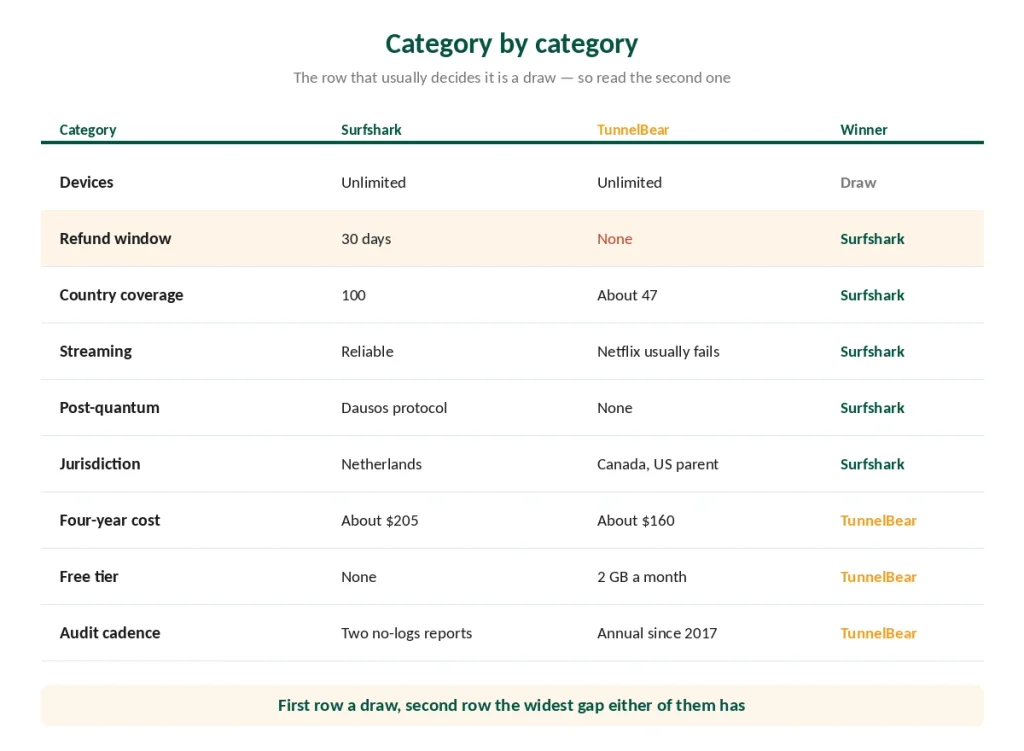
Surfshark and TunnelBear both allow unlimited simultaneous connections, so that argument is off the table before it starts. Two of the providers we cover do this, and these are both of them.
What is left turns out to be sharper than the device count would have been. One of them will refund you within thirty days. The other does not offer a refund window at all.
The Short Answer
Surfshark wins, at 4.6 against 4.0. Streaming that works, a hundred countries against forty-seven, post-quantum encryption shipping today, and thirty days to change your mind.
TunnelBear costs $45 less across four years and has the longest unbroken audit record in the category — published every year since 2017, which nobody else can claim.
Test TunnelBear on its free tier before paying, because that free tier is the only trial you get.
Head to Head
| Surfshark | TunnelBear | |
|---|---|---|
| Devices | Unlimited | Unlimited |
| Refund window | 30 days | None — case by case |
| Free tier | None | 2 GB a month, no card |
| Countries | 100 | ~47 |
| Streaming | Reliable | Netflix usually fails |
| No-logs audits | 2, by Deloitte | Covered in the annual run |
| Audits published | Trust page | Openly, since 2017 |
| Post-quantum | Yes, in Dausos | No |
| Owner | Nord Security | McAfee |
| Jurisdiction | Netherlands | Canada, US parent |
| Four years | $205 | $160 |
| Our rating | 4.6 | 4.0 |
What Unlimited Actually Removes
Worth being precise, because it changes which questions matter.
Neither provider caps connections, and neither sells a higher tier to raise a limit that does not exist. A household with a dozen devices pays the same as one person with two.
So per-device cost stops being a lever. In most of our comparisons that number decides it — Mullvad’s five against Surfshark’s unlimited worked out at twice the cost per device. Here both denominators are the same.
⚠️ What replaces it is the refund window, and that is a larger difference than most device limits.
The Refund Difference
Surfshark gives thirty days, granted on request. Buy, use the real product for a month, ask for the money back if it disappoints.
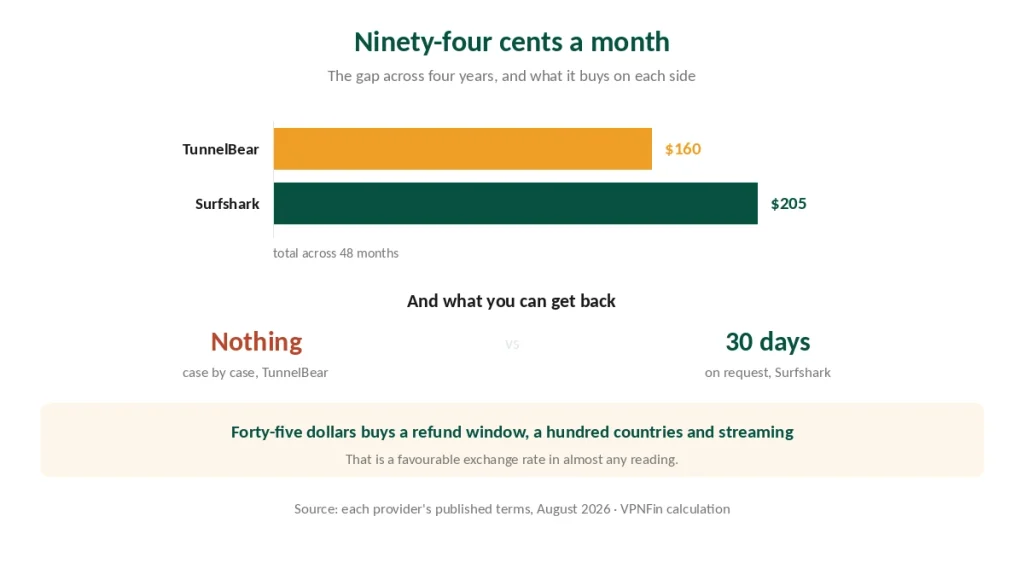
TunnelBear considers refunds case by case. There is no fixed window and no guarantee. That is the only such policy among the providers we cover.
So the free tier is not a bonus, it is the evaluation period. Two gigabytes a month with no payment card and full server access — roughly two hours of HD video. Enough to confirm the apps work on your devices; not enough to test sustained use or streaming.
⚠️ Practical order: run TunnelBear free for a week on the machines you actually use, then treat the paid subscription as non-refundable. Our free trial guide covers what each provider’s conditions mean, and CyberGhost makes the same point at almost the same price.
Winner: Surfshark, and it is the clearest line in this comparison.
Audits: Two Kinds of Record
Counting the wrong thing here produces the wrong answer, so it is worth separating.
TunnelBear has the longer unbroken run. Cure53 audited it in 2016, the report appeared in 2017 — the first public third-party VPN audit anyone had commissioned — and it has repeated the exercise annually since, reaching the eighth by 2024. Every report is published with the findings intact.
Surfshark has the wider coverage. Two no-logs assurance reports by Deloitte, in 2023 and June 2025 under the ISAE 3000 standard, plus Cure53 on its browser extensions in 2018, its infrastructure in 2021 and again in 2026, and its Dausos protocol in April 2026. SecuRing reviewed infrastructure security in 2025. All published on its trust page.
⚠️ A no-logs audit and a security audit answer different questions. The first asks whether the company keeps what it says it does not; the second asks whether the system can be broken into. Surfshark has more of both kinds in total; TunnelBear has the longer consecutive record and started the practice.
Winner: Surfshark on breadth, TunnelBear on cadence and on having invented this.
Coverage, Streaming and Protocols
The direction here is one-sided.
Servers: 4,500 across 142 locations in 100 countries, against roughly 47 countries. For a traveller that is the difference between having a nearby option and not.
Streaming settles itself. Surfshark unblocks reliably. Published testing reports Netflix failing on most TunnelBear servers, and TunnelBear maintains no streaming-optimised servers and no Smart DNS — our streaming guide covers why access shifts monthly for everyone.
Protocols: Surfshark is well ahead. Its in-house Dausos protocol uses AEGIS-256X2 with hybrid post-quantum key exchange, audited by Cure53 in April 2026. TunnelBear supports WireGuard, OpenVPN and IKEv2, with no post-quantum equivalent.
⚠️ Surfshark discontinued its Smart DNS, which matters only if you have older hardware that cannot run an app — our Apple TV guide covers where that gap shows up.
Neither offers port forwarding. Our torrenting guide covers who that affects.
Winner: Surfshark.
Ownership and Jurisdiction
Surfshark merged with NordVPN under Nord Security in 2022. The brands run separate infrastructure and commission separate audits, but two of the five providers we rank answer to one parent. Its jurisdiction is the Netherlands.
TunnelBear was acquired by McAfee in March 2018, a publicly traded US security company. The team stayed in Toronto and the audit programme survived intact, which is real evidence. Canada is a Five Eyes member and the corporate parent is American.
⚠️ Nothing has gone wrong at either. No breach, no logging incident, no reported disclosure. The concerns are structural rather than historical, and our legality guide covers how much jurisdiction decides on its own.
Winner: Surfshark, narrowly, on jurisdiction rather than on ownership.
Price: $45 Apart, With a Condition
TunnelBear runs about $3.33 a month on the three-year plan, $4.00 annually and $9.99 month to month. Across four years, roughly $160.
Surfshark Starter runs about $2.49 a month on the two-year plan with three bonus months, then renews near $79 a year. Across four years, roughly $205.
A gap of $45, or about ninety-four cents a month.
⚠️ Ninety-four cents a month buys thirty days of refund, a hundred countries and working streaming. That is a favourable exchange rate in almost any reading.
⚠️ And a cheap subscription you cannot return is not automatically cheaper. Across nine providers we found price and rating unrelated; this pair is a small illustration of why.
Winner: TunnelBear on the number, Surfshark on what the number buys.
Winners by Category
| Category | Winner |
|---|---|
| Devices | Draw — both unlimited |
| Refund window | Surfshark |
| Country coverage | Surfshark |
| Streaming | Surfshark |
| Post-quantum encryption | Surfshark |
| Jurisdiction | Surfshark |
| Four-year cost | TunnelBear |
| Free tier | TunnelBear |
| Audit cadence | TunnelBear |
| Ease of use | TunnelBear |
| Port forwarding | Neither offers it |
When to Choose TunnelBear Instead
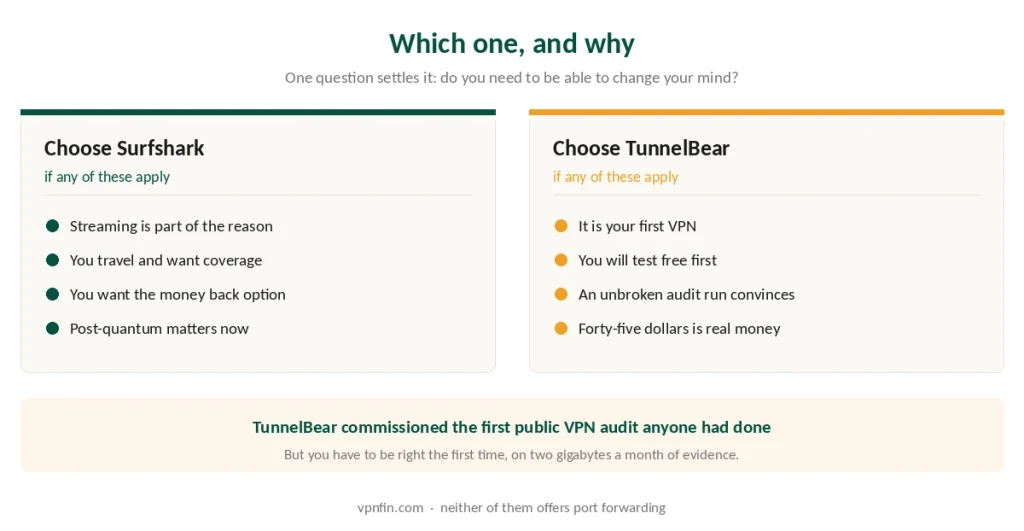
It is your first VPN. The interface is the friendliest in the category by a distance, and for someone who has never used one that matters more than a feature list.
You will test on the free tier first. Two gigabytes a month with no card tells you whether the apps work on your machines before any money changes hands.
An unbroken audit run convinces you. Nobody else has published every year since 2017, and nobody else publishes the findings alongside the fixes.
Forty-five dollars is forty-five dollars. If streaming is irrelevant to you and your servers are nearby, the gap is real money.
⚠️ Do not choose it for streaming, and do not choose it expecting to change your mind later.
How We Research
This comparison draws on our full reviews of both providers, where every figure was verified against named primary sources at the time of writing — the published Cure53 audit reports and TunnelBear’s summaries of them, Surfshark’s published Deloitte, Cure53 and SecuRing engagements, contemporaneous reporting on the March 2018 McAfee acquisition, and each provider’s own pricing and refund terms. We don’t run our own speed tests, and we have not restated any claim here that was not already sourced in those reviews. Where reviews carried figures a provider has since changed, notably TunnelBear’s device limit, we use the current number. Our full approach lives on the About Us page.
Surfshark vs TunnelBear FAQ
Yes, and they are the two providers we cover that do. Neither caps simultaneous connections and neither sells a higher tier to raise a limit that does not exist. A household with a dozen devices pays the same as a single user, which removes the argument that usually settles this kind of comparison.
Not through a standard guarantee. TunnelBear considers requests case by case rather than offering a fixed window, which sets it apart from every other provider we cover. Surfshark gives thirty days on request. Use TunnelBear’s free tier to evaluate first and treat the subscription as difficult to reverse.
It depends what you count. TunnelBear has the longer unbroken run — annually by Cure53 since 2017, and it commissioned the first public VPN audit anyone had done. Surfshark has wider coverage: two Deloitte no-logs reports plus Cure53 and SecuRing engagements on extensions, infrastructure and its protocol.
TunnelBear, by about $45. It comes to roughly $160 against Surfshark’s $205, or about ninety-four cents a month. What that gap buys is a thirty-day refund window, a hundred countries instead of forty-seven, and streaming that works.
Usually not. Published testing reports Netflix failing on most TunnelBear servers, and the company maintains no streaming-optimised servers and no Smart DNS. Surfshark unblocks reliably, so if regional catalogues are part of why you are buying, that settles it.
The Verdict
Surfshark takes it, and unusually the device count has nothing to do with it. Both are unlimited, which removes the argument that normally decides these comparisons.
What decides it instead is the refund window. Thirty days against none is a bigger practical difference than most spec-sheet gaps, because it determines whether you find out before or after committing.
TunnelBear’s case is genuine and cheaper. Forty-five dollars less across four years, the friendliest apps anywhere, and an audit record that started before the industry had one.
But you have to be right the first time, on two gigabytes a month of evidence. Against NordVPN it faces the same objection from a different direction.