
Disclosure: VPNFin is reader-supported. If you buy a VPN through links on this page, we may earn a commission at no extra cost to you. This never affects our ratings — here’s how we research.
Using a VPN in Turkey is legal. There is no criminal prohibition on individuals connecting to one, and the official framework treats VPNs as legitimate tools for secure remote access — what the law actually says, and who it obliges, is worth reading if that is your question.
Obtaining one inside Turkey is the problem. The telecoms regulator BTK has blocked more than 27 commercial VPN services — a list that includes every provider we rank — and Turkish networks use deep packet inspection to identify and drop standard VPN protocol signatures.
So the practical advice for Turkey isn’t which VPN to choose. It’s when to install it, and the answer is before you arrive.
The Short Answer
Install and test before you travel. Provider websites are unreachable from Turkish networks, and app store availability varies. Arriving without the app already working means you probably can’t get it.
Enable obfuscation. Standard OpenVPN, WireGuard and IPSec signatures are identified by DPI and dropped. Obfuscation disguises VPN traffic as ordinary HTTPS.
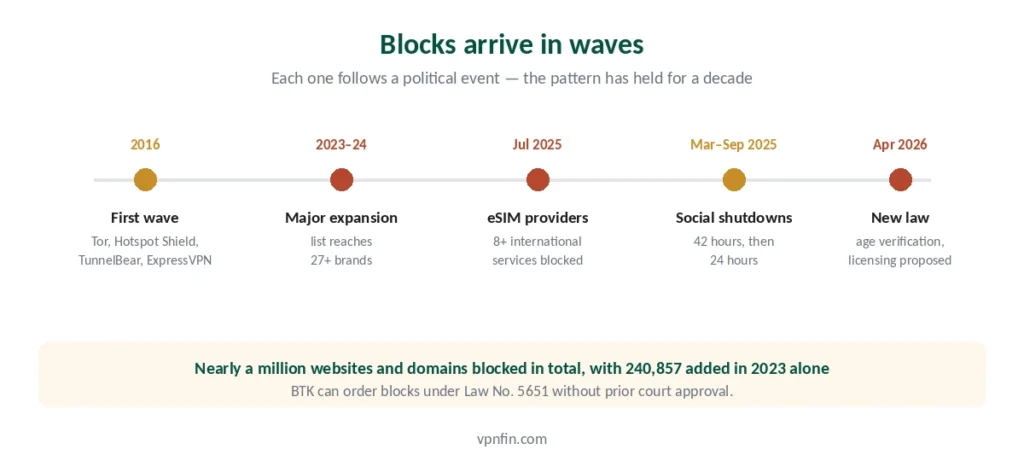
Expect it to be inconsistent. Blocks arrive in waves tied to political events, and what works this week may not next.
What’s Actually Blocked
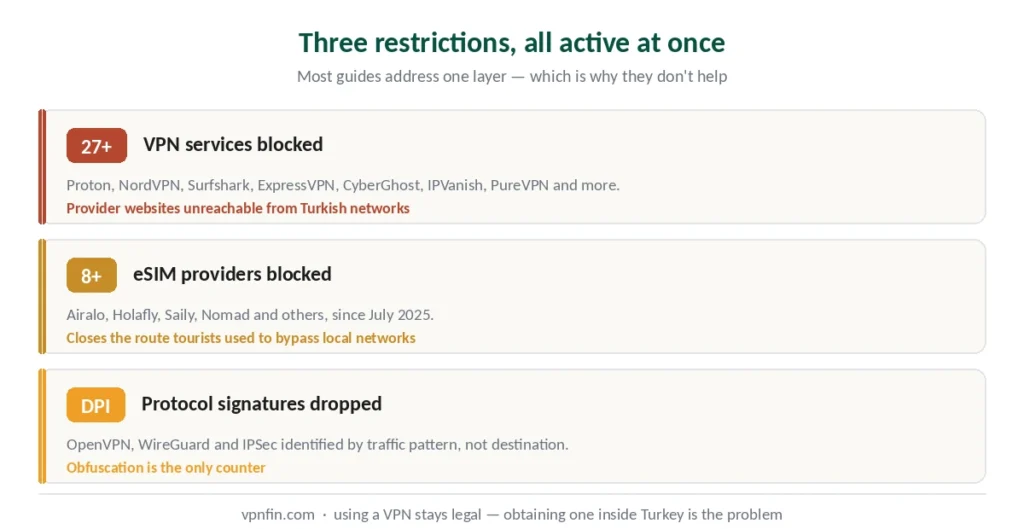
Turkey layers three separate restrictions, and they hit simultaneously.
VPN services. More than 27 commercial brands are on BTK’s blocklist, based on operator notices and reporting from the Stockholm Center for Freedom. The list includes Proton, NordVPN, Surfshark, ExpressVPN, CyberGhost, IPVanish, PureVPN, TunnelBear, Hotspot Shield and Private Internet Access.
Social platforms, periodically. Instagram, WhatsApp, X, YouTube and TikTok were blocked simultaneously for 42 hours in March 2025 during protests, and again for 24 hours that September. In April 2026 Turkey passed the Digital Platforms and Gaming Law, adding ID-linked age verification and banning social media for under-15s.
eSIM providers. Since July 2025, BTK has blocked at least eight international eSIM services — Airalo, Holafly, Saily, Nomad and others — closing the route tourists used to bypass Turkish networks entirely.
The scale of website blocking is the wider context. According to the Engelliweb 2023 report, nearly a million websites and domains have been blocked in Turkey, with over 240,000 added in 2023 alone. BTK can order blocks under Law No. 5651 without prior court approval.
Why Standard Setups Fail
This is the technical part, and it explains why “just use a VPN” doesn’t work here.
Brand-level blocking targets the provider’s marketing domain and known server IPs. That’s why you can’t reach the website to download the app, even though the service itself may still function.
Deep packet inspection goes further. Turkish networks examine traffic patterns rather than just destinations, identifying the signatures of OpenVPN, WireGuard and IPSec — and dropping them regardless of which server they’re headed to. South Korea took a different route in 2026, moving blocks to CDN level instead.
Obfuscation is the counter. It wraps VPN traffic so it resembles ordinary HTTPS, which DPI cannot distinguish from normal browsing without breaking everything else. Providers call this different things: obfuscated servers, camouflage mode, stealth protocol, NoBorders.
⚠️ Obfuscation is usually off by default, because it costs speed. In Turkey it’s the setting that determines whether the connection works at all.
What to Do Before You Go
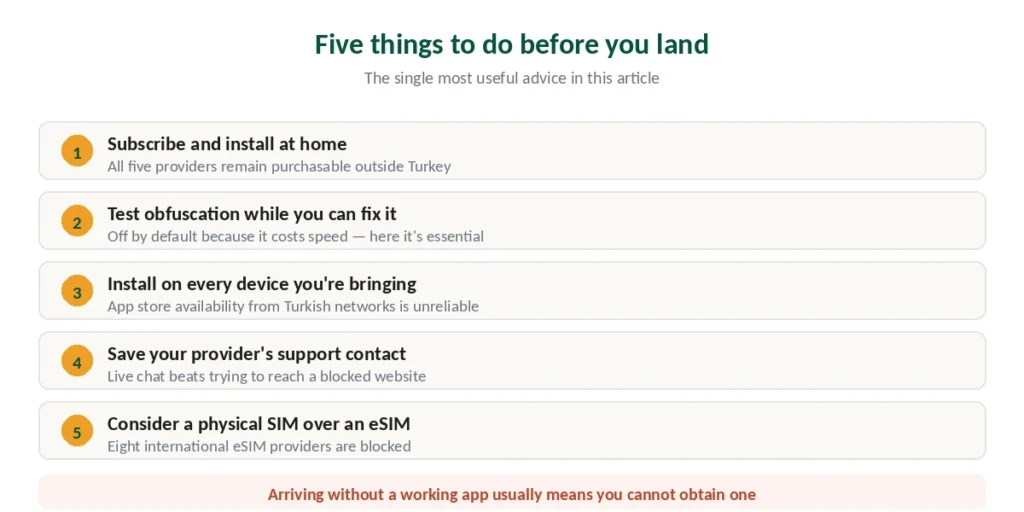
Five things, and the order matters.
1. Subscribe and install at home. All five providers we rank remain purchasable outside Turkey. Getting the account and the app sorted before departure removes the main obstacle.
2. Test obfuscation while you can still fix problems. Turn on the obfuscated or stealth option and confirm the connection holds. Finding out it’s misconfigured after landing is considerably worse.
3. Download the app on every device you’re bringing. Phone, laptop, tablet. App store availability from Turkish networks is unreliable.
4. Note your provider’s support contact. Live chat via a working connection is easier than trying to reach a blocked website.
5. Consider a local SIM rather than an eSIM. With eight international eSIM providers blocked, a physical Turkish SIM avoids one layer of the problem — though it puts you on a Turkish network with the associated filtering.
⚠️ Set up the five verification tests before you travel too. A VPN that connects but leaks DNS is worse than no VPN in a country with active filtering.
What’s Coming
A licensing regime is under discussion, and it would change the situation materially. Indonesia raised the same idea in 2019 and never resolved how to enforce it.
The proposal would require VPN providers to obtain BTK authorisation to operate legally, appoint local legal representatives, and comply with data retention obligations under Law No. 5651. Providers may be required to respond to regulatory orders within tight timeframes.
The penalties discussed range from administrative fines of 1 to 30 million Turkish Lira to bandwidth throttling of up to 95% or complete blocking for non-compliance.
Why this matters to you: the pattern resembles what happened in India, where providers chose to leave rather than comply with retention requirements — our India guide covers how that played out. If Turkey implements similar rules, expect providers to make similar choices.
Nothing is settled. Discussions indicate near-term implementation, but timelines have slipped before. Verify the current position before relying on anything here.
Which Provider to Choose
Since every major service is blocked at brand level, the question is which handles obfuscation best — not which is fastest or cheapest.
ExpressVPN has the strongest published record on restricted networks among the providers we rank, with obfuscation that works where others fail. Its website is blocked in Turkey, so purchase before arrival.
NordVPN offers obfuscated servers as a specialty category, alongside the fastest speeds of the five — useful when obfuscation is already costing you throughput.
Surfshark includes NoBorders mode, which activates automatically on restricted networks, and unlimited devices for a travelling household.
⚠️ No provider guarantees access. Blocks arrive in waves following political events, and any specific claim about Turkey — including in this article — is a snapshot. Use the refund window to test rather than trusting a review.
What a VPN Doesn’t Change
Turkish law still applies. Gambling rules, media licensing under RTÜK, and the 2022 disinformation law criminalising the spread of false information all remain in force regardless of how your traffic is routed.
Content restrictions have legal weight. Circumventing a block doesn’t remove the underlying legal position on what’s being blocked — our legality guide covers this distinction properly.
And the tool being legal doesn’t make everything legal. Turkish authorities focus on controlling access rather than prosecuting individual VPN users, but that’s an enforcement priority rather than a permanent guarantee.
How We Research
This guide draws on reporting from the Stockholm Center for Freedom, published analysis from named sources including VoidMob and Octohide, Turkish legal commentary on the proposed licensing regime, and the Engelliweb monitoring reports — cross-checked and verified at publication. Several sources have commercial interests in VPN services; we used them for technical detail confirmed elsewhere. Blocking in Turkey changes frequently and this is not legal advice — verify the current position before travelling. Our full approach lives on the About Us page.
Turkey VPN FAQ
Yes for individuals. There is no general criminal prohibition on connecting to a VPN, and the official framework treats them as legitimate tools for secure remote access. What’s restricted is access to the services themselves — BTK has blocked more than 27 commercial VPN brands, and authorities focus on controlling access rather than prosecuting users.
The BTK blocklist includes Proton, NordVPN, Surfshark, ExpressVPN, CyberGhost, IPVanish, PureVPN, TunnelBear, Hotspot Shield and Private Internet Access, among others — more than 27 brands across blocking waves in 2016, 2023 and 2024. Blocks typically target the provider’s website and known server addresses.
Usually not. Provider websites are unreachable from Turkish networks and app store availability is unreliable. This is why the practical advice is to subscribe, install and test before travelling — arriving without a working app means you probably can’t obtain one.
Turkish networks use deep packet inspection to identify the traffic signatures of OpenVPN, WireGuard and IPSec, and drop them regardless of destination. The counter is obfuscation, which disguises VPN traffic as ordinary HTTPS. It’s usually switched off by default because it costs speed — in Turkey it’s what makes the connection work at all.
A discussed regime would require providers to obtain BTK authorisation, appoint local legal representatives, and comply with data retention obligations. Penalties under discussion range from fines of 1 to 30 million Turkish Lira to bandwidth throttling of up to 95% or full blocking. Implementation timelines remain unclear.
Several international providers have been blocked since July 2025, including Airalo, Holafly, Saily and Nomad — their profiles can’t activate or top up from Turkish networks. A physical local SIM avoids this, though it places you on a Turkish network with the associated filtering.
The Short Version
Legal to use, hard to obtain. No law prohibits individuals from connecting to a VPN, but BTK has blocked over 27 services at brand level and provider websites are unreachable from Turkish networks.
Install before you land. This is the single most useful thing in this article. Subscribe, install on every device, and test obfuscation while you can still fix problems.
Turn obfuscation on. Deep packet inspection identifies standard protocol signatures. Without obfuscation the connection often fails regardless of which provider you chose.
And watch the licensing discussion, because it could change what providers are willing to offer there at all.