
Disclosure: VPNFin is reader-supported. If you buy a VPN through links on this page, we may earn a commission at no extra cost to you. This never affects our ratings — here’s our full disclosure.
French television has an unusual advantage over most of Europe. The main catch-up platforms cost nothing, need no subscription and ask for no licence fee, so an address in the right country is usually the entire job.
Inside France the picture is less simple. Five named providers now execute a court-ordered blocklist, and knowing which list that is saves a lot of confusion.
Which Problem Do You Have?
Abroad and missing French channels? You need a French IP address that france.tv, TF1+ or M6+ have not already flagged. Because those services are free, nothing else stands in the way.
Physically in France? You need ordinary cover on hotel and café networks. One extra detail applies: a short list of piracy domains fails on five major providers, and that list has nothing to do with broadcasters.
Watching French TV From Abroad
The mechanism is the same everywhere, and so is the fix.
Broadcasting rights stop at the border. France Télévisions, TF1 and Groupe M6 buy rights valid on French territory, so the player reads your address and refuses the stream. Expats and holidaymakers hit the identical wall.
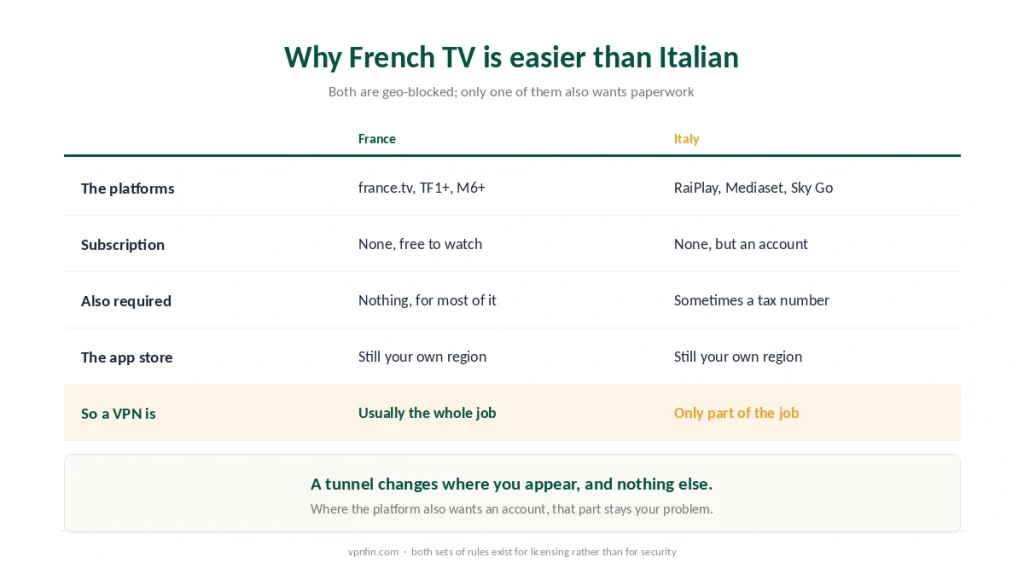
Then the useful part. France.tv live channels and replay are free, TF1+ is free with ads, and M6+ is free with ads as well. Consequently a French address is often all that is missing, which is not true of Italian platforms, where an account and a local tax number get in the way.
⚠️ Some corners still ask for more. M6+ requires an account for parts of its catalogue, and its MAX tier adds paid features. A tunnel does not create accounts or pay for anything.
Detection moves constantly. Broadcasters flag datacentre address ranges and recycle them, so a server that worked in spring may fail in autumn. Our streaming guide treats this as a moving target rather than a settled ranking, and switching to another French server usually solves it in a click.
⚠️ Reaching content this way may breach a platform’s terms. That is a contractual matter rather than a criminal one, and we would rather say it than pretend the question does not arise.
Smart DNS on a Television
Worth a paragraph, because most people set it up and then forget what they did.
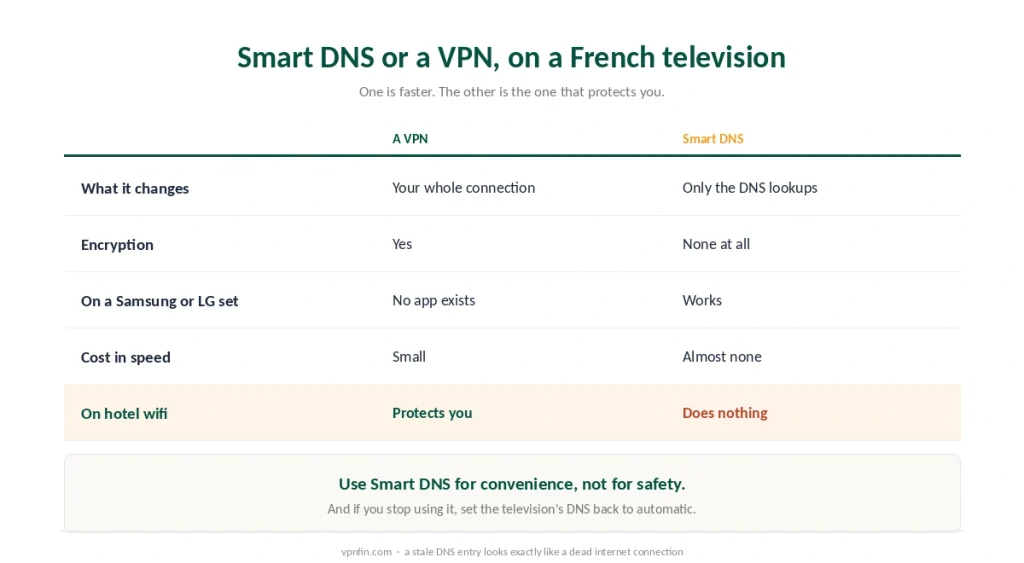
It reroutes lookups instead of building a tunnel. Nothing is encrypted, speed barely drops, and it works on sets that cannot run apps at all.
The trade-off is real protection. On hotel wifi it does nothing for you, so treat it as a streaming convenience rather than a privacy tool.
⚠️ A stale DNS entry looks exactly like a dead internet connection. When a provider retires the feature, the television reports no connection and nothing hints at the cause — our page on switching it off covers the fix, which takes about a minute.
If You Are Actually In France
Here the ordinary reasons apply, plus one that arrived in 2025.
Shared networks stay the main argument. Public wifi is where a VPN earns its keep, and French hotels, trains and cafés run a great deal of it.
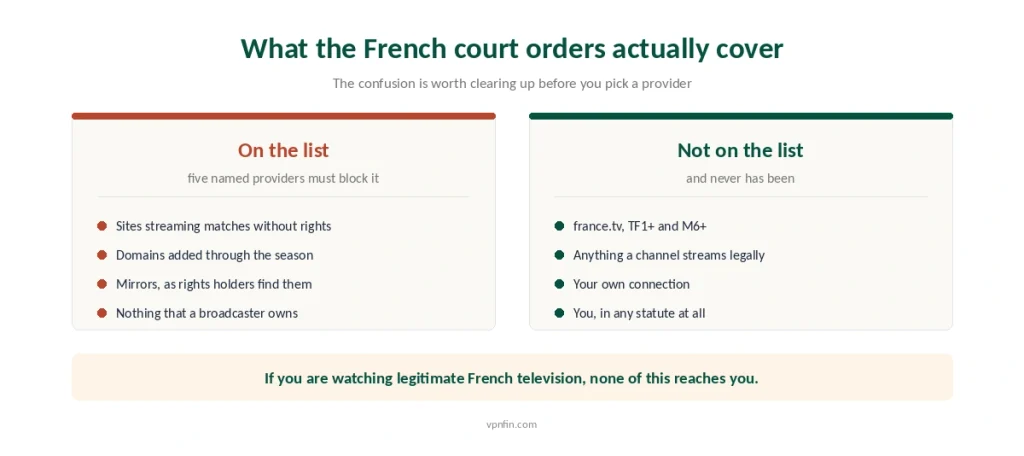
Now the new part. Since May 2025 the Paris Judicial Court has repeatedly ordered NordVPN, Proton VPN, Surfshark, ExpressVPN and CyberGhost to block piracy domains for users in France, on lists that grow through the football season. Our page on French VPN law explains who those orders bind and why they never mention subscribers.
⚠️ That list does not touch france.tv or any broadcaster. It covers sites streaming matches without rights. If you are watching legitimate French television, nothing about these orders affects you.
Nothing there restricts you personally either. No French law penalises using a VPN, and no bill has proposed one.
What to Look For
Four criteria, in the order they matter here.
French servers in more than one city. Providers with locations in Paris, Marseille and Strasbourg have more addresses to rotate when a broadcaster flags one.
A published streaming record. Providers that document which platforms they handle are easier to hold to account than those making general promises.
A refund window long enough to test. The only reliable test is your own connection on your own device, on the platforms you actually watch.
Jurisdiction, if privacy is the point. France sits inside the Nine Eyes arrangement, so the provider’s home country decides who could ever be asked for records — what a VPN hides and what it does not is the honest baseline.
What a VPN Will Not Do
Four limits, all worth knowing before you pay.
It will not create an account. Free platforms need little, but anything gated still needs registering.
It will not change your GPS. Mobile apps reading location directly still know where you are, which is why laptops often work where phones do not.
It will not survive a leak. Run the checks once after setup, because a connected app is not the same as a working tunnel.
It will not remove a blocklist from a compliant provider. Those blocks run at the provider rather than on your device.
Which Providers Make Sense Here
Named picks, with the reasoning attached.
NordVPN for reliability with broadcasters. It scores highest on our scale at 4.8, and it keeps servers across several French cities rather than one.
Surfshark for a household split between countries. Unlimited simultaneous connections cover a family in two places, which is exactly the expat situation.
Proton VPN if privacy outranks streaming. Five audits published in full and a Swiss base, though its free tier offers few locations and France is not reliably among them.
ExpressVPN for the steadiest record on live television. Three audits, and a long history of handling live streams without stalling.
⚠️ All four appear in the French court orders, alongside CyberGhost. That matters for piracy domains and for nothing else, so treat it as context rather than as a reason to choose differently.
| Provider | Speed loss | Source |
|---|---|---|
| NordVPN | 2.9% | CNET |
| Surfshark | 21% | CNET |
| ExpressVPN | 18% | CNET |
| CyberGhost | 31–38% | independent labs |
| PureVPN | 12–67% | four labs, varies by server |
| Proton VPN | 16% | CNET |
Before You Travel
Install and pay before you fly. Nothing prevents subscribing from France, but doing it at home avoids app store regions, foreign card checks and hotel wifi — our travel guide covers the rest of that habit.
Test it from your sofa. Connect to a French server at home and open the channels you care about. Finding out in the hotel is worse.
Spain is the harder neighbour. Its blocking runs by IP address rather than by domain, so unrelated sites go dark during matches — a problem French orders never produced.
How We Research
This guide draws on Cybernews and AnonymFlow for the geo-restriction behaviour of france.tv, TF1+ and M6+ and for the account requirements that survive a VPN, on StreamFix for the free-to-air status of the main catch-up platforms and the Smart DNS trade-off, on Copycatcafe for the audience share figures behind those channels, and on our own page on French VPN law for the Paris court orders of 2025 and the providers they name. We do not run our own speed tests. Where a platform’s terms are involved we say so rather than implying otherwise. Our full approach lives on the About Us page.
VPN for France FAQ
Usually, and more easily than in most countries. France.tv, TF1+ and M6+ are free to watch, so no subscription stands in the way once you have a French address the platform has not flagged. Some parts of M6+ still ask for an account, which a VPN cannot create for you.
Not for legal reasons, because no French statute restricts using one. The practical arguments are the usual ones: hotel, train and café networks, and reaching services from home that check your location. Neither is unique to France.
Because the block may sit with your provider. Since May 2025 the Paris Judicial Court has ordered five major providers to block piracy domains for users in France. Those lists cover sites streaming sport without rights, and they do not include broadcasters such as france.tv.
Yes, completely. No French law penalises using, buying or installing one. The court orders issued since 2025 bind five named companies over specific domains, and the age-verification rules of the same period apply to adult platforms rather than to viewers.
Smart DNS is faster and works on sets that cannot run apps, but it encrypts nothing. Use it for streaming convenience only. If you later stop using it, set the television’s DNS back to automatic, because a stale entry looks exactly like a broken connection.
The Verdict
If you are abroad and want French television, the job is simpler than in most countries. The main platforms are free, so a French address the broadcasters have not flagged is usually enough.
If you are in France, the job is ordinary cover on shared networks, with one caveat: five major providers block a court-ordered list of piracy domains, and legitimate broadcasters are not on it.
Neither situation carries any risk to you personally. French law places its obligations on companies, and no statute there penalises using a VPN.