
Disclosure: VPNFin is reader-supported. If you buy a VPN through links on this page, we may earn a commission at no extra cost to you. This never affects our ratings — here’s our full disclosure.
People who did not ask permission have tested both of these, and neither handed over customer records. That is unusual enough on its own — nobody has ever tested most providers.
The routes were opposite. One answered three federal demands and had nothing to give. The other settled a lawsuit by changing its product, and a service called TorGuard now blocks BitTorrent on its American servers.
The Short Answer
Private Internet Access for torrenting. Three Deloitte audits, a court record, unlimited devices, port forwarding, and no restriction on the traffic itself.
TorGuard for independence. No outside investors, still run by its founder, and port forwarding it has offered for over a decade.
⚠️ And a warning that reverses the names. If torrenting is why you are here, TorGuard’s settlement means avoiding its United States servers — which is a peculiar thing to have to say about that brand.
What Happened to Each of Them
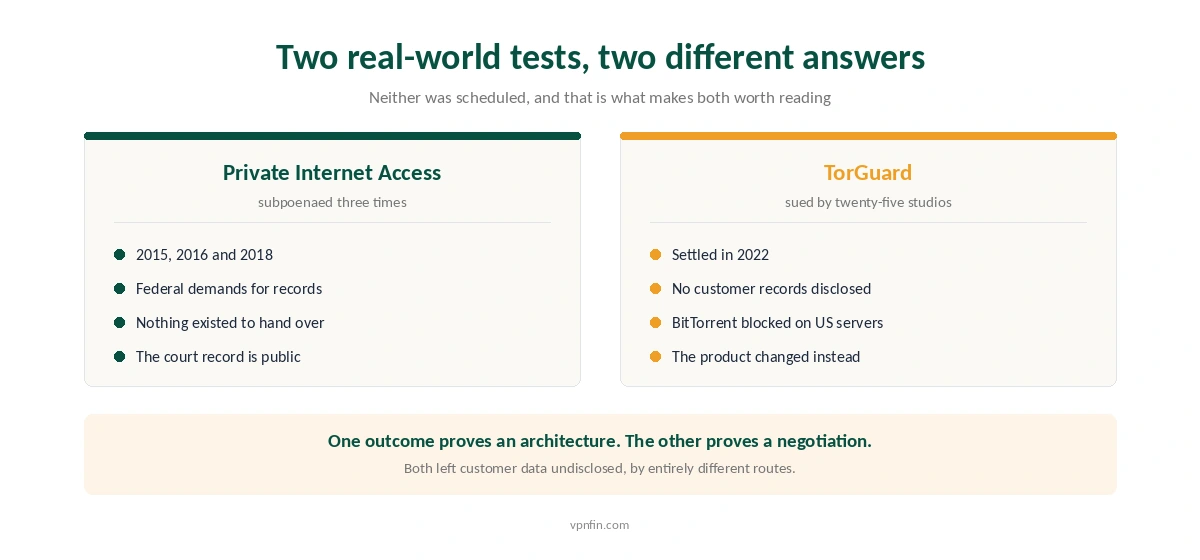
Federal investigators subpoenaed Private Internet Access in 2015, 2016 and 2018. They demanded user records, and the company produced nothing because it had retained nothing. The court record is public.
Twenty-five film studios sued TorGuard, and it settled in 2022. The company disclosed no customer records in the process.
The settlement changed the service instead. It blocks BitTorrent traffic on its American servers as a result — the company altered what it offered rather than what it stored.
⚠️ Those two outcomes prove different things. One demonstrates an architecture that holds no records; the other demonstrates a negotiation that avoided disclosing them — and the distinction matters more than the similarity.
The Evidence Gap
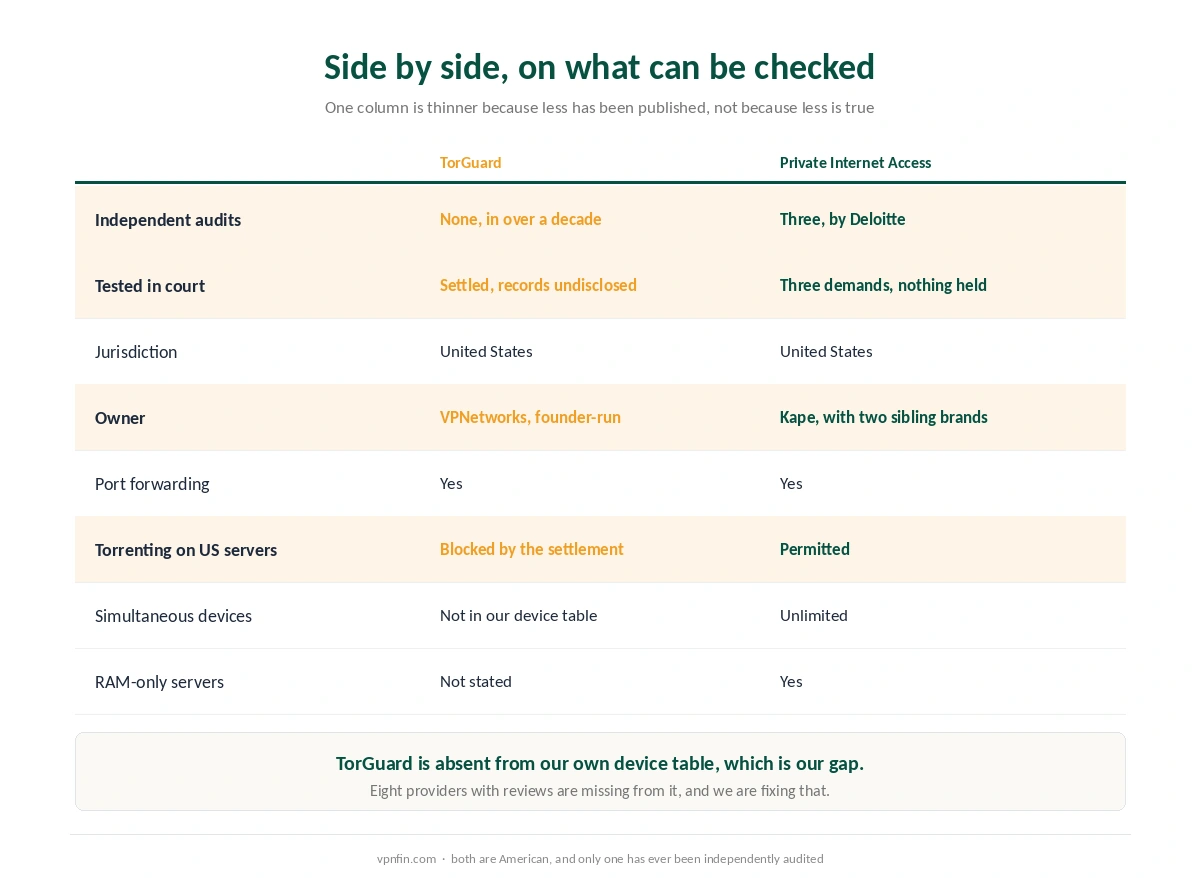
Private Internet Access has three independent audits by Deloitte alongside the court record, and RAM-only servers across its network.
TorGuard has published none in more than a decade. Its no-logs claim rests on its privacy policy and on the settlement outcome — evidence of a kind, though not the kind an audit provides.
⚠️ Which is why one of them appears in our privacy ranking and the other does not. Unaudited providers are excluded there on principle, whatever else they have.
And the ownership runs the other way. Private Internet Access belongs to Kape, which also owns ExpressVPN and CyberGhost; TorGuard answers to nobody with a competing brand — the trade our ownership map sets out.
For Torrenting Specifically
Both offer port forwarding, which puts them in a short group — our torrenting guide covers why it matters and how few providers still support it.
⚠️ But only one permits the traffic everywhere. TorGuard’s settlement blocks BitTorrent on its American servers, so the provider whose name invokes the protocol is the one that restricts it.
Private Internet Access allows unlimited devices, which matters for a seedbox, a desktop and a phone at once — though a router makes that count less decisive than it looks.
And a working kill switch is the requirement neither can skip. BitTorrent exposes your address to every peer in a swarm, so a dropped tunnel is the failure that matters — and testing has found many providers failing exactly that.
Where Our Own Data Is Thin
TorGuard is missing from our device table. So are seven other providers we have reviewed, which is a gap on our side rather than a fact about them.
We have no renewal figure for it either, which means a four-year comparison is not available here the way it is for pairs we have priced — our renewal table shows which providers we track.
⚠️ We are saying that rather than estimating. An invented figure would make this page look more complete and be less useful.
Who Each Is For
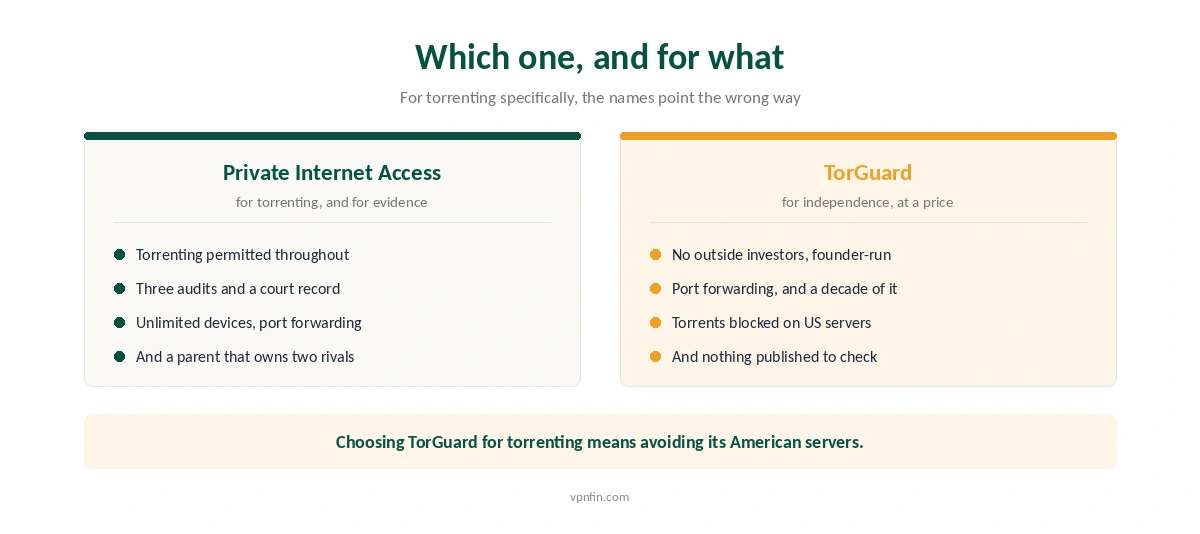
Private Internet Access if evidence decides it, and for torrenting without a geographic asterisk. Three audits, a court record and permitted traffic throughout.
TorGuard if independence decides it, and you accept that the only verification is an outcome rather than a report. Port forwarding, a founder still running it, and no parent company with rival brands.
⚠️ Neither if the United States is the problem. Both operate there, and the providers above them in our privacy ranking sit elsewhere for a reason.
How We Research
Audit counts, auditors, jurisdictions, ownership and device limits come from our own published tables. The 2015, 2016 and 2018 federal demands to Private Internet Access and the 2022 settlement involving TorGuard come from our reviews of both providers and from our page on no-logs claims, which name their sources. TorGuard is absent from our device and renewal tables, so figures that would normally appear here do not, and we have said so rather than estimating. Neither provider has commissioned an audit in the period since its own test, and only one has commissioned any. We do not run our own tests. Our method lives on the About Us page.
TorGuard vs PIA FAQ
Not on its American servers. A 2022 settlement with twenty-five film studios led the company to block BitTorrent there, so the provider whose name invokes the protocol restricts it in one country. Its other locations still permit it.
Private Internet Access, on published evidence. It has three Deloitte audits and a public court record of three federal demands producing nothing. TorGuard has published no audit in over a decade, though it disclosed no customer records during its own lawsuit.
Yes, both operate from the United States inside the Five Eyes arrangement. The difference is ownership: TorGuard is independent and founder-run, while Private Internet Access belongs to Kape Technologies, which also owns ExpressVPN and CyberGhost.
Yes, and that puts them in a small group — most providers have dropped it. For anyone seeding rather than only downloading, it is often the feature that decides the choice.
We cannot answer that here honestly. TorGuard is absent from our renewal table, so the four-year comparison we would normally publish is missing. Private Internet Access sits in the cheaper half of our renewal table.
The Verdict
Outsiders tested both without warning, and neither gave up customer data. In a market where nobody has ever tested most providers, that puts both ahead of the field on the one measure no company can arrange in advance.
The routes were not equivalent. Having nothing to hand over is a property of the architecture. Settling without disclosure is a property of the negotiation, and the second one changed the product.
So for torrenting the names mislead. The provider named after the protocol blocks it in the country most of its customers are in, and the one with the court record does not.