
Disclosure: VPNFin is reader-supported. If you buy a VPN through links on this page, we may earn a commission at no extra cost to you. This never affects our ratings — here’s our full disclosure.
Anyone choosing a VPN for Pakistan meets a system that throttles rather than bans. VPNs are legal and widely used, and Pakistan’s IT-export economy depends on freelancers reaching foreign clients through them. The telecom regulator, PTA, instead asks businesses and freelancers to register their VPN connections. During enforcement windows, it slows or blocks unregistered VPN traffic.
The platform picture shifts too. X was blocked from February 2024 until 7 May 2025, TechRadar reported, and Access Now counted 21 shutdowns in 2024, the country’s highest. This guide covers the registration routes, why ordinary VPNs slow to a crawl, and which to use.
VPN for Pakistan: The Short Answer
Using a VPN is legal in Pakistan. In late 2024 the Law Ministry advised that the Prevention of Electronic Crimes Act gives the government no power to impose a blanket ban, according to Profit, as reported by BeingGuru.
Unregistered VPN traffic can be throttled. For steady access, freelancers can register their VPN and IP with PTA, or use a provider PTA has licensed since late 2025. For everyone else, an obfuscated VPN is the practical answer.
NordVPN and Proton VPN are sensible picks, both with obfuscation modes. Our NordVPN review covers the top pick.
Registration: Two Routes
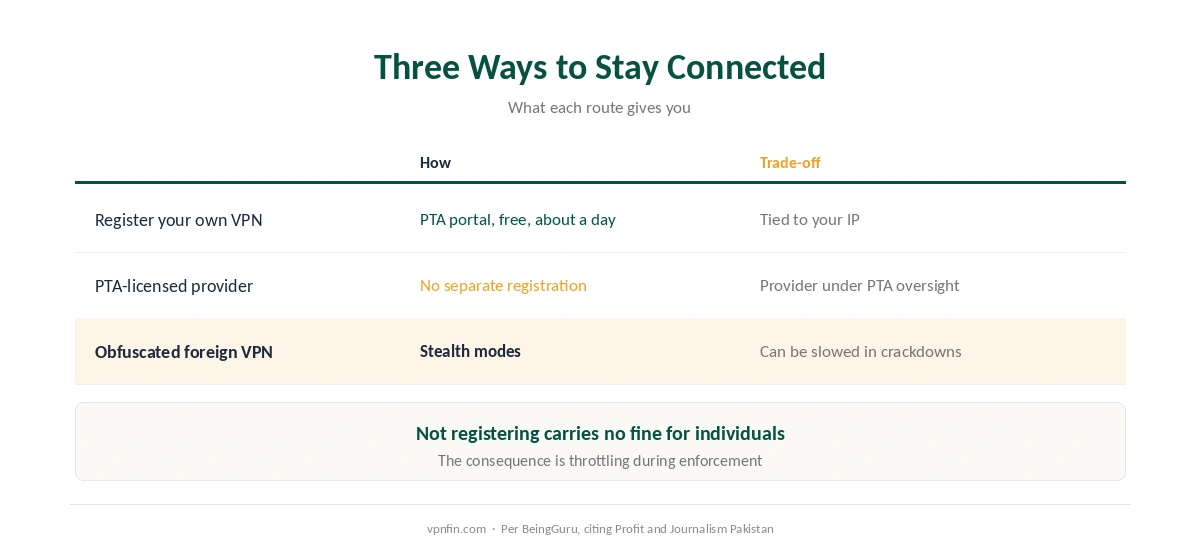
Register your own VPN. BeingGuru’s September 2026 guide describes PTA’s online portal as free, with approval usually within a working day. It is aimed at IT companies, software houses, freelancers and banks, which PTA has said must register their IP addresses to avoid disruption, according to Journalism Pakistan.
Or use a PTA-licensed provider. Pakistan introduced a licensing category for VPN providers, and licensed services need no separate registration. That route trades one thing for another: a provider under PTA oversight is a different privacy proposition from an audited foreign one. Our no-logs guide explains what to weigh.
Not registering is not an offence. BeingGuru notes there is no fine or criminal penalty for individuals who do not register, and no known prosecution. The consequence is practical: throttling when enforcement runs.
Why Your VPN Crawls in Pakistan
The firewall recognises ordinary VPN traffic. Outbyte reported in January 2026 that deep packet inspection identifies the handshake of standard protocols such as OpenVPN and throttles the connection until it times out.
Changing DNS no longer helps much. Veilock, a VPN vendor, notes that switching to 1.1.1.1 or 8.8.8.8 used to work, but that providers now add IP and SNI blocking on top. Our DNS leak guide explains why DNS alone is not the whole picture.
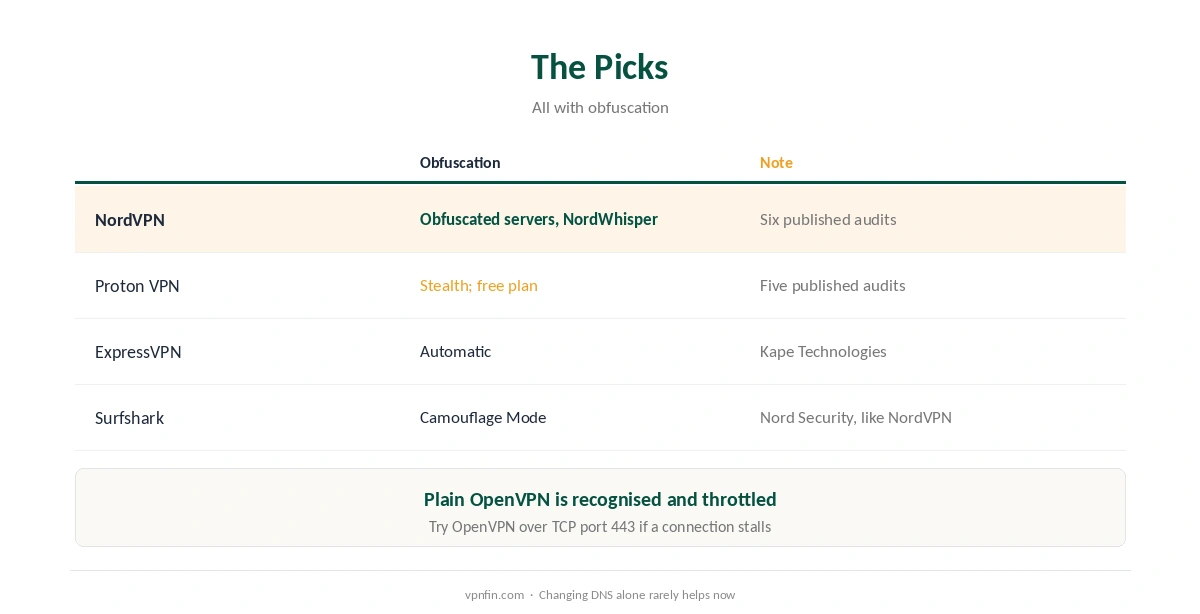
Obfuscation is the fix. It disguises the VPN as ordinary HTTPS traffic, as our obfuscation guide explains. Try OpenVPN over TCP on port 443 if a standard connection stalls.
The Picks
| VPN | Why for Pakistan | Note |
|---|---|---|
| NordVPN | Obfuscated servers and NordWhisper | Six published audits |
| Proton VPN | Stealth protocol; free plan | Five published audits |
| ExpressVPN | Automatic obfuscation | Kape-owned |
| Surfshark | Camouflage Mode, no device limit | Nord Security, like NordVPN |
Free VPNs mostly lack obfuscation, so they suffer most under throttling. Proton VPN’s free plan is the exception worth trying, as our free VPN guide explains. Our Proton VPN review and our ExpressVPN review cover two of the picks.
Ownership is worth knowing too. NordVPN and Surfshark belong to Nord Security. ExpressVPN belongs to Kape Technologies, as our ownership guide sets out.
For Freelancers
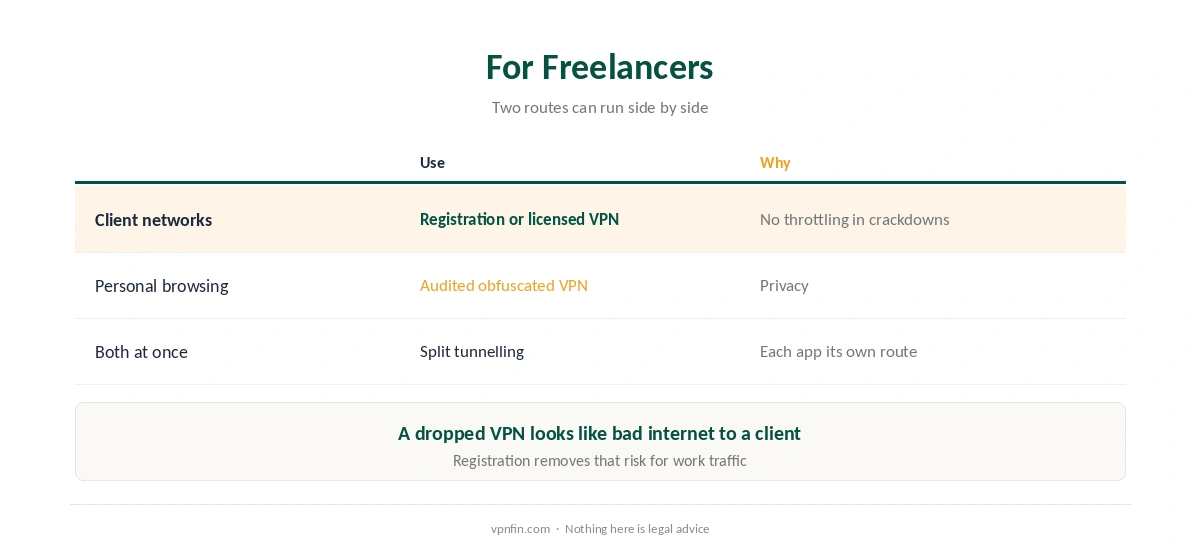
A dropped VPN looks like bad internet to a client. If your work depends on reaching a client’s network, registration or a licensed provider removes the throttling risk during enforcement windows.
For your own privacy, an audited foreign VPN with obfuscation is the stronger choice. You can keep both, and split tunnelling lets work apps and personal browsing take different routes. Our public Wi-Fi guide covers co-working spaces, and our kill switch guide explains the setting that keeps a dropped tunnel from leaking.
What Pakistan Blocks
Restrictions come and go. X returned in May 2025 after 15 months, and TechRadar reported that Facebook, Instagram, WhatsApp and Bluesky had also been briefly restricted, while Telegram remained blocked at the time. Mobile data is sometimes throttled around sensitive events.
What you post stays yours. A VPN hides your traffic from your provider, not content under your name, as our guide to what a VPN hides explains.
How We Research
The legal position and registration routes come from BeingGuru’s September 2026 guide, citing Profit and Journalism Pakistan. The platform history comes from TechRadar and NetBlocks, the throttling method from Outbyte, and the DNS note from Veilock, which sells VPNs. We name each source where used; all were read on 26 September 2026. Nothing here is legal advice. Our full approach lives on the About Us page.
VPN for Pakistan FAQ
Yes. No law criminalises personal VPN use, and the Law Ministry advised in late 2024 that the government has no power to impose a blanket ban. Unregistered traffic can be throttled.
PTA asks businesses, freelancers and banks to register. For individuals there is no fine for not registering; the consequence is throttling during enforcement windows.
Deep packet inspection recognises standard VPN protocols and throttles them. Switch on obfuscation, or try OpenVPN over TCP on port 443.
It was blocked from February 2024 until 7 May 2025, when access was restored. Restrictions on platforms have come and gone since.
One with obfuscation: NordVPN, Proton VPN, ExpressVPN or Surfshark. Freelancers who need steady client access may also register with PTA or use a licensed provider.
The Verdict
A VPN for Pakistan is legal, but it needs to survive throttling. Choose one with obfuscation, such as NordVPN or Proton VPN, and switch it on before enforcement tightens.
If your income depends on a stable connection, add PTA registration or a licensed provider for client work, and keep an audited VPN for your own privacy.