
Disclosure: VPNFin is reader-supported. If you buy a VPN through links on this page, we may earn a commission at no extra cost to you. This never affects our ratings — here’s our full disclosure.
A VPN for Egypt carries more legal weight than in most countries we cover. Egypt has blocked hundreds of news and political websites since 2017, including Al Jazeera and Mada Masr. The 2018 cybercrime law gave that practice a legal basis. A law firm, Andersen Egypt, reads its Article 14 as making it illegal to use tools such as VPNs to reach blocked websites. The penalty it cites is at least a year in prison and fines of EGP 50,000 to 100,000.
Other guides call it a grey area and say enforcement targets political activity and prohibited content rather than everyday use. This guide sets out both readings, what the state blocks, and which VPNs work, so you can weigh the risk yourself.
VPN for Egypt: The Short Answer
A VPN itself is not banned in Egypt, and businesses use them for secure communications. Using one to reach blocked sites is where the legal risk sits.
Andersen Egypt reads the law strictly. Its March 2024 note says Article 14 of Law No. 175 of 2018 covers using tools such as VPNs to access blocked sites. Treat that as a real risk.
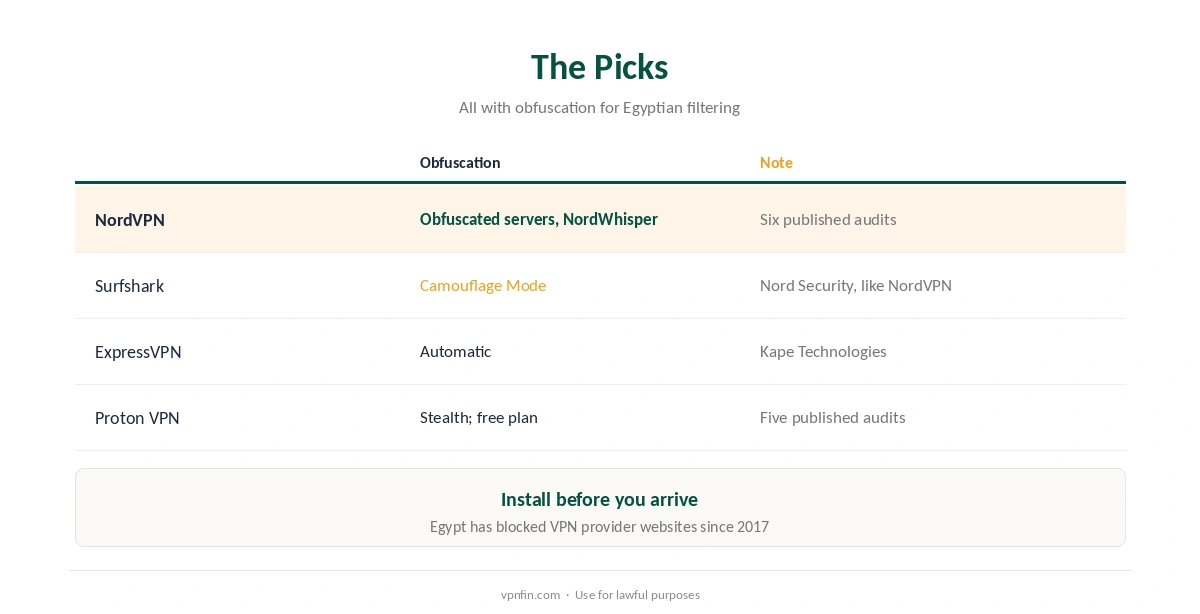
For lawful use, choose a VPN with obfuscation, such as NordVPN or Surfshark, because Egyptian providers disrupt standard VPN connections. Our NordVPN review covers the top pick.
What Egypt Blocks
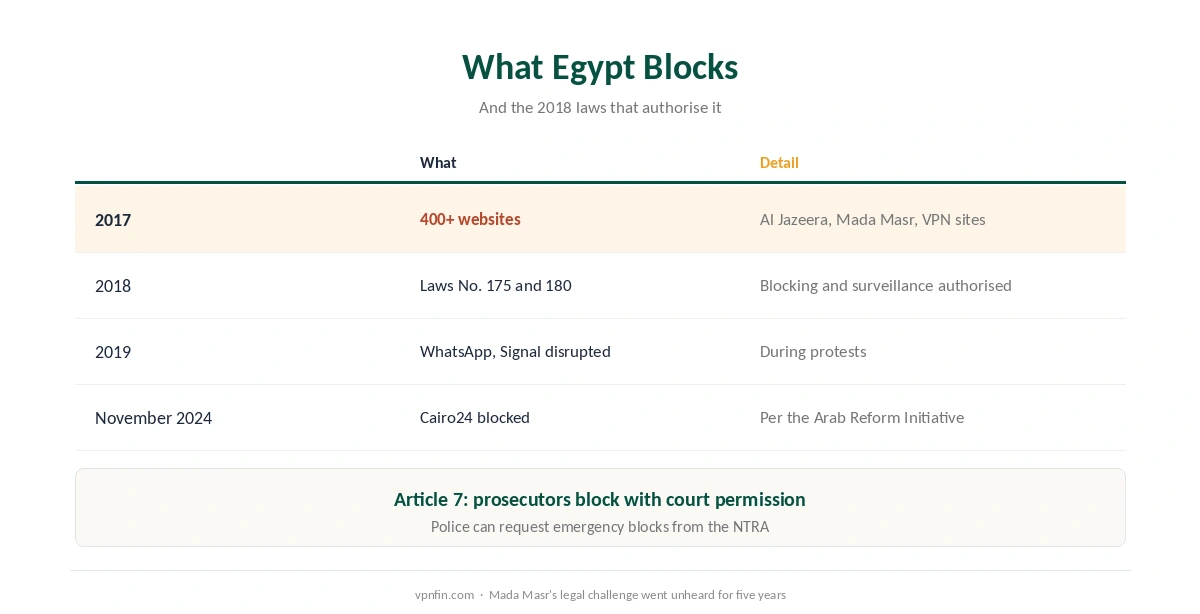
News and political sites. In 2017 the authorities ordered providers to block more than 400 websites, according to uPhone’s guide. The list included Al Jazeera, Mada Masr and VPN providers’ own sites. The Arab Reform Initiative notes that no court had heard Mada Masr’s challenge after five years, and that providers blocked the news site Cairo24 in November 2024.
Messaging and calls. Providers have blocked Signal, and disrupted WhatsApp and Signal during the 2019 protests. Several guides report that Egyptian networks throttle internet calls.
The legal basis. Laws No. 175 and No. 180 of 2018 authorise website blocking and surveillance, the Arab Reform Initiative explains. According to the Cairo Institute for Human Rights Studies, Article 7 lets prosecutors block sites with court permission. It also lets police request emergency blocks from the regulator, the NTRA.
The Article 14 Question
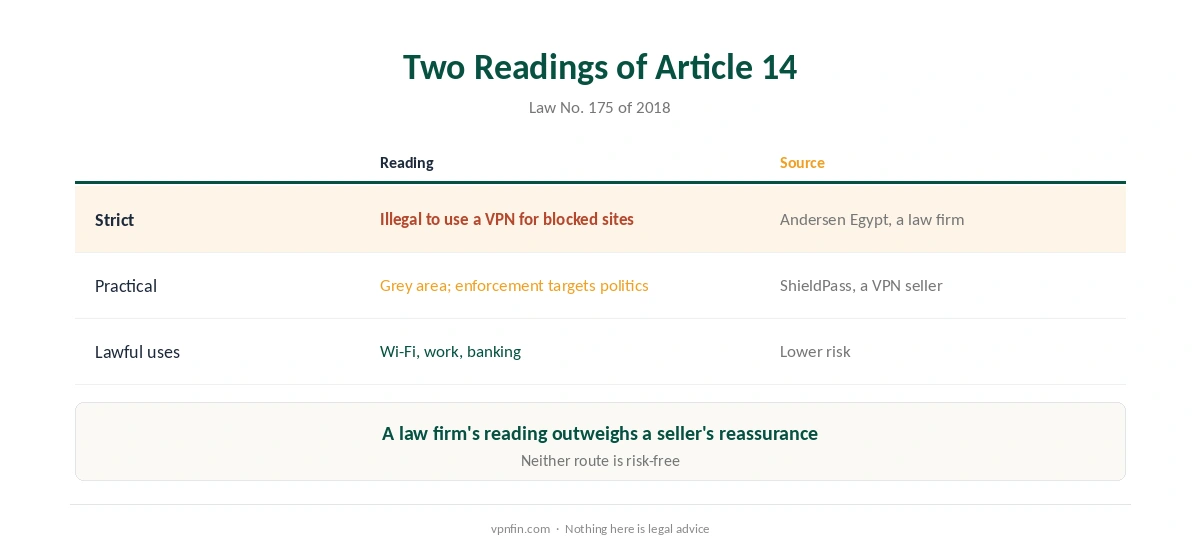
The strict reading. Andersen Egypt, a law firm, states that Article 14 makes it illegal for anyone to use tools or software such as VPNs to access blocked websites or services. It cites penalties of at least one year in prison and fines between EGP 50,000 and 100,000.
The practical reading. VPN-selling guides such as ShieldPass describe a grey area, with enforcement focused on political activity and prohibited content. They also note that many people use VPNs daily. That may describe current practice, but it does not change the text of the law.
⚠️ Our view is simple. A law firm’s reading outweighs a VPN seller’s reassurance. Using a VPN for privacy and lawful services carries less risk than using it to reach blocked news or political sites. Neither choice is risk-free. Our guide to VPN legality compares Egypt with other countries.
Lawful Uses
Public Wi-Fi and travel. Hotel and café networks are the everyday case for a VPN for Egypt, as our public Wi-Fi guide explains. Our travel guide covers setting up before you arrive, and our kill switch guide the setting to switch on.
Work and banking. Connecting to an employer’s network or banking securely are lawful uses that businesses rely on. If a banking app objects, exclude it with split tunnelling.
Privacy from your provider. A VPN hides the sites you visit from your provider, though not what you post under your name, as our guide to what a VPN hides explains.
The Picks
| VPN | Obfuscation | Note |
|---|---|---|
| NordVPN | Obfuscated servers, NordWhisper | Six published audits |
| Surfshark | Camouflage Mode | Shares a parent with NordVPN |
| ExpressVPN | Automatic | Kape-owned |
| Proton VPN | Stealth; free plan | Five published audits |
Install before you arrive. Egypt has blocked VPN provider websites since 2017, so download apps at home or from an app store. Our obfuscation guide explains why disguised connections hold up better.
Ownership, briefly. NordVPN and Surfshark share a parent, Nord Security, and ExpressVPN belongs to Kape Technologies, as our ownership guide sets out.
Every pick has its own review. Our reviews of Surfshark, ExpressVPN and Proton VPN cover the other three in full.
How We Research
The strict legal reading comes from Andersen Egypt’s March 2024 note, the blocking laws from the Arab Reform Initiative and the Cairo Institute for Human Rights Studies, and the 2017 block list from uPhone. The practical reading comes from ShieldPass, which sells VPNs. We name each source where used; all were read on 26 September 2026. Nothing here is legal advice. Our full approach lives on the About Us page.
VPN for Egypt FAQ
A VPN is not banned outright. But a law firm, Andersen Egypt, reads Article 14 of the 2018 cybercrime law as covering its use to reach blocked websites.
According to Andersen Egypt, at least one year in prison and fines between EGP 50,000 and 100,000 for using tools such as VPNs to access blocked sites.
Hundreds of news and political sites since 2017, including Al Jazeera and Mada Masr, plus VPN providers’ websites and Signal. Networks often throttle internet calls.
One with obfuscation, such as NordVPN, Surfshark, ExpressVPN or Proton VPN. Install it before you arrive, because Egypt blocks provider websites.
For public Wi-Fi and banking, a VPN is a lawful privacy tool. Using it to reach blocked news or political sites carries legal risk under the strict reading of the law.
The Verdict
A VPN for Egypt is useful for privacy and lawful services, and NordVPN and Surfshark handle the providers’ filtering with obfuscation on.
The law is stricter than in most countries: a law firm reads Article 14 as covering VPN access to blocked sites. Keep to lawful uses, and weigh that risk before going further.