
Disclosure: VPNFin is reader-supported. If you buy a VPN through links on this page, we may earn a commission at no extra cost to you. This never affects our ratings — here’s our full disclosure.
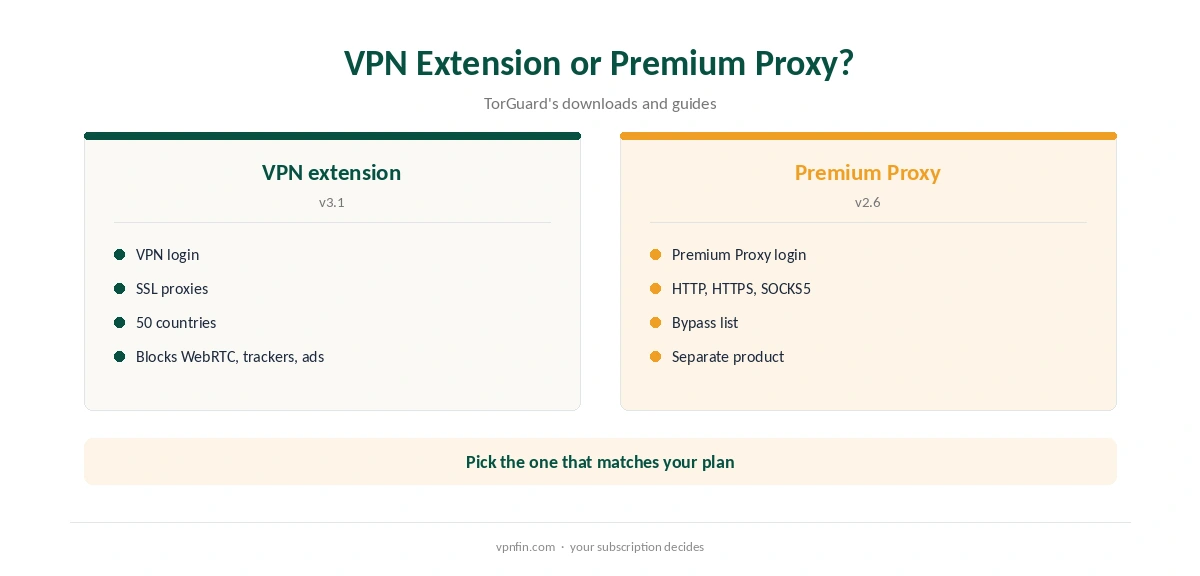
TorGuard Chrome support comes in two extensions, both updated in March 2026 on TorGuard’s downloads page. The TorGuard Chrome VPN Extension uses SSL proxies across 50 countries and blocks WebRTC requests, trackers and adverts, its listing says. The separate Premium Proxy extension adds HTTP, HTTPS and SOCKS5 proxies for Premium Proxy subscribers. Both cover Chrome only.
This guide covers which extension to use, the setup, the limits and when the desktop app is better.
Two Extensions
TorGuard’s downloads page lists the Chrome VPN Extension at version 3.1 and the Premium Proxy Chrome Extension at version 2.6. The VPN extension works with your TorGuard VPN login. The Premium Proxy extension needs separate Premium Proxy credentials, its setup guide explains. Pick the one that matches your subscription.
TorGuard Chrome Setup
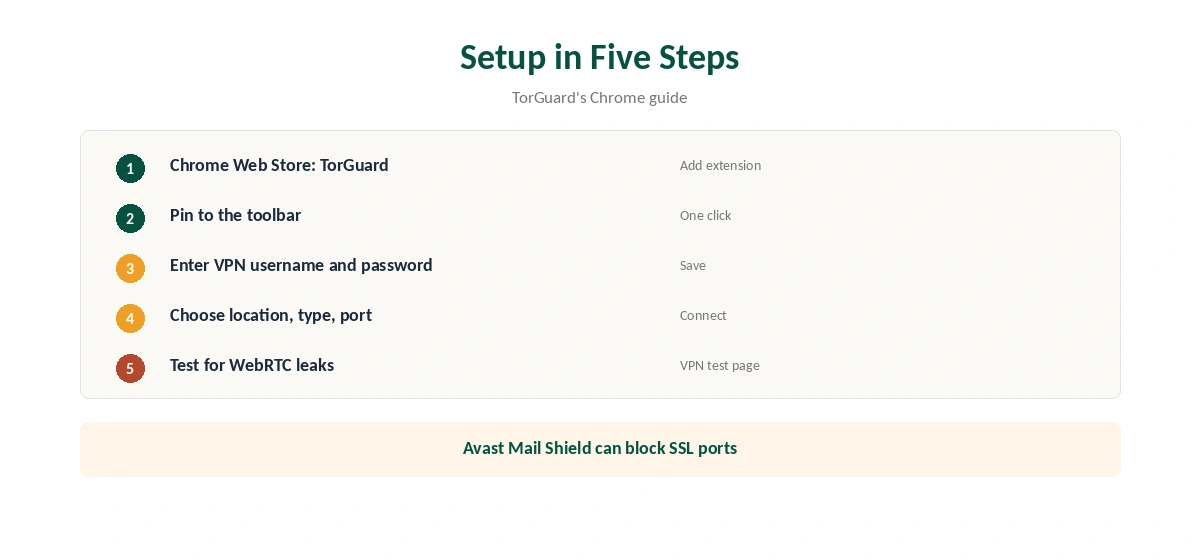
Open the Chrome Web Store, search for TorGuard and add the extension. Pin it to the toolbar, click it, enter your TorGuard VPN username and password and save. Choose a location, type and port, then connect, as TorGuard’s guide shows. Check the new address on TorGuard’s IP page or our VPN test page.
What the VPN Extension Blocks
The extension’s listing describes blocking WebRTC requests, trackers and adverts, and overriding HTML5 geolocation so sites cannot read your real location. Still test with our WebRTC leak guide after connecting.
Known Issues
TorGuard’s guide notes that Avast Mail Shield can block some SSL ports the extension uses; disable it or allow those ports. Login failures usually mean a wrong username or password, but other proxy extensions can interfere too.
TorGuard Chrome on Public Wi-Fi
On café and hotel networks, the VPN extension’s SSL proxies encrypt Chrome traffic between your browser and TorGuard’s server. Other apps on the laptop stay outside it. Turn it on before signing in to anything, and use the desktop app on laptops you carry everywhere. Our public Wi-Fi guide explains the risks.
Other Browsers
TorGuard’s features page lists extensions for Chrome and Firefox, and its guides cover Edge through the Chrome Web Store. Each protects only its own browser. Our NordVPN Chrome guide covers a rival extension; NordVPN shares an owner, Nord Security, with Surfshark.
Using It With the Desktop App
Do not run the extension and the desktop app together. Two layers slow browsing and confuse location checks. Pick one for each session.
A Quick Rule
Quick browsing privacy? Use the VPN extension. Need SOCKS5 in the browser? Choose Premium Proxy with its own login. Torrenting, banking or other apps? Install the desktop app and turn the kill switch on.
Ports and Proxy Types
The VPN extension lets you choose location, type and port before connecting. If one port is blocked on a work or school network, try another. SSL proxies encrypt traffic between Chrome and TorGuard; plain HTTP proxies are faster but leave traffic unencrypted on that leg.
Is TorGuard Chrome Protection Enough?
For browsing on a trusted machine, or changing Chrome’s location, TorGuard Chrome protection does the job. For anything involving other apps, sensitive logins or torrents, it does not, because only Chrome is covered and there is no kill switch.
Quick Check
After connecting, open our test page in Chrome and confirm the address changed. Open the same page in another browser: it should still show your real address, which confirms TorGuard Chrome protection covers Chrome only.
Keeping It Updated
Chrome updates extensions automatically. If the extension stops connecting, check its version, sign out and back in, then restart Chrome.
Privacy Note
A proxy extension sees the sites you visit in Chrome. Use it only if you trust the provider with that browsing. TorGuard has no independent audit in our table, so weigh that before relying on it.
Firefox and Edge
TorGuard’s guides cover Firefox and Edge premium proxy extensions too. Install the one that matches each browser you use, and sign in with the same account.
Extension or Desktop App?
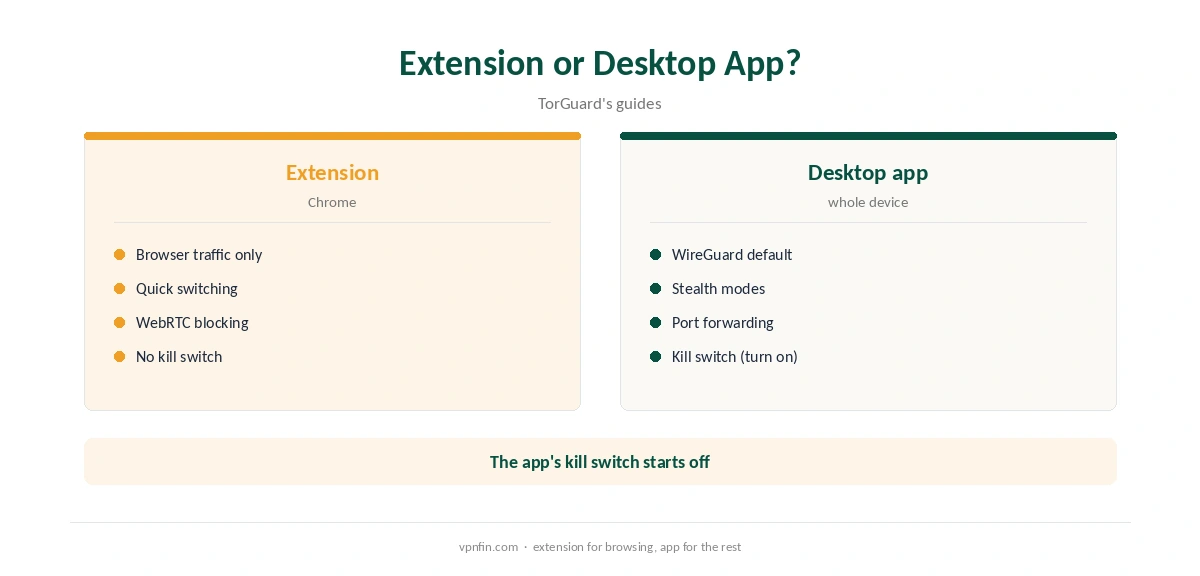
The extensions cover Chrome only. TorGuard’s desktop app covers every program, with WireGuard by default, Stealth modes and port forwarding, though its kill switch starts switched off. Our TorGuard Windows guide covers the app, and our VPN vs proxy guide explains the difference.
TorGuard’s Record
Our audit table records no independent audit for TorGuard. It is run by VPNetworks LLC in Florida and settled a copyright lawsuit in 2022 by blocking BitTorrent on its US servers. It allows up to eight devices on Standard, and its refund window is seven days. Our TorGuard cost guide covers the plans.
Turning It Off
Click the extension and disconnect, or remove it from Chrome’s extensions page. If Chrome still uses a proxy, clear the proxy settings under Chrome’s system settings, TorGuard’s Premium Proxy guide advises. Our guide to turning off a VPN in Chrome covers stubborn cases.
How We Research
This page draws on TorGuard’s downloads page, its Chrome VPN and Premium Proxy extension guides, the extension’s listing and our TorGuard tables. We cross-checked these sources against each other, and where they conflict or something can’t be verified, we say so in the text rather than guessing. We checked time-sensitive figures, including prices in US dollars, on 7 October 2026. The main source we relied on is TorGuard’s Chrome extension guide. Our full approach lives on the About Us page.
TorGuard Chrome FAQ
It has two: a VPN extension and a Premium Proxy extension.
The VPN extension with a VPN plan; the Premium Proxy one with a Premium Proxy plan.
The listing says it blocks WebRTC requests; test after connecting.
50, per the VPN extension’s listing.
No. Only Chrome traffic goes through it.
The Verdict
TorGuard Chrome support suits quick browser privacy, with WebRTC and tracker blocking built in. Use the desktop app, with its kill switch turned on, for anything beyond the browser. Our page on TorGuard on Chromebook covers the Android app, L2TP and Linux routes.