Disclosure: VPNFin is reader-supported. If you buy a VPN through links on this page, we may earn a commission at no extra cost to you. This never affects our ratings — here’s our full disclosure.
This AdGuard VPN review covers a VPN from a company better known for blocking ads. AdGuard Software Limited, based in Limassol, Cyprus, has made ad blockers since 2009, RTINGS notes. Its VPN adds a free plan, a protocol of its own and tight links to the AdGuard ad blocker.
The appeal is clear: a cheap two-year plan and a usable free tier. The concern is equally clear: the protocol is proprietary, and no outside firm has audited the service. We set out both, along with prices and what reviewers found.
AdGuard VPN Review: Is It Worth It in 2026?
It is worth it if you already use AdGuard’s ad blocker, or want a low-cost VPN for everyday browsing. The apps are simple, and the two-year price is low.
It is a weaker choice if privacy is your priority. You cannot inspect the protocol, and no audit backs the no-logs promise. RTINGS, which tested the paid plan in April 2026, rated Proton VPN better overall.
What AdGuard VPN Costs
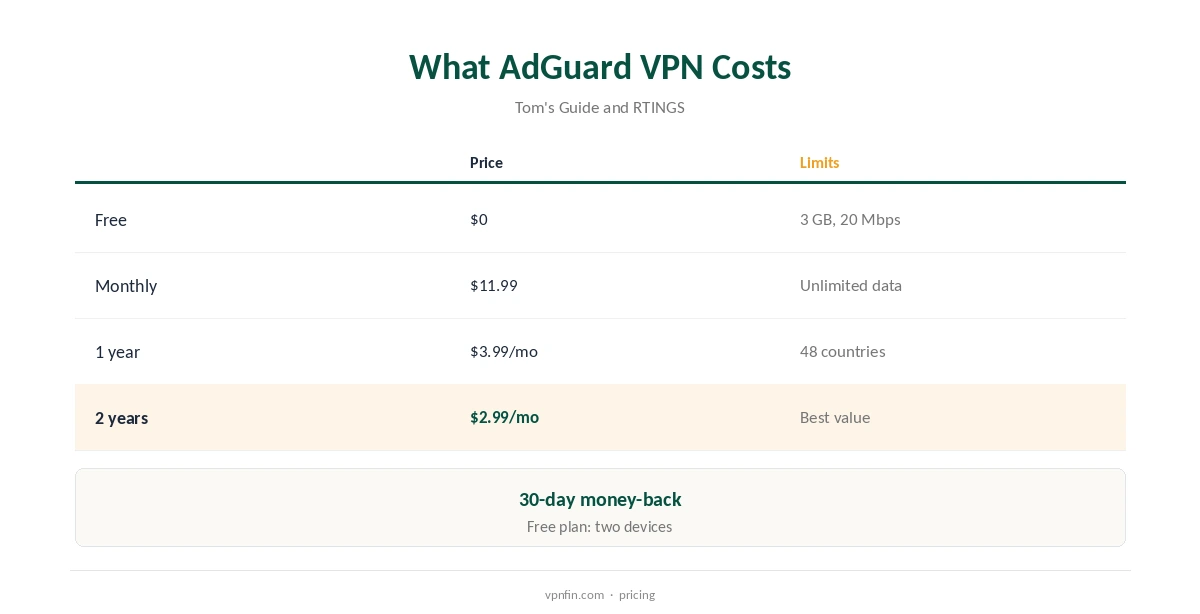
The paid plan costs $11.99 on a monthly basis, according to Tom’s Guide. A one-year plan works out at $3.99 a month, and a two-year plan at $2.99 a month.
The free plan gives 3 GB of data a month. Tom’s Guide adds a 20 Mbps speed cap, and RTINGS a limit of two devices. Paid plans add unlimited data and servers in 48 countries, RTINGS reports. A 30-day money-back guarantee covers paid plans, TechRadar notes.
Its Own Protocol: The Reason People Choose It
AdGuard VPN does not use WireGuard or OpenVPN. Instead, it runs its own protocol, which RTINGS calls TrustTunnel. It wraps your data inside an ordinary-looking HTTPS connection, Tom’s Guide explains.
That design helps on networks that block VPNs, because the traffic looks like normal web browsing. SafetyDetectives adds that obfuscation works on every server, and that QUIC is available as an option.
⚠️ Nobody outside AdGuard can inspect the protocol. AdGuard VPN is not open source, so outsiders cannot check how the company built it, Tom’s Guide’s AdGuard VPN review warns. By contrast, WireGuard and OpenVPN are open, as our protocol comparison explains.
What Reviewers Disagree On
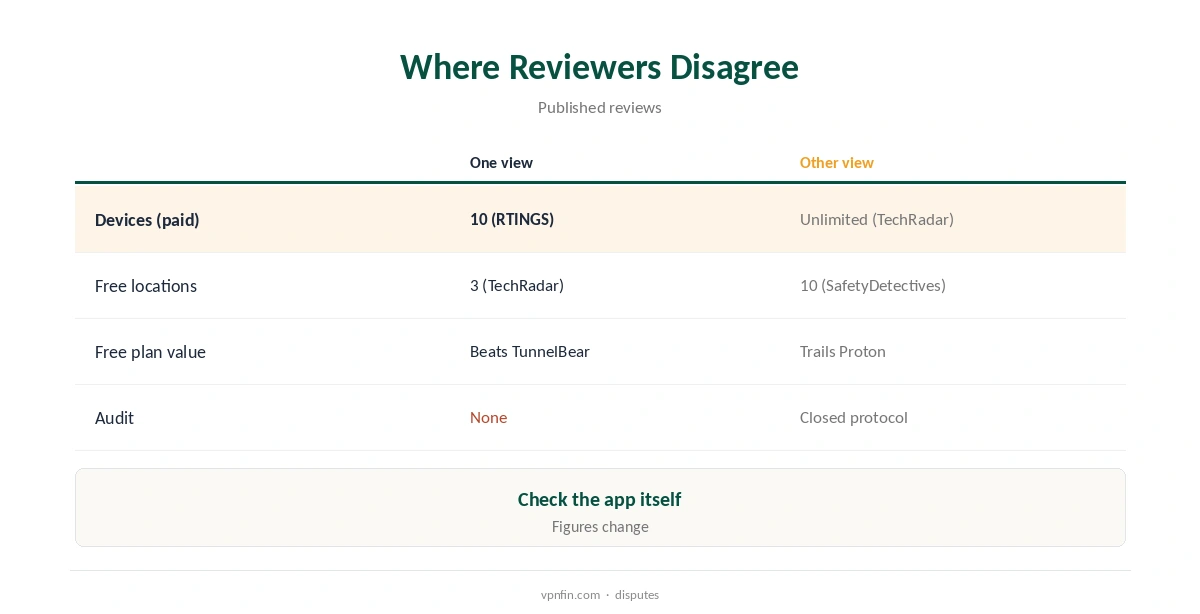
Device limits. RTINGS counts 10 simultaneous devices on the paid plan. TechRadar, however, says AdGuard VPN works on an unlimited number of devices.
Free locations. TechRadar lists three free servers, in London, Amsterdam and Paris. SafetyDetectives counts 10 free locations instead. Check the app before relying on either figure.
Value. SafetyDetectives prefers Proton VPN’s free plan, which has no data cap. Cloudwards notes that the free 3 GB beats TunnelBear’s 500 MB but trails Windscribe’s free allowance.
Privacy and Logging
AdGuard VPN states a strict no-logs policy. Cyprus sits outside the Five, Nine and Fourteen Eyes alliances, as our Five Eyes guide explains.
However, no independent audit has tested that promise, Tom’s Guide and SafetyDetectives both note. Our VPN audit tracker shows which providers have one.
Holafly describes AdGuard Software as a company of Russian origin registered in Cyprus. That does not prove any problem, but it is worth knowing, as our guide to VPN ownership explains.
Speed and Streaming
The free plan caps speed at 20 Mbps, which suits browsing but not HD video. Paid plans remove the cap.
TechRadar found AdGuard VPN a decent choice for Netflix and streaming in general. Results vary by location, so test during the refund window. Our streaming VPN guide lists alternatives.
Features Worth Knowing
Apps cover Windows, macOS, Linux, Android and iOS, plus routers, TechRadar reports. The VPN pairs with AdGuard’s ad blocker and AdGuard DNS, which blocks malicious sites, Holafly notes.
Support is email-based. TechRadar points out there is no live chat or phone line, which slows down fixes.
Using the VPN and ad blocker together cuts both tracking and ads. Check that both apps work together on your device.
Who Should Look Elsewhere
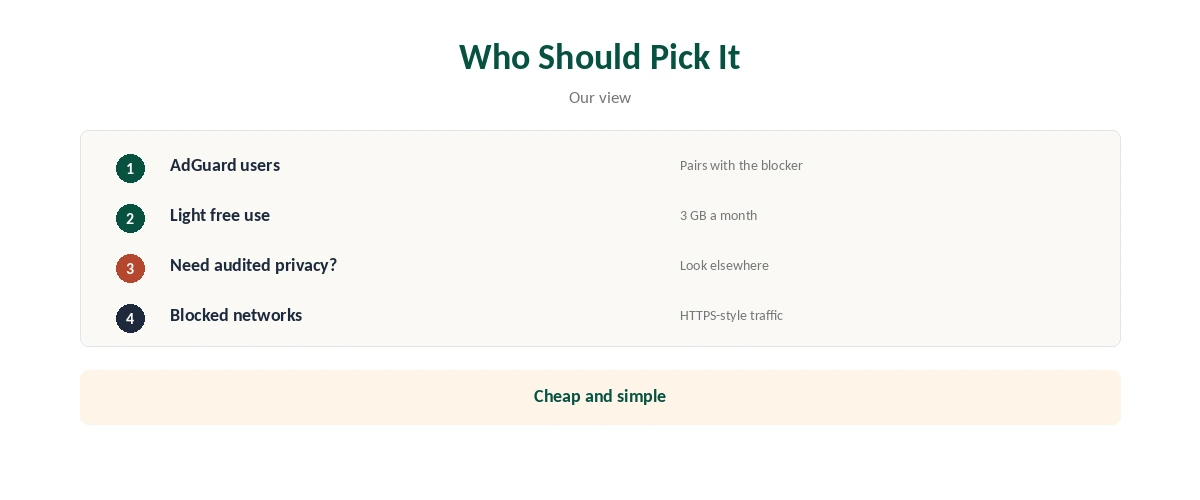
If you want audited privacy, a provider from our no-logs VPN guide is safer. If you need a bigger free plan, compare the options in our guide to free VPN data limits.
Light users may find the free plan enough. Heavy streamers should budget for a paid plan from the start.
For a fuller picture of AdGuard VPN, our guides cover whether AdGuard VPN is safe, AdGuard VPN alternatives, what AdGuard VPN costs, AdGuard VPN’s free plan and head-to-head comparisons with ExpressVPN, NordVPN, Proton VPN and Surfshark.
Similar services are covered in PotatoVPN review and OrionVPN review.
How We Research
For this AdGuard VPN review, we took prices and the protocol details from Tom’s Guide’s AdGuard VPN review, plan limits from RTINGS, and support and streaming notes from TechRadar, read on 21 October 2026. SafetyDetectives, Cloudwards and Holafly add the remaining points, each named where used. Our scores weigh speed, security and privacy, streaming, price and ease of use equally. We do not run our own tests. Our full approach lives on the About Us page.
AdGuard VPN Review FAQ
Yes, with limits: 3 GB a month, a 20 Mbps cap and two devices. Paid plans remove them.
$11.99 a month, $3.99 a month on one year or $2.99 a month on two years, according to Tom’s Guide.
It claims a strict no-logs policy, but its protocol is proprietary and no independent audit has checked it.
In Limassol, Cyprus, outside the Five, Nine and Fourteen Eyes alliances.
No. It uses its own protocol, which hides VPN traffic inside an HTTPS connection.
AdGuard VPN
Cheap and simple, but unaudited
AdGuard VPN offers a usable free plan, a low two-year price and a protocol that disguises VPN traffic as HTTPS. Against that: the protocol is proprietary, no audit backs the no-logs promise, and support is email only.
The Verdict
Our AdGuard VPN review finds a cheap, simple VPN that pairs well with AdGuard’s ad blocker. The free plan is fine for light use.
However, privacy rests on trust alone: a proprietary protocol and no audit. If that matters to you, choose an audited provider.