
Disclosure: VPNFin is reader-supported. If you buy a VPN through links on this page, we may earn a commission at no extra cost to you. This never affects our ratings — here’s our full disclosure.
Search this question and the first thing you meet is a number: two million dirhams. It appears in headline after headline, usually beside the word “VPN” and rarely beside an explanation of what it actually attaches to.
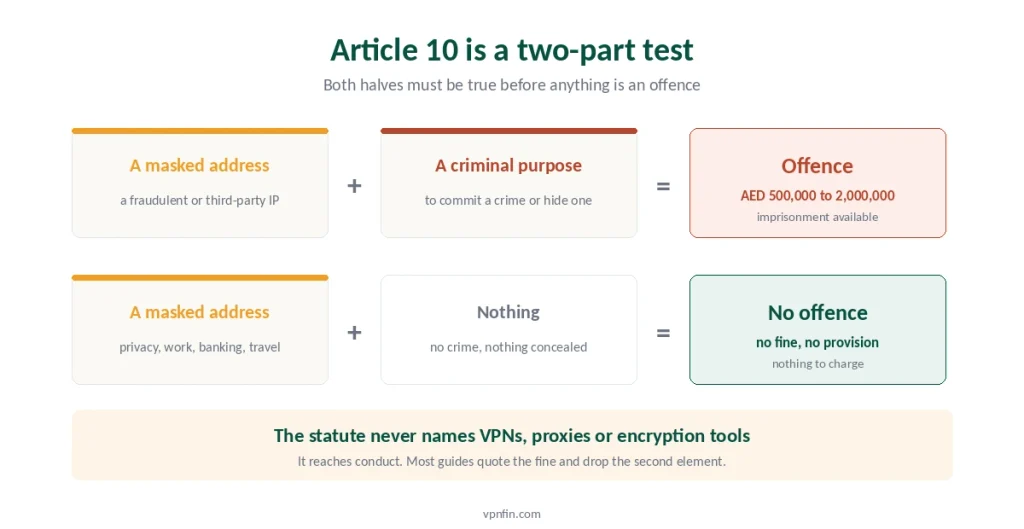
Here is what the law says. Federal Decree-Law No. 34 of 2021 — the statute every one of those headlines cites — does not define or mention VPNs, proxies or encryption tools anywhere in its text. The fine belongs to a different offence, and that offence requires two things to be true at once.
Most guides quote the first thing and skip the second. The second is the one that decides whether you have committed anything.
Is a VPN Legal in the UAE?
Yes, for lawful use. No UAE law bans VPN technology, and the telecommunications regulator confirmed as much publicly in 2016. The cybercrime law penalises using a fraudulent IP address to commit a crime or conceal one — both elements are required. Corporate, banking and privacy use are ordinary and lawful.
What Article 10 Actually Requires
The governing text is Federal Decree-Law No. 34 of 2021 on Combatting Rumours and Cybercrimes, in force since 2 January 2022, which replaced the 2012 law and was itself amended in 2024.
Article 10 is the provision behind every headline. It penalises the use of a fraudulent IP address, or a third party’s, for the purpose of committing a crime or preventing its discovery. The penalty runs from AED 500,000 to AED 2,000,000 with imprisonment available.
Read the sentence again and count the elements. There is the technical act — masking an address. There is the purpose — committing or hiding an offence. The provision joins them. Remove the second and the first is not an offence at all, which is why ordinary privacy use has never produced a prosecution anyone can point to.
Article 9 sits nearby and is different. It covers unauthorised access to codes, passwords or systems, carrying at least six months and AED 300,000 to 500,000. That is hacking, not browsing.
⚠️ What the law never does is name the tool. It reaches conduct, not software. Every guide that writes “VPN fine: AED 2 million” has compressed a two-part test into a product name — and for a reader trying to decide whether to install something, that compression is the whole problem. If you want the plain version of what the technology does before deciding, what a VPN actually hides covers it without the legal frame.
The Regulator Said So Itself
This is the part that almost never gets quoted, and it comes from the body with the authority to say it.
On 31 July 2016 the Telecommunications and Digital Government Regulatory Authority issued a statement confirming that nothing in the regulations prevents companies, institutions and banks from using VPN technology to reach their internal networks.
That statement has never been withdrawn. It is the reason every bank in Dubai runs one, every remote employee connects through one, and nobody treats either as remarkable.
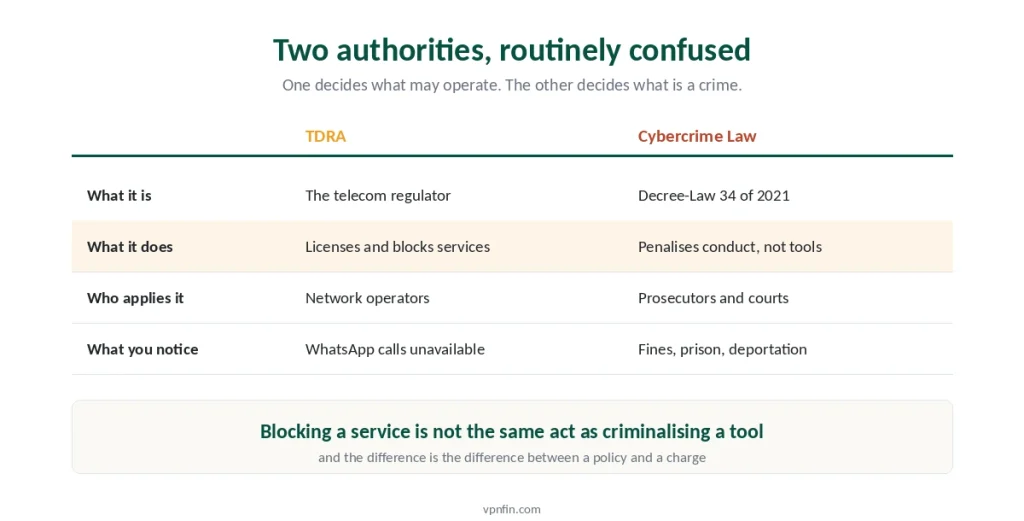
So two authorities are being conflated across most of the coverage. TDRA is a regulator: it decides which services may operate on UAE networks, and its decisions are administrative. The cybercrime law is criminal, and it is enforced by prosecutors. Blocking a service is not the same act as criminalising a tool, and the difference is not academic — it is the difference between a policy and a charge.
Where the Grey Area Actually Sits
Having said what is clear, here is what is not.
Voice calling over the internet is restricted on UAE networks. WhatsApp messaging works normally; WhatsApp voice and video calls do not. That restriction comes from TDRA policy rather than from the criminal statute.
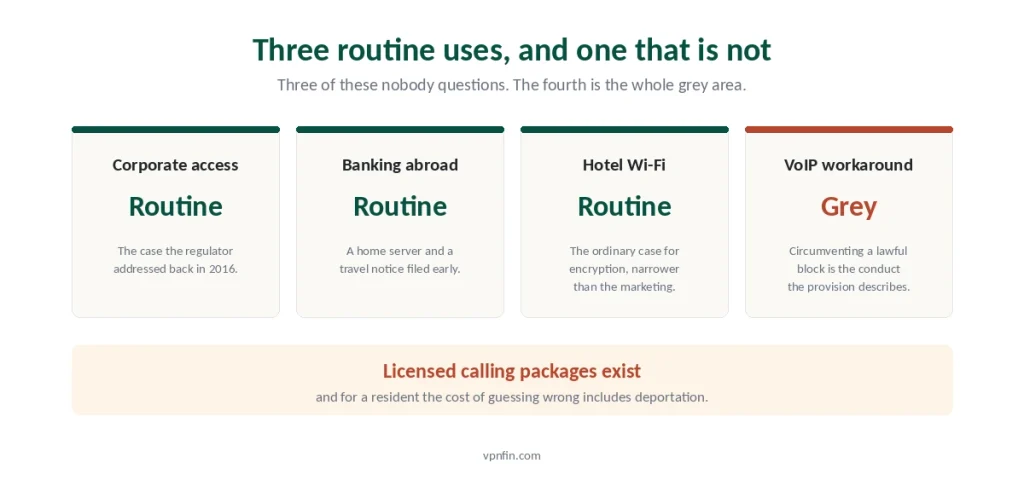
⚠️ Using a VPN specifically to get around that restriction is the one place the two elements of Article 10 could plausibly meet. Circumventing a lawful block is exactly the shape of conduct the provision describes. Enforcement against ordinary individuals appears to have been rare, and licensed calling packages exist for the same purpose.
We are not going to tell you it is fine because everyone does it. Plenty of pages will. The consequence of being wrong falls on the person inside the country, not on the website, and for a resident a cybercrime conviction can carry deportation alongside the fine.
⚠️ This page describes published law. It is not legal advice. Enforcement is discretionary, the framework has been amended, and a specific question deserves a licensed UAE lawyer rather than a review site. Our wider legality guide explains why the same caution applies across every restricted jurisdiction.
The 2026 Amendment That Sources Disagree About
Worth flagging, because it is circulating widely.
Several sites published an urgent alert in early 2026 describing immediate amendments to the cybercrime law, complete with new VPN penalties and a mandatory deportation clause.
Legal publishers do not corroborate it. Law-firm commentary and legal directories writing through mid-2026 continue to treat Federal Decree-Law No. 34 of 2021, as amended by Federal Law No. 5 of 2024, as the controlling text. Deportation for convicted foreign nationals and confiscation of devices used in an offence are features of the existing framework rather than new ones.
Our reading is that the alert restates the 2021 law with a 2026 date on it. We flag it rather than resolve it, because we cannot read the Arabic gazette and would rather say so than sound certain. The practical answer does not change either way: the offence is conduct, not connection.
What Your ISP Can See
A technical point that changes expectations without changing the law.
Etisalat and du both deploy deep packet inspection. That means the network can identify that a connection is running through a VPN, even though the contents stay encrypted. The protocols have recognisable signatures, and identifying them is routine.
Being visible is not being liable. Your employer’s VPN is equally visible, and nobody suggests that is a problem. But it is worth knowing that a VPN in the UAE is not invisible to the network, whatever the marketing implies, and a leak test tells you what is actually happening rather than what the app icon claims.
The Uses Nobody Questions
Four categories account for almost all VPN use in the country, and none of them touches Article 10.
Corporate access. Reaching internal systems remotely, which is precisely what the regulator addressed in 2016.
Banking and payments. A home-country server plus a travel notice keeps fraud systems calm — our banking guide covers the mechanism and, honestly, its limits.
Hotel and airport networks. The ordinary case for encryption anywhere, and narrower than the marketing suggests.
Travel generally. Reaching your own accounts from abroad, where the practical obstacle is usually connectivity rather than law.
⚠️ Install before you fly. Provider websites and app-store listings are unreliable from inside restricted networks, and arriving without the app already working is the most common avoidable problem. Our setup guide covers the checks that confirm it works.
⚠️ Free services are the wrong tool here. A provider funded by selling data is a poor answer to a privacy question anywhere, and worse in a jurisdiction with this penalty structure. Only three free tiers are worth trusting, and the reasoning is the same everywhere.
How the UAE Compares
Placing it beside the two jurisdictions readers ask about next.
The UAE regulates conduct. No licensing regime for VPNs, no criminal provision naming them, and a regulator that confirmed their legitimacy — but severe penalties attached to what you do behind one.
Turkey regulates the tunnel. Internet providers are obliged to block VPN services, so reaching one is the difficulty rather than using it.
India regulates the company. Providers with local servers must retain subscriber records for five years, which emptied the country of physical VPN hardware.
Three approaches, one shared feature: in all of them, business and institutional use is permitted — as it is in China, which regulates the provider, the tunnel and the user at once. Whatever these frameworks are aimed at, it is not the technology.
| Country | What the rule aims at | Reaches the user? |
|---|---|---|
| Turkey | The tunnel — ISPs must block | No |
| The UAE | Conduct behind an address | No |
| India | The provider's records | Not nationally |
| China | Provider, tunnel and user | Yes |
| Brazil | Nothing, until a court acts | For 39 days |
| Indonesia | Paperwork — registration | No |
| The UK | The destination you visit | No, and ministers said so |
| The US | The platform, state by state | No, in all twenty-seven |
| Russia | The search, not the tool | Only if you went looking |
| Australia | The platform, and the tunnel itself | No — platforms must detect it |
| France | The VPN provider itself | No, the orders bind five companies |
| Italy | The provider, by regulator order | No, but one VPN left the market |
| Spain | The provider, by injunction without a hearing | No, and only two firms were named |
| Germany | The provider's logfile, for three months | No, and the courts twice removed it |
If jurisdiction matters to your choice, the useful question is what a provider could be compelled to produce. Proton VPN publishes its audit reports in full; NordVPN runs RAM-only servers that hold nothing between reboots.
How We Research
This page draws on the text of Federal Decree-Law No. 34 of 2021 as reported by UAE law firms and legal directories publishing through 2026, on the TDRA statement of 31 July 2016 concerning corporate VPN use, and on published reporting of the VoIP restriction and of deep packet inspection by the national carriers. Where sources conflicted — as they do on the reported 2026 amendment — we say so rather than picking the more dramatic version. We don’t run our own speed tests, we are not lawyers, and we don’t publish methods for evading network-level blocking. Our full approach lives on the About Us page.
UAE VPN Legality FAQ
Not for the connection itself. Article 10 of the cybercrime law penalises using a fraudulent IP address to commit a crime or prevent its discovery, and both elements are needed. The fines of AED 500,000 to 2,000,000 that circulate online attach to that offence, not to encrypting your own browsing.
Yes, and the rules are federal rather than emirate-level, so Dubai, Abu Dhabi and Sharjah share the same framework. The telecommunications regulator confirmed in 2016 that companies, institutions and banks may use VPN technology for internal network access, and that position has not been withdrawn.
Because two different bodies are involved. The regulator restricts which voice services may operate on UAE networks, which is an administrative decision. The cybercrime law is criminal and enforced by prosecutors. Messaging works normally; voice and video calling is the restricted part, and licensed calling packages exist.
Yes. Both national carriers deploy deep packet inspection, which identifies VPN protocols by their signatures even though the contents stay encrypted. That visibility does not create liability — corporate VPNs are equally visible — but it is worth knowing that a VPN in the UAE is not invisible to the network.
Several sites published an alert describing immediate amendments with new VPN penalties. Law firms and legal directories writing through 2026 continue to treat the 2021 decree-law, amended in 2024, as the controlling text. We flag the disagreement rather than resolving it, and the practical position is unchanged.
The Verdict
Using a VPN in the UAE is lawful, and the law behind the scary number never mentions one. Federal Decree-Law No. 34 of 2021 reaches the use of a fraudulent IP address to commit or conceal an offence. Both halves are required.
The regulator settled the ordinary case a decade ago, confirming that companies, institutions and banks may use the technology freely. Nothing has withdrawn that.
One area is genuinely unsettled, and it is the VoIP restriction rather than VPNs in general. Licensed alternatives exist, and the cost of guessing wrong is high enough that we will not encourage the guess.
For everything else — work, banking, hotel Wi-Fi, reaching your own accounts — the question answers itself. Install it before you travel, choose a provider that publishes what it holds, and keep what you do behind it as ordinary as what you would do without it.