
Disclosure: VPNFin is reader-supported. If you buy a VPN through links on this page, we may earn a commission at no extra cost to you. This never affects our ratings — here’s our full disclosure.
VPNs are entirely legal in Australia. No law restricts using one, apps remain freely available, and millions of Australians use them for remote work, public Wi-Fi and streaming.
The reasons to want one here are more specific than the usual marketing suggests. Under the Telecommunications (Interception and Access) Act, Australian telcos must retain certain metadata for at least two years. And Australia is a founding member of the Five Eyes intelligence-sharing alliance alongside the US, UK, Canada and New Zealand.
Neither fact makes a VPN essential. Both make it more relevant than in countries without those arrangements.
The Short Answer
Legal, with no restrictions on individuals. The laws that exist target service providers and content, not users.
Two years of metadata is the practical driver. A VPN doesn’t hide that you’re using one, but it substantially reduces what your ISP can record about where you go.
Jurisdiction matters more here than elsewhere. Because Australia sits inside Five Eyes, where your provider is incorporated is worth weighing alongside its audits.
What Two Years of Metadata Actually Means
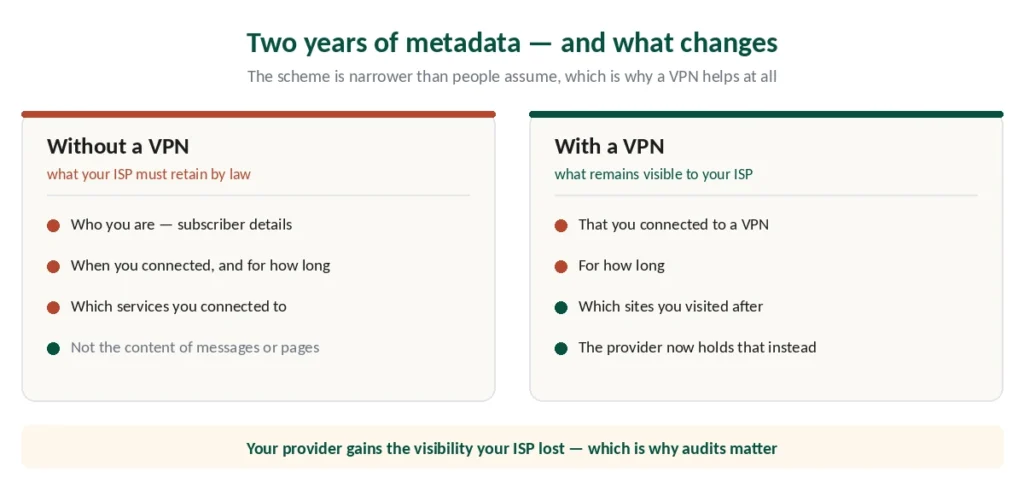
The scheme is narrower than people assume, and that matters for understanding what a VPN changes.
What telcos must store: subscriber information, connection timestamps, and which services you connected to. Law enforcement can request it under specific powers or with a warrant.
What they don’t store: the content of your messages or the pages you viewed.
What a VPN changes: your ISP still sees that you connected to a VPN server, and for how long. It no longer sees which sites you went to afterwards. The metadata they’re obliged to retain becomes considerably less informative. The full breakdown of who sees what applies in any jurisdiction.
What it doesn’t change: the fact of VPN use is visible, and your provider now holds the visibility your ISP lost. That’s why an audited no-logs policy is the thing that matters — our reviews examine those records in detail for each provider.
Why Jurisdiction Matters More Here
Australia co-founded Five Eyes, and the practical implication is straightforward.
A provider incorporated inside a Five Eyes country can in principle be served legal demands to assist surveillance or hand over data. A provider outside those arrangements cannot as easily be compelled in the same way.
This doesn’t make domestic providers untrustworthy. It means jurisdiction is a factor to weigh alongside audits rather than instead of them.
It’s also why privacy-focused providers incorporate where they do. NordVPN operates from Panama, ExpressVPN from the British Virgin Islands, CyberGhost from Romania — all outside the intelligence-sharing blocs and none with mandatory data-retention regimes.
| Provider | No-logs audits | Auditor | Jurisdiction |
|---|---|---|---|
| NordVPN | 6 | PwC, Deloitte | Panama |
| Surfshark | 2 | Deloitte | Netherlands (9 Eyes) |
| ExpressVPN | 3 | KPMG | British Virgin Islands, Kape-owned |
| CyberGhost | 3 | Deloitte | Romania, Kape-owned |
| PureVPN | 4 | KPMG | BVI, operated from Pakistan |
| IPVanish | 2 | Leviathan, Schellman | United States (Five Eyes), Ziff Davis-owned |
| Windscribe | 1 | Packetlabs, production infrastructure | Canada (Five Eyes); Greek case dismissed, no data to give |
| Proton VPN | 5 | Securitum | Switzerland, moving infrastructure to EU |
| Private Internet Access | 3 | Deloitte | United States (Five Eyes), Kape-owned |
| Mullvad | 10+ | Cure53, Assured AB | Sweden (14 Eyes) |
| TunnelBear | Annual since 2017 | Cure53 | Canada (Five Eyes), US parent |
| Norton VPN | 2 | VerSprite | United States (Five Eyes) |
| Hotspot Shield | 0 | protocol audited, policy not | United States (Five Eyes) |
| AirVPN | 0 | none — the client is open source instead | Italy (14 Eyes) |
| IVPN | 8, annual since inception | Cure53 | Gibraltar (status disputed) |
| Hide.me | 1 modern, in 2024 | Securitum, though one source names Altius IT | Malaysia (outside the alliances) |
| PrivadoVPN | 0 | none in six years of operation | Iceland (moved from Switzerland, 2026) |
| TorGuard | 0 | none; settled a lawsuit without disclosing records | United States (Five Eyes) |
| FastestVPN | 1, in 2023 | Altius IT | Cayman Islands (outside the alliances) |
| StrongVPN | 0 | none in over two decades | United States (Five Eyes), Ziff Davis-owned |
| VyprVPN | 1, in 2018 | Leviathan Security, before the 2023 sale | United States (Five Eyes), Certida-owned since 2023 |
| PrivateVPN | 0 | none; support says there is nothing to audit | Sweden (14 Eyes), ownership disputed |
| ZoogVPN | 0 | none; support describes one as planned | Greece (outside the alliances), run from Ukraine |
⚠️ One further piece of context: the Assistance and Access Act 2018 allows authorities to compel technology companies to assist investigations. It targets service providers rather than end users, and doesn’t make encryption or VPN use illegal for individuals — but it’s part of why provider location gets attention in Australian discussions.
Australian Content, and Getting It Abroad
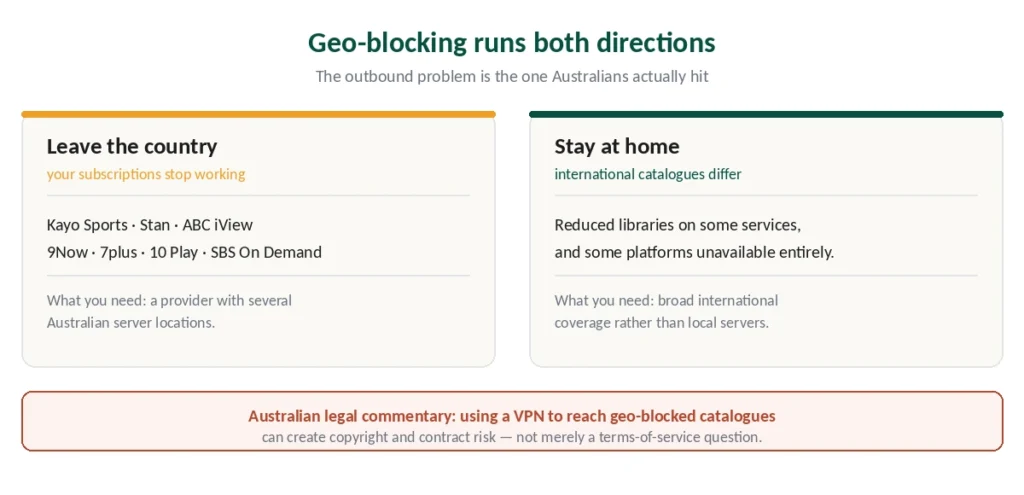
Geo-blocking runs both directions, and the outbound problem is the one Australians actually hit.
Blocked when you travel: Kayo Sports, Stan, ABC iView, 9Now, 7plus, 10 Play and SBS On Demand all restrict access to Australian IP addresses. Leave the country and your subscriptions stop working.
Blocked when you’re home: international catalogues differ, and some services are unavailable or carry reduced libraries in Australia.
What you need: a provider with several Australian server locations if you travel, or broad international coverage if you want other regions. Our streaming guide covers library counts across providers.
⚠️ An honest legal note. Australian legal commentary indicates that using a VPN to reach geo-blocked catalogues can create copyright and contract risk — it’s not merely a terms-of-service question as it is in some jurisdictions. There’s no specific offence for using a VPN with a streaming service, but content licensing rules still apply, and this is a greyer area in Australia than elsewhere. Our legality guide covers how this varies by country.
What Changed Recently
Two developments worth knowing about.
Two age-assurance regimes arrived nine months apart. The under-16 social media rules started on 10 December 2025, and age checks for adult content followed on 9 March 2026, when several major platforms blocked Australian IP addresses rather than build the verification. Britain settled the same question differently, ruling out VPN restrictions in July 2026.
⚠️ Both regimes put the duty on the platform, and neither creates an offence for a person. Our page on Australian VPN law sets out what each one requires, what the regulator told platforms to do about VPN traffic, and why no penalty reaches the people holding the accounts.
What a VPN Won’t Do
It won’t hide that you’re using one. Your ISP sees an encrypted connection to a known VPN address. That’s unavoidable and legal.
It won’t make piracy lawful. The Copyright Amendment (Online Infringement) Act 2015 lets rights holders request ISP-level blocks of piracy sites. Routing around a block doesn’t change the legal position on what’s being accessed.
It won’t move your provider outside Australian reach entirely. If your provider holds data and can be compelled, jurisdiction affects how easily — not whether it’s theoretically possible.
And it won’t fix a slow NBN connection. Australian speeds vary substantially by plan, and a VPN adds overhead on top of whatever you have — our speed guide covers how much and why.
Which Provider to Choose
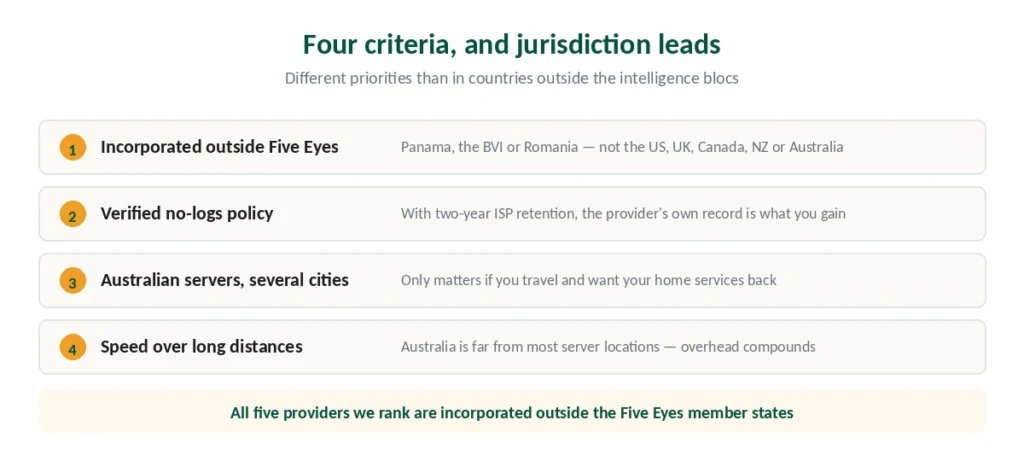
Four things matter for Australia specifically, and jurisdiction leads.
Incorporation outside Five Eyes. Panama, the British Virgin Islands or Romania rather than any of the five member states. Several providers we cover sit inside it — PIA and Norton VPN are American, TunnelBear is Canadian — which is a reason to read their audit records closely rather than to dismiss them.
Australian servers across multiple cities, if you travel and want your home services. Coverage varies — some providers offer one Australian location, others five.
Verified no-logs policy. With two-year retention on the ISP side, the provider’s own record-keeping is what determines whether you’ve gained anything. Audits are the only evidence worth weighing.
Speed over long distances. Australia is far from most server locations, so a provider that loses little baseline throughput matters more here. NordVPN posted the best result in independent benchmark testing.
⚠️ Test on the refund window. Every provider we rank offers at least 30 days, and CyberGhost gives 45 on longer plans — enough to check whether your specific Australian services work.
How We Research
This guide draws on Australian legal reporting including the Canberra Times, published analysis from named sources including CyberInsider and Tech Insider, and the text of the relevant legislation — the Telecommunications (Interception and Access) Act, the Assistance and Access Act 2018, the Copyright Amendment (Online Infringement) Act 2015 and the Online Safety Act. All cross-checked and verified at publication. Several sources carry commercial interests in VPN services and were used only for claims confirmed elsewhere. This is not legal advice. Our full approach lives on the About Us page.
Australia VPN FAQ
Yes, entirely. No law restricts individuals from using one, and VPN apps remain freely available in Australian app stores. The relevant legislation — including the Assistance and Access Act 2018 — targets service providers and content rather than end users. Australia regulates through targeted rules rather than by restricting encryption tools.
Under the Telecommunications (Interception and Access) Act, telcos must store certain metadata for at least two years: subscriber information, connection timestamps and which services you connected to. It does not include the content of your messages or the pages you viewed. Law enforcement can request it under specific powers or with a warrant.
Partially. Your ISP still records that you connected to a VPN server and for how long — that part is unavoidable. What it no longer records is which sites you visited afterwards, which makes the retained metadata considerably less informative. Your VPN provider now holds that visibility, which is why an audited no-logs policy matters.
Australia co-founded the alliance alongside the US, UK, Canada and New Zealand. A provider incorporated within a member state can in principle be compelled to assist surveillance in ways a provider outside those arrangements cannot as easily be. It’s a factor to weigh alongside audits rather than instead of them.
Those services restrict access to Australian IP addresses, so a VPN with Australian servers is the usual approach. Note that Australian legal commentary indicates using a VPN to reach geo-blocked catalogues can create copyright and contract risk — this is a greyer area here than in jurisdictions where it’s purely a terms-of-service matter.
Rather than implement the age verification required under the Online Safety Act, several major platforms including Pornhub, RedTube, YouPorn and Tube8 chose to block Australian IP addresses entirely. The rules target platforms rather than individual adult viewers, and there is no criminal offence for viewers in that framework.
The Short Version
Legal, and the reasons to want one are specific. Two years of mandatory metadata retention and Five Eyes membership are real, documented facts rather than marketing.
A VPN reduces what your ISP can record — not that you’re using one, but where you go afterwards. That’s a meaningful narrowing of the retained metadata.
Jurisdiction deserves more weight here than in countries outside the intelligence-sharing arrangements.
And two things it won’t fix: the legal position on copyright, and a slow NBN plan.