
Disclosure: VPNFin is reader-supported. If you buy a VPN through links on this page, we may earn a commission at no extra cost to you. This never affects our ratings — here’s our full disclosure.
No Indonesian law bans VPNs. Nothing licenses them, nothing registers you for using one, and nothing in the criminal code mentions the technology.
The rule that actually governs the internet here is a filing requirement, and in 2022 it took PayPal, Yahoo, Epic Games and Steam offline nationwide. None of them had published anything objectionable. They had missed a deadline.
That mechanism is the thing worth understanding, because it reaches any service with Indonesian users — and it comes with an obligation that sits awkwardly beside what a VPN is supposed to be.
Is a VPN Legal in Indonesia?
Yes. Nothing prohibits using one, and no penalty attaches to the software. What Indonesia regulates is operators: any service accessible here must register with the communications ministry or face having its access blocked. Registered operators owe the authorities cooperation, including access to systems and user data.
The Rule That Governs the Internet Here
One regulation does most of the work, and almost nobody outside compliance departments has heard of it.
Ministerial Regulation 5 of 2020, usually called MR5, requires every private-scope electronic system operator whose service is used in Indonesia to register with the ministry. It builds on Government Regulation 71 of 2019 and was amended in 2021.
It applies to foreign companies with no local presence. Operating entirely from abroad, with no Indonesian entity and no office here, does not remove the obligation.
And it has no size threshold. A platform with a hundred Indonesian users faces the same requirement as one with ten million.
Registered operators take on duties, including removing prohibited content within twenty-four hours — four for urgent categories — appointing local contacts, and providing authorities with access to systems and user data.
⚠️ The ministry changed its name, not its powers. Kominfo became Komdigi under a 2024 presidential regulation, and older guidance still uses the former name. The obligation traces back to the same 2019 and 2020 instruments either way.
What Happened in 2022
The enforcement wave that made this real, and the reason it is worth taking seriously.
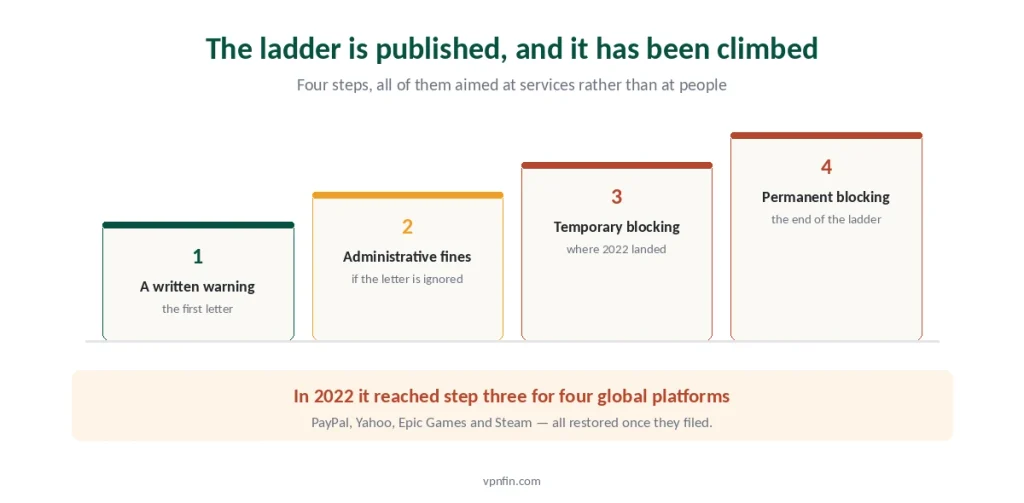
In July 2022 the ministry blocked PayPal, Yahoo, Epic Games and Steam across Indonesia. The cause was non-registration rather than anything they hosted.
Services returned once they filed. PayPal completed registration within days and was restored; the others followed over the following weeks.
The ladder is published: written warning first, then administrative fines, then temporary or permanent blocking.
And it is still running. In June 2026 the ministry notified twenty-five operators — fifteen foreign, ten domestic, covering fifty-seven websites and applications — to complete registration by 3 July or face administrative sanctions including access blocking.
⚠️ Notice what makes this different from every other country in this series. Turkey obliges providers to block. India demands records. China licenses. Brazil uses a court order. Indonesia withdraws access for a missing form, and it does so on a published schedule with names attached.
The Question Nobody Asks About Their Provider
Here is where the registration rule stops being an abstraction for a VPN user.
A VPN service used in Indonesia meets the description of a private-scope operator on a plain reading of the regulation. It is an electronic system, offered to the public, used in Indonesian territory.
Officials have said as much since 2019. The ministry stated then that VPN providers operating without Indonesian licences should be blocked, arguing they function like internet service providers. Reporting at the time noted the enforcement mechanism was never made clear, and that remains largely true.
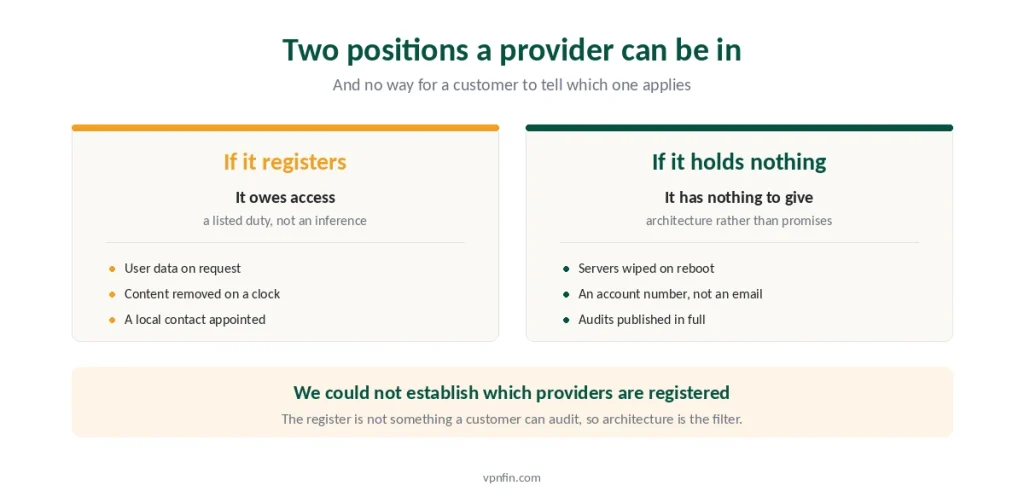
Registered operators must be able to provide access to user data. That is a listed duty, not an inference.
Which puts two things in tension. A provider that registers accepts an obligation it may have spent years telling customers it cannot fulfil. A provider that does not register is exposed to the blocking ladder.
We could not establish which major providers are registered, and the register is not something a customer can meaningfully audit. So we are raising the question rather than answering it, and we would rather say that than guess.
⚠️ What follows from this is architectural rather than legal. A provider that holds nothing cannot produce anything, whatever it agrees to. Mullvad issues an account number instead of an email address; Proton VPN publishes five annual audits in full; NordVPN runs servers that keep nothing between reboots. None of that is Indonesia-specific, and all of it matters more in a jurisdiction that asks.
What the ITE Law Reaches
The other statute people encounter, and it aims somewhere a tunnel does not help.
The Electronic Information and Transactions Law, passed in 2008 and amended in 2016 and again in 2024, criminalises online defamation, hoaxes and several categories of content. Defamation carries up to two years.
It reaches the person, not the transport. Nothing in it turns on whether traffic was encrypted or where the connection appeared to originate.
Critics say it chills expression, and that criticism is longstanding rather than new. We note it because a reader deciding what to post should know the provision exists, not because a VPN changes it.
⚠️ This is general information about published regulations, not legal advice. Indonesian rules in this area have been amended repeatedly and enforcement is administrative rather than predictable. A specific question deserves someone qualified in Indonesian law.
What the Law Does Not Do
Four things worth stating plainly.
No licensing for users. Nothing requires you to register, declare or seek permission before installing a VPN.
No penalty for the software. Possessing or running one is not an offence anywhere in Indonesia.
⚠️ The instructions are a different matter. MR5 classifies material providing access to prohibited information as prohibited in its own right, and a tutorial on using a VPN is the example the regulation itself gives. That is why this page describes the framework rather than walking through any setup.
No retention rule aimed at VPN providers specifically, unlike India’s directive. The registration duty is general rather than targeted.
And illegal acts stay illegal. A VPN changes nothing about the conduct underneath it — what a VPN actually hides is narrower than most people assume.
| Country | What the rule aims at | Reaches the user? |
|---|---|---|
| Turkey | The tunnel — ISPs must block | No |
| The UAE | Conduct behind an address | No |
| India | The provider's records | Not nationally |
| China | Provider, tunnel and user | Yes |
| Brazil | Nothing, until a court acts | For 39 days |
| Indonesia | Paperwork — registration | No |
| The UK | The destination you visit | No, and ministers said so |
| The US | The platform, state by state | No, in all twenty-seven |
| Russia | The search, not the tool | Only if you went looking |
| Australia | The platform, and the tunnel itself | No — platforms must detect it |
| France | The VPN provider itself | No, the orders bind five companies |
| Italy | The provider, by regulator order | No, but one VPN left the market |
| Spain | The provider, by injunction without a hearing | No, and only two firms were named |
| Germany | The provider's logfile, for three months | No, and the courts twice removed it |
How Indonesia Compares
Every framework in this series aims at something different.
Turkey regulates the tunnel. Internet providers must block VPN services, so reaching one is the obstacle.
The UAE regulates conduct. The statute never names VPNs; it reaches what you do behind a masked address.
India regulates records. Five years of subscriber data, which emptied the country of physical VPN hardware.
China regulates all three — provider, tunnel and user — and names a figure for the individual.
Brazil regulates nothing until a court acts, and then fined users directly for thirty-nine days.
Indonesia regulates paperwork. No statute touches the technology, and access to any service can be withdrawn administratively for a filing failure. Our wider legality guide covers why the legal-or-illegal framing answers this badly nearly everywhere.
For anyone travelling or moving there, the practical advice is unchanged: install before you fly, since connectivity rather than law is the usual obstacle, and read our Indonesia guide for what actually works on the ground. Free services are the wrong tool in a jurisdiction that asks operators for user data — only three free tiers are worth trusting anywhere.
How We Research
This page draws on published legal analysis of Ministerial Regulation 5 of 2020 and the Government Regulation it implements, compliance guidance describing the registration duty and its absence of a size threshold, contemporaneous reporting on the July 2022 blocking of PayPal, Yahoo, Epic Games and Steam and their subsequent restoration, the ministry’s June 2026 notification of twenty-five operators, and summaries of the Electronic Information and Transactions Law as amended. Where we say a VPN service appears to meet the definition of a covered operator, that is our reading of the regulation’s text rather than a determination anyone has published, and where we could not establish which providers are registered we say so. We are not lawyers and this is not legal advice. Our full approach lives on the About Us page.
Indonesia VPN Legality FAQ
No. Nothing in Indonesian law prohibits installing or using one, and no penalty attaches to the software. What the rules govern is operators: any service accessible in Indonesia must register with the communications ministry, and failing to do so can result in access blocking rather than any consequence for users.
Not as a category. The blocking mechanism applies to operators that have not registered, whatever they do. In July 2022 it took PayPal, Yahoo, Epic Games and Steam offline for missing a registration deadline, and all returned after filing. Nothing published targets VPN services specifically.
A requirement under Ministerial Regulation 5 of 2020 that every private-scope electronic system operator serving Indonesian users register with the ministry. It applies to foreign companies with no local presence and has no minimum size threshold. Registered operators accept content-removal deadlines and obligations to provide authorities with access to user data.
We could not establish that for the major providers, and the register is not something a customer can meaningfully audit. The more useful question is architectural: a service that holds no logs and issues no email-based accounts has less to produce if asked, whatever agreements it has signed.
Yes. The Electronic Information and Transactions Law criminalises online defamation, hoaxes and several content categories, with defamation carrying up to two years. Nothing in it depends on how your traffic travelled, so encryption changes neither the offence nor the exposure.
The Verdict
Using a VPN in Indonesia is legal, and no rule reaches the person running one. There is no licence, no registration for users, and no penalty attached to the software.
The regulation that matters is about operators. Any service used here must register with the ministry or face blocking, and that duty carries an obligation to provide access to user data.
The 2022 wave proved it works. Four major platforms went dark for missing a deadline rather than for anything they published, and the ladder is still being climbed — twenty-five operators were notified in June 2026.
Which leaves an open question rather than a warning. Whether your provider has registered, and what it agreed to if it did, is not something a customer can check. That makes architecture the useful filter: a service that holds nothing has nothing to produce, whatever it signed.