
Disclosure: VPNFin is reader-supported. If you buy a VPN through links on this page, we may earn a commission at no extra cost to you. This never affects our ratings — here’s our full disclosure.
On 25 July 2025 the United Kingdom switched on mandatory age checks for adult content. Within hours, half of the ten most downloaded free apps in the British App Store were VPNs.
No marketing campaign in this industry has ever done that. A statute did it in an afternoon, and the effects are still visible a year later.
What Actually Changed
The Online Safety Act obliges platforms to verify that users are over eighteen before showing content classed as harmful. Not only pornography sites: Reddit, X, Discord, Bluesky, Spotify and dating services all introduced checks for British users.
Verification means an identity document, a credit card, or a face scan. Ofcom requires methods to be highly effective without prescribing which ones.
The penalty for platforms reaches £18 million or ten per cent of worldwide revenue, whichever is larger.
⚠️ The obligation falls on platforms, not on you. Using a VPN in Britain is lawful and the Act does not make individual use an offence. What it does prohibit is a platform promoting VPNs as a way round its own checks.
The Numbers From That Week
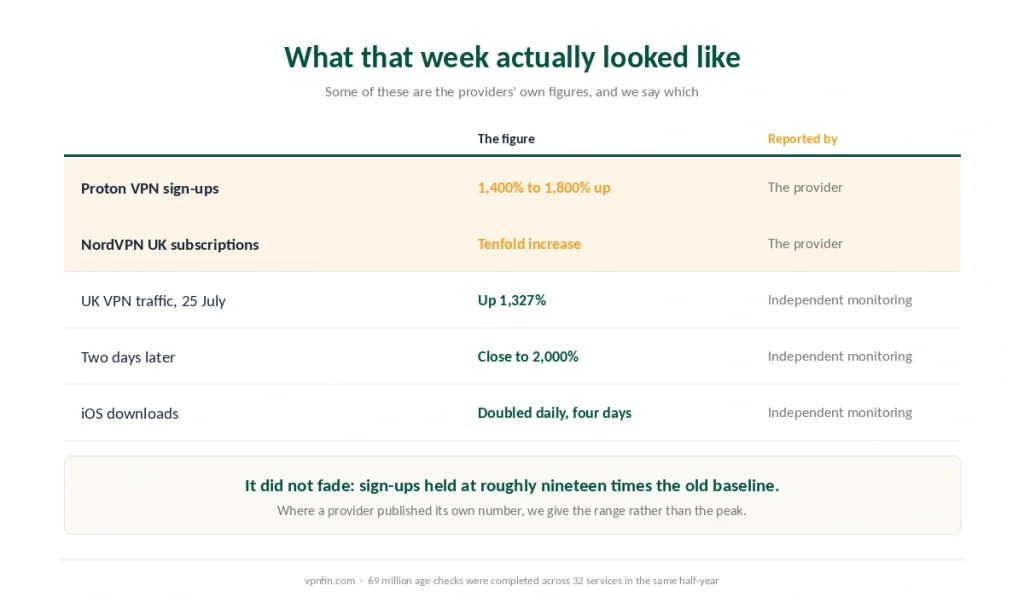
They are unusually well documented, because several providers published their own.
Proton VPN reported sign-ups between 1,400 and 1,800 per cent above baseline, depending on which figure you take, and it led the free app chart outright.
NordVPN reported a tenfold rise in UK subscriptions.
Independent monitoring put UK VPN traffic up 1,327 per cent on the day, and close to 2,000 per cent two days later.
iOS downloads doubled day over day for four consecutive days.
⚠️ And it did not fade. Proton reported UK sign-ups holding at roughly nineteen times the pre-enforcement level days afterwards, which is a change in the shape of British internet traffic rather than a spike.
Who Actually Signed Up
The assumption is teenagers. The evidence says otherwise.
Ofcom’s own guidance, cited in the House of Lords on 15 September 2025, put the figure at roughly one VPN user in ten being a child.
Ofcom research found 29 per cent of eleven to seventeen-year-olds have used a VPN at some point, and 25 per cent had in the six months to March 2026 — real numbers, and not the bulk of the surge.
The surge was adults declining to upload a passport to a pornography site. That is a rational response to a data-collection requirement rather than an attempt to evade a rule aimed at children.
⚠️ Which does not make the checks pointless. Ofcom recorded 69 million age checks across 32 services in the second half of 2025, a 23-fold increase, and the share of children encountering the content the law targets fell. Both things are true at once.
Where the Government Landed
The clearest statement came a year in.
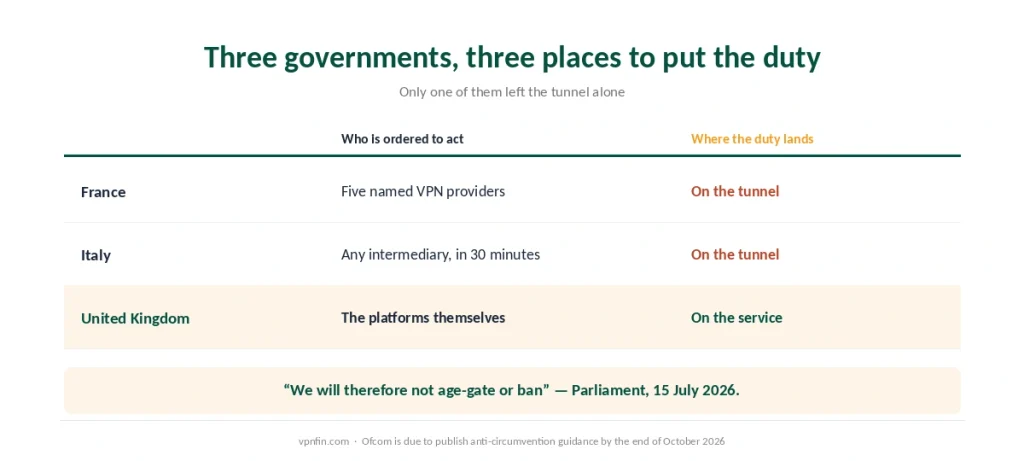
On 15 July 2026 the Technology Secretary told Parliament the government “will therefore not age-gate or ban” VPNs. The reasoning is that they have obvious legitimate uses, which is the same conclusion our legality guide reached a year earlier.
Instead, platforms are expected to detect and prevent circumvention themselves. Ofcom has been told to publish guidance on how by the end of October 2026.
⚠️ That is a meaningful difference in approach. France ordered VPN companies to do the blocking and Italy obliges intermediaries to act within thirty minutes. Britain has put the duty on the services rather than on the tunnel.
The Uncomfortable Part
Here is what the charts actually showed, and it deserves more attention than it received.
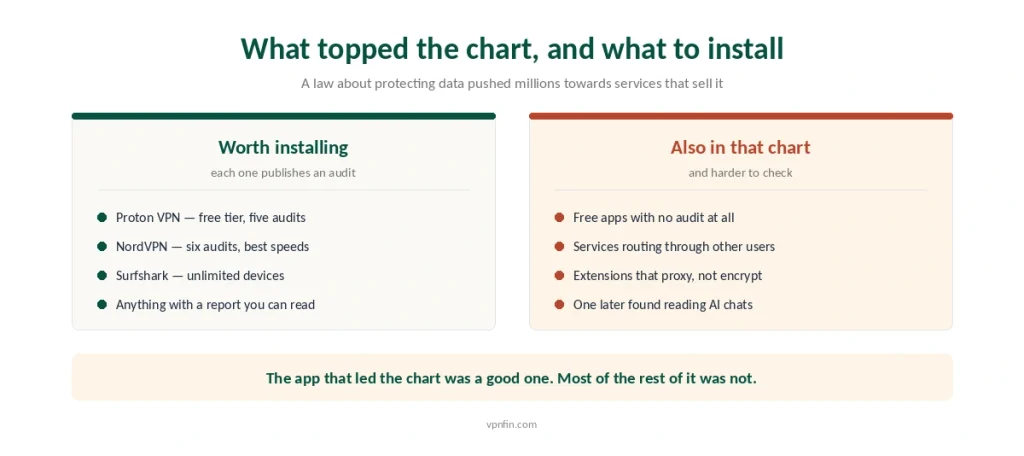
The top of the UK free app chart was dominated by free VPNs. Proton VPN led, which is one of the three free tiers we consider safe. The rest of the list was not.
A law about protecting personal data pushed millions of people towards services that monetise it. Free VPNs are where the documented incidents cluster, and the reason is structural rather than accidental.
⚠️ One of those services was later found harvesting AI conversations. Researchers documented a browser extension with millions of users capturing what people typed into eight assistants — the full account is on its own page.
So the honest advice for a British reader is narrower than the moment suggested. If you want a VPN, the free tier that topped the chart is a reasonable choice; most of the others on that list were not.
The Ordinary Reasons, Which Have Not Changed
Public networks. Hotels, trains and cafés, where a VPN does its clearest work.
Travelling and wanting British television. BBC iPlayer runs the hardest detection of any service we have examined, and the licence question is separate from the geographic one.
Your internet provider’s visibility. A VPN moves who can see where you go rather than making you anonymous, in Britain as anywhere.
⚠️ The United Kingdom sits at the centre of the Five Eyes arrangement, so a provider’s own jurisdiction matters here more than the marketing suggests — and what a no-logs claim is worth is the question underneath it.
What We Will Not Publish
We are not writing a guide to getting past age checks. The rule exists to keep specific content away from children, and a page explaining the workaround would be read by exactly the people it is meant to exclude.
We will explain what the law requires and what the data shows, which is what everything above does.
⚠️ Ofcom has told platforms they may not promote VPNs as a bypass. That obligation is theirs rather than ours, but the reasoning applies to anyone writing about it.
Which Providers Suit a British Reader
Proton VPN has the free tier we recommend most, five published audits, and it topped the chart on the day for good reasons.
NordVPN scores highest on our scale at 4.8, with servers across the country and the best independent speed record.
Surfshark covers unlimited devices, which suits a household where several people made the same decision in the same week.
⚠️ Test inside the refund window. Every provider we cover offers at least thirty days, and British streaming is the case where that matters most.
How We Research
This guide draws on Ofcom’s first statutory report under section 157 of the Online Safety Act, published 16 July 2026, for the 69 million age checks recorded across 32 services, on parliamentary reporting for the Technology Secretary’s statement of 15 July 2026 and the House of Lords debate of 15 September 2025, on TechRadar and Cybernews for the App Store chart positions and the platforms that introduced checks, on Proton’s and NordVPN’s own published figures for the sign-up surges, and on independent monitoring for the traffic measurements. Where providers reported their own numbers we have said so and given the range rather than the highest figure. We do not run our own tests. Our method lives on the About Us page.
UK VPN FAQ
Yes. No British law restricts using, buying or installing one, and the Online Safety Act does not make individual use an offence. The Technology Secretary told Parliament in July 2026 that the government will not ban or age-gate VPNs, because they have obvious legitimate uses.
Mandatory age checks took effect on 25 July 2025 under the Online Safety Act, requiring identity documents, credit cards or face scans on platforms including Reddit, X, Discord and Spotify. Within hours, half the ten most downloaded free apps in the UK App Store were VPNs.
Mostly not. Ofcom guidance cited in the House of Lords put roughly one VPN user in ten as a child. Its research found 29 per cent of eleven to seventeen-year-olds have used one at some point, which is significant but far from the bulk of a surge dominated by adults.
The government has said it will not. On 15 July 2026 the Technology Secretary told Parliament there would be no age-gating or ban, and that platforms are instead expected to detect and prevent circumvention. Ofcom is due to publish guidance on that by the end of October 2026.
Proton VPN if you want a free tier that is genuinely safe, NordVPN for the strongest independent speed record and six published audits, Surfshark if several people in a household need covering. Avoid the free apps that filled the rest of that chart.
The Verdict
A statute created the fastest VPN adoption Britain has seen, and the government has now said explicitly that it will not restrict the tool in response.
The surge was adults declining to hand over identity documents, not children evading a rule — though both happened, and Ofcom records the checks working at the same time.
The part worth acting on is which app you install. Half the chart that week was free VPNs, and the reasons to be careful there have only grown since — as one of them demonstrated.