
Disclosure: VPNFin is reader-supported. If you buy a VPN through links on this page, we may earn a commission at no extra cost to you. This never affects our ratings — here’s our full disclosure.
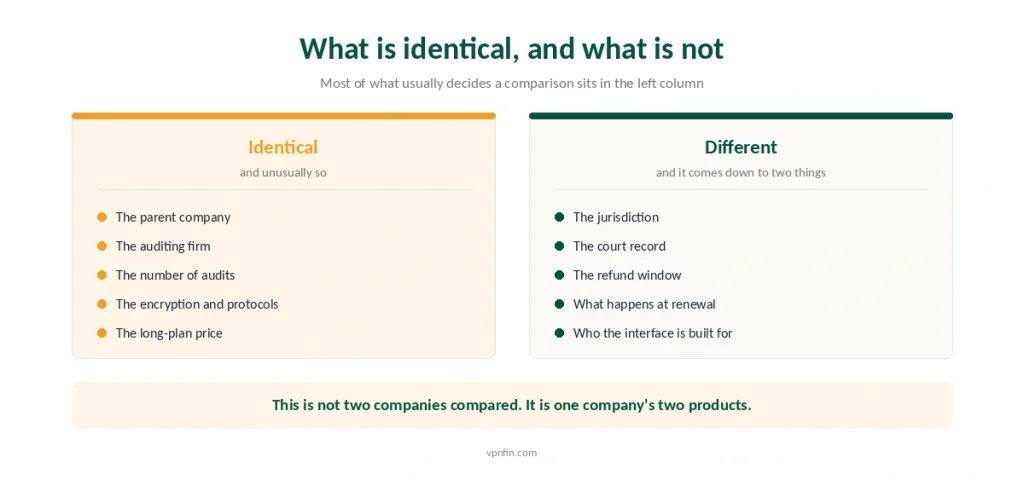
These two belong to the same company. They were audited by the same firm, the same number of times, and they sell at roughly the same price.
What is left after all that is a country and a courtroom, and they point in opposite directions.
The Short Answer
CyberGhost has the better address. Bucharest, Romania — outside the Five, Nine and Fourteen Eyes arrangements, inside the European Union.
Private Internet Access has the better evidence. Denver, Colorado — inside Five Eyes, and the only one of the pair asked by federal authorities to produce records, three times, with nothing to produce.
Both are owned by Kape Technologies, which also owns ExpressVPN — three of the brands in our catalogue share one parent.
⚠️ So this is not a comparison of two companies. It is a comparison of two products from one company, sold to different people.
What Is Identical
Worth listing, because it is most of what usually decides these things.
The parent company. Kape acquired Private Internet Access in November 2019 and CyberGhost before that.
The auditor. Deloitte examined both no-logs policies.
The number of audits. Three each, on our count.
The encryption and protocols. AES-256, with WireGuard and OpenVPN on both.
The price, roughly. Long plans land in the same two-to-three dollars a month range.
⚠️ The parent has a history worth knowing. Kape was formerly Crossrider, a development platform that third parties used to distribute adware. Both brands inherit that context regardless of how they operate today.
The Jurisdiction Argument
Here CyberGhost wins on paper, and the paper matters less than it looks.
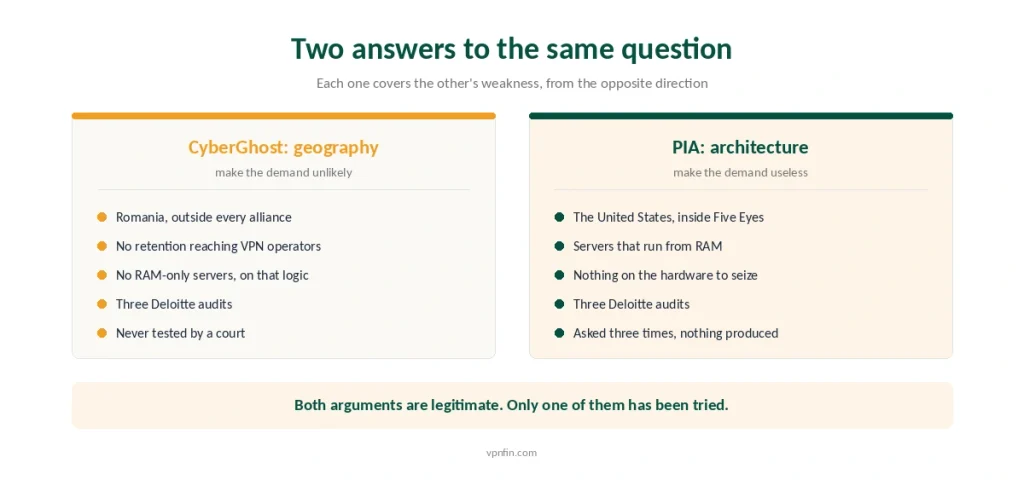
Romania sits outside every intelligence-sharing arrangement and has no mandatory retention regime reaching VPN operators. It is a genuinely good answer to the question of who could compel a disclosure.
The United States is a founding member of Five Eyes — though it has no mandatory VPN retention either, which is the detail most jurisdiction charts omit.
PIA answers this with architecture rather than geography. Servers run from RAM, so a seizure produces hardware with nothing on it. CyberGhost does not run RAM-only infrastructure, on the reasoning that Romania makes it unnecessary.
⚠️ Each has covered the other’s weakness, in opposite directions. One picked a country that makes demands unlikely; the other built systems that make demands useless. Both arguments are legitimate and only one of them has been tested.
| Provider | No-logs audits | Auditor | Jurisdiction |
|---|---|---|---|
| NordVPN | 6 | PwC, Deloitte | Panama |
| Surfshark | 2 | Deloitte | Netherlands (9 Eyes) |
| ExpressVPN | 3 | KPMG | British Virgin Islands, Kape-owned |
| CyberGhost | 3 | Deloitte | Romania, Kape-owned |
| PureVPN | 4 | KPMG | BVI, operated from Pakistan |
| IPVanish | 2 | Leviathan, Schellman | United States (Five Eyes), Ziff Davis-owned |
| Windscribe | 1 | Packetlabs, production infrastructure | Canada (Five Eyes); Greek case dismissed, no data to give |
| Proton VPN | 5 | Securitum | Switzerland, moving infrastructure to EU |
| Private Internet Access | 3 | Deloitte | United States (Five Eyes), Kape-owned |
| Mullvad | 10+ | Cure53, Assured AB | Sweden (14 Eyes) |
| TunnelBear | Annual since 2017 | Cure53 | Canada (Five Eyes), US parent |
| Norton VPN | 2 | VerSprite | United States (Five Eyes) |
| Hotspot Shield | 0 | protocol audited, policy not | United States (Five Eyes) |
| AirVPN | 0 | none — the client is open source instead | Italy (14 Eyes) |
| IVPN | 8, annual since inception | Cure53 | Gibraltar (status disputed) |
| Hide.me | 1 modern, in 2024 | Securitum, though one source names Altius IT | Malaysia (outside the alliances) |
| PrivadoVPN | 0 | none in six years of operation | Iceland (moved from Switzerland, 2026) |
| TorGuard | 0 | none; settled a lawsuit without disclosing records | United States (Five Eyes) |
| FastestVPN | 1, in 2023 | Altius IT | Cayman Islands (outside the alliances) |
| StrongVPN | 0 | none in over two decades | United States (Five Eyes), Ziff Davis-owned |
| VyprVPN | 1, in 2018 | Leviathan Security, before the 2023 sale | United States (Five Eyes), Certida-owned since 2023 |
| PrivateVPN | 0 | none; support says there is nothing to audit | Sweden (14 Eyes), ownership disputed |
| ZoogVPN | 0 | none; support describes one as planned | Greece (outside the alliances), run from Ukraine |
The Courtroom Difference
This is the part that decides it for us.
PIA has been asked at least three times. Federal demands in 2015, in a 2016 FBI case in Virginia and again in June 2018 produced nothing, because there was nothing recorded — the strongest category of evidence any provider can offer, and one that cannot be commissioned.
CyberGhost has never been tested that way. Three Deloitte audits and a favourable jurisdiction, and no occasion on which either was put under pressure.
⚠️ An audit examines whether records could exist. A subpoena examines what happened when someone demanded them. The second is rarer and worth more, which is why a Five Eyes provider can outrank a Romanian one on the question the flags were supposed to settle.
Where They Actually Differ in Use
CyberGhost labels servers by platform. You pick Netflix or Disney+ from a menu rather than hunting — which shortens the work our streaming guide describes.
PIA gives you more control and less guidance. Port forwarding, granular settings, and an interface aimed at people who enjoy them — which is why it appears in our torrenting guide and CyberGhost does not.
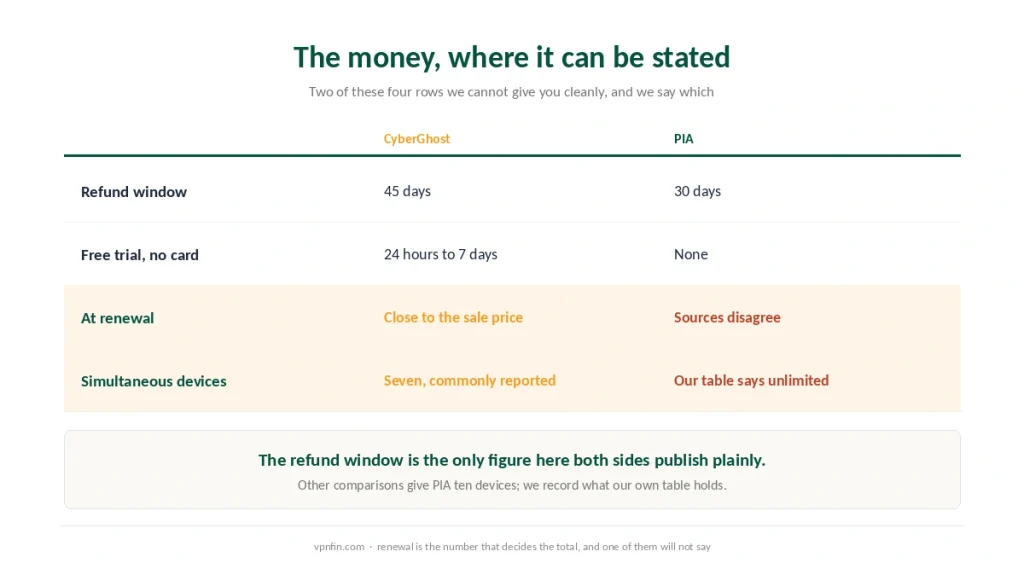
Device limits differ, and so do the sources. Our table records unlimited connections for PIA; several published comparisons still say ten. Check the current terms rather than either of us.
Server counts are not comparable. CyberGhost publishes a figure above eleven thousand; PIA stopped disclosing its total and reports only the country count. Neither number tells you much.
⚠️ CyberGhost’s long-distance speeds are its documented weakness. Testing describes losses above fifty per cent on routes to Australia and South Africa, which matters if your server is far away.
Money
CyberGhost gives 45 days, the longest refund window we track, on its six-month and two-year plans. PIA gives thirty.
CyberGhost also runs genuine free trials — 24 hours on Windows and Mac, three days on Android, seven on iOS, none requiring a card.
And its renewal does not jump. The two-year plan renews at close to the rate it was sold at, which is one of only two exceptions in our catalogue.
⚠️ PIA’s renewal we cannot state cleanly. Our own table records that sources disagree, and we would rather say so than pick a figure — the renewal page explains why this number is the one that matters.
| Provider | First term | Every year after |
|---|---|---|
| Norton VPN | $39.99 (12 months) | $79.99 |
| Private Internet Access | ~$49 (24 months) | Sources disagree |
| PureVPN | ~$52 (24 months) | $47.95 |
| Surfshark | ~$54 (27 months) | ~$79 |
| CyberGhost | $56.94 (26 months) | $56.94 |
| Mullvad | ~$65 (12 months) | ~$65 |
| Proton VPN | ~$71.76 (24 months) | $83.88 |
| Hotspot Shield | ~$71.88 (12 months) | $95.99 |
| NordVPN | ~$94 (27 months) | $139.08 |
| ExpressVPN | ~$98 (28 months) | $99.95 |
Which One
Take CyberGhost if you want streaming with no configuration, a long trial, and a jurisdiction you do not have to argue about. The 45 days are genuinely useful and the renewal will not surprise you.
Take PIA if evidence outranks geography for you. Two federal subpoenas answered with nothing is a record no audit reproduces, and RAM-only servers are the reason it holds.
Take neither if shared ownership is the problem. Both answer to Kape, and if that is disqualifying then so is ExpressVPN — the alternatives are elsewhere entirely.
How We Research
This comparison draws on Security.org, VPNpro, vpnMentor and Forbes Advisor for the jurisdictions, refund windows, trial lengths and server figures, on VPNCompare for the acquisition date and Kape’s earlier identity as Crossrider, on PrivacyTestLab for CyberGhost’s renewal behaviour and the reported long-distance speed losses, and on our own tables for audit counts and renewal pricing. Where sources disagree — as they do on PIA’s device limit — we have said so rather than choosing. Several of those sources earn commissions from both providers, and one of them belongs to the same parent company as the products it compares. We do not run our own tests. Our method lives on the About Us page.
CyberGhost vs PIA FAQ
They have the same owner. Kape Technologies acquired Private Internet Access in November 2019 and CyberGhost earlier, and it also owns ExpressVPN. The brands operate separately, but the revenue reaches one parent, which is worth knowing before comparing their privacy claims.
CyberGhost. Romania sits outside the Five, Nine and Fourteen Eyes arrangements. PIA is based in the United States, a founding Five Eyes member, though the country has no mandatory data retention reaching VPN providers and PIA runs its servers from RAM in response.
Private Internet Access. It received federal demands in 2015, 2016 and 2018 and produced nothing each time, because nothing had been recorded. CyberGhost has three Deloitte audits and a favourable jurisdiction, but has never been tested by a court in that way.
They land in the same range on long plans, at roughly two to three dollars a month. The meaningful difference is at renewal: CyberGhost’s two-year plan renews close to the rate it was sold at, while published figures for PIA’s renewal disagree with each other.
CyberGhost, at 45 days on six-month and two-year plans against PIA’s 30. CyberGhost also offers free trials without a card — 24 hours on Windows and Mac, three days on Android and seven on iOS.
The Verdict
On paper CyberGhost wins, and the paper is a country. Romania is outside every alliance, the refund window is the longest we track, and the renewal price does not climb.
On evidence PIA wins, and the evidence is a courtroom. Three federal demands produced nothing, which is the only test in this pair that anybody actually ran.
And both are the same company. Whichever you choose, the money reaches Kape — which is worth knowing before the jurisdiction argument persuades you of anything.