
Disclosure: VPNFin is reader-supported. If you buy a VPN through links on this page, we may earn a commission at no extra cost to you. This never affects our ratings — here’s how we research.
Hotspot Shield’s strongest card in most comparisons is its 45-day refund window — fifteen days longer than the category standard, and long enough to test a VPN properly rather than once.
CyberGhost matches it exactly. Both give 45 days, which is the longest window available from anyone we cover, so that argument is neutral here before the comparison starts.
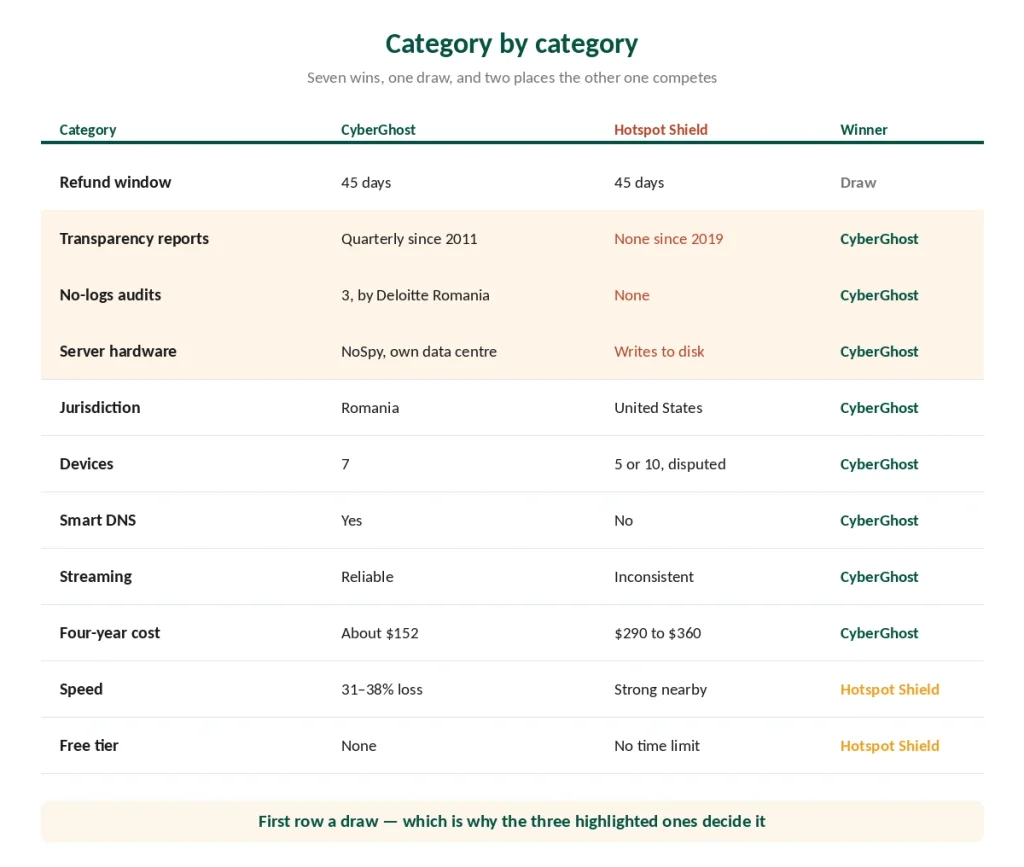
What replaces it is a gap of fifteen years. CyberGhost has published a transparency report every quarter since 2011. Hotspot Shield has published none since 2019.
The Short Answer
CyberGhost wins, at 4.3 against 3.4, and costs roughly half as much across four years.
Both give 45 days, so test either properly before deciding.
Hotspot Shield’s remaining case is a free tier and speed on nearby servers. Both are real, and neither closes the reporting gap.
Head to Head
| CyberGhost | Hotspot Shield | |
|---|---|---|
| Refund window | 45 days | 45 days |
| Transparency reports | Quarterly since 2011 | None since 2019 |
| No-logs audit | 3, by Deloitte Romania | None |
| Server storage | NoSpy servers, own data centre | Writes to disk |
| Smart DNS | Yes | No |
| Devices | 7 | 5 or 10, disputed |
| Jurisdiction | Romania | United States |
| Owner | Kape Technologies | Point Wild |
| Streaming | Reliable | Inconsistent |
| Free tier | None | Yes, no time limit |
| Renewal | $56.94/yr | $95.99/yr |
| Four years | ~$152 | $290 – $360 |
| Our rating | 4.3 | 3.4 |
Fifteen Years of Quarterly Reports
This is the difference that produces the ratings gap, and it is unusual enough to be worth spelling out.
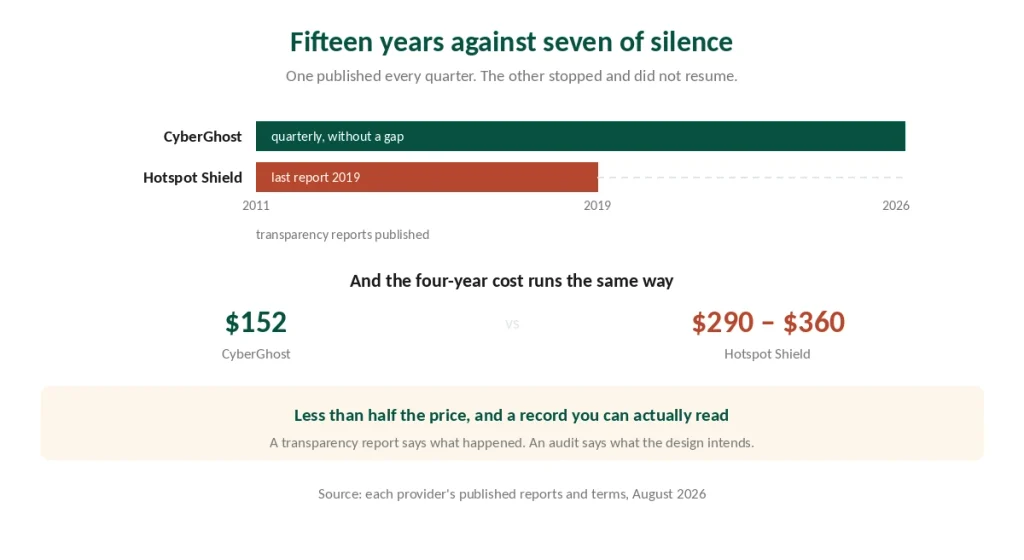
CyberGhost has published a transparency report every quarter since 2011. Not annually, not when convenient — quarterly, for fifteen years. Each one documents legal requests received and how the company responded.
Hotspot Shield published its last in 2019. Seven years of silence from a provider operating in the United States, inside the Five Eyes arrangement.
⚠️ A transparency report is not an audit, and neither substitutes for the other. An audit asks whether the architecture does what the company says. A transparency report asks what actually happened when someone came asking.
CyberGhost has three no-logs audits as well, by Deloitte Audit Romania in 2022, 2024 and 2025. Hotspot Shield has none — its Catapult Hydra protocol has been examined, which the company points to, but a protocol audit answers a different question entirely.
And the hardware differs. CyberGhost runs NoSpy servers from its own Romanian data centre with staff-only physical access, included free on longer plans. Sources disagree on whether its whole fleet is RAM-only, so we do not claim that. Hotspot Shield writes to disk throughout.
Winner: CyberGhost, decisively.
The Refund Window, Which Is a Draw
Worth pausing on, because it is the rare case where two providers land on the same number.
Forty-five days from both, against thirty from almost everyone else. That is long enough to test through a full billing cycle of whatever you are trying to unblock, on the networks you actually use.
⚠️ Use it either way. Whichever you pick, run the five verification tests and confirm your own streaming services rather than trusting any review, including this one.
Winner: a genuine draw.
Price: Half, or Less
CyberGhost’s two-year plan runs about $56.94 for 28 months, then renews at $56.94 a year.
⚠️ That is frequently described as a flat renewal, and it is not. The dollar figure repeats while the period halves, so the monthly cost goes from roughly $2.03 to $4.75. We made the same error ourselves and corrected it — our renewal price table sets out the arithmetic for all ten providers.
Across four years CyberGhost comes to roughly $152.
Hotspot Shield’s annual plan works out near $7.99 a month, with the regular rate reported at $95.99. Across four years, $290 to $360 — a range rather than a figure, because published prices for the same plan differ across six sources.
So CyberGhost costs less than half, while rating 4.3 against 3.4.
⚠️ CyberGhost’s renewal is the gentlest we track, at $56.94 a year against Hotspot Shield’s $95.99 and NordVPN’s $139.08.
Winner: CyberGhost, by a wide margin.
Devices, Streaming and Hardware
CyberGhost allows seven simultaneous connections. Hotspot Shield’s limit is given as five by some published sources and ten by others — a device count you cannot confirm before buying is itself worth noting.
Streaming favours CyberGhost, which maintains servers optimised for specific platforms and ships Smart DNS for televisions and consoles that cannot run an app. Published assessments describe Hotspot Shield’s streaming as inconsistent.
⚠️ Neither has an Apple TV app, so on that device Smart DNS is the difference between working and not — our Apple TV guide covers which providers built one.
CyberGhost also offers NoSpy servers, run from its own Romanian data centre rather than rented from third parties, included free on plans of six months or longer.
Winner: CyberGhost.
Ownership: Two Holdings, Neither Independent
Both belong to larger groups, and the structures are worth naming.
CyberGhost belongs to Kape Technologies, alongside ExpressVPN and Private Internet Access — three brands we cover under one board.
Hotspot Shield belongs to Point Wild since December 2024, after a chain running from AnchorFree through Pango and Aura. ⚠️ Point Wild’s own press release lists its brands, and two sit oddly together: Hotspot Shield and Comparitech, a website that reviews VPNs.
Jurisdiction favours CyberGhost. Romania has no mandatory data-retention law and its constitutional court struck down the EU directive in 2009 and again in 2014. Hotspot Shield operates from the United States.
⚠️ We name these because the pattern repeats, and because we have no such relationship ourselves.
Winner: CyberGhost on jurisdiction, and neither on independence.
Winners by Category
| Category | Winner |
|---|---|
| Transparency reporting | CyberGhost |
| No-logs audit | CyberGhost |
| Server hardware | CyberGhost |
| Jurisdiction | CyberGhost |
| Devices | CyberGhost |
| Streaming and Smart DNS | CyberGhost |
| Four-year cost | CyberGhost |
| Refund window | Draw — 45 days each |
| Speed nearby | Hotspot Shield |
| Free tier | Hotspot Shield |
| Corporate independence | Neither |
When to Choose Hotspot Shield Instead
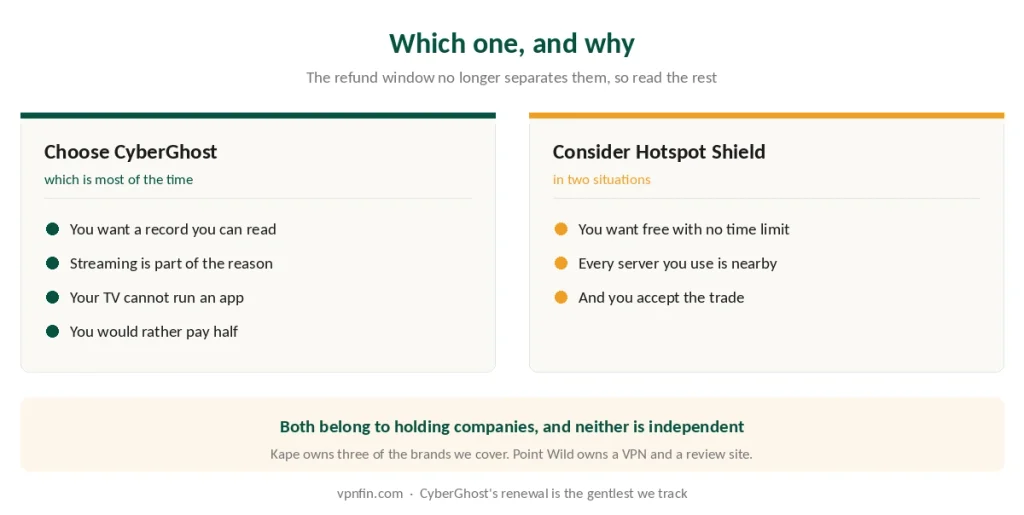
Two situations, and the refund window is no longer one of them.
You want a free VPN with no time limit and accept that location data from free users funds it — our free VPN guide covers which free tiers avoid that trade.
Every server you use is nearby. Catapult Hydra reaches gigabit throughput on European and US East routes, and if the distance penalty never applies to you, that is a real advantage.
⚠️ Outside those two the comparison is not close, and Hotspot Shield costs roughly twice as much.
How We Research
This comparison draws on our full reviews of both providers, where every figure was verified against named primary sources at the time of writing — CyberGhost’s published transparency reports and renewal terms, Point Wild’s December 2024 merger announcement as carried by the wire services, published speed testing from named reviewers, and each provider’s own pricing pages. We don’t run our own speed tests. Where a provider’s published prices and device limits differ across sources, as Hotspot Shield’s do, we give the range and say plainly that we could not resolve it. Our full approach lives on the About Us page.
CyberGhost vs Hotspot Shield FAQ
Yes, and they are the two providers we cover that do. Everyone else offers 30. Forty-five days is long enough to test through a full billing cycle of whatever you are trying to unblock, on the networks you actually use, which makes it a genuine advantage for both.
CyberGhost has published a transparency report every quarter since 2011 — fifteen years of documented legal requests and responses. Hotspot Shield published its last in 2019. A transparency report is not an audit; it records what actually happened when someone came asking rather than what the architecture is designed to do.
CyberGhost, by less than half. It comes to roughly $152 against Hotspot Shield’s $290 to $360. Its renewal of $56.94 a year is the gentlest we track, against Hotspot Shield’s reported $95.99.
No, though it is often described that way. The two-year plan costs about $56.94 for 28 months and then renews at $56.94 for 12 months. The dollar amount repeats but the period halves, so the monthly cost rises from roughly $2.03 to $4.75.
CyberGhost allows seven simultaneous connections. Hotspot Shield’s limit is given as five by some published sources and ten by others, which is unusual and worth confirming at checkout. Neither offers an Apple TV app, though CyberGhost ships Smart DNS for devices that cannot run one.
The Verdict
Both give you 45 days, which removes Hotspot Shield’s strongest argument in most comparisons before this one begins.
What remains is a fifteen-year reporting record against seven years of silence. CyberGhost has published quarterly since 2011; Hotspot Shield has published nothing since 2019.
And CyberGhost costs less than half. Its renewal is the gentlest we track, against a rival whose price nobody can state precisely.
Hotspot Shield’s free tier and its speed on short routes are genuine. They are also the whole of its case here. Against Surfshark and against ExpressVPN the pattern repeats.