
Disclosure: VPNFin is reader-supported. If you buy a VPN through links on this page, we may earn a commission at no extra cost to you. This never affects our ratings — here’s our full disclosure.
France reached its VPN providers through a courtroom. Italy skipped that step. A regulator wrote the obligation into a rulebook, built a platform to deliver it, and gave the companies thirty minutes to comply.
Rights holders fill the list themselves. No judge reviews it first, and the site being blocked hears about it afterwards.
Is a VPN Legal in Italy?
Yes, and no Italian law says otherwise. Buying, installing and using one carries no penalty of any kind. What exists instead is an obligation on the companies: since February 2025 AGCOM has classed VPN and DNS providers as intermediaries who must execute blocking orders through the Piracy Shield platform.
What Piracy Shield Actually Is
Understanding the machine matters more than the statute here.
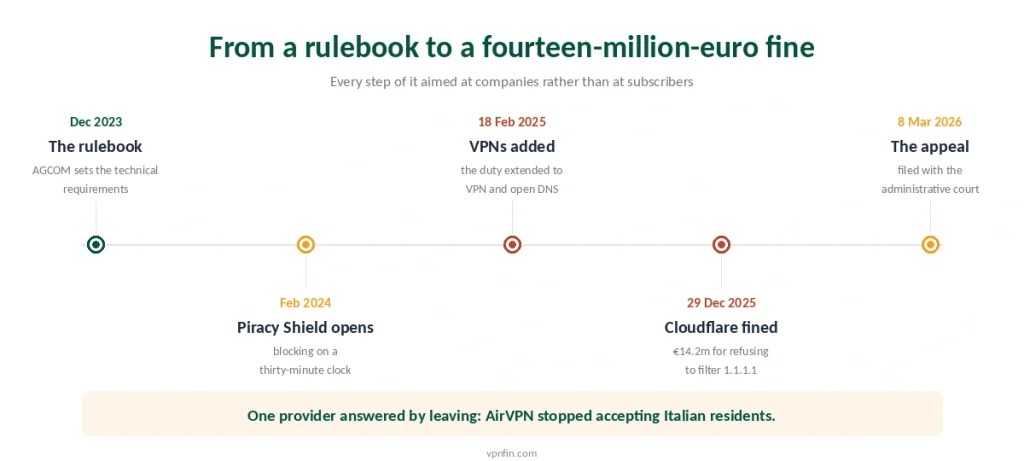
Law 93/2023 created it, and it went live in February 2024. AGCOM set the technical requirements in deliberation 321/23/CONS, then updated them in February 2025.
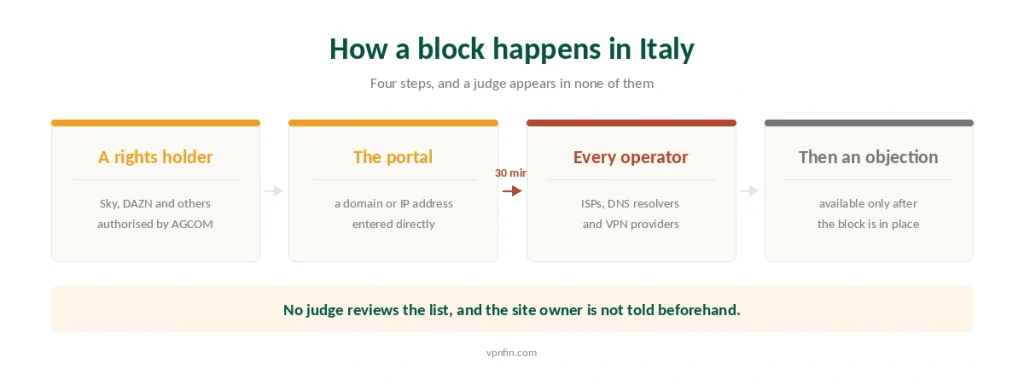
Rights holders enter the targets directly. Bodies authorised by the regulator — Sky and DAZN among them — submit domains and IP addresses through a portal. Registered operators must block them within thirty minutes.
No judge signs off, and neither does AGCOM. Blocks execute without hearing the other side and without any way to refuse in real time, even where the error is obvious. Objections come afterwards.
⚠️ The scale is not theoretical. Piracy Shield has disabled more than 65,000 domain names and roughly 14,000 IP addresses since launch. Overblocking incidents have swept up legitimate services along the way.
February 2025: The Obligation Reached VPNs
The expansion happened on a single day, and it changed who the system talks to.
On 18 February 2025 AGCOM voted to extend the duty to VPN and open DNS providers, on the same thirty-minute clock, and beyond live sport to films and television.
The wording is deliberately open. Any party involved in making infringing content accessible must execute the blocks — VPN and open DNS services named as examples rather than as an exhaustive list.
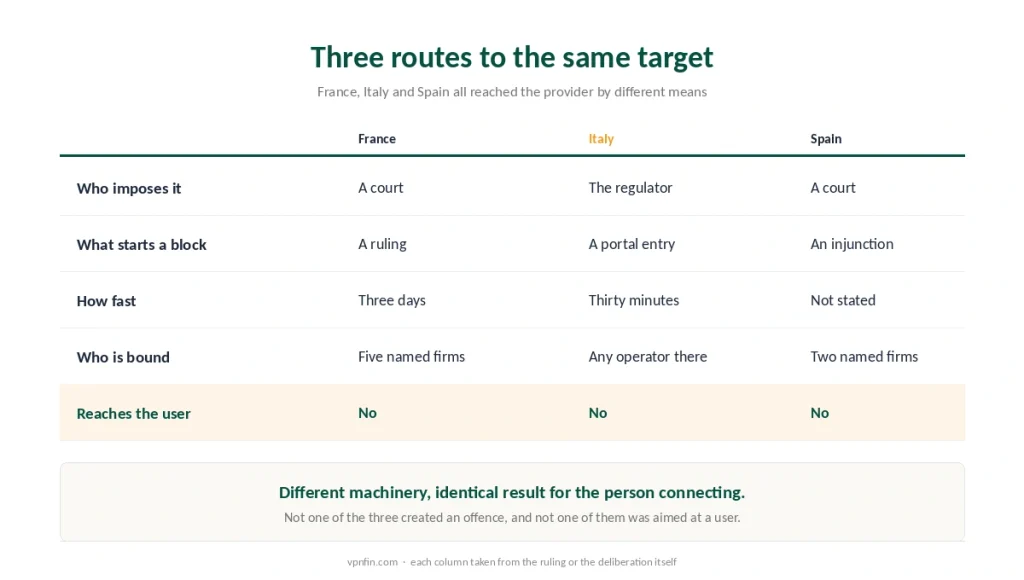
⚠️ Compare that with the French route. There, Canal+ and a football league sued five named companies and a court issued orders. Here, a regulator wrote a rule that binds anyone offering a service to Italian residents, and the naming happens later.
Accreditation is part of it. Operators are expected to register with the platform so the list reaches them automatically.
The €14 Million Went to a DNS Company
The largest penalty so far landed on infrastructure rather than on a subscriber, which is the pattern of this whole series.
AGCOM fined Cloudflare €14.2 million on 29 December 2025, announcing it on 8 January 2026, for refusing to block domains through its public 1.1.1.1 resolver. The company had been ordered to comply in February 2025 and declined.
Cloudflare’s answer was practical. Filtering a global resolver would touch billions of daily queries and degrade performance everywhere for a national list.
⚠️ The arithmetic is itself disputed. Italian law caps these fines at 2% of turnover. AGCOM calculated 1% of Cloudflare’s global revenue rather than of its Italian revenue, which the company argues would have produced roughly €140,000 instead. Its appeal went to the administrative court on 8 March 2026.
The timing drew attention too. An Italian court had ordered AGCOM to hand over Piracy Shield records on 23 December 2025. The fine followed six days later, and the regulator offered inspection of some documents in person at its Naples office rather than full disclosure.
Brussels had already objected. The European Commission sent a letter in June 2025 criticising the system’s lack of oversight, and one AGCOM commissioner voted against the fine.
One Provider Left Instead of Complying
This is the part with no equivalent anywhere else in the series.
AirVPN stopped accepting users resident in Italy. Its published explanation called the requirements too burdensome economically and technically, incompatible with its purpose, and a route to blocking across every area of activity.
Nobody else followed, so far. The larger providers have not announced departures, and Italian users can still subscribe to NordVPN and the rest.
⚠️ A blocked site can stay blocked with a VPN running. If your provider complies with the list, connecting through it changes nothing for those domains. That is the intended effect of the February 2025 extension, and it surprises people who assume a tunnel routes around everything. What a VPN actually hides sets out the limits honestly.
Nothing Here Reaches the User
Worth saying plainly, because the coverage is alarming and the personal exposure is not.
No Italian statute penalises using a VPN. Not Law 93/2023, not the AGCOM deliberations, not any bill in front of parliament.
Every enforcement action so far has hit a company. The fine went to a DNS provider, the obligations bind intermediaries, and the list targets domains. Russia is the European exception, where one provision does reach a person.
⚠️ This is now the dominant design in Europe. Britain put the duty on platforms and ruled out touching VPNs. Italy put it on providers and gave them half an hour. Neither created an offence for a person.
Spain has joined in. In February 2026 a commercial court in Córdoba granted LaLiga an injunction against two VPN companies without notifying them first, and they learned of it from the press.
If You Are Visiting or Living There
Ordinary points, all lawful.
Nothing restricts you as a user. Install what you like, connect where you like, and expect a list of sports and film domains to fail regardless — our Italy guide covers what to look for in a provider there.
Set it up before you travel as normal preparation rather than for any legal reason — our travel guide covers what breaks in hotels.
Test the connection once. Running the leak checks confirms the tunnel does what the app claims, which is a different question from what the list blocks.
⚠️ Streaming choices are affected in a small, specific way. Several providers we recommend now execute an Italian blocklist, so our streaming guide is worth reading with that in mind if you subscribe from Italy.
⚠️ Not legal advice. We are not lawyers, the deliberations changed twice in fourteen months, and the Cloudflare appeal is unresolved.
Where Italy Sits Against the Rest
Each framework aims somewhere different, and Italy aims at the same place as France by a different route. Australia told platforms to detect VPN traffic; Italy told the providers to execute a list.
The difference is who decides and how fast. A court weighs arguments over months. A portal with a thirty-minute clock does not.
| Country | What the rule aims at | Reaches the user? |
|---|---|---|
| Turkey | The tunnel — ISPs must block | No |
| The UAE | Conduct behind an address | No |
| India | The provider's records | Not nationally |
| China | Provider, tunnel and user | Yes |
| Brazil | Nothing, until a court acts | For 39 days |
| Indonesia | Paperwork — registration | No |
| The UK | The destination you visit | No, and ministers said so |
| The US | The platform, state by state | No, in all twenty-seven |
| Russia | The search, not the tool | Only if you went looking |
| Australia | The platform, and the tunnel itself | No — platforms must detect it |
| France | The VPN provider itself | No, the orders bind five companies |
| Italy | The provider, by regulator order | No, but one VPN left the market |
| Spain | The provider, by injunction without a hearing | No, and only two firms were named |
| Germany | The provider's logfile, for three months | No, and the courts twice removed it |
Our wider legality guide covers why the legal-or-illegal framing answers this question badly almost everywhere.
How We Research
This page draws on TorrentFreak and Ars Technica for the AGCOM fine of 29 December 2025 and Cloudflare’s refusal, on TechRadar for the 18 February 2025 vote extending the obligation to VPN and DNS providers, on Neowin for the blocking totals and the divided AGCOM board, on Walled Culture for the technical requirements and AirVPN’s withdrawal from the Italian market, on reporting of Cloudflare’s 8 March 2026 appeal and the disclosure order of 23 December 2025, and on Techdirt for the Spanish injunction of February 2026. We do not run our own tests and we do not publish circumvention instructions for any jurisdiction. Our full approach lives on the About Us page.
Italy VPN Law FAQ
No. Italian law contains no offence for using, buying or installing one, and no bill has proposed restricting them. Law 93/2023 and the AGCOM deliberations that followed place obligations on intermediaries — internet providers, DNS resolvers and now VPN companies — rather than on the people who subscribe to them.
Because the block may sit with your provider rather than with your connection. Since February 2025 AGCOM has required VPN and DNS services to execute Piracy Shield blocking orders within thirty minutes. If your provider complies with that list, routing through it changes nothing for those specific domains.
No published case has penalised a subscriber. The only significant penalty so far went to Cloudflare — €14.2 million, decided on 29 December 2025 — for refusing to block domains on its public DNS resolver. That fine concerned a company’s compliance, not anybody’s browsing.
Most of them. AirVPN stopped accepting Italian residents, citing the cost and the principle, and published its reasoning. The larger providers have not announced departures, so Italian users can still subscribe, with the caveat that compliant services execute the blocklist.
An automated blocking platform created under Law 93/2023 and running since February 2024. Rights holders authorised by AGCOM submit domains and IP addresses through a portal, and registered operators must block them within thirty minutes, before any judicial review. More than 65,000 domains have been disabled through it.
The Verdict
Using a VPN in Italy is legal, and no proposal would change that. No offence exists and no fine has ever reached a subscriber.
The obligation sits with the companies, on a thirty-minute clock. Rights holders compile the list, the platform distributes it, and objections arrive after the block.
One provider decided the price was too high and left. That, more than any statute, is the measure of what Piracy Shield asks. France arrived at a similar place through the courts, and Spain is now following.