
Disclosure: VPNFin is reader-supported. If you buy a VPN through links on this page, we may earn a commission at no extra cost to you. This never affects our ratings — here’s our full disclosure.
Is a VPN legal in Saudi Arabia? The tool itself is. Saudi Arabia’s Anti-Cyber Crime Law, issued by Royal Decree M/17 in March 2007, never mentions VPNs, and no fixed penalty for using one exists. The disagreement is over what you use it for, and VPN sellers wrote most of the guides that answer the question.
This page sets out what the 2007 law actually covers, where the sources split, and which uses sit safely outside it.
Is a VPN Legal in Saudi Arabia? The Short Answer
Owning and using a VPN is not a crime, which answers the core of whether a VPN is legal in Saudi Arabia. The law targets acts such as unauthorised access and prohibited content, not the tool. Saudi cybersecurity documents treat VPNs as ordinary remote-work tools, one guide notes.
Reaching blocked content is the grey area. Some guides argue that Article 3’s unauthorised-access clause could cover blocked sites; others say no court has tested that reading. Nobody we found cites a case.
Content offences are serious. Articles 5 and 6 carry penalties of up to five years and SAR 3 million. Our guide to a VPN for Saudi Arabia covers what is blocked in practice.
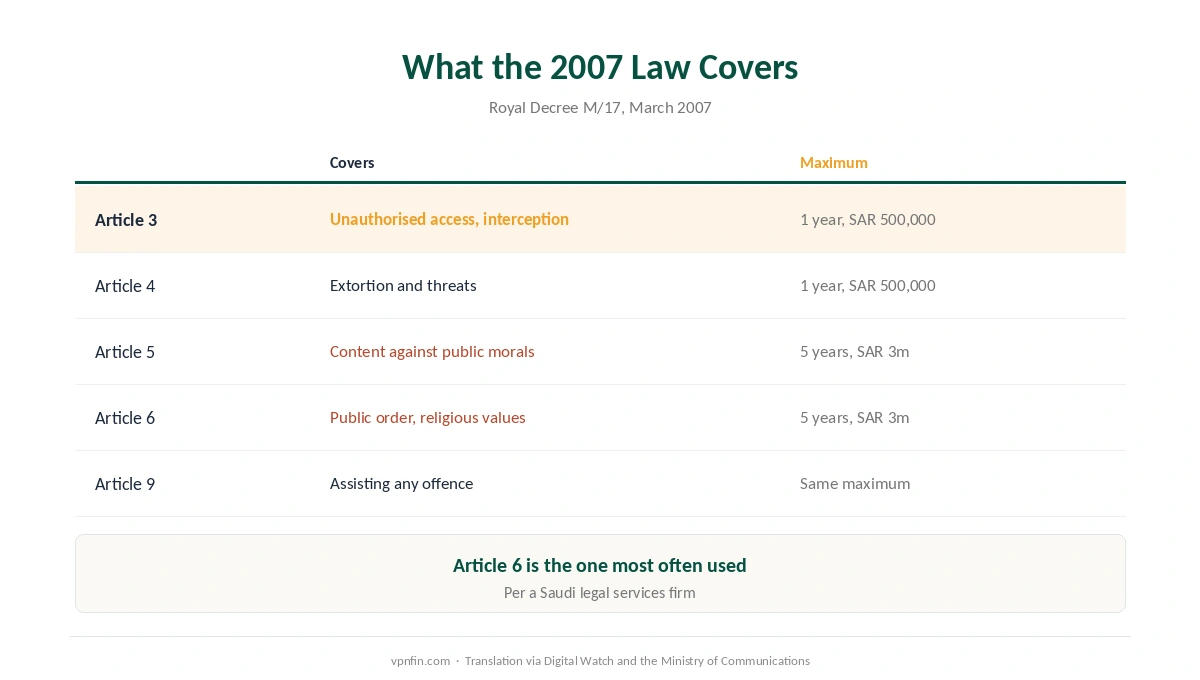
What the 2007 Law Covers
| Article | Covers | Maximum penalty |
|---|---|---|
| Article 3 | Unauthorised access, interception | One year and SAR 500,000 |
| Article 4 | Electronic extortion and threats | One year and SAR 500,000 |
| Article 5 | Content infringing public morals | Five years and SAR 3 million |
| Article 6 | Content prejudicing public order, religious values, morals or privacy | Five years and SAR 3 million |
| Article 9 | Assisting any of these offences | Up to the same maximum |
The law defines unauthorised access as a person’s deliberate, unauthorised access to computers, websites, information systems or networks, according to the translation published by Digital Watch. It took effect three months after publication in March 2007, LexisNexis notes.
Article 6 is the one most often used, a Saudi legal services firm says, because it covers content prejudicing public order, religious values, public morals or privacy. That is where most online prosecutions sit, with or without a VPN.
Where the Sources Disagree
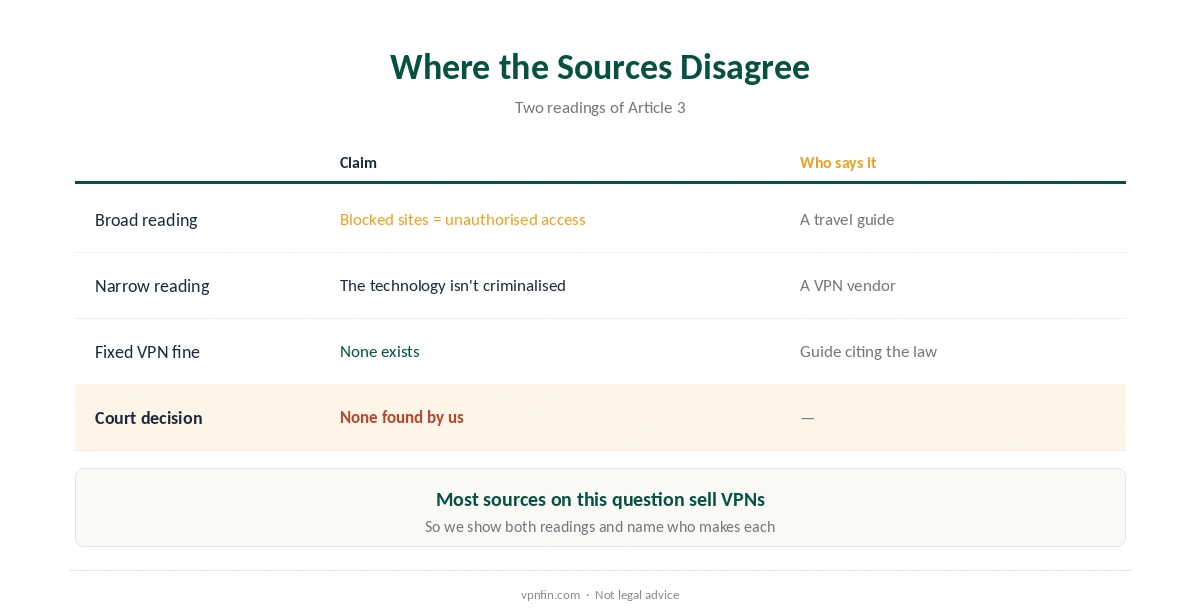
Some read Article 3 broadly. One travel guide argues that accessing blocked sites could fall under Article 3, with up to a year and SAR 500,000, while acknowledging this is an interpretation.
Others say the tool is not criminalised. A VPN vendor’s guide notes that Royal Decree M/17 does not criminalise the technology, and a second guide finds no fixed fine for using a VPN to make a call.
Most of these sources sell VPNs. We could not find a Saudi court decision applying Article 3 to VPN use, so we present both readings. Our country-by-country legality guide explains how we treat vendor claims.
Is a VPN Legal in Saudi Arabia for Everyday Use?
Yes, for work, banking and privacy. Company VPNs, remote access and protecting a connection on public Wi-Fi involve no blocked content. Banks may still refuse logins over a VPN, one guide notes, as our online banking guide explains.
Calls are the everyday grey zone. WhatsApp messaging works; voice and video calls have been restricted, with reports since February 2026 that calls sometimes work without any announcement. Our Saudi guide, linked above, covers the details.
What we will not do is give instructions for reaching blocked content. Authorities block gambling, pornography and material against public morals, and Article 6 applies to that content whatever the route. Our guide to what a VPN hides explains the limits of encryption, and our no-logs guide what a provider keeps.
How Saudi Arabia Compares
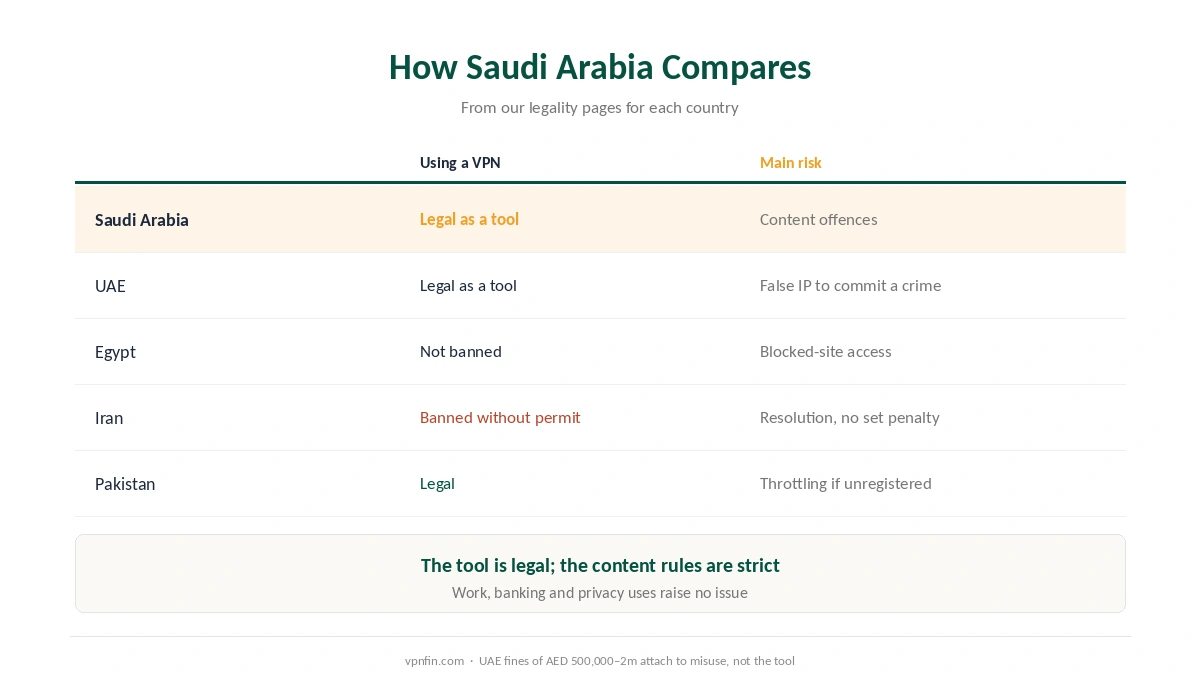
The UAE is stricter on paper, with fines of AED 500,000 to 2 million for using a false IP address to commit or hide a crime, as our UAE legality page explains. Egypt targets access to blocked sites directly, as our Egypt page sets out.
Iran bans VPN use without a permit, as our Iran page explains, while Pakistan dropped its 2024 push and relies on registration. Saudi Arabia sits in between: the tool is legal, the content rules are strict.
So is a VPN legal in Saudi Arabia by Gulf standards? Yes, and visitors are in the same position, as our travel guide explains for restricted destinations.
How We Research
The law’s text comes from the translation on Digital Watch and Saudi Arabia’s Ministry of Communications, its date from LexisNexis Middle East, and the article-by-article penalties from a Saudi legal services firm and CaseGuard. The competing readings come from travel and VPN guides, several of them VPN sellers, which we flag. We are not lawyers, and this is not legal advice. We name each source where used; all were read on 27 September 2026. Our full approach lives on the About Us page.
Saudi Arabia VPN Legality FAQ
The tool is legal. The 2007 Anti-Cyber Crime Law does not mention VPNs and sets no penalty for using one. What you access or share can still be an offence.
No fixed fine for VPN use exists. Some guides argue Article 3’s unauthorised-access clause could cover blocked sites, with up to a year and SAR 500,000, but we found no case applying it.
The Anti-Cyber Crime Law, issued by Royal Decree M/17 in March 2007. Articles 5 and 6, on content, carry the heaviest penalties.
Calls sit in a grey zone. Reports since February 2026 say calls sometimes work without a VPN; sources disagree on the legal position.
Yes. Saudi cybersecurity documents treat VPNs as ordinary remote-work tools.
The Verdict
A VPN is legal in Saudi Arabia as a tool, and work, banking and privacy uses raise no legal issue.
Reaching blocked content is contested, and the content rules themselves are strict. Treat vendor claims either way with caution, and take legal advice for anything beyond everyday use. Our NordVPN review covers one audited option for the everyday kind.