
Disclosure: VPNFin is reader-supported. If you buy a VPN through links on this page, we may earn a commission at no extra cost to you. This never affects our ratings — here’s our full disclosure.
Can you use a VPN for Call of Duty without being banned? Activision’s Security and Enforcement Policy, updated in July 2026, doesn’t name VPNs. What it penalises is using code, cheats or third-party software to gain an unfair advantage or manipulate stats or game data, timesaver.gg notes, quoting the policy. So a VPN for privacy is one thing; a VPN used to steer matchmaking into easier lobbies is where the risk sits, and sellers of ‘bot lobby’ VPNs have an interest in telling you otherwise.
This page covers what a VPN does for ping and safety in Call of Duty, what the rules say, and the honest answer on lobbies.
VPN for Call of Duty: What It Does and Doesn’t Do
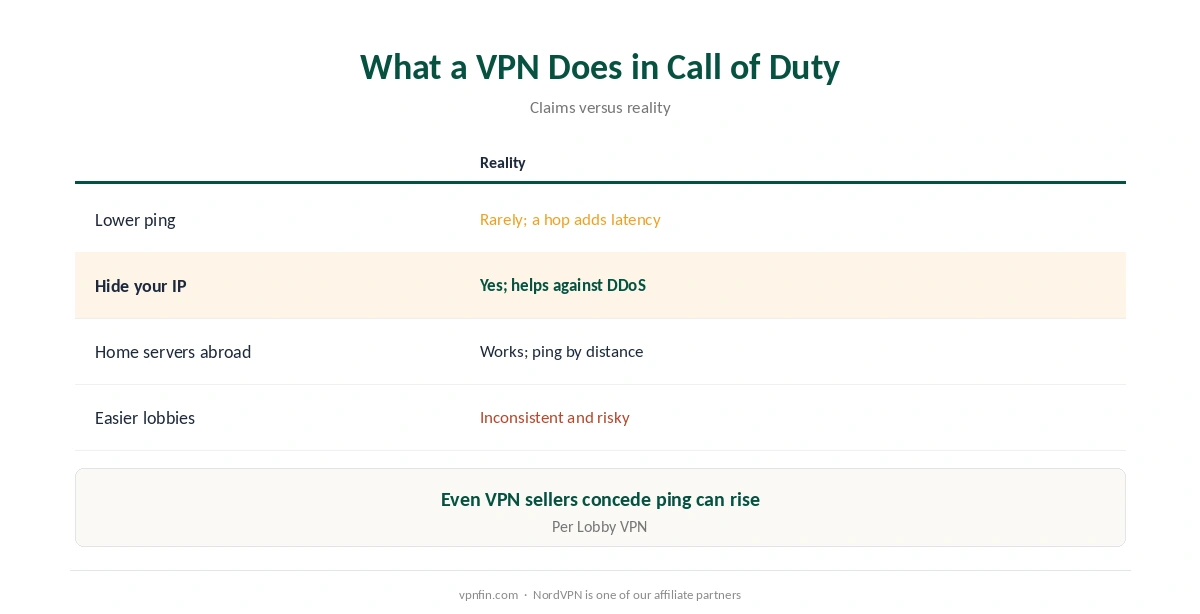
| Claim | Reality |
|---|---|
| Lower ping | Rarely; an extra hop tends to add latency |
| Hide your IP from other players | Yes; helps against DDoS and harassment |
| Play from abroad on home servers | Works; ping depends on distance |
| Easier ‘bot lobbies’ | Inconsistent, and matchmaking manipulation risks penalties |
With a VPN for Call of Duty, ping tends to go up, not down. Routing through a VPN server adds distance; even VPN sellers such as Lobby VPN concede a VPN can raise ping. Our gaming guide explains the rare cases where routing helps.
Hiding your IP is the solid benefit. Other players can’t target your home connection with a DDoS attack if they only see the VPN’s address, as our guide to what a VPN hides explains.
What Activision’s Rules Say
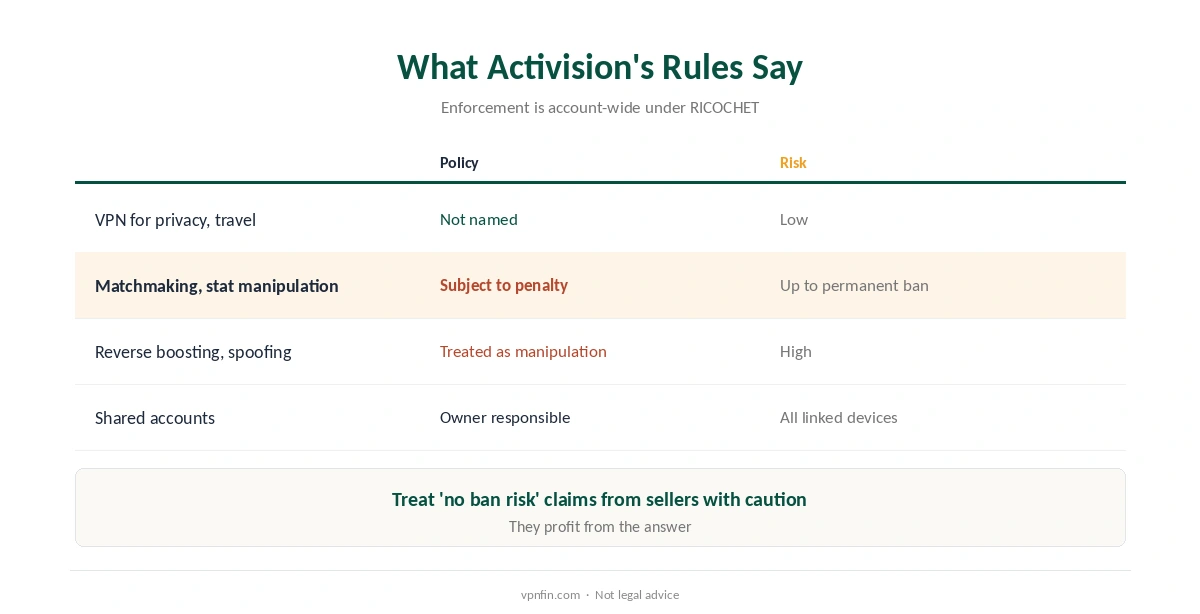
| Activity | Policy position | Risk |
|---|---|---|
| VPN for privacy or travel | Not named in the policy | Low |
| Manipulating matchmaking or stats | Subject to penalty | Stat resets to permanent bans |
| Reverse boosting, packet exploits, spoofing | Treated as manipulation | High |
| Anything on a shared account | Owner is responsible | Penalties hit all linked devices |
Enforcement is account-wide, a point often missed when people pick a VPN for Call of Duty. Activision’s policy says penalties apply to the account holder whoever was playing, and across every device linked to the account, under its RICOCHET anti-cheat system.
Opinions differ on grey areas. Cybernews notes Activision’s terms can be read as prohibiting VPNs, even though it hasn’t heard of bans for simple VPN use. Activision also tightened ping thresholds when Black Ops 6 and Warzone merged, to keep players in their regions, NoLagVPN reports; frequent region hopping looks like proxy behaviour to many services, as our guide to why services block VPNs explains.
The Honest Answer on Lobbies
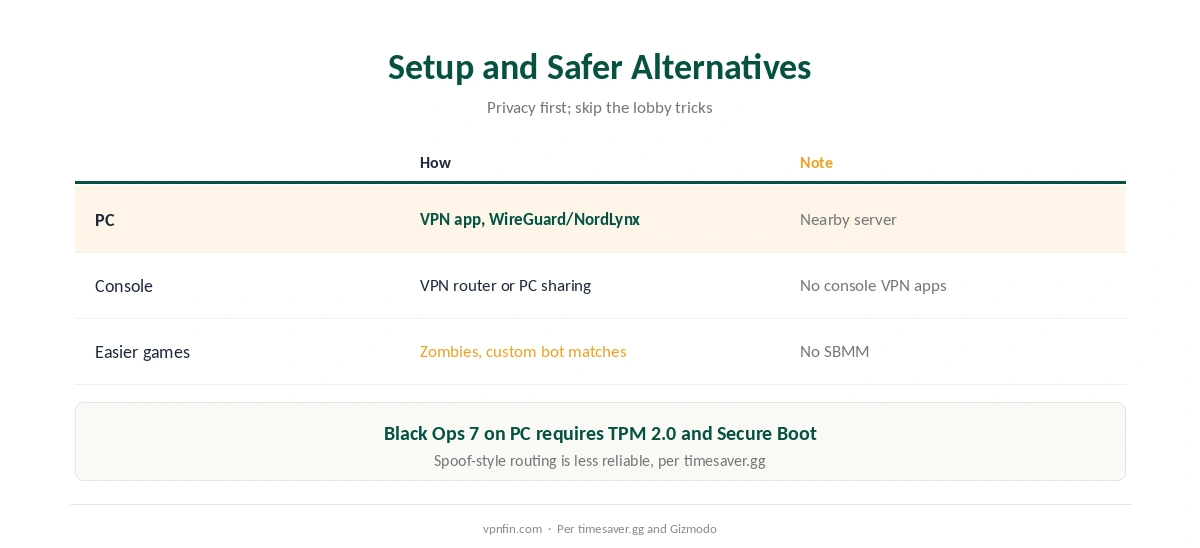
We don’t publish ‘bot lobby’ locations. Steering matchmaking is what the policy targets, and results are unreliable anyway: skill-based matchmaking readjusts quickly, and Black Ops 7’s PC requirement for TPM 2.0 and Secure Boot has made spoof-style routing less reliable, timesaver.gg notes.
Legitimate alternatives exist. Zombies is player-versus-environment with no skill-based matchmaking, and custom games with bots let you practise, as timesaver.gg and Gizmodo describe. For the anti-cheat side of gaming privacy, a kill switch keeps your IP hidden if the VPN drops mid-match.
Setting Up a VPN for Call of Duty
PC: use the VPN app with WireGuard or NordLynx and a server near you; our NordLynx guide explains the protocol. Consoles can’t run VPN apps, so use a VPN router or share from a computer, as our router vs device guide and our Xbox guide explain. Keep the console on a nearby server, since distance adds lag in every match.
How We Research
The enforcement policy comes from Activision’s support page, updated on 31 July 2026, quoted via timesaver.gg, which sells levelling services; the terms interpretation from Cybernews; ping thresholds from NoLagVPN and ping effects from Lobby VPN, both VPN sellers; alternatives from timesaver.gg and Gizmodo. Activision’s policy is at support.activision.com. We read all sources on 28 September 2026. NordVPN is one of our affiliate partners. Our full approach lives on the About Us page.
VPN for Call of Duty FAQ
Activision’s policy doesn’t name VPNs. It penalises manipulating matchmaking, stats or game data, so using a VPN to steer lobbies carries risk.
Rarely. It adds a hop, so ping tends to rise. Use a nearby server and a WireGuard-based protocol.
It hides your home IP from other players, which helps against DDoS attacks aimed at your connection.
Inconsistently. Matchmaking readjusts quickly, and manipulating it is what Activision’s policy targets.
Consoles can’t run VPN apps, so use a VPN router or share a VPN connection from a computer.
The Verdict
A VPN for Call of Duty is worth it for privacy and DDoS protection, not for lower ping.
Using one to game matchmaking is what Activision’s rules target; treat ‘no ban risk’ claims from VPN sellers with caution.