
Disclosure: VPNFin is reader-supported. If you buy a VPN through links on this page, we may earn a commission at no extra cost to you. This never affects our ratings — here’s our full disclosure.
PrivadoVPN OpenVPN support covers every server, PCWorld notes, alongside WireGuard and IKEv2. In the apps, you can switch protocol in the settings. On Linux, there is no app, but Premium accounts get CLI and Network Manager guides, PrivadoVPN’s help centre says; free accounts get no Linux support. OpenVPN is the slower but more widely compatible choice. Our page on PrivadoVPN WireGuard covers the protocol on free and paid plans and when to switch.
This guide covers when to choose OpenVPN, how to switch and the trade-offs.
When to Choose PrivadoVPN OpenVPN
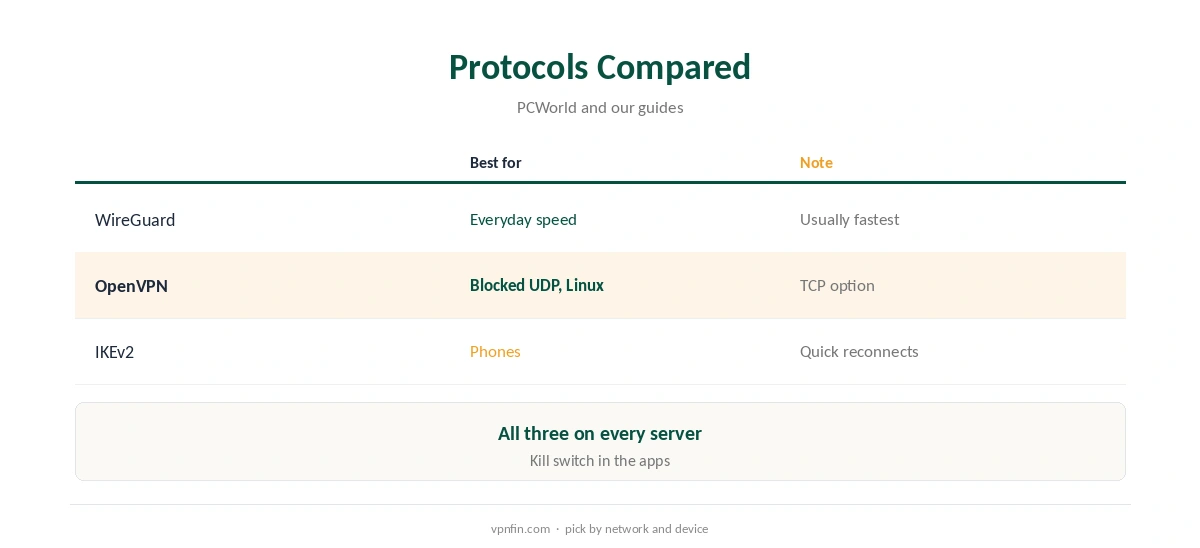
WireGuard is usually faster, and IKEv2 reconnects quickly on phones. OpenVPN helps where networks block UDP, since it can run over TCP, and on platforms where manual setups are the only route, such as Linux. Our WireGuard vs OpenVPN guide explains the differences.
Switching Protocol in the App
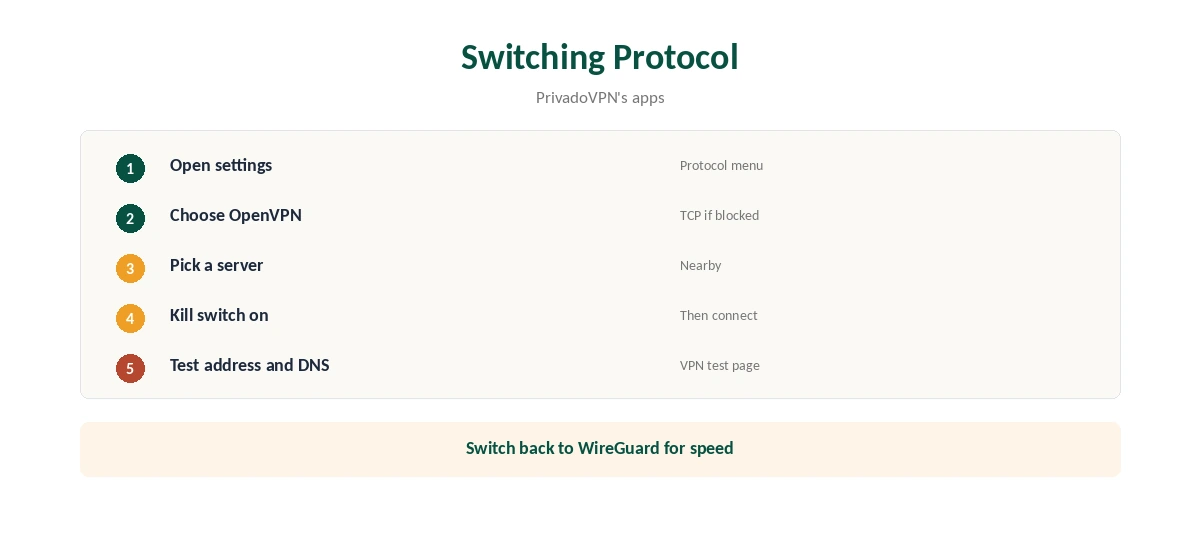
Open PrivadoVPN’s settings, choose OpenVPN as the protocol, pick a server and connect. Keep the kill switch on; TechRadar found PrivadoVPN’s new kill switch passed its stress tests. Our PrivadoVPN for PC guide covers the desktop settings.
OpenVPN on Linux
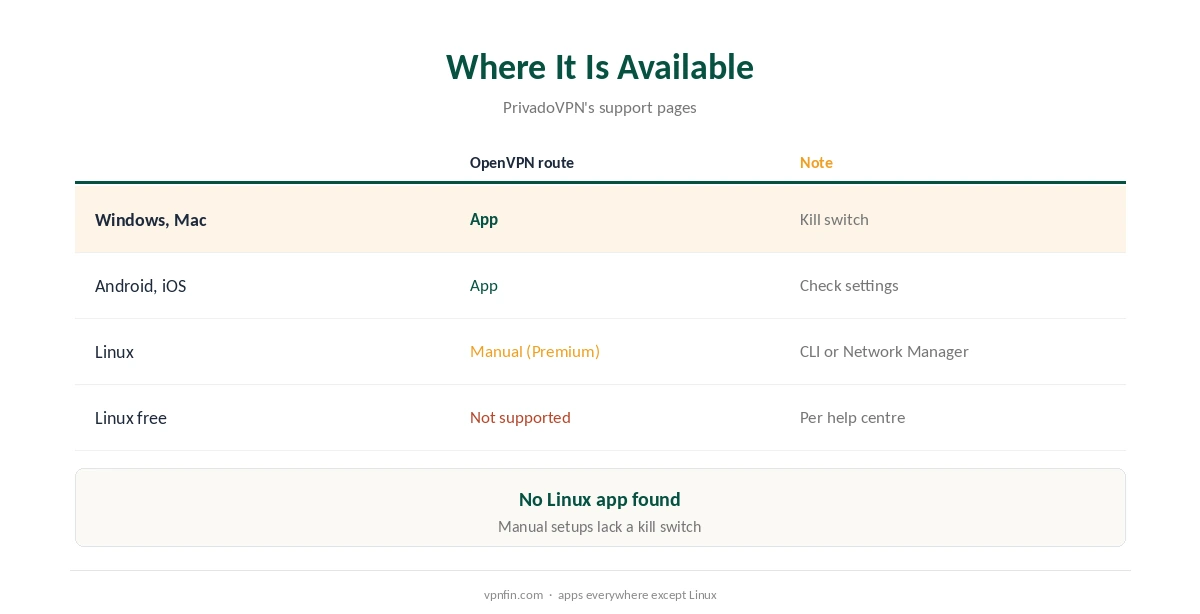
PrivadoVPN has no Linux app in the sources we read. Premium users follow its CLI or Network Manager guides, which use OpenVPN or other manual connections. Free accounts are not supported on Linux, its help centre says. Our PrivadoVPN Linux guide covers the setup.
PrivadoVPN OpenVPN on Phones
Phones change networks often, so IKEv2 or WireGuard usually suit them better. Use OpenVPN on a phone only when a network blocks the others. Our PrivadoVPN Android guide covers the Android app’s settings.
UDP or TCP
OpenVPN can run over UDP or TCP. UDP is faster; TCP gets through networks that block UDP but adds overhead. If your app offers both, start with UDP.
Routers
We found no PrivadoVPN router guide in the sources we read. If you want PrivadoVPN OpenVPN on a router, check its help centre for current manual configs before buying, or choose a provider that documents routers.
Speed
OpenVPN usually loses more speed than WireGuard. Run a speed test on both protocols on the same server at the same time of day and keep the faster one for everyday use. Our guide to VPN speed explains the overhead.
A Quick Rule
Everyday? WireGuard. Phone on the move? IKEv2. Network blocks UDP? PrivadoVPN OpenVPN over TCP. Linux with Premium? Follow the manual guides.
Is PrivadoVPN OpenVPN Worth Using?
For most people, WireGuard covers daily use better. PrivadoVPN OpenVPN earns its place as the fallback on restrictive Wi-Fi and as the manual route on Linux. Keep both in mind rather than picking one for good.
Free Plan and OpenVPN
Free accounts use the same apps and protocols, with 10 GB a month at full speed. Linux manual setups need Premium. Our PrivadoVPN free guide covers the limits.
Several Devices
Premium covers 10 devices, PCWorld notes. Each can use its own protocol, so a laptop on WireGuard and a Linux server on OpenVPN share one plan.
Restrictive Networks
On hotel, school or office Wi-Fi that blocks VPNs, switching to OpenVPN over TCP sometimes helps. We found no dedicated obfuscation mode described for PrivadoVPN, so very strict networks may still block it. Our obfuscation guide explains the options.
Quick Check
After connecting over OpenVPN, open our test page, then switch to WireGuard and test again. Note the speed of each so you know which to use where.
Keeping It Updated
App updates can reset protocol choices. After updating, confirm the protocol stayed the same.
Checking for Leaks
Run our WebRTC leak guide in your browser after switching protocol. Browser leaks can expose your real address even when the tunnel is up, whatever the protocol.
Linux Distributions
PrivadoVPN’s manual guides cover CLI and Network Manager routes. Network Manager is standard on most desktop distributions, so the same steps usually apply on Ubuntu, Mint and Fedora.
Testing Before You Pay
The free plan uses the same apps, so you can try OpenVPN on your own networks before upgrading. Test the networks that block other protocols, since that is where OpenVPN earns its place, and note the results before you pay for Premium.
Several Countries
Try OpenVPN on two servers in different countries to see how distance changes speed on your connection.
Kill Switch on Manual Setups
A manual OpenVPN connection lacks the app’s kill switch. Add firewall rules so traffic stops if the tunnel drops, as our kill switch guide explains.
Torrenting
PrivadoVPN allows P2P, and Premium adds SOCKS5 proxies for clients that support them. OpenVPN with the kill switch on is a steady choice for long downloads. Our torrenting VPN guide compares providers.
Checking the Connection
After switching, confirm the address with our VPN test page and run our DNS leak guide.
Privacy Record
No independent audit appears in our audit table for PrivadoVPN, which lists Iceland as its base after a 2026 move. Our PrivadoVPN safety guide weighs the evidence.
How We Research
This page draws on PCWorld’s and TechRadar’s PrivadoVPN reviews, PrivadoVPN’s Linux support article and our PrivadoVPN tables. We cross-checked these sources against each other, and where they conflict or something can’t be verified, we say so in the text rather than guessing. We checked time-sensitive figures, including prices in US dollars, on 7 October 2026. The main source we relied on is PrivadoVPN’s Linux support article. Our full approach lives on the About Us page.
PrivadoVPN OpenVPN FAQ
It does, on all servers, alongside WireGuard and IKEv2, per PCWorld.
Where networks block UDP, or for manual setups such as Linux.
No; Linux support is for Premium accounts only.
Usually, yes.
No; add firewall rules.
The Verdict
PrivadoVPN OpenVPN is the compatible fallback: use it where WireGuard is blocked or on Linux with Premium. Keep the kill switch on, and weigh the missing audit.