
Disclosure: VPNFin is reader-supported. If you buy a VPN through links on this page, we may earn a commission at no extra cost to you. This never affects our ratings — here’s how we research.
Several 2026 reviews describe CyberGhost as the provider that does not raise your bill. They report a flat renewal of $56.94, identical to the first term, and present it as the fix for the industry’s oldest trick.
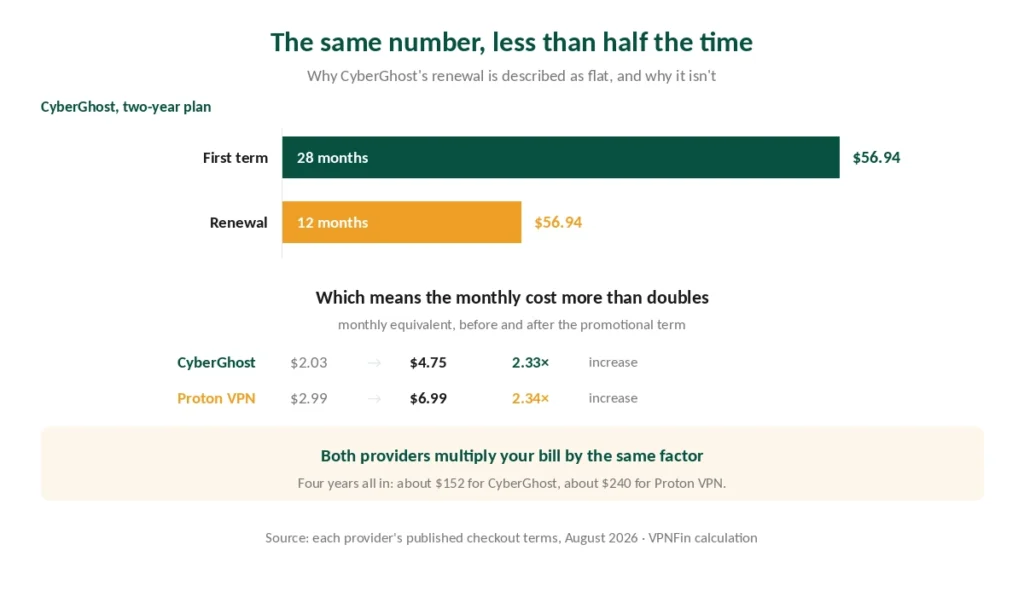
The number is right. However, the conclusion is not. $56.94 buys 28 months on the two-year plan and 12 months on renewal — the same figure covering less than half the time. That works out to $2.03 a month, then $4.75.
Proton VPN does the same thing at a different scale, going from $2.99 to $6.99. Both multiply your bill by roughly 2.3 when the promotion ends. So this CyberGhost vs Proton VPN comparison starts by clearing that up, then moves to what actually separates them: $88 over four years against an audit published every single year.
The Short Answer
CyberGhost wins on cost and on risk. It runs about $88 cheaper across four years, refunds for 45 days rather than 30, and has published quarterly transparency reports since 2011 — a longer unbroken record than Proton VPN has existed as a product.
Proton VPN wins on what you can verify and what you get. Five annual no-logs audits against three, open-source apps, port forwarding, multi-hop, a genuinely free tier, and ten devices instead of seven.
Head to Head
| CyberGhost | Proton VPN | |
|---|---|---|
| Intro price | ~$2.03/mo | ~$2.99/mo |
| Renewal | $56.94/yr | ~$83.88/yr |
| Refund window | 45 days | 30 days, disputed |
| No-logs audits | 3 | 5, one a year |
| Transparency reports | Quarterly since 2011 | Periodic |
| Devices | 7, registered | 10 |
| App code | Closed | Open source |
| Jurisdiction | Romania | Switzerland, moving |
| Owner | Kape Technologies | Independent |
| Port forwarding | No | Yes |
| Multi-hop | No | Secure Core |
| Free plan | Short trials | Yes, no data cap |
| Our rating | 4.3 | 4.6 |
The Renewal Number, Explained Properly
CyberGhost sells one tier and three billing terms. Consequently, there is no upsell ladder to navigate, which is genuinely simpler than most of this category.
The two-year plan costs about $56.94 for 28 months, or roughly $2.03 a month. It then renews at $56.94 a year, which is $4.75 a month.
Reviewers see the same dollar figure on both lines and call it flat. In fact, your monthly cost rises by 2.3 times.
Proton VPN’s arithmetic runs parallel. VPN Plus costs $71.76 for 24 months, about $2.99 monthly, then renews near $83.88 a year, about $6.99. That is also a 2.3-times jump.
⚠️ Neither is doing anything unusual, and that is the point. Introductory VPN pricing is a customer-acquisition cost across the whole category, so budget for the renewal figure rather than the headline. Every renewal price we have verified sits in one table, and the multiplier clusters tightly around 2.3.
Over four years, CyberGhost costs about $152 and Proton about $240 — a real gap of roughly $88, or $1.83 a month.
Winner: CyberGhost, decisively on price.
Refunds: 45 Days Against 30 That Are Argued About
CyberGhost refunds for 45 days on six-month and two-year plans, which is the longest window any major provider offers. Monthly plans get 14 days. Reviewers who have tested the process report same-day approval without questions.
Proton VPN offers 30 days. Yet its own FAQ describes a full money-back guarantee while its terms mention refunds of the unused portion, and several reviewers report receiving prorated amounts. We could not reconcile those, so ask explicitly and keep what support tells you in writing.
⚠️ The gap matters more than fifteen days suggests. Streaming access shifts constantly, and 45 days is long enough to find out whether a provider works for your services before the window closes. Our streaming guide covers why no snapshot stays accurate.
Winner: CyberGhost.
Audits and the Fifteen-Year Paper Trail
Here the two swap places, though not as cleanly as the audit counts suggest.
Proton VPN has five annual no-logs audits, 2022 through 2026, all by Securitum, each published as a dated file that needs no account to open. Every app is open source as well.
CyberGhost has three Deloitte no-logs audits — 2022, 2024 and Q4 2025 — covering server configuration, connection timestamps and IP handling.
But CyberGhost has been publishing quarterly transparency reports since 2011. That is fifteen years of continuous disclosure covering legal requests received and data handed over, and it predates most of the companies in this comparison. Meanwhile, Proton’s transparency reporting is periodic rather than quarterly.
⚠️ Audits and transparency reports answer different questions. An audit asks whether the system could log you. A transparency report asks how often somebody demanded that it had. CyberGhost has the longer record on the second, Proton the deeper record on the first.
Winner: Proton VPN on audit cadence, CyberGhost on disclosure history.
Devices, Features and What Is Missing
CyberGhost allows seven simultaneous connections, registered to your account rather than counted loosely. Proton allows ten. Seven covers a single user; a household of two with phones, laptops and a TV will feel it.
CyberGhost’s gaps are specific. Port forwarding is absent, which affects seeding on private trackers, as our torrenting guide explains. Multi-hop is missing entirely, whereas Proton routes through Secure Core, and our multi-hop guide sets out what that buys. China, meanwhile, is not supported at all.
CyberGhost’s advantages are equally specific. NoSpy servers run on hardware CyberGhost owns outright in its own Romanian data centre, rather than rented rack space, and they now come free on six-month and longer plans. Smart DNS reaches consoles and smart TVs that cannot run an app, which Proton has no answer to. Purpose-built streaming, gaming and torrenting servers spread across roughly 73 P2P countries, and the network runs 11,690 servers in 100 countries.
Proton counters with 140-plus countries, one-click Tor over VPN, NetShield filtering, the Stealth protocol for restrictive networks, and port forwarding at no charge.
Free Options: Not Comparable
CyberGhost gives you short trials without a card: 24 hours on Windows and macOS, three days on Android, seven days on iOS.
Proton VPN Free is a permanent tier, not a trial. No data cap, no ads, and the same no-logs policy as paid, restricted to one device and ten countries the app assigns for you. Neither streaming nor P2P works on it.
Therefore, if the question is whether you can use a VPN indefinitely without paying, only one of these answers yes. Our free VPN guide explains why that tier stands apart from the rest of the free category.
Winner: Proton VPN.
Ownership and Jurisdiction
CyberGhost belongs to Kape Technologies, alongside ExpressVPN and Private Internet Access. Three brands we cover therefore answer to one board.
Proton AG has no parent, funding itself through subscriptions across its own product suite.
Romania is the stronger jurisdiction today. It sits outside the 14 Eyes arrangement, and its courts struck down EU-style data-retention mandates years ago. Switzerland also sits outside every bloc, but it is revising its surveillance ordinance, and Proton announced in July 2025 that it was moving most physical infrastructure out of the country. Our full Proton VPN review covers that in detail.
Winner: CyberGhost on jurisdiction stability, Proton VPN on independence.
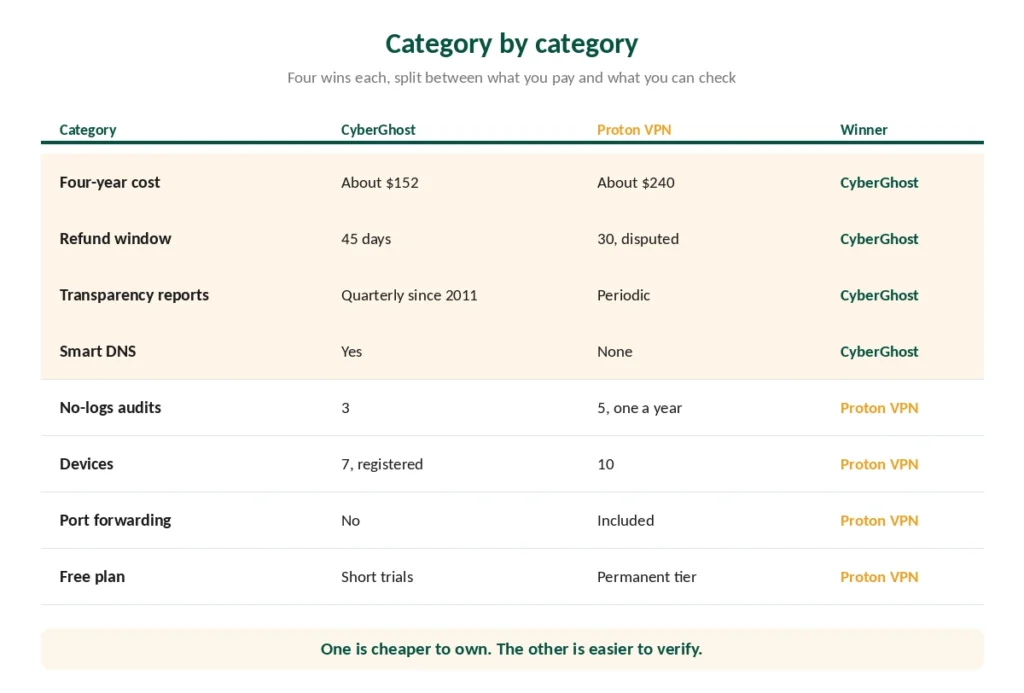
Winners by Category
| Category | Winner |
|---|---|
| Four-year cost | CyberGhost |
| Refund window | CyberGhost |
| Transparency history | CyberGhost |
| Smart DNS and streaming servers | CyberGhost |
| Jurisdiction stability | CyberGhost |
| Audit cadence | Proton VPN |
| Open-source apps | Proton VPN |
| Devices | Proton VPN |
| Port forwarding and multi-hop | Proton VPN |
| Free tier | Proton VPN |
| Corporate independence | Proton VPN |
| Server countries | Proton VPN |
When to Choose CyberGhost Instead
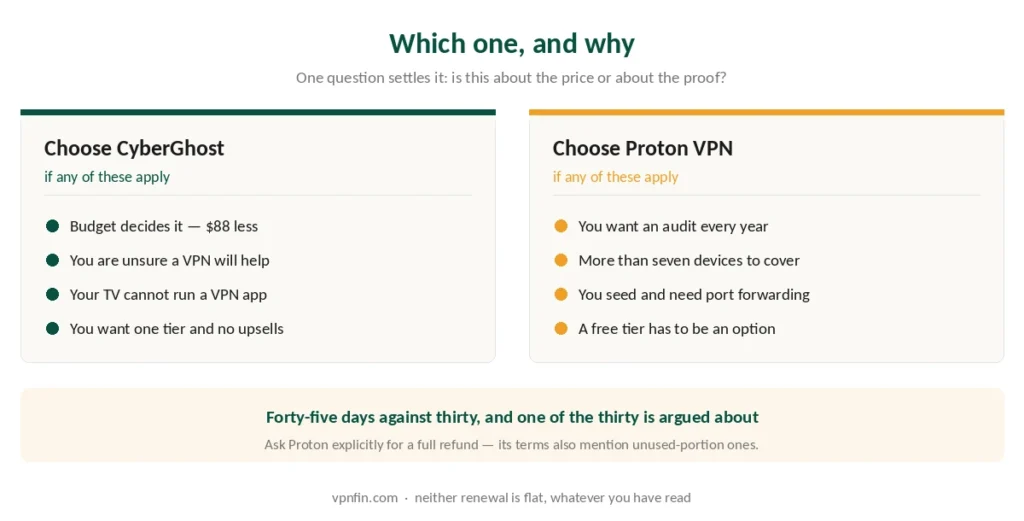
Budget is the deciding factor. $88 over four years is real money, and CyberGhost is fully audited at that price rather than cutting corners to reach it.
You are not sure a VPN will help. Forty-five days is long enough to test streaming, speed and your own devices properly. No other major provider gives you that.
Your TV or console cannot run an app. Smart DNS solves this; Proton offers nothing equivalent.
You want simple. One tier, three billing lengths, and the most beginner-friendly interface of any provider we cover.
How We Research
This comparison draws on our full reviews of both providers, CyberGhost’s published Deloitte audit record and quarterly transparency reporting, the published Securitum reports for Proton, and renewal figures taken from each provider’s own checkout terms — cross-checked and verified at publication. We don’t run our own speed tests. Where published claims conflicted with the underlying figures, above all the widely repeated description of CyberGhost’s renewal as flat, we recalculated from the billing terms and show our working. Our full approach lives on the About Us page.
CyberGhost vs Proton VPN FAQ
No, though several reviews say so. The two-year plan costs about $56.94 for 28 months, then renews at $56.94 for 12 months. The dollar figure repeats, but the period shrinks, so your monthly cost rises from roughly $2.03 to $4.75. Proton VPN rises by a similar multiple, from $2.99 to $6.99.
CyberGhost, by about $88. Its four-year total comes to roughly $152 against Proton’s $240, which is $1.83 a month. Both figures assume the longest available term followed by standard renewal, and both providers bill the first term upfront.
Proton VPN, on cadence. It has five annual no-logs audits by Securitum, published as open files. CyberGhost has three Deloitte audits, in 2022, 2024 and Q4 2025. However, CyberGhost has published quarterly transparency reports since 2011, which is the longest continuous record in the category.
CyberGhost allows seven simultaneous connections, registered to your account. Proton VPN Plus allows ten. Neither offers an add-on that raises the limit, so count your household before deciding — phones, laptops, tablets, TVs and consoles add up faster than most people expect.
Yes, with a difference for heavy users. CyberGhost provides P2P-optimised servers across roughly 73 countries but no port forwarding, which limits seeding efficiency on private trackers. Proton restricts P2P to designated servers and includes port forwarding at no extra cost.
The Verdict
Proton VPN takes it, on an audit published every year, open-source apps, three more devices, port forwarding, multi-hop and a free tier that never expires.
CyberGhost takes the money, and the argument is stronger than the rating gap. Roughly $88 less across four years, 45 days to change your mind instead of 30, Smart DNS for devices that cannot run apps, and fifteen unbroken years of quarterly transparency reports — a record neither Proton nor anyone else in this category can match.
Above all, ignore anyone telling you either renewal is flat. Both rise by about 2.3 times, and the figure to budget for is the second-year one. Against NordVPN, Proton makes the same verifiability case at a different price point.