
Disclosure: VPNFin is reader-supported. If you buy a VPN through links on this page, we may earn a commission at no extra cost to you. This never affects our ratings — here’s our full disclosure.
FastestVPN Mac support comes through an app in the Mac App Store for macOS 10.15 or later, its support pages say. The app offers Auto, WireGuard, IKEv2 and OpenVPN over TCP or UDP. An earlier version of its guide says the kill switch is always on by default. FastestVPN also documents manual setups through macOS network settings, Tunnelblick and Viscosity. Our guide to FastestVPN IKEv2 covers where IKEv2 works in the apps, manual setups and when to use it.
This guide covers the setup, the protocols, the kill switch and troubleshooting.
FastestVPN Mac Setup
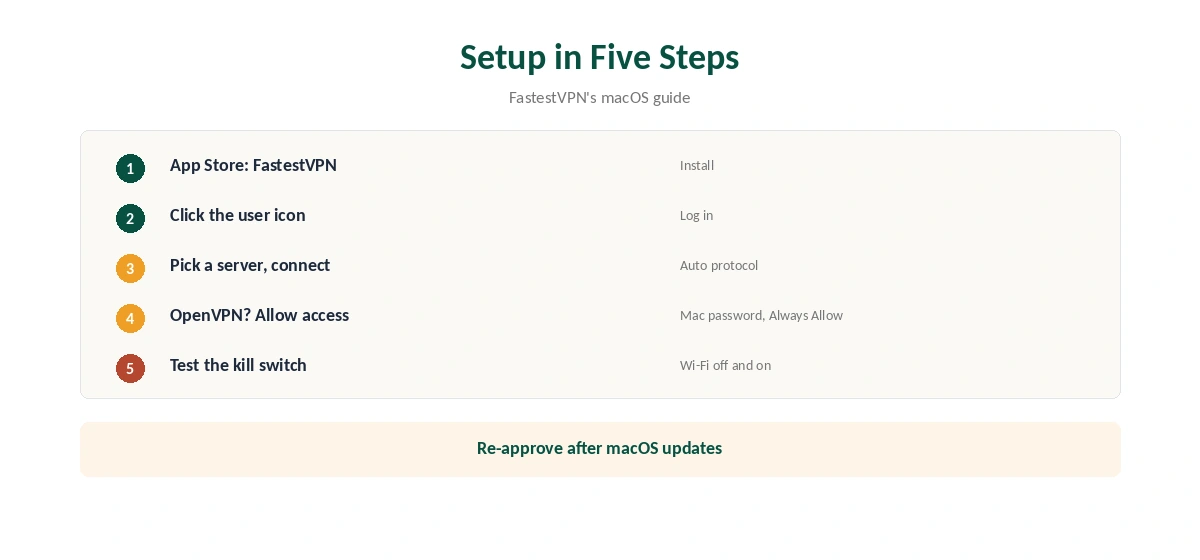
Open the App Store on your Mac, search for FastestVPN and install it. Launch the app, click the user icon, enter your FastestVPN username and password and log in. Pick a server and connect. Switching to OpenVPN TCP or UDP asks for permission; enter your Mac password and choose Always Allow, the guide explains.
Protocols
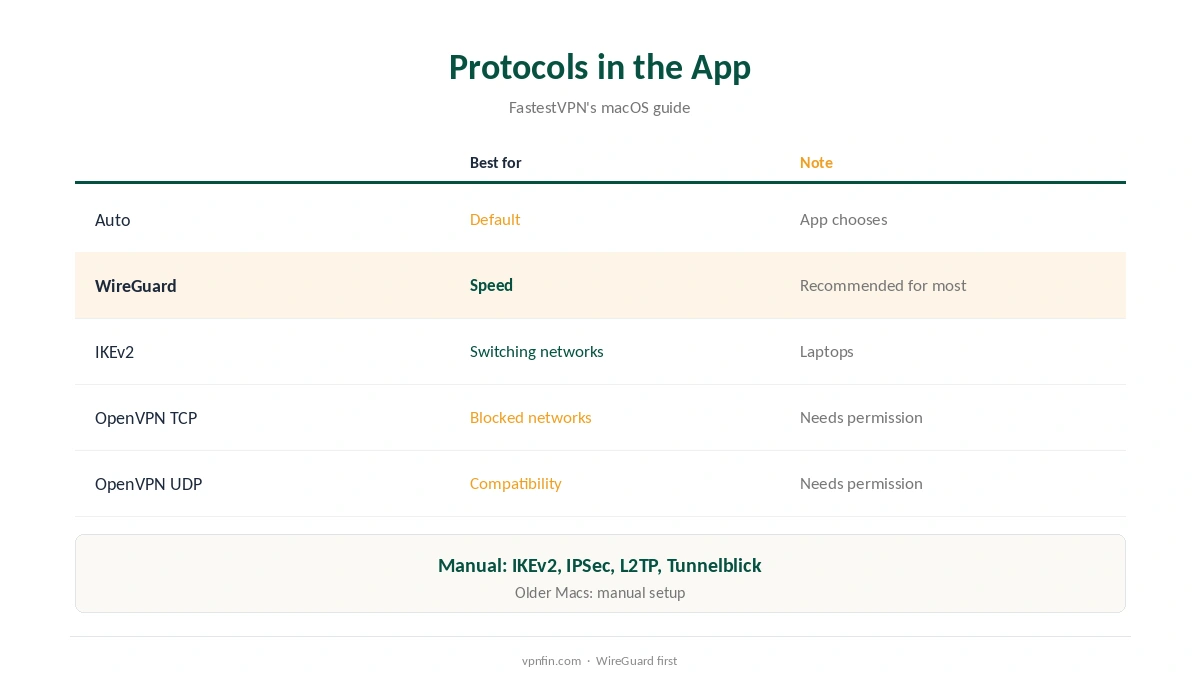
FastestVPN’s macOS guide lists Auto, WireGuard, IKEv2, TCP and UDP in the app’s settings, with TCP and UDP meaning OpenVPN. Use WireGuard for speed, IKEv2 for laptops that switch networks, and OpenVPN TCP on networks that block other protocols. Our WireGuard vs OpenVPN guide explains the trade-offs.
Kill Switch
An earlier FastestVPN macOS guide says the internet kill switch is always on by default in the Mac app. Test it by switching Wi-Fi off and on while connected; apps should stop loading until the VPN reconnects. Our kill switch guide explains why it matters.
Manual Setup
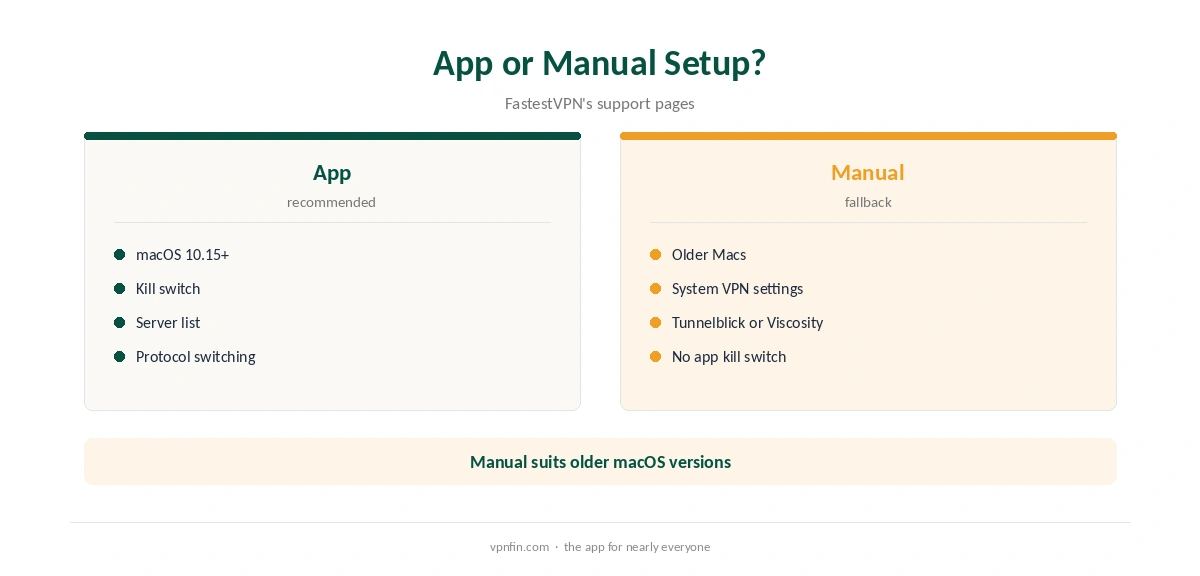
FastestVPN also documents manual connections: IKEv2, IPSec and L2TP through System Settings, Network, VPN, and OpenVPN through Tunnelblick or Viscosity. These suit older Macs or users who prefer a third-party client, but lack the app’s kill switch and server list.
FastestVPN Mac on Public Wi-Fi
On laptops, the app protects every program, not just the browser. With the kill switch always on, a dropped connection stops traffic rather than leaking it. Connect before you sign in to anything on café or hotel networks. Our public Wi-Fi guide explains the risks.
Split Tunnelling and AdBlock
FastestVPN’s support pages list manual split tunnelling and AdBlock among its app features. Use split tunnelling for apps that misbehave on a VPN, such as video calls. Check your Mac version’s settings for both, since the macOS guides focus on protocols.
Torrenting on a Mac
FastestVPN includes port forwarding and P2P-optimised servers. Keep the kill switch on and bind your torrent client to the VPN. Our torrenting VPN guide compares providers.
Older Macs
The current app needs macOS 10.15 or later. FastestVPN’s guides for older versions point to manual setups, such as IKEv2 in network settings or OpenVPN through Tunnelblick. An archived guide described an earlier app version for older macOS releases, but rely on the manual routes today.
Several Devices
Our tables record 10 devices per plan, with 15 reported on the top lifetime plan, enough for Macs, phones and a TV box in one household. Sign in on each with the same account.
A Quick Rule
Mac on macOS 10.15 or later? Install FastestVPN Mac from the App Store and choose WireGuard. Older Mac? Use the manual IKEv2 or Tunnelblick guides. Network blocking you? Switch to OpenVPN TCP.
Checking for Leaks
After connecting, confirm the address with our VPN test page and run our DNS leak guide. Repeat after macOS updates, which can reset network settings.
Quick Check
After connecting, switch Wi-Fi off and on. Apps should stop loading until FastestVPN reconnects, which confirms the kill switch works on your Mac.
Keeping It Updated
The App Store updates FastestVPN Mac automatically if you allow it. After an update, check that your protocol choice stayed the same, and reconnect if the app asks you to approve the VPN configuration again. Then test once.
Troubleshooting
If you are logged in but cannot connect, FastestVPN’s guide suggests logging out and back in, then switching to UDP or TCP. After a major macOS update, re-approve the VPN configuration if asked. Our Mac VPN troubleshooting guide covers more fixes.
FastestVPN Is Not FastVPN
Namecheap sells a different product called FastVPN, with its own Mac app and help pages. Search results often mix the two. Check the developer or publisher name before installing, so you get FastestVPN’s client and follow its own guides.
FastestVPN’s Record
Our audit table records a single audit, by Altius IT in 2023, and our ownership table lists FastestVPN as independent and based in the Cayman Islands. It allows 10 devices, with 15 reported on its top lifetime plan, and includes port forwarding, our review notes. Our VPN audit tracker explains why audits matter.
Related Guides
Our Mac VPN guide compares providers, and our guide to turning off a VPN on a Mac covers removing profiles.
For a rival Mac app, see our NordVPN Mac guide; NordVPN shares an owner, Nord Security, with Surfshark.
How We Research
This page draws on FastestVPN’s macOS app guides (2023 and 2024), its manual macOS setup index and our FastestVPN review and tables. We cross-checked these sources against each other, and where they conflict or something can’t be verified, we say so in the text rather than guessing. We checked time-sensitive figures, including prices in US dollars, on 7 October 2026. FastestVPN runs lifetime promotions; check the checkout. The main source we relied on is FastestVPN’s macOS guide. Our full approach lives on the About Us page.
FastestVPN Mac FAQ
It does, in the Mac App Store, for macOS 10.15 or later.
Auto, WireGuard, IKEv2 and OpenVPN over TCP or UDP.
An earlier FastestVPN guide says it is always on; test it.
Yes, with IKEv2, IPSec, L2TP or OpenVPN through Tunnelblick or Viscosity.
No. FastVPN is Namecheap’s separate product.
The Verdict
FastestVPN Mac support is simple through the App Store app, with WireGuard and a kill switch. Use manual setups only for older Macs, and weigh the single audit.