
Disclosure: VPNFin is reader-supported. If you buy a VPN through links on this page, we may earn a commission at no extra cost to you. This never affects our ratings — here’s our full disclosure.
Every German household pays the Rundfunkbeitrag, around €18.36 a month, whether anyone watches or not. It funds ARD and ZDF and keeps their catch-up services almost free of advertising.
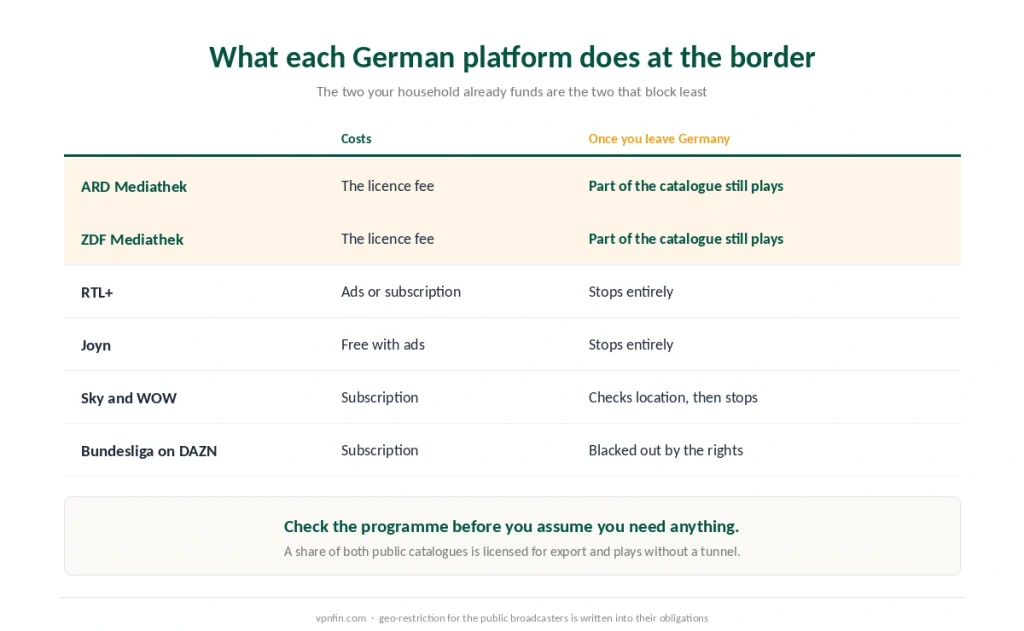
Cross the border and most of what you funded stops playing. German law requires those broadcasters to restrict streaming to German addresses, so the geo-block is an obligation rather than a business decision.
Which Problem Do You Have?
Abroad and missing German channels? You need a German address that ARD, ZDF, RTL+ or Joyn have not flagged. The public services are free to watch, so nothing else usually stands in the way.
Living in Germany? The argument here is privacy rather than blocking. No German court has ordered any provider to block anything, but the cabinet approved a bill in April 2026 that would have your access provider keep your IP address for three months.
Watching German TV From Abroad
The wall goes up at the border, and the reason is written into the licences.
ARD and ZDF block partially rather than completely. A large share of both Mediatheken is licensed for Germany only, so some of the catalogue still plays abroad. Try first, because you may not need anything at all for the programme you want.
RTL+ and Joyn stop entirely. Both refuse a foreign address the moment you leave, and Sky and its WOW app check location as well.
⚠️ Bundesliga carries extra blackouts. Rights on DAZN and Sky are German, so matches go dark abroad regardless of what you pay for.
Netflix and Prime keep working. They simply serve the catalogue of wherever you physically are — our Netflix page explains why the library changes rather than the access.
Frankfurt is usually the server to pick. It carries the most bandwidth for international connections, and switching between German cities resolves most detection errors — our streaming guide treats platform access as a moving target rather than a settled ranking.
⚠️ Reaching content this way may breach a platform’s terms, which is a contractual matter rather than a criminal one. The licence fee you pay does not change that.
Smart DNS on a Television
Worth knowing, because Samsung and LG sets cannot run VPN apps at all.
It reroutes lookups instead of building a tunnel. Nothing is encrypted, speed barely changes, and the entry goes into the television’s network settings.
Treat it as convenience, not protection. On hotel wifi it does nothing for you.
⚠️ A stale DNS entry looks exactly like a dead connection. If you ever stop using one, set the DNS back to automatic — our page on switching it off covers the fix.
If You Live in Germany
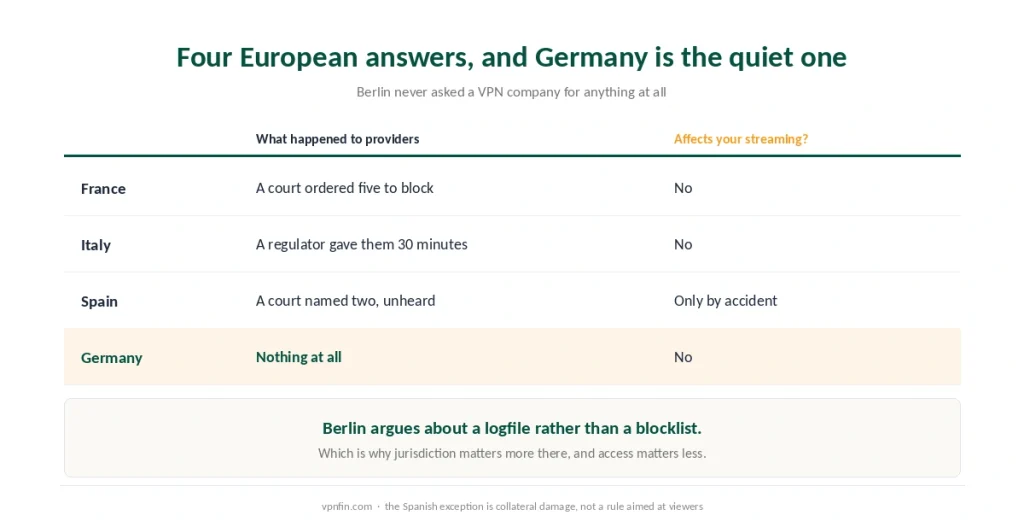
Here the German story diverges from its neighbours, and the difference is worth understanding.
Nobody has ordered a provider to block anything. Spanish and Italian courts and regulators reached the VPN companies themselves; Germany never went near that idea.
The argument is about a logfile instead. On 22 April 2026 the federal cabinet approved a bill requiring access providers to keep IP addresses and port numbers for three months. Both chambers still have to pass it, and two earlier attempts died in court — our page on German VPN law sets out that history.
⚠️ That bill concerns exactly the record a tunnel moves. Your access provider would log which address it assigned you, but not which sites you reached. The VPN company then occupies that position instead, which is why its jurisdiction matters more here than in most countries.
Shared networks stay the ordinary reason. Public wifi is where a VPN earns its keep, in Germany as everywhere else.
What to Look For
Four criteria, in the order they matter here.
German servers in more than one city. Frankfurt, Munich and Nuremberg locations give a provider addresses to rotate when a broadcaster flags one.
Jurisdiction, more than elsewhere. Germany sits inside the Fourteen Eyes arrangement, and the retention bill makes the question concrete rather than theoretical.
A published audit record. A no-logs claim is worth what the report behind it says, and nothing more — what a VPN hides and what it does not is the honest baseline.
A refund window long enough to test. The only reliable test is your own connection on the platforms you actually watch.
What a VPN Will Not Do
Four limits worth knowing before you pay.
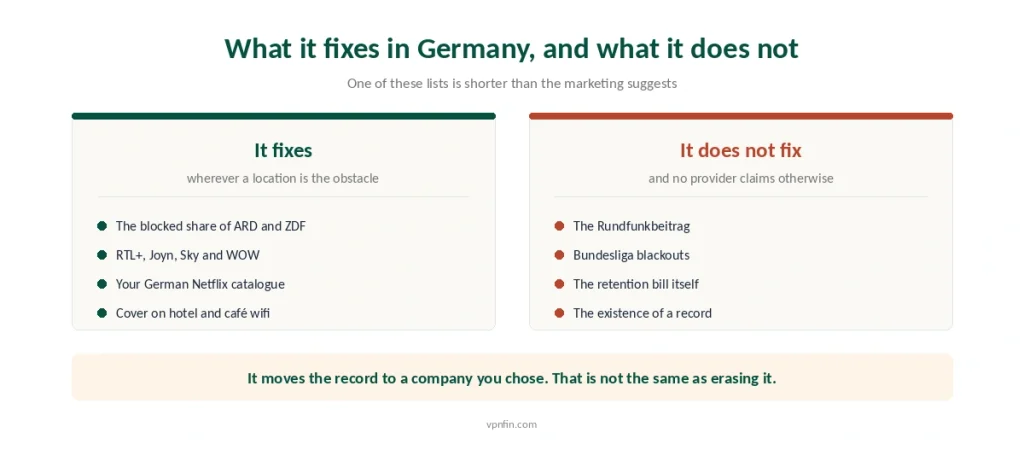
It will not refund the Rundfunkbeitrag. The fee follows the household, not the viewer.
It will not lift a Bundesliga blackout. Those apply to the rights, not to your address alone.
It will not survive a leak. Run the checks once after setup, because a connected app is not a working tunnel.
It will not remove you from retention. It moves the record to a company you chose, which is a different thing from erasing it.
Which Providers Make Sense Here
Named picks, with the reasoning attached.
Proton VPN for the jurisdiction argument. Swiss base, five audits published in full, and that combination answers the retention question more directly than a marketing claim.
NordVPN for reliability with broadcasters. Highest on our scale at 4.8, six audits, and consistent access to the German platforms in independent testing.
Surfshark for a household in two countries. Unlimited simultaneous connections, which is the usual expat arrangement.
ExpressVPN for live television. Three audits and a long record of handling live streams without stalling.
| Provider | No-logs audits | Auditor | Jurisdiction |
|---|---|---|---|
| NordVPN | 6 | PwC, Deloitte | Panama |
| Surfshark | 2 | Deloitte | Netherlands (9 Eyes) |
| ExpressVPN | 3 | KPMG | British Virgin Islands, Kape-owned |
| CyberGhost | 3 | Deloitte | Romania, Kape-owned |
| PureVPN | 4 | KPMG | BVI, operated from Pakistan |
| IPVanish | 2 | Leviathan, Schellman | United States (Five Eyes), Ziff Davis-owned |
| Windscribe | 1 | Packetlabs, production infrastructure | Canada (Five Eyes); Greek case dismissed, no data to give |
| Proton VPN | 5 | Securitum | Switzerland, moving infrastructure to EU |
| Private Internet Access | 3 | Deloitte | United States (Five Eyes), Kape-owned |
| Mullvad | 10+ | Cure53, Assured AB | Sweden (14 Eyes) |
| TunnelBear | Annual since 2017 | Cure53 | Canada (Five Eyes), US parent |
| Norton VPN | 2 | VerSprite | United States (Five Eyes) |
| Hotspot Shield | 0 | protocol audited, policy not | United States (Five Eyes) |
| AirVPN | 0 | none — the client is open source instead | Italy (14 Eyes) |
| IVPN | 8, annual since inception | Cure53 | Gibraltar (status disputed) |
| Hide.me | 1 modern, in 2024 | Securitum, though one source names Altius IT | Malaysia (outside the alliances) |
| PrivadoVPN | 0 | none in six years of operation | Iceland (moved from Switzerland, 2026) |
| TorGuard | 0 | none; settled a lawsuit without disclosing records | United States (Five Eyes) |
| FastestVPN | 1, in 2023 | Altius IT | Cayman Islands (outside the alliances) |
| StrongVPN | 0 | none in over two decades | United States (Five Eyes), Ziff Davis-owned |
| VyprVPN | 1, in 2018 | Leviathan Security, before the 2023 sale | United States (Five Eyes), Certida-owned since 2023 |
| PrivateVPN | 0 | none; support says there is nothing to audit | Sweden (14 Eyes), ownership disputed |
| ZoogVPN | 0 | none; support describes one as planned | Greece (outside the alliances), run from Ukraine |
Before You Travel
Install and pay before you fly. Nothing prevents subscribing from Germany, but doing it at home avoids app store regions and foreign card checks — our travel guide covers the rest of that habit.
Test it from your sofa. Connect to a German server at home and open what you care about. Finding out in the hotel is worse.
How We Research
This guide draws on StreamFix for the Rundfunkbeitrag figure and the geo-blocking behaviour of ARD, ZDF, RTL+, Joyn, Sky and WOW, on VPN Adviser for the legal obligation behind the broadcasters’ geo-restriction, on Safe Expat VPN and Comparitech for server selection and the Smart DNS route on televisions, on VPNOverview for the platform list, and on our own page on German VPN law for the cabinet decision of 22 April 2026 and the two court defeats before it. We do not run our own speed tests. Where a platform’s terms are involved we say so rather than implying otherwise. Our full approach lives on the About Us page.
VPN for Germany FAQ
Often, and sometimes without one. Both Mediatheken block a large share of their catalogue outside Germany rather than all of it, so check the programme first. For the rest, a German address restores access, and switching between German cities usually clears detection errors.
The fee attaches to a household in Germany, not to a person watching. Around €18.36 a month funds ARD and ZDF and keeps their catch-up services largely ad-free, and it is the reason many expats find the geo-block particularly irritating.
Not for access, since nothing is blocked there. The arguments are hotel and café networks, reaching home services that check your location, and the retention bill the cabinet approved in April 2026, which would have access providers keep IP addresses for three months.
Yes, completely. No German law restricts using, buying or installing one, and no party has proposed it. Every draft in the long data retention argument places obligations on internet access providers rather than on their customers.
Usually because the platform flagged the server address. Disconnect, clear cookies and cache, connect to a different German city, then reload. Frankfurt generally carries the most bandwidth for international connections, so try it before assuming the provider does not work.
The Verdict
If you are abroad and want German television, the public broadcasters block part of their catalogue rather than all of it, so check before assuming you need anything. RTL+, Joyn and Sky stop entirely.
If you live in Germany, the reason to buy is privacy rather than access. No provider there operates a blocking list, and the live question is who keeps a record of the address you were assigned.
Neither situation carries risk to you personally. German obligations fall on access providers, and no statute there penalises using a VPN.