
Disclosure: VPNFin is reader-supported. If you buy a VPN through links on this page, we may earn a commission at no extra cost to you. This never affects our ratings — here’s our full disclosure.
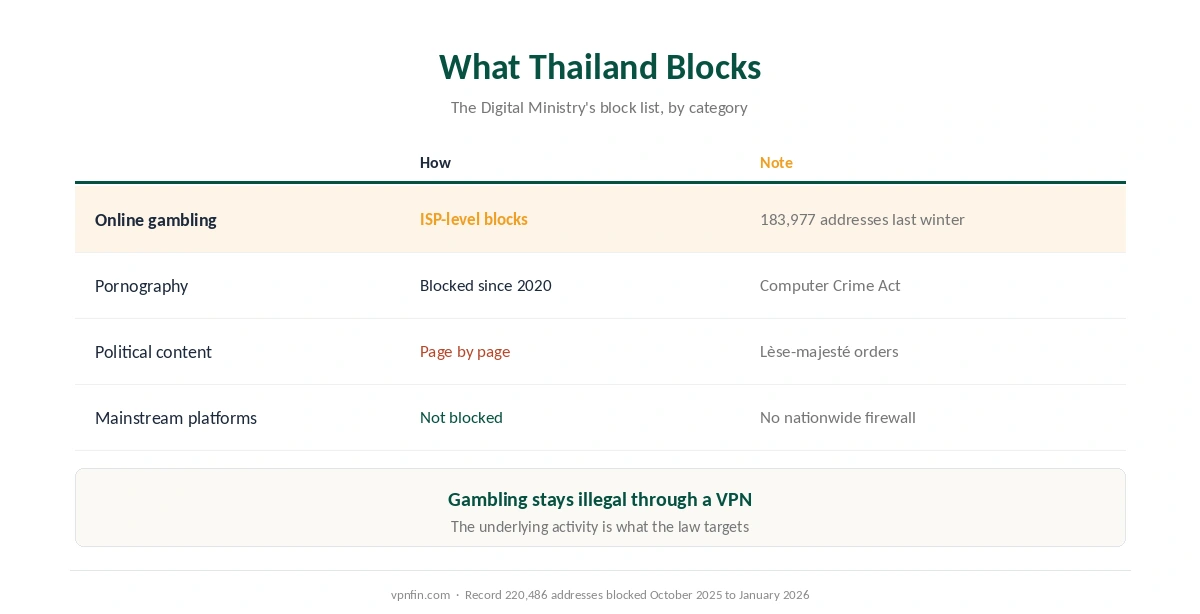
A VPN for Thailand is legal to use, and Thailand has no nationwide firewall. What it has is a long and growing block list, and laws that bite on what people post rather than on how they connect. Between October 2025 and January 2026 the Digital Ministry blocked a record 220,486 web addresses. According to BearVPN’s July 2026 overview, 183,977 of them were gambling sites.
The legal line matters more here than the technical one. Thai lawyers put it simply: there is no law against using a VPN, but a VPN gives no immunity for what you do through it. This guide covers what is blocked, where the law reaches, and which VPNs to use.
VPN for Thailand: The Short Answer
Using a VPN is legal in Thailand, Anglo Siam Law confirmed in April 2026. Reaching blocked gambling sites, or committing an offence through a VPN, remains illegal.
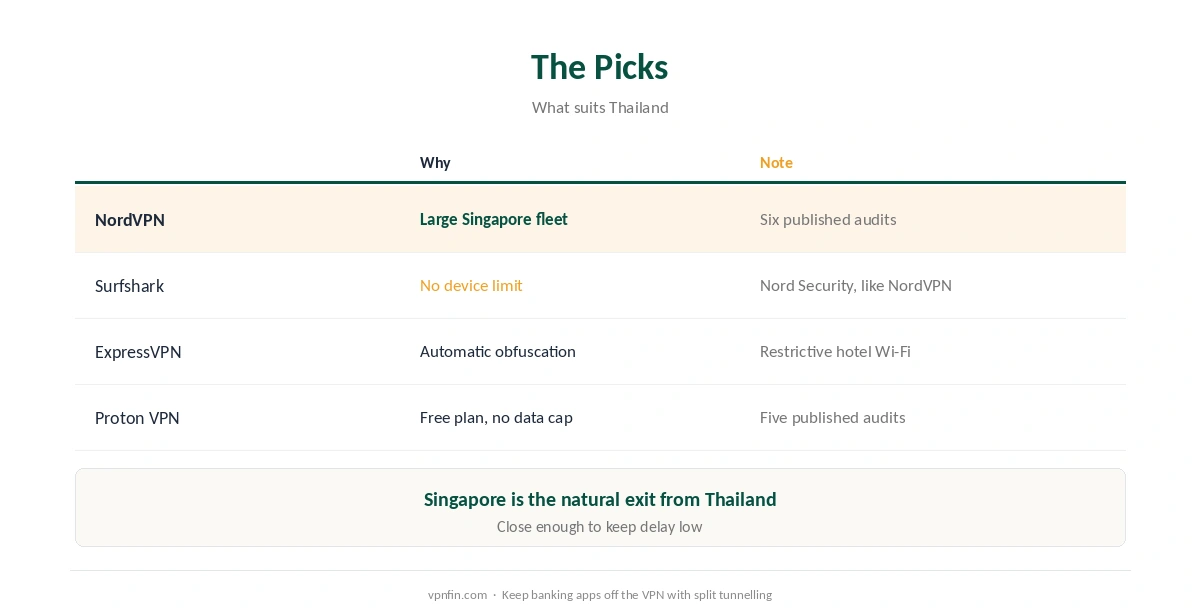
NordVPN and Surfshark are the usual picks, with large fleets in nearby Singapore for low latency. Our NordVPN review and our Surfshark review cover both.
The law reaches speech, not software. Posting or sharing content that breaches the Computer Crime Act or the lèse-majesté law carries heavy penalties with or without a VPN.
What Thailand Blocks
Gambling is most of the list. All online gambling is illegal in Thailand, and it accounted for most of the record 220,486 addresses blocked over the winter, BearVPN reports. The Ministry of Digital Economy and Society maintains the block list that licensed providers enforce.
Pornography is blocked too. Pornhub and many similar sites were blocked in 2020 under the Computer Crime Act, and enforcement is consistent across the major providers.
Political content is blocked page by page. Rather than banning platforms, authorities order specific pages, posts or groups restricted, especially content that falls foul of the lèse-majesté law. Mainstream platforms and services otherwise work normally, TrustedVPNReviews notes.
Where Thai Law Actually Reaches
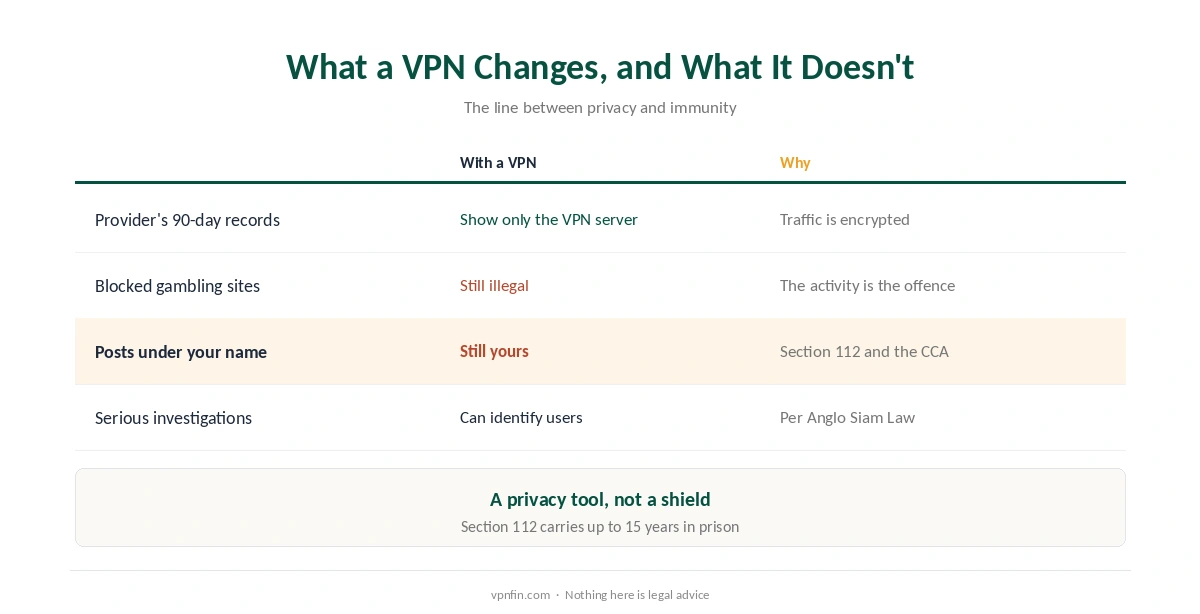
Section 112, the lèse-majesté law, makes it an offence to defame, insult or threaten the monarch or royal family. Le VPN notes penalties of up to 15 years in prison. BearVPN adds that simply browsing ordinary websites is generally not a crime, but sharing or commenting on violating content is.
Section 14(1) of the Computer Crime Act covers content deemed false or damaging, and VPNOverview reports fines of up to 100,000 baht and up to five years in prison for individuals.
⚠️ A VPN does not protect what you publish. It hides your traffic from your provider, but a post under your name is still yours, and Anglo Siam Law notes that authorities have ways to identify VPN users in serious investigations. Our guide to what a VPN hides sets out the limits.
Data Retention
Thai providers must keep records. Reporters Without Borders notes that the Computer Crime Act requires internet providers to keep individual users’ records for 90 days, available to the authorities without a judge’s order.
This is where a VPN for Thailand helps most. With a VPN on, your provider records a connection to the VPN server rather than the sites you visit. The VPN provider’s own policy then matters, which is why a published no-logs audit counts, as our audit tracker and our no-logs guide explain.
The Picks
| VPN | Why for Thailand | Note |
|---|---|---|
| NordVPN | Large Singapore fleet, obfuscated servers | Six published audits |
| Surfshark | No device limit, Camouflage Mode | Shares a parent with NordVPN |
| ExpressVPN | Automatic obfuscation | Useful on restrictive hotel Wi-Fi |
| Proton VPN | Free plan with no data cap | Five published audits |
Singapore servers are the natural exit, close enough to keep delay low, as our Singapore guide explains. NordVPN and Surfshark share a parent, Nord Security. Our ExpressVPN review and our Proton VPN review cover the other two.
Everyday Uses
Public Wi-Fi is the everyday reason to use a VPN for Thailand. Cafés, hotels and co-working spaces are the usual places, as our public Wi-Fi guide explains. Streaming is the other, though services block VPN addresses, as our Netflix guide sets out.
Banking apps may object to logins from unfamiliar countries, so keep them off the VPN with split tunnelling, as our split tunnelling guide shows, and our online banking guide covers the wider issue.
How We Research
The block figures come from BearVPN’s July 2026 overview, the legal position from Anglo Siam Law’s April 2026 FAQ, the penalties from VPNOverview and Le VPN, and the data retention rule from Reporters Without Borders. TrustedVPNReviews supplied the note on targeted restrictions. Each source is named where used and read on 26 September 2026. Nothing here is legal advice. Our full approach lives on the About Us page.
VPN for Thailand FAQ
Yes. No law prohibits VPN use. Using one to reach blocked gambling sites, or to commit an offence, remains illegal.
Mainly online gambling and pornography, plus specific pages under the lèse-majesté law. The Digital Ministry blocked a record 220,486 addresses between October 2025 and January 2026.
No. The law targets what you post and share. A VPN hides your traffic from your provider, not content published under your name.
NordVPN and Surfshark are the usual picks, with large server fleets in nearby Singapore. ExpressVPN suits restrictive hotel Wi-Fi, and Proton VPN offers a free plan.
Yes. The Computer Crime Act requires providers to keep users’ records for 90 days. With a VPN, those records show a connection to the VPN server rather than the sites you visit.
The Verdict
A VPN for Thailand is legal and useful for privacy, public Wi-Fi and streaming, and it keeps your browsing out of your provider’s retained records. NordVPN and Surfshark are the usual picks.
It does not change the law on gambling, and it does not protect what you post. Treat it as a privacy tool, not a shield.