
Disclosure: VPNFin is reader-supported. If you buy a VPN through links on this page, we may earn a commission at no extra cost to you. This never affects our ratings — here’s how we research.
These two belong to the same company. Kape Technologies owns both, alongside Private Internet Access, and neither brand advertises the connection.
That makes this comparison more interesting than most, because you’re not looking at two companies competing — you’re looking at how one company segments its own portfolio. ExpressVPN is positioned as the premium option at $99.95 a year on renewal. CyberGhost sits at $56.94 with the longest refund window in the category.
Here’s what the $43 difference actually buys.
The Short Answer
ExpressVPN if speed matters or you need more than seven devices. It loses roughly half as much throughput and scales to 14 connections on its top tier.
CyberGhost if price matters. It renews $43 cheaper, gives 45 days instead of 30, and offers a 24-hour desktop trial requiring no payment card — the only one among the providers we rank.
Neither if you need port forwarding. Kape doesn’t offer it on either brand.
Head to Head
| ExpressVPN | CyberGhost | |
|---|---|---|
| Speed loss | 18% | 31–38% |
| No-logs audits | 3 (KPMG) | 3 (Deloitte) |
| Total published audits | 28 | 3 |
| Devices | 10 / 12 / 14 by tier | 7 (router = 1) |
| Servers | undisclosed | ~11,500 |
| Countries | 113 | 100 |
| Jurisdiction | British Virgin Islands | Romania |
| Renewal | $99.95/yr | $56.94/yr |
| Refund window | 30 days | 45 days |
| No-card trial | No | 24 hrs desktop |
| Parent company | Kape Technologies | Kape Technologies |
| Our rating | 4.5 | 4.3 |
Speed: ExpressVPN, and It’s Not Close
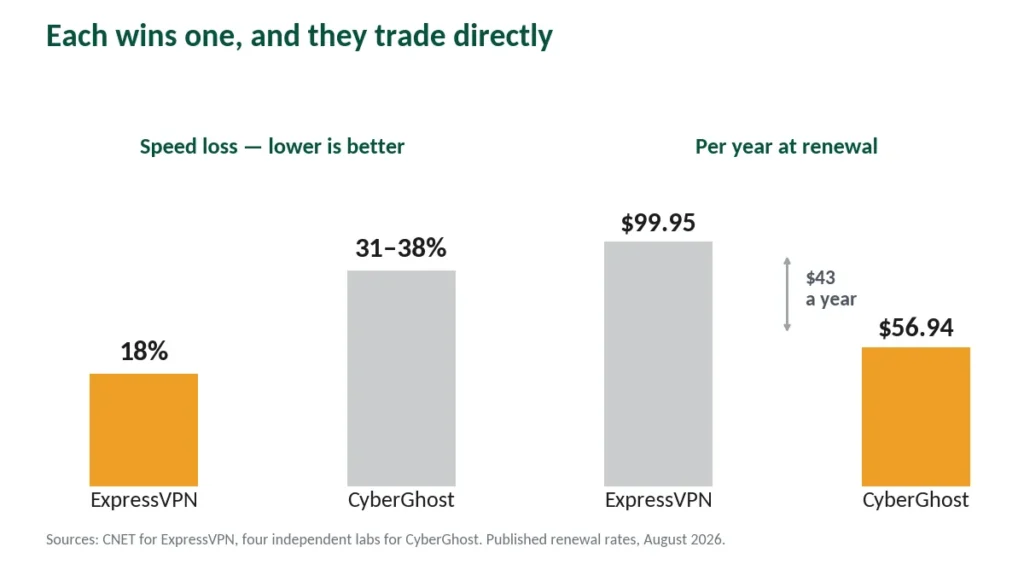
CNET measured an 18% average download loss for ExpressVPN. Independent testers put CyberGhost between 31% and 38%, with the gap widening on long-distance routes.
That’s roughly double, and it comes from infrastructure rather than protocol — both offer modern options, but ExpressVPN’s Lightway was rewritten in Rust in 2025 and kept to about 2,000 lines specifically for performance and auditability.
Whether it matters depends on your connection. On 500 Mbps fibre, a 38% loss still leaves 310 Mbps, and 4K streaming needs 15–25. On a 50 Mbps line the same percentage leaves 31 Mbps, where two simultaneous streams become marginal. Our speed guide covers how the same percentage lands differently.
Winner: ExpressVPN.
Price: CyberGhost, With an Unusual Structure
Intro pricing runs close — roughly $3.49 a month for ExpressVPN Basic against $2.19 for CyberGhost’s two-year plan. Then the terms end.
ExpressVPN Basic renews at $99.95 a year. Advanced at $119.95, Pro at $199.95.
CyberGhost renews at $56.94 — and here’s what makes it unusual: that’s the same total you paid upfront, simply charged annually instead of biennially. No other major provider does this, and our cheap VPN guide puts both against the rest of the field.
The gap widens if you need devices. ExpressVPN Advanced, which allows 12, renews at $119.95 — $63 more than CyberGhost.
| Provider | Renewal price | Per month | Tier |
|---|---|---|---|
| NordVPN | $139.08/yr | ~$11.59 | Basic |
| Surfshark | ~$79/yr | ~$6.58 | Starter |
| ExpressVPN | $99.95/yr | ~$8.33 | Basic |
| CyberGhost | $56.94/yr | ~$4.75 | 2-year |
| PureVPN | $47.95/yr | ~$4.00 | Standard |
| IPVanish | $89.99/yr | ~$7.50 | Essential |
| Windscribe | ~$69/yr | ~$5.75 | Pro |
| Proton VPN | ~$83.88/yr | ~$6.99 | VPN Plus |
| Mullvad | ~$65/yr | ~$5.40 | flat, no tiers |
| Norton VPN | $79.99/yr | ~$6.67 | Standard |
| Hotspot Shield | ~$95.99/yr | ~$8.00 | Premium annual |
CyberGhost also gives 45 days to request a refund against ExpressVPN’s 30, plus a genuine 24-hour desktop trial with no payment card at all.
Winner: CyberGhost.
Audits: Closer Than the Headline Suggests
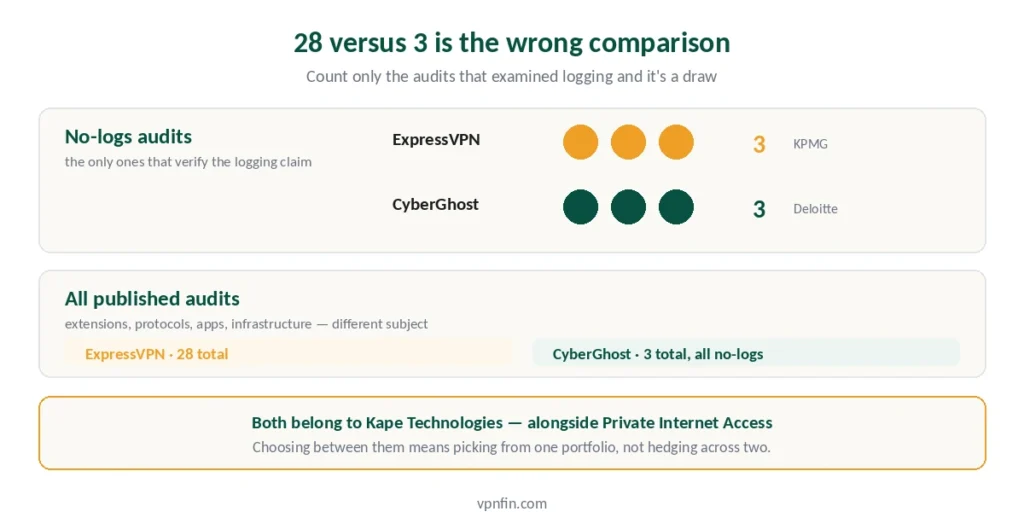
ExpressVPN publishes 28 independent audits, CyberGhost publishes three. That comparison misleads, and it’s worth correcting.
Three of ExpressVPN’s 28 examined the no-logs claim, all by KPMG, the most recent covering the system as of February 2025. The other 25 audited browser extensions, protocols, apps and infrastructure — real scrutiny, different subject.
All three of CyberGhost’s are no-logs audits, by Deloitte Audit Romania in 2022, 2024 and 2025, the latest under ISAE 3000 (Revised).
So on logging verification it’s three against three. On total published scrutiny ExpressVPN is far ahead.
Jurisdiction slightly favours CyberGhost. Romania sits outside the 5, 9 and 14 Eyes arrangements and rejected the EU Data Retention Directive twice. The British Virgin Islands is also outside those blocs but is a British Overseas Territory — a distinction some privacy commentators weigh and others don’t.
CyberGhost additionally publishes quarterly transparency reports with actual numbers: 105,332 DMCA complaints and three police requests in the first quarter of 2025, none complied with.
Winner: draw on logging, CyberGhost on transparency reporting.
Devices: The Number That Trips People Up
ExpressVPN allows 10, 12 or 14 depending on tier — the only major provider whose device limit rises with price.
CyberGhost allows 7, the lowest among the providers we rank. But there’s a detail that changes the arithmetic: a router connection counts as one device, and everything behind it is covered. With a VPN-capable router, one slot handles your entire home network — our router guide covers the setup.
Without a router, seven is genuinely tight. Two people with a phone and laptop each, plus a tablet and a TV, uses all of them.
Winner: ExpressVPN, unless you have a router, in which case it’s closer than the numbers suggest.
Features Where They Diverge
ExpressVPN covers 113 countries — the widest of the providers we rank — with TrustedServer running everything from RAM, obfuscation that works reliably on restricted networks, and Aircove, a router with the VPN built into its firmware. Higher tiers bundle a password manager, identity monitoring and a dedicated IP.
CyberGhost runs roughly 11,500 servers across 100 countries and labels them by platform — you pick Netflix, Disney+ or BBC iPlayer from a menu rather than guessing which city works. NoSpy servers sit in its own Romanian data centre with staff-only physical access.
⚠️ Neither offers port forwarding, and neither offers multi-hop routing. Both are Kape products, and the portfolio simply doesn’t include those features — our torrenting guide covers who does.
On streaming, CyberGhost’s labelled servers are the more practical implementation, while ExpressVPN’s broader country coverage reaches more regional services.
The Shared Owner
Worth stating plainly, since neither brand volunteers it.
Kape Technologies acquired CyberGhost in 2017 and ExpressVPN in 2021, alongside Private Internet Access. The brands run separate infrastructure, commission their own audits and compete on price — but the parent is the same.
Kape’s earlier corporate history under a previous name has drawn scrutiny from privacy commentators. No audit of either brand has surfaced a technical problem connected to the ownership, and both have continued auditing since acquisition.
What this means practically: choosing between these two is choosing between two products from one company, not hedging across two. If shared ownership concerns you, our NordVPN review covers the alternative — though NordVPN and Surfshark are themselves siblings under Nord Security.
Kape holds a third brand as well. Private Internet Access sits under the same parent, along with the review sites vpnMentor, WizCase and SafetyDetectives.
Consolidation is the norm in this market. Almost nobody is independent.
Which Should You Buy?
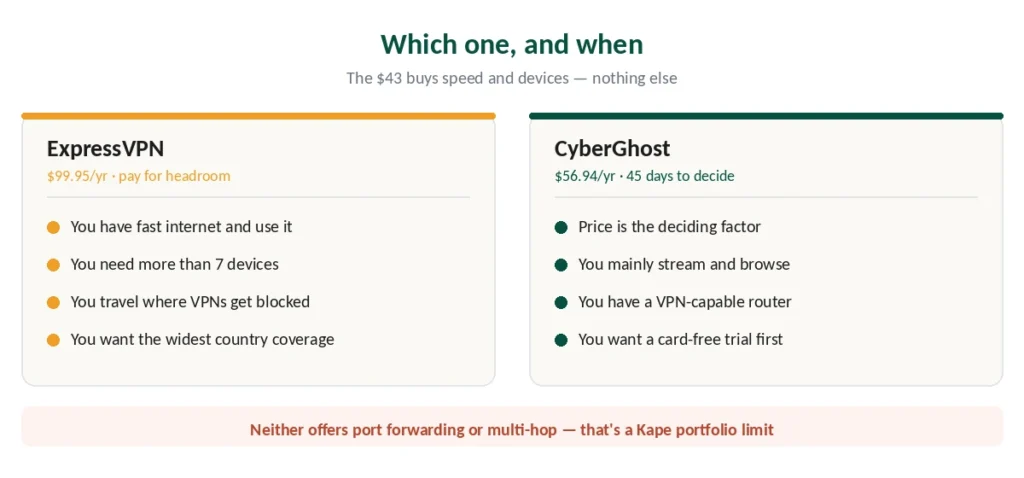
Buy ExpressVPN if you have fast internet and intend to use it, you need more than seven devices without a router, or you travel to countries where VPNs get blocked. Full detail in our ExpressVPN review.
Buy CyberGhost if price is the deciding factor, you mainly stream and browse, you have a VPN-capable router, or you want the longest window to test before committing. Full detail in our CyberGhost review.
Buy neither if you need port forwarding or multi-hop — Kape offers neither on either brand.
How We Research
This comparison draws on our full reviews of both providers, published audit records from KPMG and Deloitte, quarterly transparency reports, speed results from named independent labs including CNET, and renewal figures taken from each provider’s own checkout terms — cross-checked and verified at publication. Where the industry’s framing misleads, as it does with audit counts that measure different subjects, we correct it. Our full approach lives on the About Us page.
ExpressVPN vs CyberGhost FAQ
They share a parent. Kape Technologies acquired CyberGhost in 2017 and ExpressVPN in 2021, alongside Private Internet Access. The brands run separate infrastructure and commission their own audits, but choosing between them means choosing between two products from one company rather than hedging across two.
ExpressVPN, by roughly double. CNET measured an 18% average download loss for ExpressVPN against 31–38% for CyberGhost in independent testing. Whether that matters depends on your connection — on fast fibre both leave far more bandwidth than streaming needs.
CyberGhost, at $56.94 a year against ExpressVPN’s $99.95 — a difference of $43. CyberGhost is also unusual in renewing at the same total you paid upfront rather than increasing. If you need more than 10 devices, ExpressVPN Advanced costs $119.95, widening the gap to $63.
It depends what you count. ExpressVPN publishes 28 independent audits, but three examined the no-logs claim specifically, all by KPMG. CyberGhost has three, all no-logs audits by Deloitte Audit Romania. On logging verification it’s a draw; on total scrutiny ExpressVPN is well ahead.
Less than it appears, because a router connection counts as a single device and everything behind it is covered. With a VPN-capable router, one slot handles your whole home network. Without one, seven is tight — two people with a phone and laptop each, plus a tablet and a TV, uses all seven.
Neither does. Both are Kape Technologies products, and the portfolio doesn’t include port forwarding or multi-hop routing on either brand. If you seed on private trackers, that rules out both — only one provider in our top five offers it.
The Verdict
ExpressVPN ranks third in our top 5, CyberGhost fourth, and the ordering reflects speed and device flexibility more than anything else.
But the $43 annual gap is real, and CyberGhost answers it with a longer refund window, a card-free trial, quarterly transparency reports and the same number of no-logs audits. For someone who streams and browses on a normal connection, the case for paying more is thinner than the rankings imply.
The honest framing: if you’d notice the speed difference, buy ExpressVPN. If you wouldn’t, you’re paying $43 a year for headroom you never touch.