
Disclosure: VPNFin is reader-supported. If you buy a VPN through links on this page, we may earn a commission at no extra cost to you. This never affects our ratings — here’s our full disclosure.
Most comparisons at this price argue about server counts. This one has something better: both providers have been tested by people who did not ask permission first, and the results went in opposite directions.
One supplied connection logs to the FBI. The other answered two federal subpoenas with nothing. Everything else here is detail.
The Short Answer
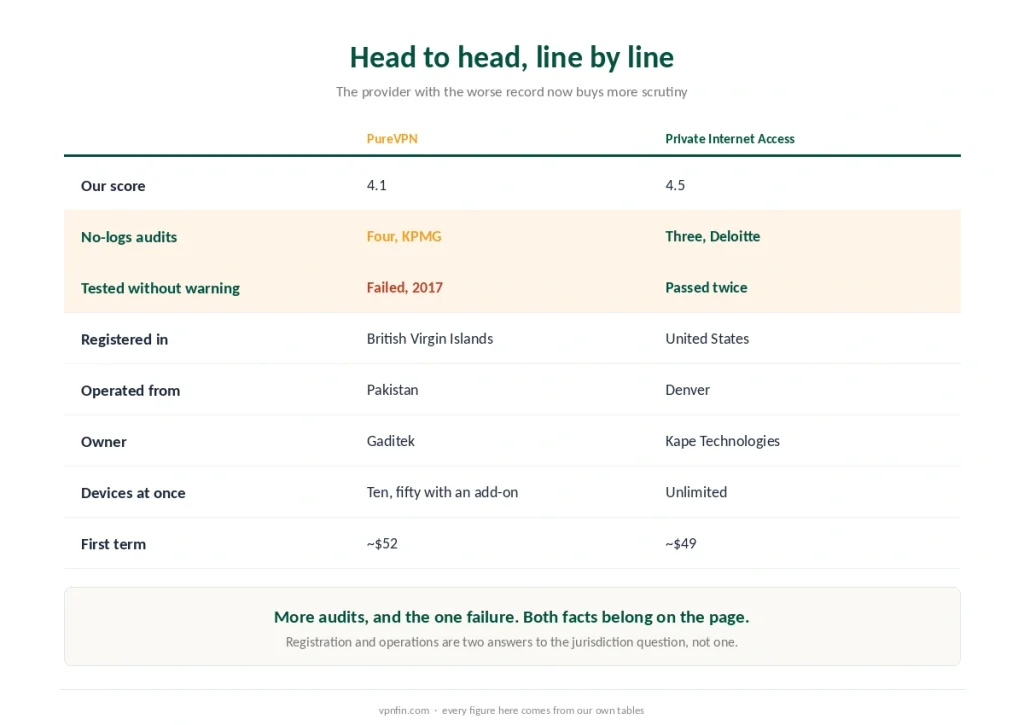
Private Internet Access scores 4.5 on our scale, PureVPN scores 4.1. Both sit at the cheap end of our catalogue, so price is not the deciding factor it usually is.
PIA answered subpoenas in 2016 and June 2018 and produced nothing. PureVPN supplied connection records to the FBI in October 2017 in a cyberstalking case.
PureVPN’s answer was to buy more proof than PIA has. Four KPMG audits followed, which raises a genuinely difficult question about whether remediation counts.
What Actually Happened in 2017
Worth stating precisely, because the case is often described loosely.
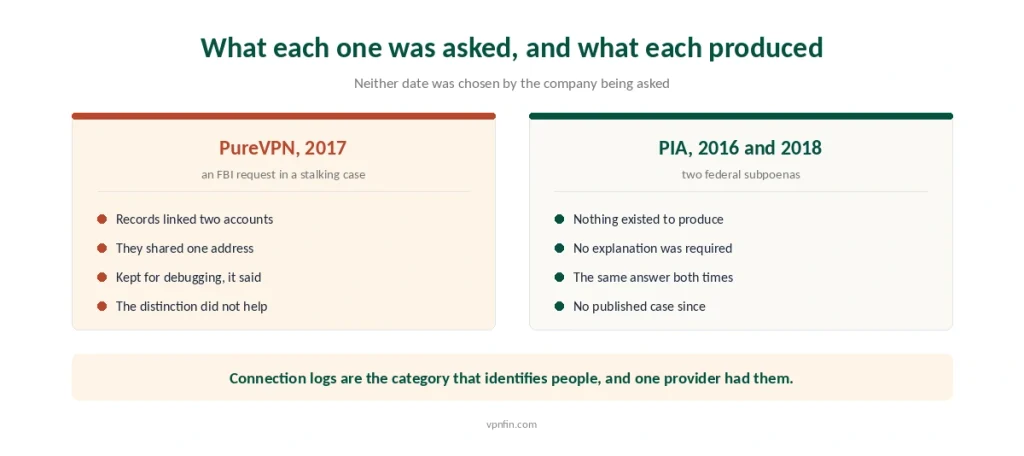
Court documents in a cyberstalking prosecution showed PureVPN’s records at work. They linked two email accounts to the same shared address, which helped identify the defendant.
The company’s explanation was technical rather than evasive. It had kept login data for debugging rather than activity logs, and it maintained that this was consistent with its policy.
⚠️ That distinction is exactly the one that matters. Connection logs are the category that identifies people, and a provider can hold them while truthfully saying it keeps no record of what you browsed.
PIA faced the same kind of demand twice and had nothing. No explanation was needed, which is the point of the arrangement.
Does Buying Audits Afterwards Count?
Here is the question this pairing asks and most reviews avoid.
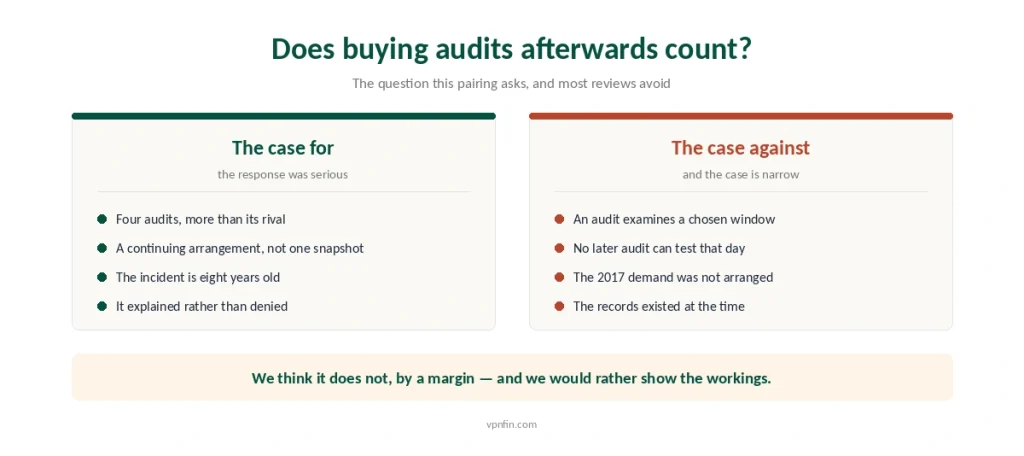
PureVPN now holds four KPMG audits, more than PIA’s three from Deloitte, and it has pursued a continuous arrangement rather than a single annual snapshot.
That is a substantial response, and it would be dishonest to treat 2017 as though nothing followed.
⚠️ An audit still describes a chosen window, though. It tells you what auditors found where they looked, on dates the company arranged. The 2017 disclosure was not arranged, and no later audit can retroactively test that moment.
Our view is that both facts belong on the page. Weighting them is a judgement, and we would rather show the workings than deliver a verdict as though the question were simple.
Jurisdiction Is Two Answers, Not One
This is the detail most comparisons collapse into a single word.
PureVPN is incorporated in the British Virgin Islands and operated from Pakistan. The incorporation is the privacy-friendly half; the operations are the half that rarely appears in marketing.
PIA is American, based in Denver. The United States is a Five Eyes member, and no audit changes which government can serve a demand.
⚠️ PIA also belongs to Kape Technologies, alongside ExpressVPN and CyberGhost — the full ownership map is a separate page. PureVPN belongs to Gaditek and has no sibling VPN brand.
Price, Devices and the Figure Nobody Publishes
Both are cheap, and the differences are narrower than the marketing suggests.
PureVPN runs about $52 for its first term, and it produces the lowest four-year total in our catalogue. It is also the one provider in our tables whose renewal costs less than the introductory term — $47.95 against roughly $52.
PIA runs about $49 for two years, with unlimited simultaneous connections against PureVPN’s ten.
⚠️ PIA’s renewal price is the number we cannot confirm. Published sources give $57 a year in one place and $11.59 a month in another, so the checkout page is the only reliable answer — renewal pricing across the category is where most of the real money hides.
| Provider | First term | Every year after |
|---|---|---|
| Norton VPN | $39.99 (12 months) | $79.99 |
| Private Internet Access | ~$49 (24 months) | Sources disagree |
| PureVPN | ~$52 (24 months) | $47.95 |
| Surfshark | ~$54 (27 months) | ~$79 |
| CyberGhost | $56.94 (26 months) | $56.94 |
| Mullvad | ~$65 (12 months) | ~$65 |
| Proton VPN | ~$71.76 (24 months) | $83.88 |
| Hotspot Shield | ~$71.88 (12 months) | $95.99 |
| NordVPN | ~$94 (27 months) | $139.08 |
| ExpressVPN | ~$98 (28 months) | $99.95 |
Everything Else
The ordinary criteria, briefly, because they do not decide this one.
Devices. PIA is unlimited; PureVPN allows ten, extending to fifty with a paid add-on.
Streaming. Neither is our first recommendation — our streaming guide ranks both below the leaders, and platform access shifts monthly for everyone.
Apps. PIA ships open-source clients, which anyone can read rather than trust.
Cost over four years. PureVPN wins, and what a VPN actually costs over that horizon is a more useful comparison than the monthly sticker.
Who Should Pick Which
Choose PIA if the 2017 disclosure weighs on you. Its record under pressure is the strongest thing about it, and unlimited devices cost nothing extra.
Choose PureVPN if the cheapest four-year total decides it, and if you accept four subsequent audits as an adequate answer to an eight-year-old incident.
⚠️ Choose neither if the question is who has never been tested and never failed. Mullvad sits in that position, and what a VPN hides regardless of provider applies to all three.
How We Research
This comparison draws on Protectstar and vpntesting for the PureVPN disclosure of October 2017 and the court documents describing it, on CyberInsider and VPNpro for the two PIA subpoenas of 2016 and June 2018, on our own no-logs guide for the distinction between activity and connection records, and on our own tables for every price, audit count, device limit and jurisdiction quoted here. Where our table and an outside source disagree on a number, we use ours. Our full approach lives on the About Us page, and PIA against NordVPN covers the pairing most readers ask about next.
PureVPN vs PIA FAQ
Yes, in October 2017. Court documents in a cyberstalking case showed that its connection records linked two email accounts to the same shared address, helping identify the defendant. The company said it had kept login data for debugging rather than logs of browsing activity.
No published case shows it doing so. Federal subpoenas in 2016 and June 2018 produced nothing, because the company held no records matching the requests. That is a different kind of evidence from an audit, and few providers have it.
PIA on the initial term, at roughly $49 for two years against about $52 for PureVPN’s first term. PureVPN produces the lower four-year total in our tables. PIA’s renewal figure is reported inconsistently by published sources, so check the checkout page.
PureVPN is incorporated in the British Virgin Islands and operated from Pakistan, which are two separate facts worth holding together. PIA is based in Denver, inside the Five Eyes arrangement, and belongs to Kape Technologies alongside ExpressVPN and CyberGhost.
It addresses it without erasing it. Four KPMG audits followed, more than PIA holds, and that is a serious response. An audit still examines a window the company arranged, whereas the 2017 disclosure happened on a day nobody chose.
The Verdict
PIA, 4.5 against 4.1, and the gap is mostly one event. Two federal demands produced nothing, and that is evidence no audit can manufacture.
PureVPN’s response was serious rather than cosmetic. Four KPMG audits and a continuous arrangement is more scrutiny than most of the category buys, and it followed a failure rather than preceding one.
So the honest framing is a question, not a ruling. Does a provider that failed once and then bought more proof than its rival deserve more credit than the one that never failed? We think not, by a margin — but we would rather you saw the reasoning than the score.