
Disclosure: VPNFin is reader-supported. If you buy a VPN through links on this page, we may earn a commission at no extra cost to you. This never affects our ratings — here’s our full disclosure.
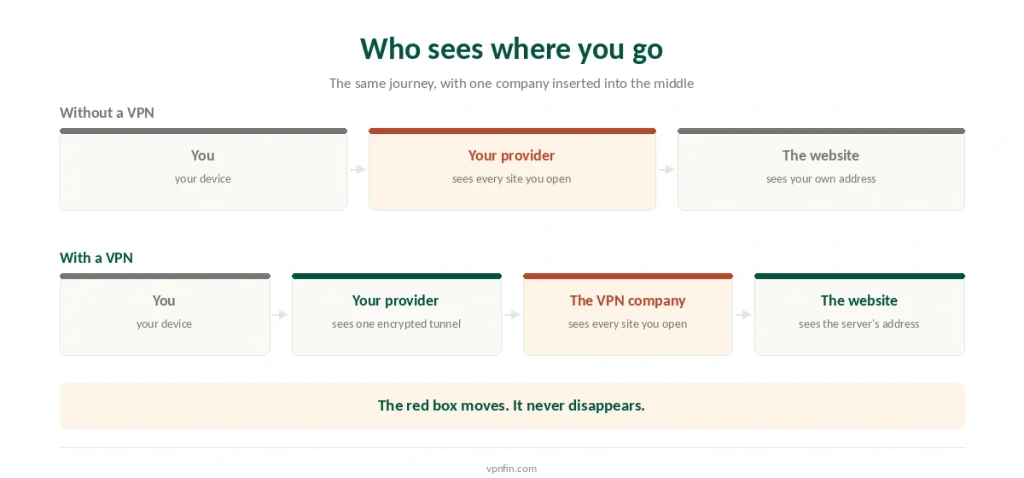
A VPN does one thing. It sends your internet traffic through a company’s server before it reaches wherever you were going.
That single change moves who can see what. Your internet provider stops seeing which sites you open. The VPN company starts seeing it instead. Everything else in the marketing follows from that swap, and most of it oversells it.
What Is a VPN?
It is an encrypted tunnel between your device and a server somewhere else. Websites see that server’s address rather than yours, and your internet provider sees only that you connected to the server.
Nothing about that makes you anonymous. It changes which company holds the record, so the useful question is which company you would rather trust.
What It Actually Does
Three things, and they are genuinely useful.
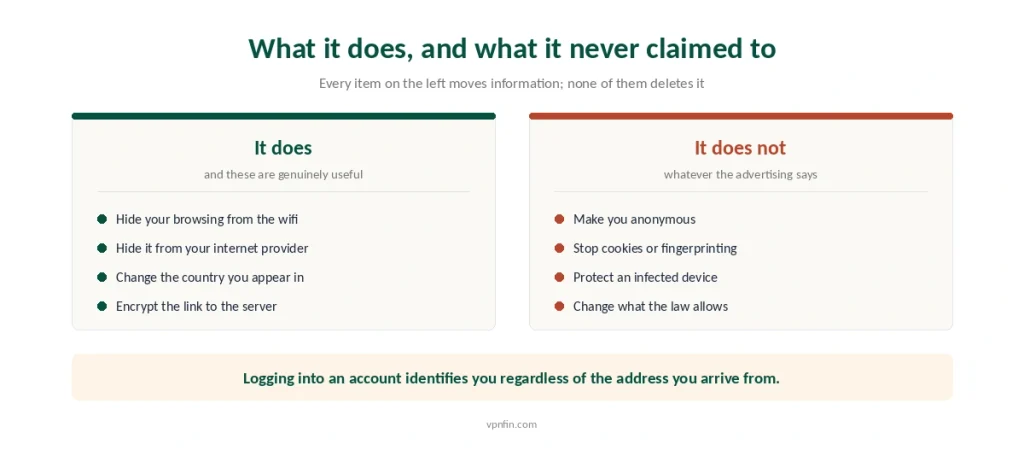
It hides your browsing from the network you are on. On hotel, café or airport wifi, the operator sees encrypted traffic instead of destinations — which is where a VPN earns its keep.
It hides your browsing from your internet provider. In several countries providers must keep records of what you reached, and a tunnel makes those records much less interesting.
It changes where you appear to be. Websites read the server’s location, so services that restrict content by country behave as though you were somewhere else. A proxy does that part too, without the encryption — the difference is scope, and it decides which tool you actually want.
⚠️ Notice what all three have in common. Each one moves information from one party to another. None of them deletes it.
What It Does Not Do
Four things, and every one of them appears in somebody’s advertising.
It does not make you anonymous. Logging into an account identifies you regardless of the tunnel, and what a VPN hides is narrower than most people assume.
It does not stop tracking. Cookies, fingerprinting and your logged-in sessions follow you across any address.
It does not protect a compromised device. Malware on your laptop is inside the tunnel with you, and the risks that are real rather than advertised are worth separating before you buy anything.
It does not make illegal things legal. Using a VPN is lawful almost everywhere, and what you do through one stays subject to the same rules.
Four Words the Marketing Uses
Worth translating, because these phrases do most of the persuading.
“Military-grade encryption” means AES-256. Your browser already uses it every time you open a banking site. It is excellent, and it is not a differentiator.
“No logs” is a claim, not a fact. Some providers have proved it under pressure and two failed, so the question is what evidence exists rather than what the homepage says.
“Unlimited bandwidth” is standard. Almost nobody caps paid plans, so the phrase describes the category rather than the product.
“100% private” describes nothing measurable. Ask instead who audits the service, where the company is registered, and who owns it.
⚠️ That last question matters more than it sounds. Two corporate groups own most of the large brands, and four of those parents also own websites that review VPNs.
Who Actually Needs One
The honest answer is narrower than the industry suggests.
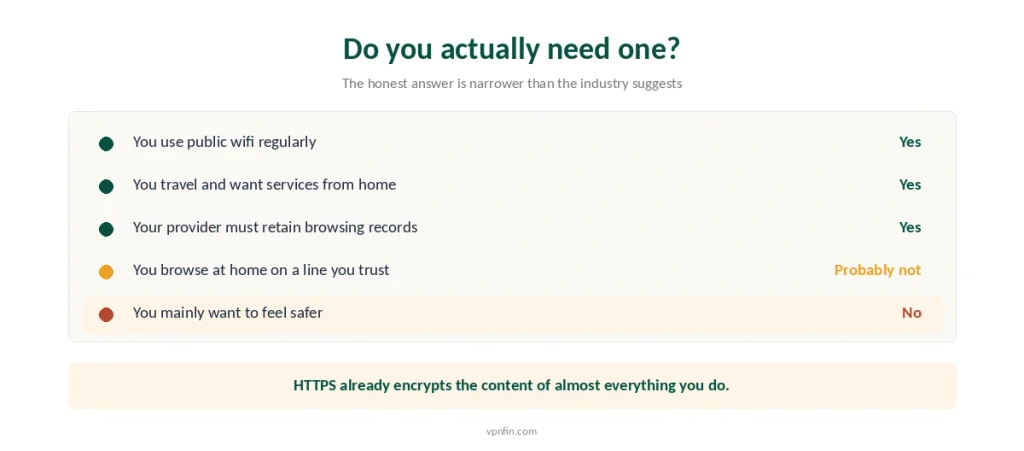
You probably want one if you use public wifi often, travel and need services from home, live where providers must retain browsing records, or have a specific reason to keep your traffic away from your internet company.
You probably do not need one if you browse from home on a connection you trust and mainly want to feel safer. HTTPS already encrypts the content of almost everything you do.
⚠️ A VPN is a tool for a stated problem. If you cannot name the problem, the honest recommendation is to wait until you can.
Speed is the usual trade. Expect to lose somewhere between five and twenty per cent — our speed page puts real measurements against the claims.
What It Costs, and the Catch
Pricing in this category has one recurring trick.
The advertised price is the first term only. Two or three years upfront looks cheap, and the renewal is frequently double.
Providers state the renewal figure in their terms, though rarely on the pricing page — we collect them in one place.
| Provider | First term | Every year after |
|---|---|---|
| Norton VPN | $39.99 (12 months) | $79.99 |
| Private Internet Access | ~$49 (24 months) | Sources disagree |
| PureVPN | ~$52 (24 months) | $47.95 |
| Surfshark | ~$54 (27 months) | ~$79 |
| CyberGhost | $56.94 (26 months) | $56.94 |
| Mullvad | ~$65 (12 months) | ~$65 |
| Proton VPN | ~$71.76 (24 months) | $83.88 |
| Hotspot Shield | ~$71.88 (12 months) | $95.99 |
| NordVPN | ~$94 (27 months) | $139.08 |
| ExpressVPN | ~$98 (28 months) | $99.95 |
⚠️ Free tiers exist and mostly deserve suspicion. A few reputable providers run genuine free plans; many others fund themselves by selling exactly the data you installed them to protect.
Setting One Up
Installation takes about five minutes. Subscribe, install the app, sign in, pick a location, connect — our setup guide covers each platform.
Then check it once. Run a leak test to confirm your real address is not visible. A connected app is not the same as a working tunnel.
If you want stronger anonymity than this, you want a different tool. Tor is the comparison worth reading, and it solves a different problem more slowly.
How We Research
We do not run our own speed tests or operate a testing lab. Every figure on this site comes from published audit reports, court records, named laboratories and providers’ own terms — and where sources disagree, we say so rather than choosing. Prices and audit counts on this page come from our own tables, which we maintain in one place so a change updates every article at once. Our full method, including what it cannot tell you, lives on the About Us page.
VPN Basics FAQ
It routes your internet traffic through a company’s server before it reaches its destination. Your internet provider then sees only the connection to that server, and websites see the server’s address rather than yours. The traffic between your device and the server is encrypted.
No. It changes which company can see where you go, rather than removing the record. Logging into any account identifies you regardless of the tunnel, and cookies and browser fingerprinting continue to work exactly as before.
It depends on whether you can name the problem. Public wifi, retention laws where you live, travel, and reaching home services from abroad are all real reasons. Browsing from a home connection you trust, with HTTPS already encrypting the content, is not.
Not as a differentiator. It means AES-256, which your browser already uses when you open a banking site. The encryption is genuinely strong, and every serious provider uses the same standard, so the phrase describes the category rather than any one product.
Usually by somewhere between five and twenty per cent, depending on the provider, the protocol and the distance to the server. A nearby server on a modern protocol is barely noticeable for browsing and streaming; a server on another continent will be.
The Verdict
A VPN moves trust rather than creating privacy. Your internet provider stops seeing where you go, and the company you chose starts.
That is worth paying for when you can name the reason. Public wifi, retention laws, travel, or reaching a service from home while abroad.
It is not worth much if you cannot. No amount of encryption compensates for a provider you picked because a website was paid to list it first.