
Disclosure: VPNFin is reader-supported. If you buy a VPN through links on this page, we may earn a commission at no extra cost to you. This never affects our ratings — here’s our full disclosure.
A dedicated IP is an address only you use. It removes the CAPTCHAs, the bank refusals and the streaming blocks that come from sharing an address with thousands of strangers.
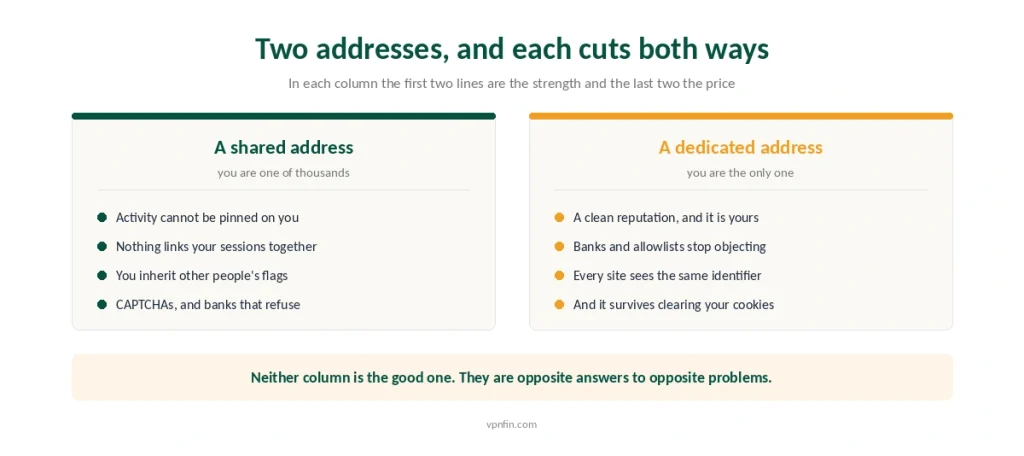
It does that by removing the thing that made a VPN private. On a shared address you are one of a crowd. On a dedicated one, every site you visit sees the same address, and that address belongs to exactly one person.
What It Fixes
The problem is real, and anyone who has used a VPN daily has met it.
Shared addresses inherit other people’s behaviour. If someone on your address scrapes a site, spams a forum or triggers a fraud rule, the address gets flagged — and you inherit the flag.
Banks are the usual casualty. Financial services treat datacentre addresses as suspicious by default, which is the recurring problem with banking over a VPN.
Allowlists need a stable address. Work systems, remote desktops and business dashboards that permit specific addresses cannot work with a rotating one.
And CAPTCHAs stop. A reputable address you alone use accumulates a clean history instead of somebody else’s.
⚠️ This is why people buy it, and the reasons are sound. What follows is the part the marketing does not put next to them.
The Trade Nobody Puts Beside It
Here is the argument this page exists to make.
A shared address hides you in a crowd. Thousands of people leave the same exit point, so activity from that address cannot be attributed to any one of them — which is most of what a VPN does for privacy.
A dedicated address is the opposite by design. One address, one person, every session. Every site you visit sees the same identifier, and it does not reset when you clear your cookies or open a private window.
That is a stable identifier you cannot clear. Cross-site correlation becomes trivial for anyone who wants it, because the thing tying your sessions together is now permanent.
⚠️ The providers’ answer addresses only half of it. Token systems stop the provider from knowing which customer holds which address — they do nothing about the websites at the other end, which see a consistent address regardless of how it was assigned.
Token Systems, and Who Actually Has One
The genuine innovation here, and the point on which our sources disagree most sharply.
The mechanism is straightforward. You buy the add-on, receive a one-time token, and enter it in the app. From then on the provider knows an address is assigned but not to whom.
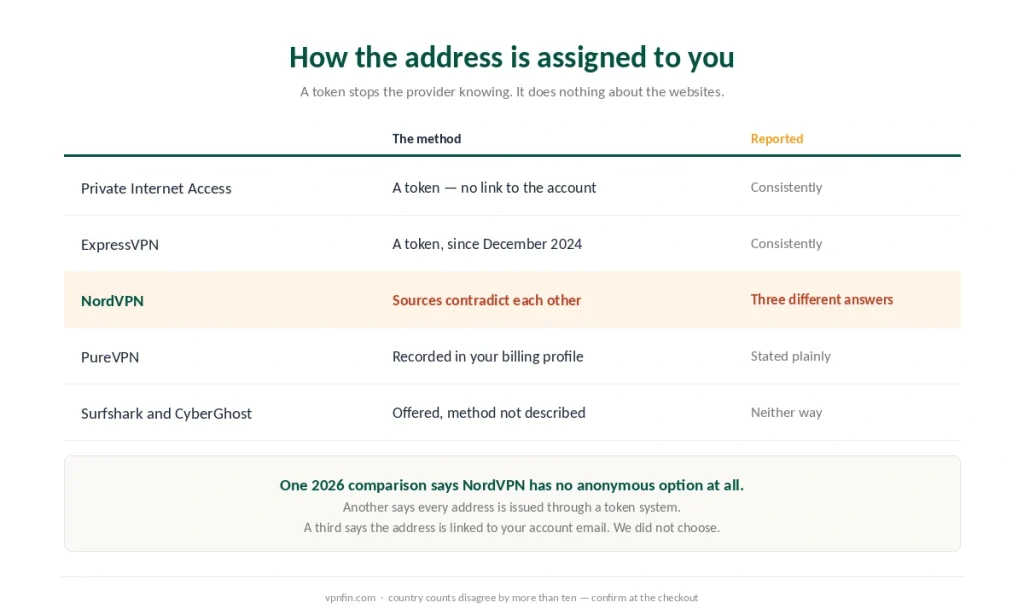
Private Internet Access is described consistently as having one, and one account states its auditors examined the arrangement.
ExpressVPN introduced an anonymous token in December 2024, which is the most recent addition and is reported across sources without contradiction.
⚠️ On NordVPN the sources contradict each other outright. One 2026 comparison states it does not offer an anonymous dedicated IP option at all. A second describes each address as issued through a token system that prevents staff from matching it to an account. A third says the address is linked to your account email. We could not reconcile them, and we are not going to pick the flattering version.
PureVPN records the address in your billing profile, which is stated plainly rather than dressed up — acceptable for a business dashboard, weaker than a token.
Surfshark and CyberGhost both offer the add-on without the token arrangement being reported either way.
What It Costs
NordVPN’s add-on is reported at around $3.69 a month on a long plan, though the company keeps the figure behind its checkout.
PureVPN publishes $4.45 a month on a two-year term, with the address available in ten countries.
CyberGhost sits around $5 a month, with the longest refund window we track — 45 days — which matters here more than usual.
Private Internet Access bundles it cheaply, with reports of a two-year subscription plus address under $80.
⚠️ Country counts are as unreliable as the prices. NordVPN’s dedicated IP coverage is given as more than fifteen countries, as twenty-seven, and as twenty-eight across three sources published in the same year. Check the checkout page rather than any list, ours included.
What We Are Not Repeating
Several sources on this subject present performance figures that read like laboratory results.
Specific throughput from named cities, CAPTCHA rates per hundred logins, and comparative session counts appear on pages that are otherwise affiliate listings.
We have not reproduced any of them. None publishes a method, and the numbers are precisely the kind that persuade without being checkable.
⚠️ The underlying claim is still sound. A clean address you alone use does reduce CAPTCHAs and fraud flags — that follows from how reputation scoring works, and it does not need invented decimals.
Who Should Buy One
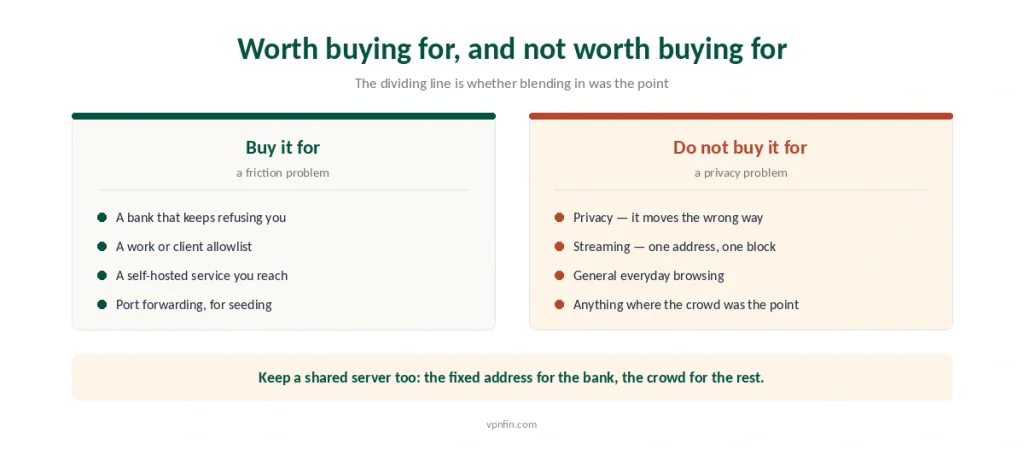
Buy it if the friction is your actual problem. Daily bank logins, a work allowlist, a business dashboard, a self-hosted service you reach from outside.
Buy it if you have already given up on a VPN once because everything asked you to prove you were human.
Buy it if you need port forwarding for seeding, where a stable address is part of the arrangement — our torrenting guide covers which providers still offer it.
Do not buy it for privacy. It moves you in the wrong direction, and no token changes what the websites see.
And do not buy it for streaming alone. A dedicated address is easier for a platform to identify and block permanently than a rotating pool — which cuts against it on the platforms that block hardest.
How to Choose
Decide which half of the privacy question matters to you. If it is the provider knowing, a token system settles it. If it is websites correlating your activity, nothing settles it and a dedicated address makes it worse.
Check the refund window before the price. An address that does not clear your bank is worth nothing, and you find out in week one — 45 days beats 30 for exactly this.
Confirm the country at checkout. Published lists disagree by more than ten countries.
And keep a shared server available. Most providers let you switch between your dedicated address and the ordinary pool, which is the arrangement to want: the fixed address for the bank, the crowd for everything else.
How We Research
This guide draws on Cloudwards, Cybernews, CyberInsider and Comparitech for the provider lists, country coverage and the December 2024 introduction of ExpressVPN’s anonymous token, on Softcircles and UrbanMatter for pricing and the conflicting accounts of NordVPN’s assignment method, and on our own reviews for audit records and refund windows. Several sources present specific performance figures — throughput from named cities, CAPTCHA rates per hundred logins — without publishing a method, and we have not reproduced them. Where sources contradict each other, as they do on NordVPN’s token system and on its country count, we have set the versions side by side rather than choosing. We do not run our own tests. Our method lives on the About Us page.
Dedicated IP FAQ
An address assigned to you alone rather than shared with other subscribers. Traffic stays encrypted, but the exit point stops changing, so banks, allowlists and corporate firewalls see a consistent location instead of a roaming one.
No — less. On a shared address you are one of thousands leaving the same exit point. On a dedicated one, every site you visit sees the same address belonging to one person, which is a stable identifier that survives clearing cookies or opening a private window.
A method of assigning the address without the provider knowing who holds it. You buy the add-on, receive a one-time token, and enter it in the app. Private Internet Access and ExpressVPN are both described as using one. It stops the provider linking the address to you; it does nothing about the websites you visit.
Reported figures vary: around $3.69 a month for NordVPN’s add-on, $4.45 for PureVPN on a two-year term, roughly $5 for CyberGhost. Several providers keep the exact price behind the checkout, so confirm it there rather than from any published list.
Usually not. A platform can identify and block a single address permanently, whereas a rotating pool means one blocked server among thousands. Dedicated addresses suit banking, allowlists and self-hosted services rather than unblocking.
The Verdict
A dedicated IP is the right answer to a friction problem and the wrong answer to a privacy one. It stops the CAPTCHAs and the bank refusals because the address is yours and its reputation is yours.
That is also what makes you easier to follow. One address, one person, every session — a stable identifier that survives clearing your cookies.
Token systems fix the provider’s half and not the internet’s. If a company matching an address to your name is your concern, they work. If sites linking your sessions is your concern, a dedicated address is the wrong purchase.