
Disclosure: VPNFin is reader-supported. If you buy a VPN through links on this page, we may earn a commission at no extra cost to you. This never affects our ratings — here’s our full disclosure.
Almost every guide to this subject assumes you want an American address. On Disney+ that instinct is backwards.
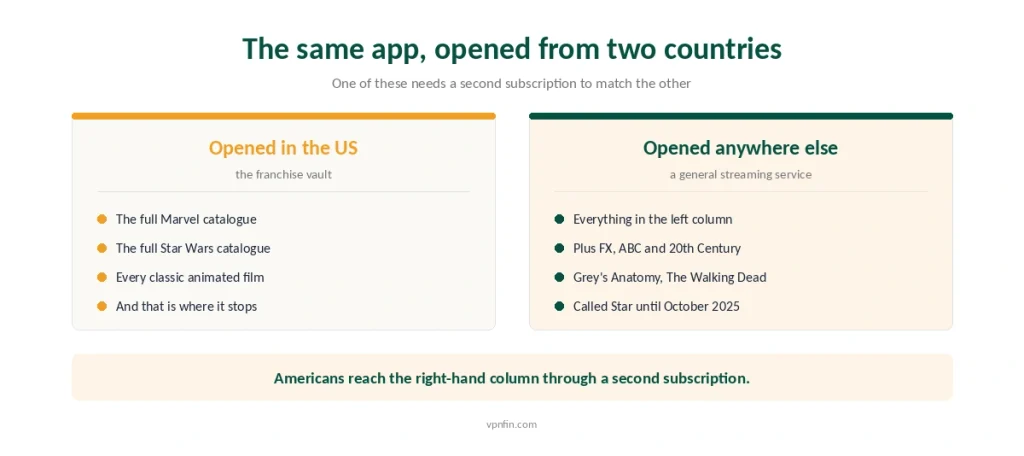
Outside the United States, the app contains a general-entertainment hub that American subscribers do not get. FX shows, ABC dramas, 20th Century titles — the sort of thing that in America sits behind a separate subscription entirely.
Which Gate Disney+ Uses
Worth establishing first, because it decides whether a VPN helps at all.
Disney+ reads your IP address and serves the matching catalogue. Your account, your subscription and your login stay exactly as they are; only the library on screen changes.
That puts it in the same category as Netflix rather than Prime Video, where the catalogue follows the account and no server change touches it.
⚠️ Accounts are not at risk. Disney+ blocks addresses rather than customers. Detection produces Error 83 and a message asking you to disable the VPN; published testing over months describes no account penalties.
Why the US Library Is the Small One
This is the part that inverts the usual advice.
In 2021 Disney added a hub called Star to Disney+ in markets outside the United States, carrying general entertainment from FX, ABC, Freeform and 20th Century Studios.
Americans never saw it, because that content lived on Hulu, sold separately.
On 8 October 2025 the hub was renamed Hulu internationally. Same content, familiar branding, and a signal of what Disney intends next.
⚠️ So a British or Australian address shows you a bigger app than an American one. Shows like Grey’s Anatomy, The Walking Dead and How I Met Your Mother sit inside Disney+ there and behind a second subscription in the States — which is what our Hulu page is about.
What Each Region Is Actually For
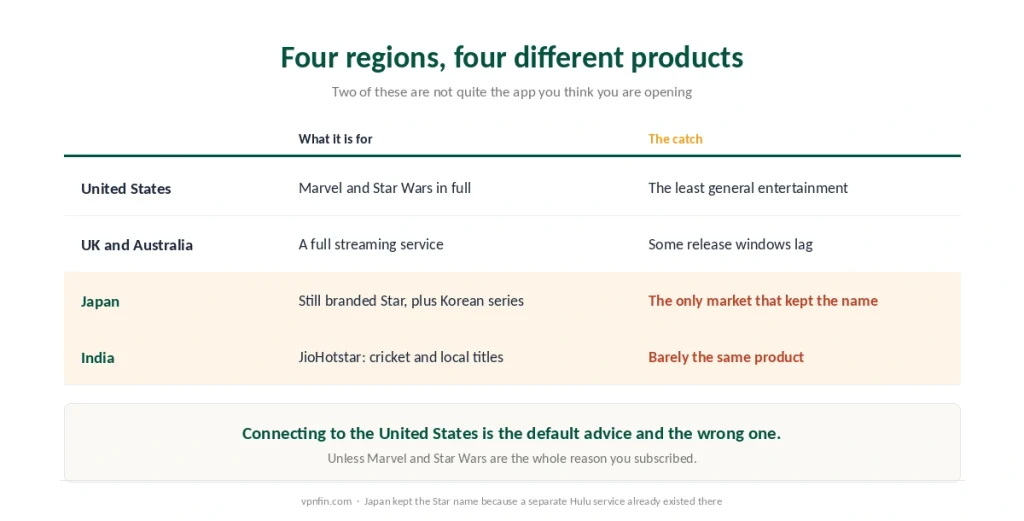
Four worth knowing, and the reasons differ.
The United States holds the complete Marvel and Star Wars catalogues and every classic animated film. It is the core Disney library at its most complete, and the least general entertainment.
Australia and the United Kingdom carry the general-entertainment hub, which makes the app closer to a full streaming service than a franchise vault.
Japan is the outlier. It is the only market still using the Star name rather than Hulu, because a separate Hulu service already existed there. A 2025 agreement also brought a large tranche of Korean series from Tving exclusively to that market — and Japan is a catalogue worth understanding generally.
⚠️ India is not really Disney+ at all. It runs through JioHotstar, formed by the 2025 merger of Hotstar and JioCinema, weighted heavily towards cricket and Indian programming with a much thinner international catalogue — our India guide covers that market.
The Shelf Life on All of This
Unusually short, and worth saying before the recommendations.
Disney is merging Hulu into Disney+ in the United States during 2026. The apps become one; the subscriptions remain separate products.
When that finishes, the gap this page describes narrows. An American subscriber paying for both will see much of what an Australian sees today.
⚠️ Which means any regional comparison written this year expires. Ours included, and we would rather date it clearly than pretend otherwise.
When It Stops Working
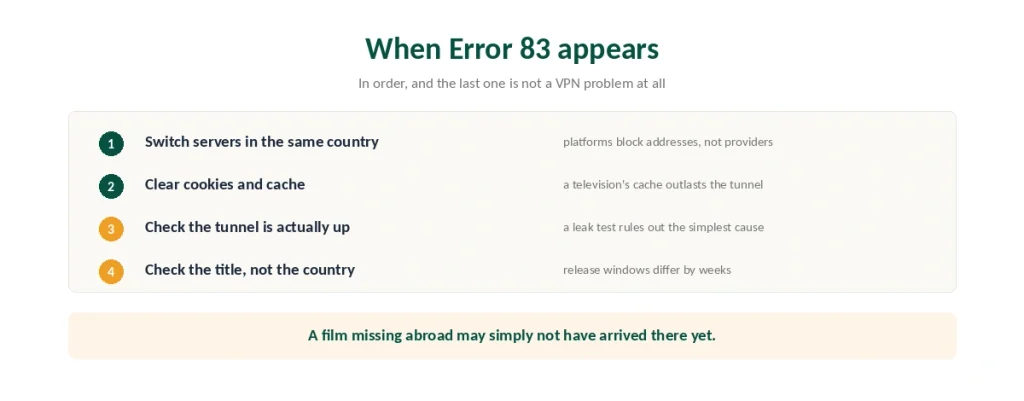
Error 83 is the message, and the causes are ordinary.
Switch servers within the same country first. Platforms block individual addresses, not whole providers, and a second server in the same place usually clears it.
Clear cookies and cache. Disney+ caches location data, and on a television that cache can outlast the tunnel entirely.
Check the tunnel is actually up. A leak test takes a minute and rules out the simplest explanation before you start switching anything.
Then check the title, not the country. Release windows differ by weeks between markets, so a film missing abroad may not have arrived yet rather than being blocked.
Which Providers Are Named
Published testing during 2026 names the same short list.
NordVPN for reliability, highest on our scale at 4.8 and cited most often for this platform specifically.
Surfshark for the number of regions, which matters more here than anywhere given how differently the libraries are built.
CyberGhost for labelled servers, with Disney+ as one of the platforms you pick from a menu rather than hunting for.
⚠️ Treat the list as perishable. Providers and platforms trade moves monthly, and our streaming guide explains why we weight refund windows as heavily as unblocking claims.
The Legal Position
Using a VPN is lawful. Watching another region’s library breaches Disney’s terms of use, which is contractual rather than criminal — the distinction our legality guide draws applies to every platform on the internet.
Nothing here involves changing your account country, which is a different act with different consequences. Disney+ serves the library your address points at while your subscription stays exactly where it is.
How We Research
This guide draws on What’s On Disney Plus for the rebranding of the Star hub to Hulu internationally on 8 October 2025 and the American merger planned through 2026, on Wikipedia for the hub’s history since February 2021 and Japan’s retention of the Star name, on TheBestVPN for the regional catalogue differences, the Tving agreement covering Korean series in Japan and the observation that Disney+ blocks addresses rather than accounts, on Astrill for the JioHotstar arrangement in India, and on Veilock for the description of how the platform selects a library from the connecting address. Several of those sources sell VPN subscriptions, so we have used them for platform behaviour rather than for rankings. We do not run our own tests. Our method lives on the About Us page.
Disney+ VPN FAQ
Yes, because Disney+ selects your library from your IP address rather than from your account. Your subscription and login stay unchanged and only the catalogue on screen differs, which is not true of every streaming platform.
Not the American one, for general entertainment. Outside the United States the app includes a hub — called Star until October 2025 and Hulu since — carrying FX, ABC and 20th Century content that Americans access through a separate subscription. The US catalogue is strongest on Marvel, Star Wars and classic animation.
The message shown when Disney+ identifies your connection as a VPN or proxy and asks you to disable it. Switching to another server in the same country usually resolves it, since platforms block individual addresses rather than entire providers.
No published account describes that happening. Disney+ blocks addresses rather than customers, and testing over extended periods reports no account penalties. Watching another region’s library does breach Disney’s terms of use, which is a contractual matter.
Because it is a different product there. Disney+ operates through JioHotstar, formed by the 2025 merger of Hotstar and JioCinema, with programming weighted towards cricket and Indian titles and a noticeably thinner international catalogue.
The Verdict
Disney+ chooses your library from your address, so a VPN genuinely changes what you see. That is not true of every platform, and it is why this one is worth the trouble.
The direction is the surprise. The American catalogue is the smallest general-entertainment offering, because the hub that fills that role sits inside the app everywhere else.
And the window is closing. The merger under way in the United States during 2026 will narrow the gap, which makes this a good year to understand the difference rather than a permanent feature to rely on.