
Disclosure: VPNFin is reader-supported. If you buy a VPN through links on this page, we may earn a commission at no extra cost to you. This never affects our ratings — here’s our full disclosure.
Our overall scores rate five things: speed, security and privacy, streaming, price and ease of use. That is the right way to answer “which VPN should I buy”.
It is the wrong way to answer “which VPN protects me best”. A provider with no streaming support and a hostile interface can be the safest service we cover and still finish mid-table, because two of the five criteria have nothing to do with privacy.
So this page removes them. The order below is built on evidence alone, and it looks very different.
What We Are Measuring
Five things, and each is checkable by you rather than asserted by us.
Audits: how many, how recent, and by whom. One report from three years ago is not the same argument as ten published across a decade.
Real tests. A police visit, a subpoena, a court order — occasions when a company was asked and had to answer with something.
Ownership. Who takes the money, and whether the same parent owns a competitor you might switch to.
Architecture. RAM-only servers, open-source clients, and whether an account requires an email address at all.
Jurisdiction, weighted lightly. We rank it last on purpose, and the next section explains why.
⚠️ Speed and streaming are not here. They matter, and they are the reason our overall ranking exists — but a fast VPN that keeps records is not a private one.
Why Jurisdiction Comes Last
This is a change from how most sites rank privacy, so it needs justifying.
A jurisdiction is a policy, and policies get rewritten. Switzerland proposed extending identification and retention duties to VPN providers, and the country’s own privacy companies said they would leave rather than comply.
Sweden shows the same thing from the other side. The state there does not attack the tunnel at all — it reaches the device before encryption, and watches the cable at the border, neither of which a flag prevents.
⚠️ What survives a change of government is design. A provider holding no records is protected anywhere; a provider holding records is exposed everywhere, whatever the postcode.
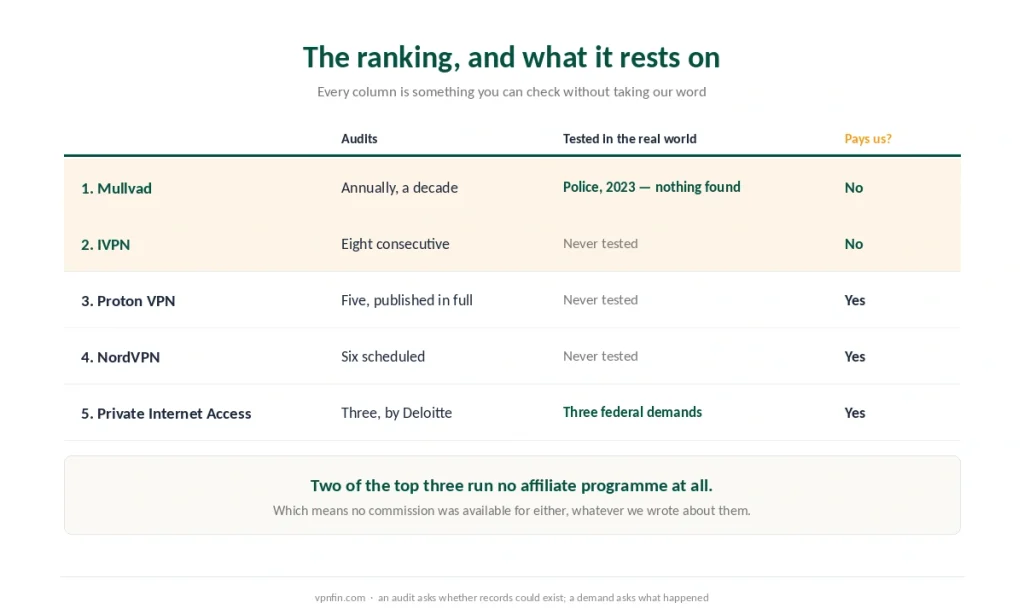
1. Mullvad — the Benchmark
Audits every year for over a decade, published in full, including the ones that found problems.
Tested in the real world. In April 2023 police arrived at the Gothenburg office with a search warrant and left with nothing, because there was nothing to take — the strongest evidence any provider in this category holds.
Owned by its two founders, in equal shares, with no outside capital and no sibling brand.
No email address at signup. An account number, and cash in an envelope if you want it.
⚠️ And it pays us nothing. Mullvad bans affiliate marketing outright, so this recommendation earns us no commission at all. That is worth stating on a page where every other entry does.
What you give up: no streaming to speak of, five devices, a flat price with no discount ever.
2. IVPN — the Most Consistent Record
Eight consecutive annual audits by Cure53, which is a cadence almost nobody matches.
No affiliate programme either, abolished on principle — the company argues the model corrupts reviews, which is an uncomfortable thing for us to link to and the reason we do.
No parent, no sibling brand, and no email required to open an account.
⚠️ The entry plan covers two devices. That is the most restrictive limit we track, and it is a real cost rather than a quibble.
3. Proton VPN — the Best of the Practical Ones
Five audits published in full, and open-source clients on every platform.
Controlled by a non-profit foundation since June 2024, which is a structure no other provider we review has.
A free tier with no data cap, funded by paying customers rather than by its free users — which is the whole of free VPN safety.
⚠️ Its jurisdiction is the open question, and the company has moved infrastructure in response. That is a mark in its favour on behaviour and against it on certainty.
This is where privacy stops costing you convenience. Proton streams, runs everywhere, and has apps a normal person can use.
4. NordVPN — the Best Audited of the Large Providers
Six scheduled audits, more than any provider at its scale, plus RAM-only infrastructure across the network.
Panama, which is the cleanest jurisdiction among the large providers, and no mandatory retention reaching it.
⚠️ It shares a parent with Surfshark. Nord Security owns both, and closed a third brand in 2024 — which matters if you were treating the two as alternatives.
Why it is not higher: the audit record is excellent and the ownership is a group rather than a founder, and nothing has tested it in court.
5. Private Internet Access — the Only One Tested by a Court
Three federal demands answered with nothing, in 2015, 2016 and 2018 — the only provider we cover with that record.
RAM-only servers and three Deloitte audits.
⚠️ It sits in the United States, inside Five Eyes, and belongs to Kape alongside ExpressVPN and CyberGhost. Both facts are real and neither has been shown to matter in the one situation that tested it.
| Provider | No-logs audits | Auditor | Jurisdiction |
|---|---|---|---|
| NordVPN | 6 | PwC, Deloitte | Panama |
| Surfshark | 2 | Deloitte | Netherlands (9 Eyes) |
| ExpressVPN | 3 | KPMG | British Virgin Islands, Kape-owned |
| CyberGhost | 3 | Deloitte | Romania, Kape-owned |
| PureVPN | 4 | KPMG | BVI, operated from Pakistan |
| IPVanish | 2 | Leviathan, Schellman | United States (Five Eyes), Ziff Davis-owned |
| Windscribe | 1 | Packetlabs, production infrastructure | Canada (Five Eyes); Greek case dismissed, no data to give |
| Proton VPN | 5 | Securitum | Switzerland, moving infrastructure to EU |
| Private Internet Access | 3 | Deloitte | United States (Five Eyes), Kape-owned |
| Mullvad | 10+ | Cure53, Assured AB | Sweden (14 Eyes) |
| TunnelBear | Annual since 2017 | Cure53 | Canada (Five Eyes), US parent |
| Norton VPN | 2 | VerSprite | United States (Five Eyes) |
| Hotspot Shield | 0 | protocol audited, policy not | United States (Five Eyes) |
| AirVPN | 0 | none — the client is open source instead | Italy (14 Eyes) |
| IVPN | 8, annual since inception | Cure53 | Gibraltar (status disputed) |
| Hide.me | 1 modern, in 2024 | Securitum, though one source names Altius IT | Malaysia (outside the alliances) |
| PrivadoVPN | 0 | none in six years of operation | Iceland (moved from Switzerland, 2026) |
| TorGuard | 0 | none; settled a lawsuit without disclosing records | United States (Five Eyes) |
| FastestVPN | 1, in 2023 | Altius IT | Cayman Islands (outside the alliances) |
| StrongVPN | 0 | none in over two decades | United States (Five Eyes), Ziff Davis-owned |
| VyprVPN | 1, in 2018 | Leviathan Security, before the 2023 sale | United States (Five Eyes), Certida-owned since 2023 |
| PrivateVPN | 0 | none; support says there is nothing to audit | Sweden (14 Eyes), ownership disputed |
| ZoogVPN | 0 | none; support describes one as planned | Greece (outside the alliances), run from Ukraine |
Who Is Not on This List
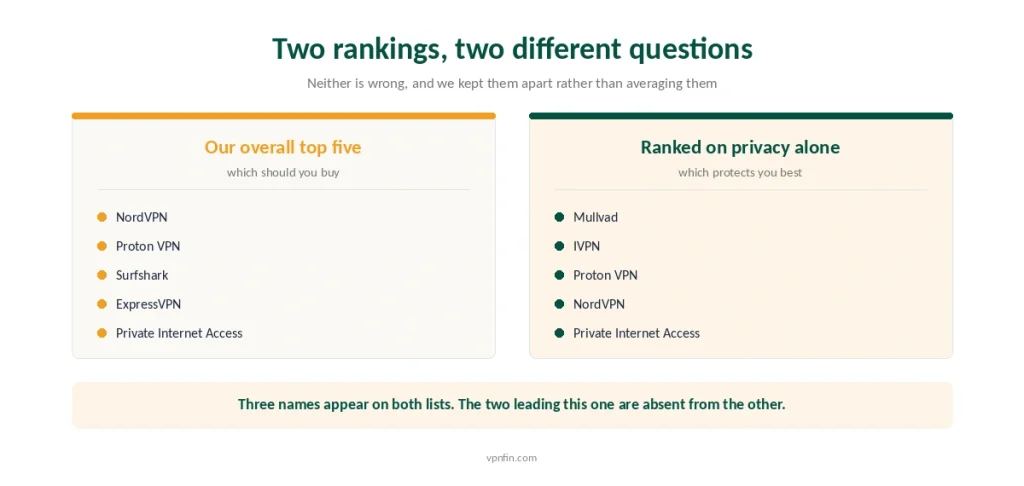
Worth saying plainly, because absence is information.
ExpressVPN and CyberGhost are audited and competent, and both belong to the same parent as the entry above them. Concentration is a privacy consideration in itself.
Surfshark is fast, cheap and audited twice. It is our overall number three and does not belong in a top five on evidence alone.
Anything with no audit does not appear. TorGuard has a decade of operation and no report; PrivadoVPN relocated over a surveillance law and still publishes nothing. Good intentions are not evidence.
How This Differs From Our Main Ranking
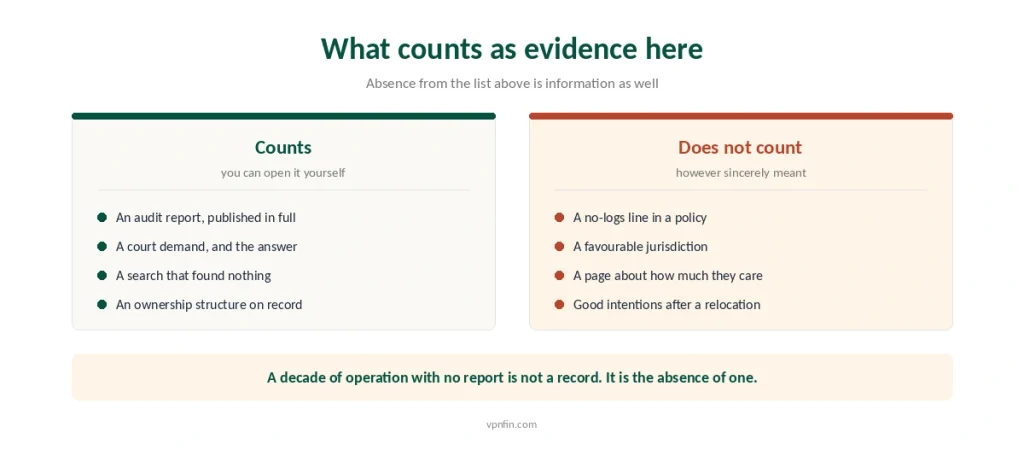
Our overall top five is NordVPN, Proton VPN, Surfshark, ExpressVPN and Private Internet Access. Three of those appear here, and the two at the top of this page are not in that list at all.
Neither ranking is wrong. They answer different questions, and a reader who wants Netflix in four countries should use the other one.
⚠️ We have kept them separate rather than reweighting the scale, because a single score that satisfies both questions ends up answering neither.
The Things That Would Change This Page
A court test for Mullvad or IVPN, which neither has had beyond the 2023 raid.
Resolution of the Swiss position, which would either confirm Proton’s jurisdiction or confirm its move.
A first audit from any of the unaudited providers, which is a low bar and would change our assessment immediately.
Or a failure. A provider found holding what it said it did not hold would leave this list the same day.
How We Research
This ranking uses our own published tables for audit counts, auditors and jurisdictions, our own reviews for ownership and account requirements, and our page on no-logs claims for the documented court and police tests. No provider paid for a position, and two of the top three run no affiliate programme at all, so no commission was available for them. We do not run our own tests and do not claim to — every fact above is one you can verify from the primary sources we name. Our method lives on the About Us page.
Privacy VPN FAQ
Mullvad, on the evidence available. It publishes audits annually, is owned outright by its two founders, requires no email address to open an account, and in April 2023 police searched its office and left with nothing because there was nothing to seize.
Our overall score weighs five criteria including streaming and ease of use, which have nothing to do with privacy. This page removes them and ranks on audits, real-world tests, ownership and architecture alone. Both answers are correct for their own question.
Less than most rankings suggest. Switzerland proposed extending retention duties to VPN providers, and Sweden’s surveillance framework reaches the device before encryption regardless of where a company is registered. A provider holding no records is protected anywhere; one holding records is exposed everywhere.
Not from the top two. Mullvad bans affiliate marketing and IVPN abolished its programme on principle, so neither pays us anything. We earn from Proton VPN, NordVPN and Private Internet Access, and our disclosure covers that.
It is the minimum, not the answer. An audit examines whether records could exist at a moment in time. A court demand examines what happened when someone asked. Private Internet Access is the only provider we cover with the second kind of evidence.
The Verdict
Mullvad is the benchmark, and has been for years: audited annually, owned by two people, tested by police, and it earns us nothing.
Proton VPN is the answer for most people, because it is the first entry on this list that does not ask you to give up streaming, devices or a usable interface.
And jurisdiction deserves less weight than it gets. A flag is written by a government and can be rewritten by one. Audits, architecture and what a company did when someone knocked are the parts that survive.