
Disclosure: VPNFin is reader-supported. If you buy a VPN through links on this page, we may earn a commission at no extra cost to you. This never affects our ratings — here’s how we research.
This is the closest matchup we have run. On speed they finish three percentage points apart in the same test round. On no-logs audits it is three against two. Both run RAM-only servers, both unblock streaming reliably, both belong to large VPN holding companies rather than being the independents their marketing suggests.
Two things actually separate them, and neither is what comparison articles usually argue about: how many devices you can connect, and what you pay once the introductory term expires.
The Short Answer
Surfshark if you have more than fourteen devices — it allows unlimited simultaneous connections, and nothing else in this category does. It also renews $20 a year cheaper.
ExpressVPN if jurisdiction matters to you. The British Virgin Islands sits outside every intelligence-sharing arrangement; Surfshark’s Netherlands is a 9 Eyes member.
On everything else the difference is marginal, which is unusual enough to be worth saying plainly.
Head to Head
| ExpressVPN | Surfshark | |
|---|---|---|
| Speed loss (CNET) | 18% | 21% |
| No-logs audits | 3 (KPMG) | 2 (Deloitte) |
| Total published audits | 28 | 2 + security audits |
| Devices | 10 / 12 / 14 by tier | Unlimited |
| Countries | 113 | 100 |
| Jurisdiction | British Virgin Islands | Netherlands (9 Eyes) |
| Renewal | $99.95/yr | ~$79/yr |
| Refund window | 30 days | 30 days |
| Parent company | Kape Technologies | Nord Security |
| Our rating | 4.5 | 4.6 |
Speed: Three Points Apart
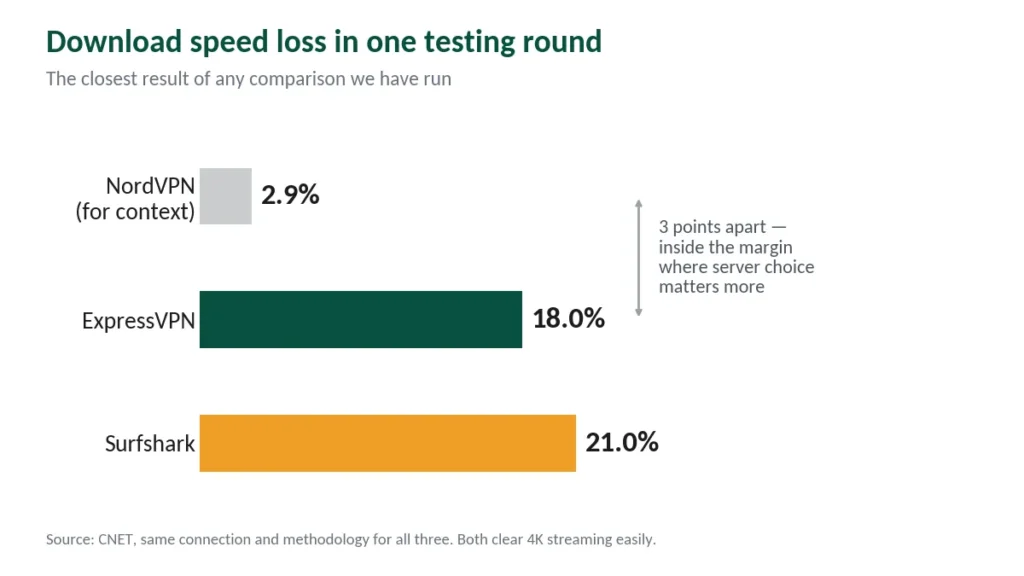
CNET tested both in the same round on the same connection. ExpressVPN lost 18% of baseline download speed, Surfshark 21%.
For context, NordVPN lost 2.9% in that same round — so both providers here sit well behind the category leader, and close to each other.
Other labs are kinder to each in turn. TechRadar clocked Surfshark above 950 Mbps on WireGuard. ExpressVPN’s Lightway Turbo mode has measured above 1,600 Mbps, though currently on Windows only.
What this means practically: nothing. Three percentage points is inside the margin where server choice, time of day and your own connection matter more than the provider. Neither will affect streaming, and on large transfers the difference is minutes rather than hours.
Winner: draw.
Devices: The Category That Decides It
Surfshark allows unlimited simultaneous connections on every tier. No cap in the terms, no higher plan that adds more.
ExpressVPN allows 10, 12 or 14 depending on which tier you buy — Basic, Advanced or Pro. It is the only major provider where the device limit rises with the price.
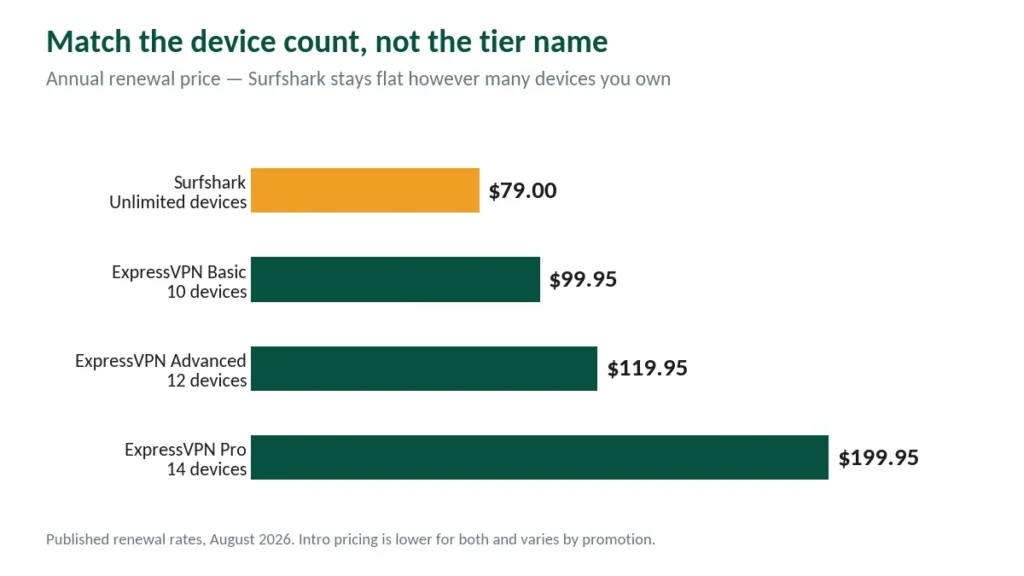
That structure matters more than the raw numbers. If your household needs twelve connections, you are not comparing Surfshark’s entry plan against ExpressVPN’s entry plan — you are comparing it against ExpressVPN Advanced, which renews at $119.95 rather than $99.95.
Count honestly: two phones, two laptops, a tablet, a smart TV, a console and a streaming stick is eight before anyone visits.
| Provider | Simultaneous | Notes |
|---|---|---|
| NordVPN | 10 | — |
| Surfshark | Unlimited | no cap in terms |
| ExpressVPN | 10/12/14 | by tier |
| CyberGhost | 7 | router counts as one |
| PureVPN | 10 | up to 50 with paid add-on |
| IPVanish | Unlimited | no cap on any plan |
| Windscribe | Unlimited | including Build a Plan |
| Private Internet Access | Unlimited | no tier gating |
| Mullvad | 5 | no paid add-on |
| TunnelBear | Unlimited | no cap on any plan |
| Norton VPN | 5 | 10 on Ultimate, US only |
| Hotspot Shield | Disputed | sources give five and ten |
| IVPN | 5 | 10 on Pro Suite |
| PrivadoVPN | 10 | 1 on the free tier |
| StrongVPN | 12 | more than either market leader |
| PrivateVPN | 10 | free dedicated IP on one plan |
| VyprVPN | Disputed | sources give five and ten |
Winner: Surfshark, and it is the clearest result in this comparison.
Privacy: Closer Than the Headline Numbers
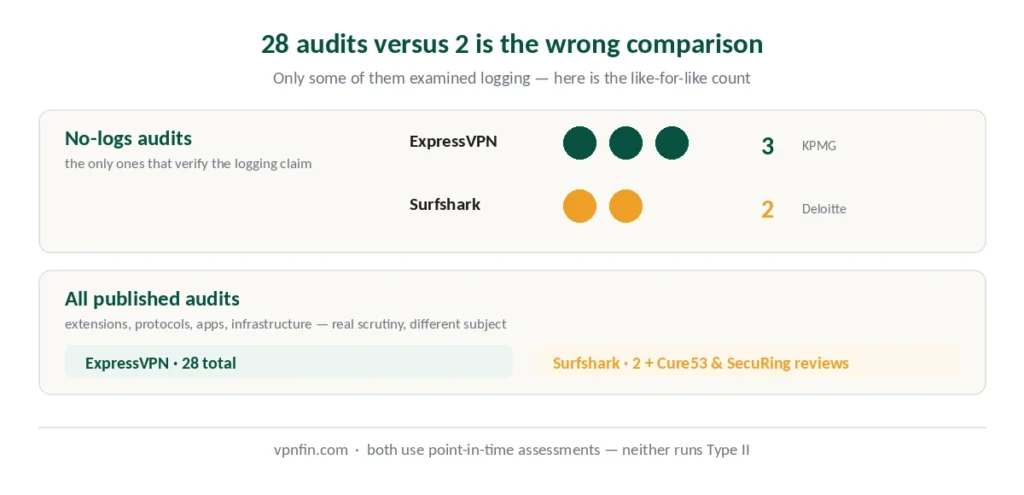
ExpressVPN publishes 28 independent audits, Surfshark publishes far fewer. That comparison is misleading, and it is worth correcting.
Three of ExpressVPN’s 28 examined the no-logs claim, all by KPMG, the most recent published in June 2025 covering the system as of 28 February 2025. The other 25 audited browser extensions, protocols, apps and infrastructure — real scrutiny, different subject.
Surfshark has two no-logs assurance reports, both by Deloitte, in 2023 and June 2025 under the ISAE 3000 standard. It has also commissioned Cure53 audits of its extensions and infrastructure, and a SecuRing infrastructure review in December 2025.
So on logging verification it is three against two — close. On total published scrutiny ExpressVPN is well ahead.
One caveat applies to both: every audit either company publishes is a point-in-time assessment. Neither runs Type II engagements, which would test whether controls held over months. We cover that distinction in our NordVPN vs ExpressVPN comparison, and it is an industry-wide limitation rather than a fault of either.
Jurisdiction is where they genuinely diverge. ExpressVPN operates from the British Virgin Islands, outside the 5, 9 and 14 Eyes arrangements. Surfshark operates from the Netherlands, a 9 Eyes member — though Dutch law imposes no data-retention obligation on VPN providers, and Surfshark’s RAM-only servers limit what could exist to hand over.
Winner: ExpressVPN on jurisdiction, marginal on audits.
Price: Surfshark, and the Gap Grows With Tiers
Intro pricing is close — roughly $3.49 a month for ExpressVPN Basic against $2.49 for Surfshark Starter, both billed upfront.
At renewal: ExpressVPN Basic converts to $99.95 a year, Surfshark Starter to roughly $79. That is $20 annually in Surfshark’s favour.
But the real gap appears when you match capability. ExpressVPN Advanced, which allows 12 devices, renews at $119.95. Pro, with 14, renews at $199.95. Surfshark’s unlimited connections cost $79 regardless.
For a single user, $20 a year. For a household, the difference can reach $120.
Our cheap VPN guide puts both into four-year totals alongside the rest of the field.
Winner: Surfshark.
Features and Ownership
ExpressVPN covers 113 countries — the widest here — with TrustedServer running everything from RAM, obfuscation that works more reliably on restricted networks, and Aircove, a router with the VPN in its firmware. Its higher tiers bundle a password manager, identity monitoring and a dedicated IP.
Surfshark puts every VPN feature in its cheapest tier: CleanWeb ad and tracker blocking, MultiHop double-routing, Bypasser split tunnelling, and Alternative ID for throwaway signup identities. P2P works across the entire network.
Neither offers port forwarding, which our torrenting guide covers as a deciding factor for seeders.
On ownership, neither is independent. ExpressVPN belongs to Kape Technologies, which also owns CyberGhost and Private Internet Access. Surfshark merged with Nord Security in 2022, making it a sibling of NordVPN. Both operate separately from their siblings, but consolidation is the norm in this market.
Which Should You Buy?
Buy Surfshark if you have more than ten devices, you want every feature in the cheapest tier, or you intend to keep the subscription past year one. Full detail in our Surfshark review.
Buy ExpressVPN if jurisdiction is a first-order concern, you travel to countries where VPNs get blocked, or you want the widest country coverage. Full detail in our ExpressVPN review.
And if neither feels decisive, that is a reasonable reading of the evidence. Three percentage points on speed and one audit apart is not a gap you should agonise over — pick on devices and price, which is where the actual difference lives.
How We Research
This comparison draws on our full reviews of both providers, published audit records from KPMG, Deloitte, Cure53 and SecuRing, speed results from named independent labs including CNET and TechRadar, and renewal figures taken from each provider’s own checkout terms — cross-checked and verified at publication. Where the industry’s standard framing misleads, as it does with audit counts that measure different things, we correct it. Our full approach lives on the About Us page.
ExpressVPN vs Surfshark FAQ
Neither meaningfully. CNET tested both in the same round and measured 18% download loss for ExpressVPN against 21% for Surfshark — three percentage points apart, which is inside the range where server choice and time of day matter more than the provider. For context, NordVPN lost 2.9% in that same round.
Surfshark, by a wide margin. It permits unlimited simultaneous connections on every tier. ExpressVPN allows 10 on Basic, 12 on Advanced and 14 on Pro — the only major provider whose device limit rises with price, which means matching a large household means paying for a higher tier.
Surfshark, at roughly $79 a year against ExpressVPN Basic’s $99.95. The gap widens if you need more devices: ExpressVPN Advanced renews at $119.95 and Pro at $199.95, while Surfshark’s unlimited connections stay at $79 regardless.
Depends what you count. ExpressVPN publishes 28 independent audits in total, but three examined the no-logs claim specifically, all by KPMG. Surfshark has two no-logs assurance reports by Deloitte, plus Cure53 and SecuRing audits of extensions and infrastructure. On logging verification it is three against two.
For privacy purposes, marginally. The BVI sits outside the 5, 9 and 14 Eyes intelligence-sharing arrangements; the Netherlands is a 9 Eyes member. In practice Dutch law imposes no data-retention obligation on VPN providers, and both companies run RAM-only servers, so there is little stored to compel either way.
Neither. ExpressVPN was acquired by Kape Technologies, which also owns CyberGhost and Private Internet Access. Surfshark merged with Nord Security in 2022, making it a sibling of NordVPN. Both brands run separate infrastructure and commission their own audits, but consolidation is the norm in this market.
The Verdict
Surfshark edges it, and ranks second in our top 5 against ExpressVPN’s third. Unlimited devices is a structural advantage nothing else in this category matches, and renewing $20 cheaper compounds every year you stay.
ExpressVPN’s case is narrower but real. A jurisdiction outside every intelligence bloc, the widest country coverage, and the deepest published scrutiny of any provider we rank. If those are your priorities, the $20 is not the deciding factor.
What should not decide it: three percentage points of speed. Both are mid-field, both clear everything you will actually do, and the difference is smaller than the variation between two servers of the same provider.