
Disclosure: VPNFin is reader-supported. If you buy a VPN through links on this page, we may earn a commission at no extra cost to you. This never affects our ratings — here’s how we research.
These are the two most recommended VPNs on the internet, and most comparisons between them get two things wrong. They quote ExpressVPN’s 28 audits against NordVPN’s six without noting that those numbers count different things. And they stop at the intro price, where NordVPN looks cheaper — while at renewal it costs $40 a year more. This NordVPN vs ExpressVPN comparison fixes both, and covers the speed gap that is not close.
The Short Answer
NordVPN wins on the measurables. It is dramatically faster in like-for-like testing, it has more no-logs audits when you compare like with like, and it operates from Panama rather than a British territory.
ExpressVPN wins on price after year one — $99.95 against NordVPN’s $139.08 — and on ease of use, restricted-network access, and the sheer breadth of its published verification.
Head to Head
| NordVPN | ExpressVPN | |
|---|---|---|
| Speed loss (CNET) | 2.9% | 18% |
| No-logs audits | 6 | 3 (KPMG) |
| Total published audits | 6 | 28 |
| Devices | 10 | 10 / 12 / 14 by tier |
| Countries | ~150 | 113 |
| Jurisdiction | Panama | British Virgin Islands |
| Intro (2-year) | ~$3.09–3.49/mo | ~$3.49/mo |
| Renewal | $139.08/yr | $99.95/yr |
| Our rating | 4.8 | 4.5 |
Speed: Not Close
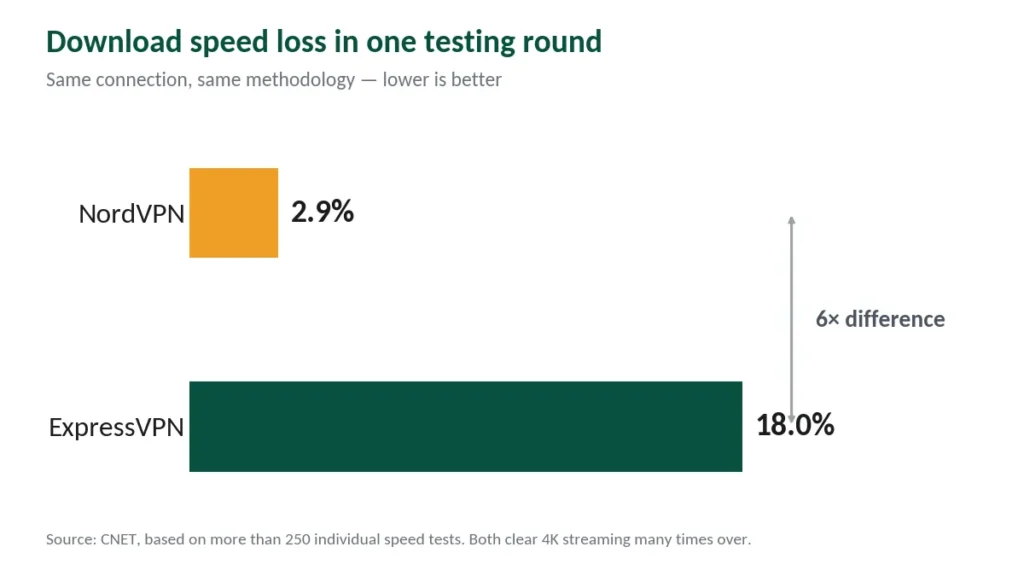
CNET tested both in the same round on the same connection. NordVPN lost 2.9% of baseline download speed. ExpressVPN lost 18%.
In other words, that is a six-fold difference — and it is the widest gap in this comparison. Independent testing has also placed NordVPN first in a 15-provider field at 86% average speed retention.
However, ExpressVPN is not slow. Its Lightway protocol was rewritten in Rust in 2025 and kept to roughly 2,000 lines specifically so it could be audited properly. Its Turbo mode has measured above 1,600 Mbps in testing, though currently on Windows only. On a normal connection you will not notice the difference — 4K streaming needs 15 to 25 Mbps and both clear that many times over.
Where it shows: gigabit fibre, large transfers, long international routes. Full detail in our NordVPN review and our ExpressVPN review.
Winner: NordVPN.
Audits: Everyone Is Comparing the Wrong Numbers
This is where most comparisons mislead, and the correction matters.
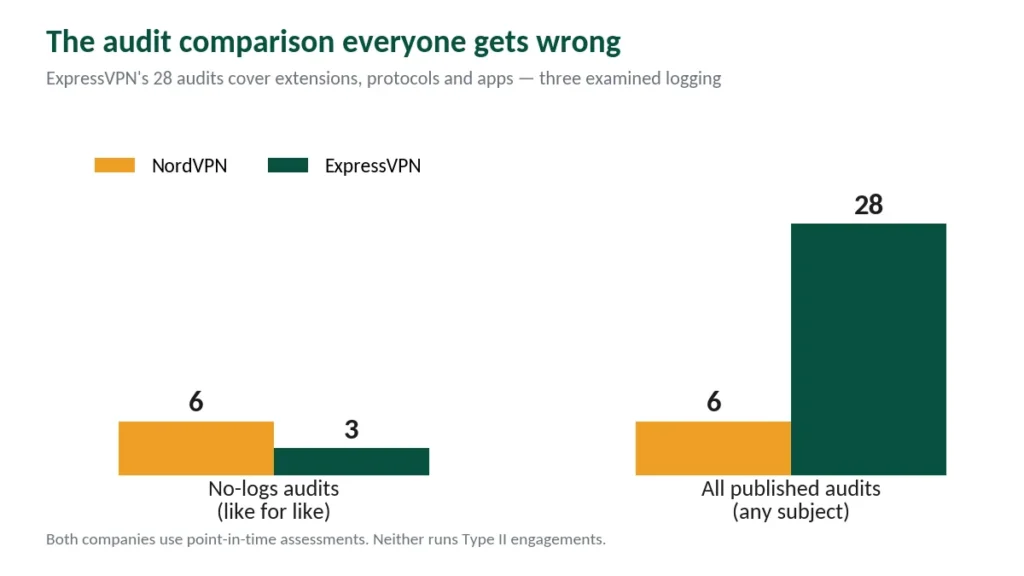
ExpressVPN’s trust center lists 28 independent audits. That figure is real. But it counts every engagement the company has commissioned: browser extension reviews by Cure53, protocol audits by Praetorian, app audits by F-Secure, infrastructure reviews. Three of those 28 examined the no-logs claim, all by KPMG, the most recent published in June 2025 covering the system as of 28 February 2025.
NordVPN’s six audits are all no-logs engagements. Two by PricewaterhouseCoopers, four by Deloitte, running annually from 2018 through the end of 2025. The sixth ran from 10 November to 12 December 2025, with Deloitte practitioners interviewing staff and inspecting server infrastructure, configurations and deployment processes across standard, Double VPN, Onion Over VPN and obfuscated servers.
So the honest comparison is 6 against 3 on logging verification, and 6 against 28 on total scrutiny. Both are true. They answer different questions.
| Provider | No-logs audits | Auditor | Jurisdiction |
|---|---|---|---|
| NordVPN | 6 | PwC, Deloitte | Panama |
| Surfshark | 2 | Deloitte | Netherlands (9 Eyes) |
| ExpressVPN | 3 | KPMG | British Virgin Islands, Kape-owned |
| CyberGhost | 3 | Deloitte | Romania, Kape-owned |
| PureVPN | 4 | KPMG | BVI, operated from Pakistan |
| IPVanish | 2 | Leviathan, Schellman | United States (Five Eyes), Ziff Davis-owned |
| Windscribe | 1 | Packetlabs, production infrastructure | Canada (Five Eyes); Greek case dismissed, no data to give |
| Proton VPN | 5 | Securitum | Switzerland, moving infrastructure to EU |
| Private Internet Access | 3 | Deloitte | United States (Five Eyes), Kape-owned |
| Mullvad | 10+ | Cure53, Assured AB | Sweden (14 Eyes) |
| TunnelBear | Annual since 2017 | Cure53 | Canada (Five Eyes), US parent |
| Norton VPN | 2 | VerSprite | United States (Five Eyes) |
| Hotspot Shield | 0 | protocol audited, policy not | United States (Five Eyes) |
| AirVPN | 0 | none — the client is open source instead | Italy (14 Eyes) |
| IVPN | 8, annual since inception | Cure53 | Gibraltar (status disputed) |
| Hide.me | 1 modern, in 2024 | Securitum, though one source names Altius IT | Malaysia (outside the alliances) |
| PrivadoVPN | 0 | none in six years of operation | Iceland (moved from Switzerland, 2026) |
| TorGuard | 0 | none; settled a lawsuit without disclosing records | United States (Five Eyes) |
| FastestVPN | 1, in 2023 | Altius IT | Cayman Islands (outside the alliances) |
| StrongVPN | 0 | none in over two decades | United States (Five Eyes), Ziff Davis-owned |
| VyprVPN | 1, in 2018 | Leviathan Security, before the 2023 sale | United States (Five Eyes), Certida-owned since 2023 |
| PrivateVPN | 0 | none; support says there is nothing to audit | Sweden (14 Eyes), ownership disputed |
| ZoogVPN | 0 | none; support describes one as planned | Greece (outside the alliances), run from Ukraine |
The Part Neither Company Advertises
Every one of these audits — on both sides — is a point-in-time assessment. NordVPN uses that exact phrase for its sixth engagement. ExpressVPN’s KPMG report was conducted under ISAE 3000 Type 1, which examines the design of controls at a moment rather than their operation over a period.
Meanwhile, nobody in this industry runs Type II engagements, which would test whether controls actually held over months. That is worth knowing before you treat any audit count as proof of continuous behaviour. It is evidence about architecture, not a guarantee about conduct.
Jurisdiction splits cleanly. NordVPN operates from Panama, outside every intelligence-sharing arrangement, with no data-retention law. ExpressVPN operates from the British Virgin Islands, also outside those blocs, but a British Overseas Territory — which some privacy commentators consider a meaningful distinction and others do not.
Winner: NordVPN on logging verification, ExpressVPN on breadth.
Price: The Comparison Everyone Stops Too Early
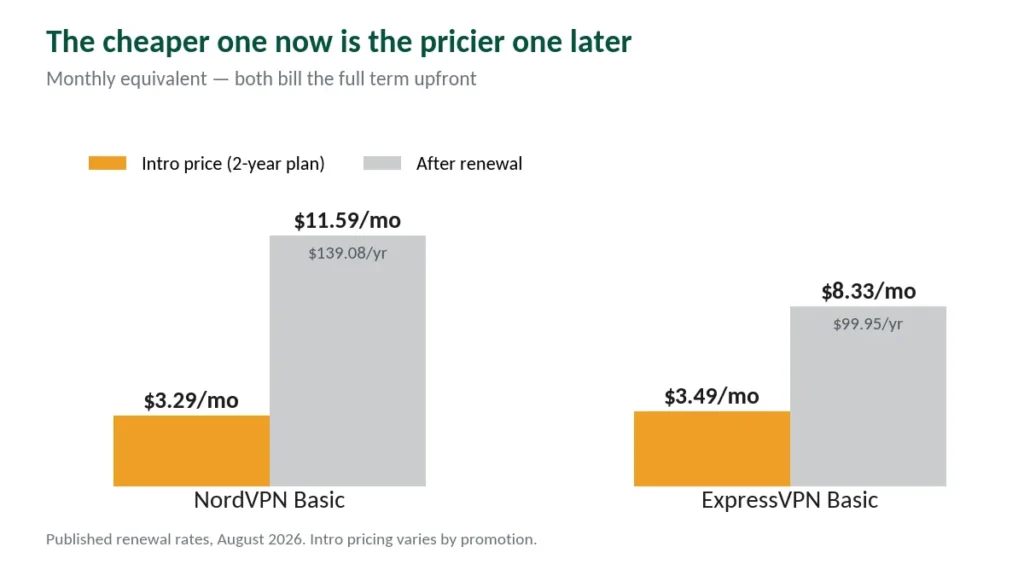
Intro pricing looks close. NordVPN Basic runs roughly $3.09–3.49 a month on a two-year plan; ExpressVPN Basic sits near $3.49. Both bill the full term upfront.
Then the first term ends.
NordVPN Basic renews at $139.08 a year. That figure appears in NordVPN’s own checkout small print — about $11.59 a month.
ExpressVPN Basic renews at $99.95 a year — about $8.33 a month.
That is a $39 annual difference in ExpressVPN’s favour, and it reverses the reputations. ExpressVPN has spent years being the expensive one; on renewal it is the cheaper one, at least at entry level. ExpressVPN’s higher tiers do climb — $119.95 for Advanced and $199.95 for Pro — but those buy more devices and bundled tools rather than a better VPN.
What Renewal Actually Costs
Auto-renewal is on by default for both. Whichever you choose, note the renewal figure at purchase. Over four years the gap widens to about $73 in ExpressVPN’s favour — we run the numbers here.
| Provider | Renewal price | Per month | Tier |
|---|---|---|---|
| NordVPN | $139.08/yr | ~$11.59 | Basic |
| Surfshark | ~$79/yr | ~$6.58 | Starter |
| ExpressVPN | $99.95/yr | ~$8.33 | Basic |
| CyberGhost | $56.94/yr | ~$4.75 | 2-year |
| PureVPN | $47.95/yr | ~$4.00 | Standard |
| IPVanish | $89.99/yr | ~$7.50 | Essential |
| Windscribe | ~$69/yr | ~$5.75 | Pro |
| Proton VPN | ~$83.88/yr | ~$6.99 | VPN Plus |
| Mullvad | ~$65/yr | ~$5.40 | flat, no tiers |
| Norton VPN | $79.99/yr | ~$6.67 | Standard |
| Hotspot Shield | ~$95.99/yr | ~$8.00 | Premium annual |
Winner: ExpressVPN.
Devices and Features
NordVPN allows 10 simultaneous connections on every plan. ExpressVPN allows 10, 12 or 14 depending on tier — the only major provider where the device limit scales with price. If your household needs 12, that changes the price comparison above.
NordVPN’s extras have no ExpressVPN equivalent: Double VPN routes traffic through two servers, Onion Over VPN combines with Tor, and Meshnet links up to 60 of your own devices privately. Threat Protection Pro blocks malware and scans downloads, but only from the Plus tier upward.
ExpressVPN’s extras favour reach and polish: coverage of 113 countries, TrustedServer running everything from RAM, obfuscation that works more reliably on restricted networks, and Aircove — a router with the VPN built into its firmware. Its higher tiers add a password manager, identity monitoring and a dedicated IP.
On the other hand, neither offers port forwarding. Both support P2P — NordVPN on dedicated servers, ExpressVPN across the network.
Which Should You Buy?
Buy NordVPN if: speed matters, you want the deepest verification of the logging claim specifically, or you use Double VPN and Onion routing. Panama is also the cleaner jurisdiction on paper.
Buy ExpressVPN if: you intend to keep the subscription past year one, you travel to places where VPNs get blocked, or you want the simplest apps in the category. It is also the pick if you need 12 or 14 devices.
Buy neither if you have more devices than either covers — our Surfshark review explains why unlimited connections beat any tiered limit, and our NordVPN vs Surfshark comparison puts that case directly. ExpressVPN against Surfshark is a separate matchup.
How We Research
This comparison draws on our full reviews of both providers, published audit announcements from PwC, Deloitte, KPMG and Cure53, speed results from named independent labs, and renewal figures taken from each provider’s own checkout terms — cross-checked and verified at publication. Where the industry’s own framing is misleading, as with audit counts that measure different things, we say so. Our full approach lives on the About Us page, and both appear in our current top 5 rankings.
NordVPN vs ExpressVPN FAQ
NordVPN, by a wide margin. CNET tested both in the same round and measured a 2.9% average download loss for NordVPN against 18% for ExpressVPN. On a normal connection neither will affect streaming — 4K needs 15 to 25 Mbps and both clear that easily. The gap shows on gigabit lines, large transfers and long international routes.
It depends what you count. ExpressVPN publishes 28 independent audits in total, but three of those examined the no-logs claim, all by KPMG. NordVPN has six audits, all of them no-logs engagements, running annually from 2018 to the end of 2025. So it is 6 against 3 on logging, and 6 against 28 on total scrutiny.
NordVPN Basic renews at $139.08 a year, about $11.59 a month. ExpressVPN Basic renews at $99.95, about $8.33. That makes ExpressVPN roughly $39 a year cheaper on renewal, reversing the intro pricing where NordVPN looks slightly cheaper. Auto-renewal is enabled by default on both.
NordVPN allows 10 simultaneous connections on every plan. ExpressVPN allows 10 on Basic, 12 on Advanced and 14 on Pro — the device limit rises with the tier, which is unusual. If you need more than 10, factor the higher ExpressVPN tier into the price comparison.
Both sit outside the 5, 9 and 14 Eyes intelligence-sharing arrangements and neither imposes data-retention obligations on VPN providers. Panama has no connection to any Western government; the BVI is a British Overseas Territory, which some privacy commentators consider a meaningful difference and others do not. In practice, both run RAM-only servers, so there is little stored to compel.
No, and this applies to both. Every audit either company has published is a point-in-time assessment — it examines systems as they were during the engagement window. Neither runs Type II engagements, which would test whether controls held over an extended period. The audits are evidence about architecture, not a guarantee about conduct over time.
The Verdict
NordVPN takes it, and ranks first in our top 5. Six times less speed loss in like-for-like testing, twice as many audits of the logging claim, and a jurisdiction outside every intelligence bloc. Those are the measurables, and it wins all three.
That said, ExpressVPN ranks third and the gap is smaller than that suggests. It renews $39 a year cheaper, it has published more third-party scrutiny than anyone in the category, and its apps are the easiest to live with. If you plan to stay past year one, the money argument is genuinely on its side.