
Disclosure: VPNFin is reader-supported. If you buy a VPN through links on this page, we may earn a commission at no extra cost to you. This never affects our ratings — here’s our full disclosure.
Russia blocks more VPN services than any framework we have looked at. It fines the people who advertise them. It has put filtering equipment at every provider to detect them. None of that makes using one an offence.
The distinction matters more here than anywhere else on this site. Russian law punishes one set of things. Most English-language coverage describes another, and the gap is unusually wide.
Is a VPN Legal in Russia?
Yes. Using a VPN is not an administrative or criminal offence in Russia. One provision of the Administrative Code mentions VPNs by name. It penalises knowingly searching for material on the state extremist register. The VPN sits in that sentence as a method rather than as the offence. The fine is 3,000 to 5,000 rubles, roughly $40 to $65.
What the Law Actually Names
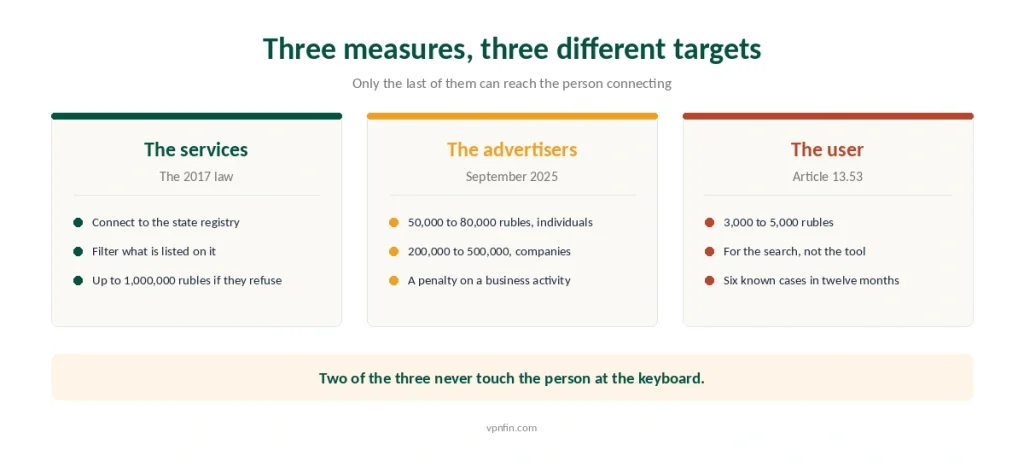
Three separate things happened, and they land on three separate parties.
The 2017 law landed on the services. VPN operators were required to connect to a state system listing blocked resources and to filter them. Providers that refuse can be fined up to one million rubles, Meduza reported when the current penalties took effect. Nothing in that arrangement reaches a subscriber.
The September 2025 amendments landed on advertisers. Promoting a VPN now costs an individual 50,000 to 80,000 rubles, an official 80,000 to 150,000, and a company 200,000 to 500,000. That is a penalty for a business activity, and it is why the pattern here rhymes with the Turkish law, which also targets the operator rather than the person connecting.
Only the third one reaches a user. Article 13.53 of the Administrative Code took effect on 1 September 2025. It penalises knowingly searching for and accessing material on the Justice Ministry’s extremist register. The statute names tools that get around blocks as one route to the offence.
⚠️ Read the object of that sentence carefully. The offence is the search. The VPN appears as one route to committing it. A car appears the same way in a speeding statute.
The One Fine That Can Reach You
Worth stating precisely, because the figure gets inflated in retelling.
Three thousand to five thousand rubles, which is about $40 to $65 — a parking-ticket amount, not a life-altering one. It applies to individuals and it is an administrative penalty rather than a criminal one.
The register it points at is real and enormous. The Justice Ministry list held 5,473 entries when the bill passed, and Russia has designated organisations, a broadly defined LGBT “movement” and even Instagram as extremist.
⚠️ The vagueness is the actual problem, not the money. Digital Development Minister Maksut Shadayev told a cabinet meeting the law would not apply to ordinary users who do not deliberately seek prohibited material, even when they use a VPN. That is a reassurance from a minister, however, and not a definition in the statute.
This puts Russia alongside China, where the rule also names the person at the keyboard. Most of the frameworks we have examined stop at the platform or the provider. These two do not.
What Has Actually Happened
The count is the part nobody publishes, so we went looking for it.
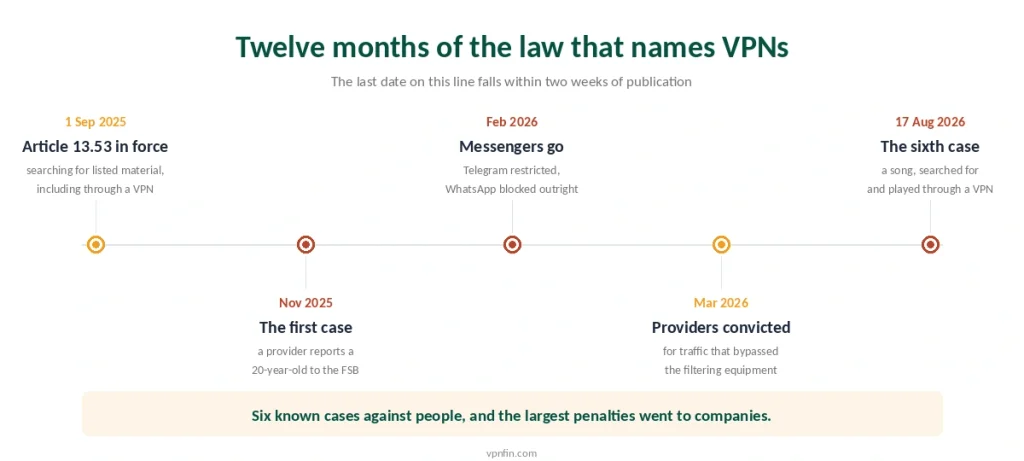
The first case opened in November 2025, two months after the law took effect. A 20-year-old in the Sverdlovsk region was prosecuted under Article 13.53 after his internet provider reported him to the FSB. His lawyer said he had come across the material while browsing on public transport and had not gone looking for it.
By August 2026 the count stood at six. A teenager was charged for searching out an “extremist” song and playing it through a VPN, which Mediazona recorded as the sixth known case since the law came into force.
⚠️ Six known cases in twelve months, in a country of 140 million. That is not nothing, and it is also not the enforcement wave the headlines implied. Meanwhile India’s directive produced its effect on the providers instead, and the same is broadly true here.
The prosecutions that did scale up went after companies. In March 2026 magistrates’ courts in Moscow and St Petersburg began convicting internet providers whose traffic reached blocked sites without passing through the state filtering equipment, according to Mediazona’s review of the case files.
Legality Is Not the Thing That Changed
What has changed is whether the tool works at all, and that is a technical question rather than a legal one.
Roskomnadzor had restricted 439 VPN services by early 2026, a figure CNN reported alongside the WhatsApp block. Deep packet inspection equipment sits at every provider’s node, which lets the regulator recognise and throttle VPN protocols rather than merely blacklisting addresses.
February 2026 removed most of what was left. WhatsApp was blocked outright on the 12th, with the Kremlin pointing users towards Max, a state messenger; Telegram restrictions began two days earlier.
⚠️ We do not publish workarounds for any of this. Explaining how to defeat a national filtering system is not advice we can give responsibly to someone sitting inside it, and this page stops at what the law says. Checking whether your connection is actually protected is a different matter and works anywhere.
If You Are Visiting
Bringing a phone with a VPN already installed is not an offence, and no published case involves a foreign visitor. Install and pay before you arrive, because app stores and card payments inside the country have both been narrowed — our travel guide covers the general version of that habit.
The behaviour rule is the one to internalise. As in the UAE, where the law never mentions VPNs and punishes the conduct behind them, what you do through the connection is what a Russian statute can reach.
⚠️ A VPN does not change which law applies to you. It moves your apparent location and nothing else, which is the same point the American page makes at length about a very different legal system.
If You Live There
Nothing in this page is a recommendation to do anything, and the calculation belongs to the person making it rather than to a review site in Southeast Asia.
Two facts are worth holding together. Using a VPN carries no penalty, and the material you reach through one can. What a VPN hides and what it does not is the honest starting point, because a tunnel protects the transport rather than the destination.
⚠️ Not legal advice. We are not lawyers, Russian administrative practice moves faster than any English-language summary, and anyone whose exposure is real should ask someone qualified inside the jurisdiction.
| Country | What the rule aims at | Reaches the user? |
|---|---|---|
| Turkey | The tunnel — ISPs must block | No |
| The UAE | Conduct behind an address | No |
| India | The provider's records | Not nationally |
| China | Provider, tunnel and user | Yes |
| Brazil | Nothing, until a court acts | For 39 days |
| Indonesia | Paperwork — registration | No |
| The UK | The destination you visit | No, and ministers said so |
| The US | The platform, state by state | No, in all twenty-seven |
| Russia | The search, not the tool | Only if you went looking |
| Australia | The platform, and the tunnel itself | No — platforms must detect it |
| France | The VPN provider itself | No, the orders bind five companies |
| Italy | The provider, by regulator order | No, but one VPN left the market |
| Spain | The provider, by injunction without a hearing | No, and only two firms were named |
| Germany | The provider's logfile, for three months | No, and the courts twice removed it |
What This Means for a Provider Choice
Jurisdiction is the variable that matters here, and it is why the providers that come up in this context tend to be the ones outside intelligence-sharing arrangements. Proton VPN operates from Switzerland with five published audits, and Mullvad issues an account number instead of asking for an email address.
Neither of those facts helps against deep packet inspection, which is a protocol problem rather than a corporate one. We would rather say that plainly than imply a subscription solves a national filtering system.
How We Research
This page draws on the text of the September 2025 amendments as reported by Meduza, Human Rights Watch and the Committee to Protect Journalists; Euronews and Meduza for the fine schedules; The Moscow Times for the first prosecution under Article 13.53 in November 2025; Novaya Gazeta Europe for the sixth known case in August 2026, citing Mediazona’s count; Mediazona via Zona.media for the March 2026 convictions of internet providers; and CNN for the February 2026 WhatsApp block and the number of restricted VPN services. We do not run our own tests and we do not publish circumvention instructions. Where the reporting on the adopted text and the earlier draft differed, we say so rather than picking the more dramatic version. Our full approach lives on the About Us page.
Russia VPN Law FAQ
No. Russian law contains no administrative or criminal offence for using a VPN, and no published case has punished someone for the tool alone. The state has instead required VPN services to filter blocked sites, fined the companies that refuse, and blocked hundreds of them outright.
Only indirectly. Article 13.53 of the Administrative Code, in force since September 2025, fines individuals 3,000 to 5,000 rubles for knowingly searching for material on the state extremist register, and it lists circumvention tools as one way of doing so. The penalty attaches to the search.
Six known cases in the first year, according to Mediazona’s count as reported in August 2026. The first opened in November 2025 in the Sverdlovsk region, after an internet provider reported a 20-year-old to the security service for material his lawyer said he had not sought out.
Often not. Roskomnadzor had restricted 439 services by early 2026 and operates deep packet inspection equipment at provider level, which recognises protocols rather than merely blacklisting addresses. Availability changes week to week, and that is a technical question rather than a legal one.
Yes. No published case involves a foreign visitor, and arriving with an app already installed is not an offence. Payment and app-store access inside the country have both narrowed, so anything you intend to use is easier to arrange before you travel.
The Verdict
Using a VPN in Russia is legal, and the state has spent five years making it difficult instead. Hundreds of services blocked, filtering equipment at every provider node, and fines aimed at the companies that sell and advertise the tools.
The single provision that can reach a person is about what was searched for. Three to five thousand rubles, six known cases in a year, and a minister on record saying it should not touch people who were not looking.
That is a different country from the one described in most coverage, and it is also not a comfortable one. The British answer put the duty on platforms and left users alone entirely; Russia leaves users mostly alone while narrowing what they can reach.