
Disclosure: VPNFin is reader-supported. If you buy a VPN through links on this page, we may earn a commission at no extra cost to you. This never affects our ratings — here’s our full disclosure.
One site, GreatFirewallGuide, has scored both Surfshark and Astrill in China with the same method, and the gap is wide. In its April 2026 results Astrill reached 98% bypass confidence on China Telecom, while Surfshark reached 65% success on the same carrier.
Other testers disagree about Surfshark more than about Astrill. Gizmodo and TheBestVPN found it working; one August review found it heavily blocked. Outside China, however, Surfshark is the stronger service by some distance: audited, cheaper and unlimited on devices. This page separates the two questions.
Surfshark vs Astrill: The Short Answer
For living in China, Astrill has the better record, at a price: $300 for two years, no audit, and disputed refund terms. Our Astrill review rates it 3.0.
For short trips and everything else, Surfshark is the better buy. It costs $67.23 for 27 months, has two Deloitte audits and no device limit. Our Surfshark review rates it 4.6.
Using an unapproved VPN in China is still a regulatory violation, with an individual fine of up to RMB 5,000, as our China legality page explains.
China: What the Tests Say
The one like-for-like comparison. GreatFirewallGuide scored Astrill at 98% on China Telecom’s CN2 GIA network and Surfshark at 65% on China Telecom in Shenzhen, both in April 2026. It calls Surfshark workable for email, messaging and light browsing, and ranks it as its budget choice.
Other Surfshark results vary. Gizmodo’s July guide says it works once you switch to OpenVPN over TCP and add NoBorders. The protocol change is what turns on Camouflage Mode. TheBestVPN reached all 19 test sites on two Chinese networks. VPNDada found the app sometimes struggled and manual setup worked better. Wallmama, in August, found it heavily blocked. VPNPicked’s June retest, meanwhile, put it at 92% of connection attempts.
Surfshark itself makes no promise. According to VPNPassport’s August summary, Surfshark’s China support page declines to guarantee access. Since May 2026 it has recommended manual WireGuard configurations when the app cannot connect. Our obfuscation guide explains why these modes help.
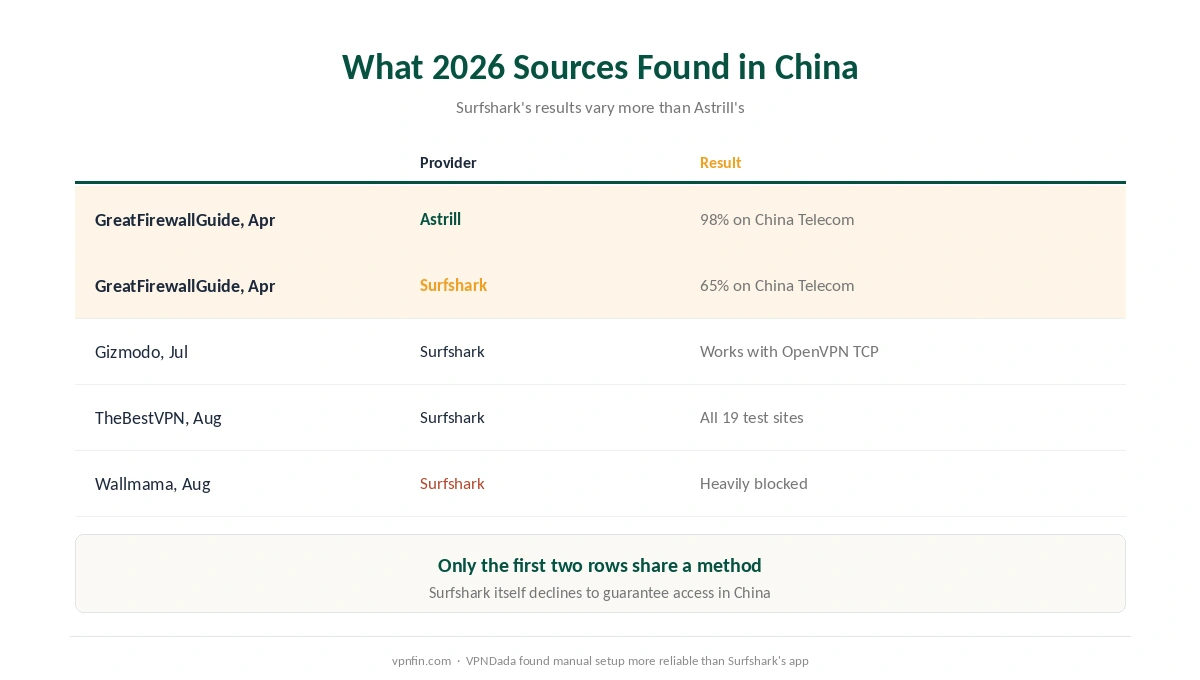
What 65% means in practice. GreatFirewallGuide measured about 350 milliseconds of latency and found that server cycling was often needed. That is fine for email, messaging and light browsing, but a video call or a working day on it will feel the gaps. Astrill’s advantage is consistency, which matters most on sensitive dates, when filtering tightens.
Setting Up Either One for China
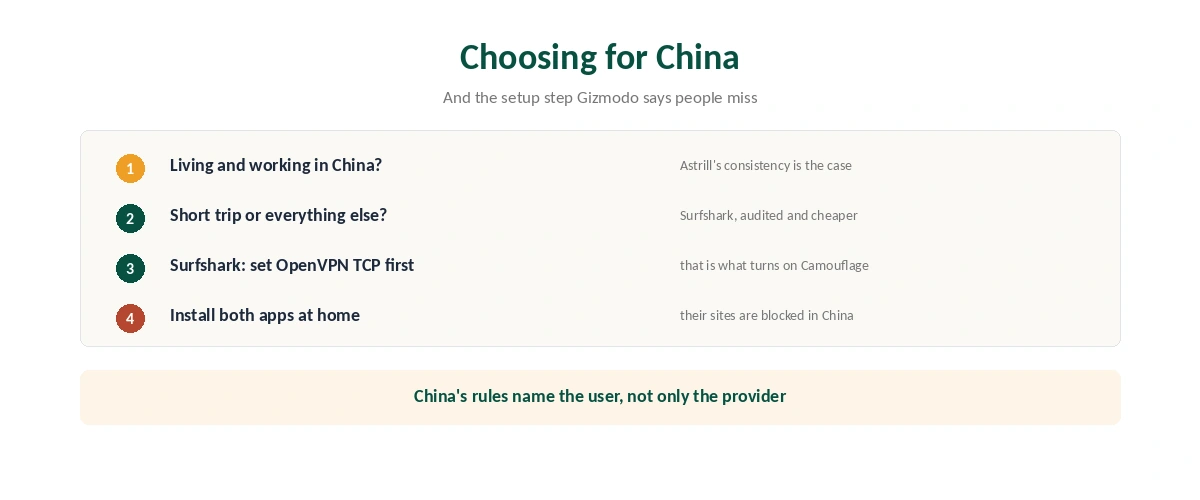
Surfshark: before you fly, set the protocol to OpenVPN over TCP so Camouflage Mode engages, then turn on NoBorders and the kill switch. Gizmodo suggests servers in Japan, Taiwan or Singapore, and says that without the protocol change it will almost certainly fail to connect.
Astrill: choose StealthVPN or OpenWeb, and GreatFirewallGuide suggests Hong Kong or Japan. On China Mobile, switching to TCP helps with evening throttling.
For both: install and log in at home, because the Great Firewall blocks both providers’ websites and the app stores. Our travel guide covers the rest of the preparation.
Privacy and Price
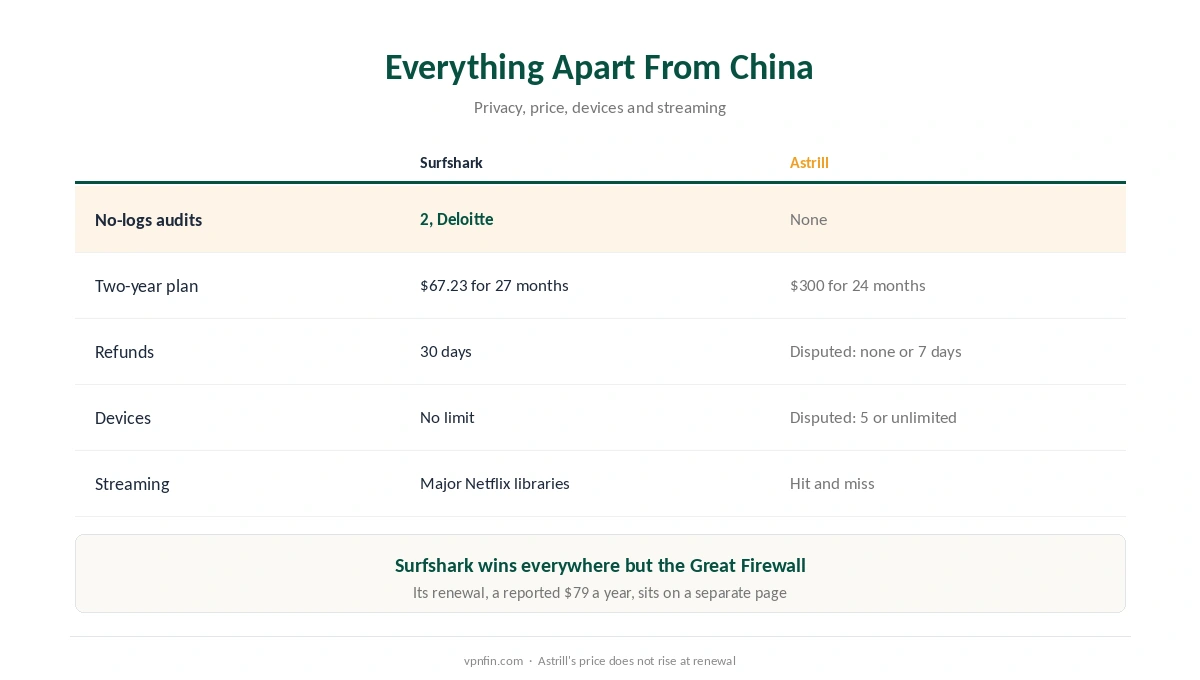
Surfshark has two no-logs assurance reports by Deloitte, from 2023 and 2025, and operates from the Netherlands. It belongs to Nord Security, which also owns NordVPN, as our ownership guide sets out. Astrill has no audit. It logs your IP address and connection details during a session, according to VPN.com, and our no-logs guide explains what that reveals. Our audit tracker compares both records.
| Provider | No-logs audits | Auditor | Jurisdiction |
|---|---|---|---|
| NordVPN | 6 | PwC, Deloitte | Panama |
| Surfshark | 2 | Deloitte | Netherlands (9 Eyes) |
| ExpressVPN | 3 | KPMG (28 security reports in total) | British Virgin Islands, Kape-owned |
| CyberGhost | 3 | Deloitte | Romania, Kape-owned |
| PureVPN | 4 | KPMG | BVI, operated from Pakistan |
| IPVanish | 2 | Leviathan, Schellman | United States (Five Eyes), Ziff Davis-owned |
| Windscribe | 1 | Packetlabs, production infrastructure | Canada (Five Eyes); Greek case dismissed, no data to give |
| Proton VPN | 5 | Securitum | Switzerland, moving infrastructure to EU |
| Private Internet Access | 3 | Deloitte | United States (Five Eyes), Kape-owned |
| Mullvad | 10+ | Cure53, Assured AB | Sweden (14 Eyes) |
| TunnelBear | Annual since 2017 | Cure53 | Canada (Five Eyes), US parent |
| Norton VPN | 2 | VerSprite | United States (Five Eyes) |
| Hotspot Shield | 0 | protocol audited, policy not | United States (Five Eyes) |
| AirVPN | 0 | none — the client is open source instead | Italy (14 Eyes) |
| IVPN | 8, annual since inception | Cure53 | Gibraltar (status disputed) |
| Hide.me | 1 modern, in 2024 | Securitum, though one source names Altius IT | Malaysia (outside the alliances) |
| PrivadoVPN | 0 | none in six years of operation | Iceland (moved from Switzerland, 2026) |
| TorGuard | 0 | none; settled a lawsuit without disclosing records | United States (Five Eyes) |
| FastestVPN | 1, in 2023 | Altius IT | Cayman Islands (outside the alliances) |
| StrongVPN | 0 | none in over two decades | United States (Five Eyes), Ziff Davis-owned |
| VyprVPN | 1, in 2018 | Leviathan Security, before the 2023 sale | United States (Five Eyes), Certida-owned since 2023 |
| PrivateVPN | 0 | none; support says there is nothing to audit | Sweden (14 Eyes), ownership disputed |
| ZoogVPN | 0 | none; support describes one as planned | Greece (outside the alliances), run from Ukraine |
| Malwarebytes Privacy VPN | 1, in 2026 | X41 D-Sec, white-box over two months | United States (Five Eyes), runs AzireVPN infrastructure |
| Astrill | 0 | — | Disputed: Seychelles or Liechtenstein |
Surfshark Starter costs $67.23 for 27 months, then a reported $79 a year, as our Surfshark price page explains. Astrill costs $30 a month, $180 a year or $300 for two years, and those amounts repeat at renewal.
Refunds differ. Surfshark gives 30 days from signing up. For Astrill, several reviews report none and others describe seven days, so confirm with its support first. Our refund guide explains the checks.
Devices and Streaming
Surfshark has no device limit. Astrill’s pricing page now claims unlimited devices in your household, while several reviewers counted five. Our multi-device guide compares the options.
Streaming favours Surfshark. It worked with the major Netflix libraries in this year’s tests, as our Surfshark and Netflix page records, while reviewers call Astrill hit and miss.
Which One
Astrill if you live or work in mainland China and cannot afford a failed connection, and you accept the cost and the open questions.
Surfshark for everyone else, including many short trips, as long as you configure it before you fly. For China on a budget, GreatFirewallGuide names it as a sensible backup. NordVPN against Astrill covers Surfshark’s sibling in the same situation.
How We Research
The China results come from GreatFirewallGuide, Gizmodo, TheBestVPN, VPNDada, VPNPassport and Wallmama, each dated where used and read on 25 September 2026. Prices come from each provider’s pricing page, read the same day, and Surfshark’s renewal from Security.org and VPNOverview. Our Surfshark and Astrill reviews supplied audits, logging, refunds and devices, and our China legality page the legal position. We do not run our own tests. Our full approach lives on the About Us page.
Surfshark vs Astrill FAQ
Partly, and sources disagree. GreatFirewallGuide measured 65% success on China Telecom in April 2026; Gizmodo and TheBestVPN found it working with the right setup; Wallmama found it heavily blocked. Use OpenVPN over TCP with NoBorders, set up before you fly.
On the one like-for-like test, yes: GreatFirewallGuide scored Astrill at 98% and Surfshark at 65% on China Telecom. Outside China, Surfshark has audits, costs less and streams better.
Surfshark by far. Its Starter plan costs $67.23 for 27 months, against $300 for two years of Astrill. Month to month, Astrill costs $30.
Using an unapproved VPN is a regulatory violation, and the rules set an individual fine of up to RMB 5,000. Enforcement is uneven, but the rule names the user.
Surfshark, on the evidence. It has two Deloitte no-logs reports. Astrill has no audit and logs some session data while you are connected.
The Verdict
For life in China, Astrill’s record justifies its price. For short trips and everything else, Surfshark has audits, costs far less and sets no device limit, and it works in China often enough to be a sound backup.
Whichever you choose, set it up before you travel, test the obfuscation modes at home, and keep a second option ready.