
Disclosure: VPNFin is reader-supported. If you buy a VPN through links on this page, we may earn a commission at no extra cost to you. This never affects our ratings — here’s our full disclosure.
ExpressVPN and Astrill are the two names that recur most often in China VPN guides, and this year’s tests back both of them. VPNPicked’s June retest found each connected in every attempt. GreatFirewallGuide, in April, put ExpressVPN first overall at 85% success and Astrill ahead on raw reliability at 98%, at about four times the price.
So the question is not which one works. It is what else you get, and what you pay for it. ExpressVPN brings automatic obfuscation, 28 published security reports and a 30-day refund. Astrill brings its StealthVPN protocol, a higher price, no audit and refund terms that reviewers dispute.
ExpressVPN vs Astrill: The Short Answer
For most travellers and expats, ExpressVPN is the better buy. It works in China with no settings to change, costs $83.72 for 28 months on the current Basic offer, and rates 4.5 in our ExpressVPN review.
Astrill makes sense if reliability during crackdowns outweighs everything else. It led GreatFirewallGuide’s reliability figures and suits people who live and work behind the firewall. It costs $300 for two years and rates 3.0 in our Astrill review.
Either way, using an unapproved VPN in China is a regulatory violation, with an individual fine of up to RMB 5,000, as our China legality page explains.
China: What the Tests Say
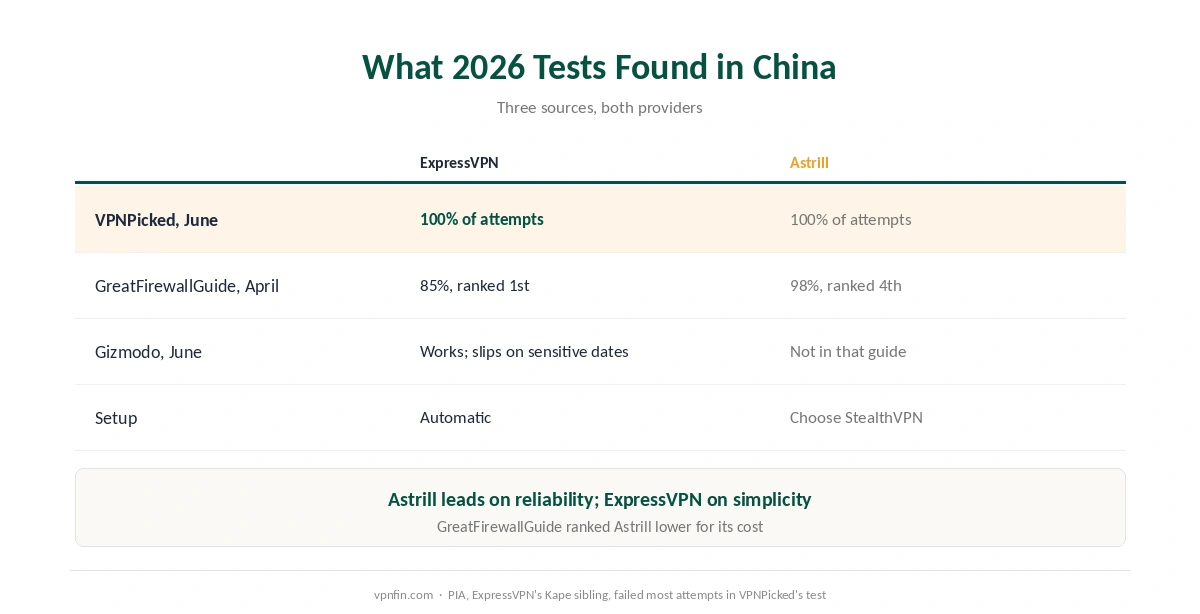
VPNPicked, June 2026: ExpressVPN and Astrill both connected in 100% of attempts. Surfshark managed 92% and NordVPN 86%, both Nord Security brands, while Mullvad, Proton VPN and PIA failed more than three quarters of the time. PIA’s result is a reminder that ownership guarantees nothing: it shares a parent, Kape Technologies, with ExpressVPN.
GreatFirewallGuide, April 2026: ExpressVPN scored 85% success on China Telecom in Shanghai, with 180 milliseconds of latency, and took first place overall for its mix of reliability, simplicity and value. Astrill scored 98%, the highest figure the site records, but ranked fourth because of its cost.
Gizmodo, June 2026: ExpressVPN worked most of the time, with obfuscation switching on automatically, and slipped mainly around politically sensitive dates. Privacy.net, in August, measured about 35 Mbps on obfuscated OpenVPN, enough for HD video. Our obfuscation guide explains how both approaches work.
Setup: Automatic Against Manual
ExpressVPN needs almost nothing. Gizmodo and VPNPicked both describe obfuscation that engages on its own when the app detects a Chinese network. If you switch to OpenVPN over TCP, Gizmodo notes you must first turn off Advanced Protection, which limits the protocol choice.
Astrill needs a choice. You select StealthVPN or OpenWeb, and GreatFirewallGuide suggests Hong Kong or Japan servers, with TCP on China Mobile in the evening. VPNPicked calls StealthVPN the most aggressive obfuscation it tested.
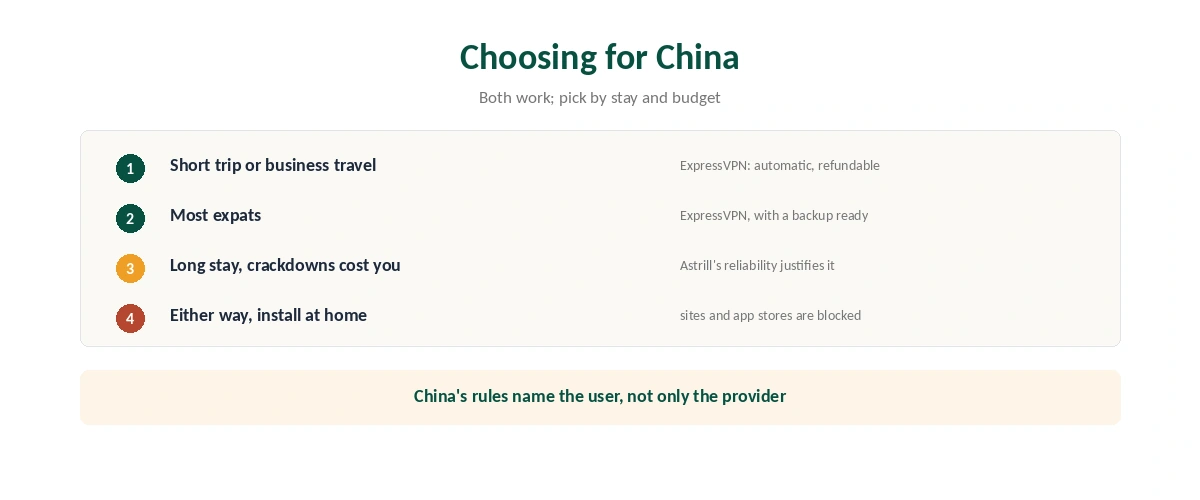
Both need installing at home. Their websites and the app stores are blocked from the mainland, so set up every device before you fly. Our travel guide covers the rest.
Privacy and Trust
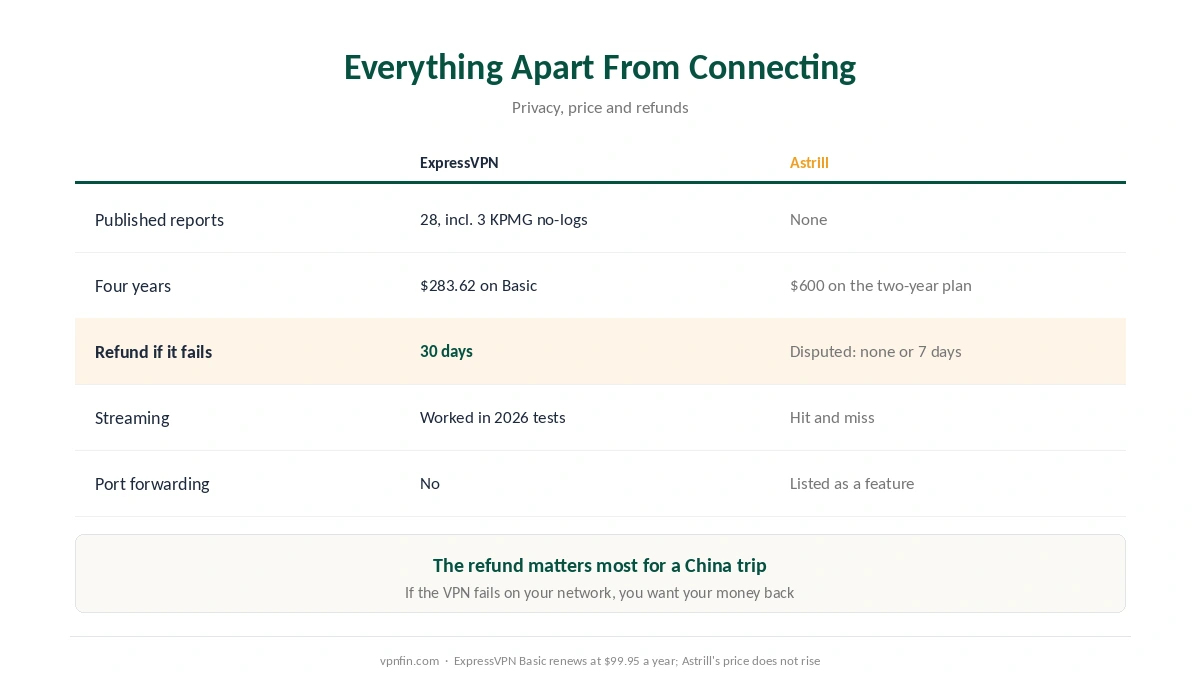
ExpressVPN lists 28 published third-party security reports, including three no-logs assessments by KPMG, and runs every server from RAM. In 2017 Turkish authorities seized one of its servers and recovered no usable data. Our audit tracker covers the record.
Astrill has no audit. It logs your IP address, connection time and device details during a session, deleting them afterwards by its own account, according to VPN.com. Reviewers also disagree on whether it is based in the Seychelles or Liechtenstein. Our no-logs guide explains what session logging reveals.
| Provider | No-logs audits | Auditor | Jurisdiction |
|---|---|---|---|
| NordVPN | 6 | PwC, Deloitte | Panama |
| Surfshark | 2 | Deloitte | Netherlands (9 Eyes) |
| ExpressVPN | 3 | KPMG (28 security reports in total) | British Virgin Islands, Kape-owned |
| CyberGhost | 3 | Deloitte | Romania, Kape-owned |
| PureVPN | 4 | KPMG | BVI, operated from Pakistan |
| IPVanish | 2 | Leviathan, Schellman | United States (Five Eyes), Ziff Davis-owned |
| Windscribe | 1 | Packetlabs, production infrastructure | Canada (Five Eyes); Greek case dismissed, no data to give |
| Proton VPN | 5 | Securitum | Switzerland, moving infrastructure to EU |
| Private Internet Access | 3 | Deloitte | United States (Five Eyes), Kape-owned |
| Mullvad | 10+ | Cure53, Assured AB | Sweden (14 Eyes) |
| TunnelBear | Annual since 2017 | Cure53 | Canada (Five Eyes), US parent |
| Norton VPN | 2 | VerSprite | United States (Five Eyes) |
| Hotspot Shield | 0 | protocol audited, policy not | United States (Five Eyes) |
| AirVPN | 0 | none — the client is open source instead | Italy (14 Eyes) |
| IVPN | 8, annual since inception | Cure53 | Gibraltar (status disputed) |
| Hide.me | 1 modern, in 2024 | Securitum, though one source names Altius IT | Malaysia (outside the alliances) |
| PrivadoVPN | 0 | none in six years of operation | Iceland (moved from Switzerland, 2026) |
| TorGuard | 0 | none; settled a lawsuit without disclosing records | United States (Five Eyes) |
| FastestVPN | 1, in 2023 | Altius IT | Cayman Islands (outside the alliances) |
| StrongVPN | 0 | none in over two decades | United States (Five Eyes), Ziff Davis-owned |
| VyprVPN | 1, in 2018 | Leviathan Security, before the 2023 sale | United States (Five Eyes), Certida-owned since 2023 |
| PrivateVPN | 0 | none; support says there is nothing to audit | Sweden (14 Eyes), ownership disputed |
| ZoogVPN | 0 | none; support describes one as planned | Greece (outside the alliances), run from Ukraine |
| Malwarebytes Privacy VPN | 1, in 2026 | X41 D-Sec, white-box over two months | United States (Five Eyes), runs AzireVPN infrastructure |
| Astrill | 0 | — | Disputed: Seychelles or Liechtenstein |
Price and Refunds
ExpressVPN Basic costs $83.72 for 28 months on the current offer, then $99.95 a year; over four years that comes to $283.62. Our ExpressVPN pricing page covers the three tiers.
Astrill costs $30 a month, $180 a year or $300 for two years, and the price does not rise at renewal. Over four years its two-year plan comes to $600.
⚠️ The refund gap matters for China. ExpressVPN gives 30 days, so if it fails on your network you can get your money back. For Astrill, several reviews report no refunds and others describe seven days. Our refund guide explains what to confirm.
Outside China
ExpressVPN is the stronger everyday VPN. It worked with the major Netflix libraries in every 2026 test we found, as our ExpressVPN and Netflix page records, allows 10 to 14 devices by tier, and has apps for both Fire TV systems.
Astrill’s extras are narrower. Port forwarding appears on its feature list, which ExpressVPN lacks, but reviewers call its streaming hit and miss. Our port forwarding guide lists who else offers that feature.
Which One
ExpressVPN for short trips, business travel and most expats: it works automatically, costs less, and the 30-day refund covers you if your network blocks it.
Astrill for long stays where a failed connection costs more than the subscription, and where its record during crackdowns justifies the price and the open questions. NordVPN against Astrill and Surfshark against Astrill cover the cheaper alternatives.
How We Research
The China results come from VPNPicked, GreatFirewallGuide, Gizmodo and Privacy.net, each dated where used and read on 25 September 2026. Prices come from each provider’s pricing page, read the same day. Our ExpressVPN and Astrill reviews supplied the audits, logging, refunds and devices, and our China legality page the legal position. We do not run our own tests. Our full approach lives on the About Us page.
ExpressVPN vs Astrill FAQ
Both work in this year’s tests. VPNPicked found each connected in every attempt in June 2026. GreatFirewallGuide rated Astrill more reliable at 98% against 85%, but ranked ExpressVPN first overall for simplicity and value.
Largely, yes. Gizmodo and VPNPicked both report that its obfuscation switches on automatically on Chinese networks. Install it before you fly, since its website and the app stores are blocked there.
It sells itself as a specialist for restrictive networks. It costs $30 a month or $300 for two years, and the price does not rise at renewal. ExpressVPN Basic costs $83.72 for 28 months on the current offer.
With ExpressVPN, yes, within 30 days. For Astrill, reviews disagree between no refunds and seven days, so confirm with its support before paying.
Using an unapproved VPN is a regulatory violation, and the rules set an individual fine of up to RMB 5,000. Enforcement is uneven, but the rule names the user.
The Verdict
Both get through the Great Firewall in 2026; ExpressVPN does it more cheaply and with far more evidence behind its privacy. For short trips and most expats, that makes it the better choice.
Astrill earns its price only where reliability during crackdowns is worth $300 every two years and a disputed refund. Whichever you pick, install it at home and test it before you fly.