
Disclosure: VPNFin is reader-supported. If you buy a VPN through links on this page, we may earn a commission at no extra cost to you. This never affects our ratings — here’s our full disclosure.
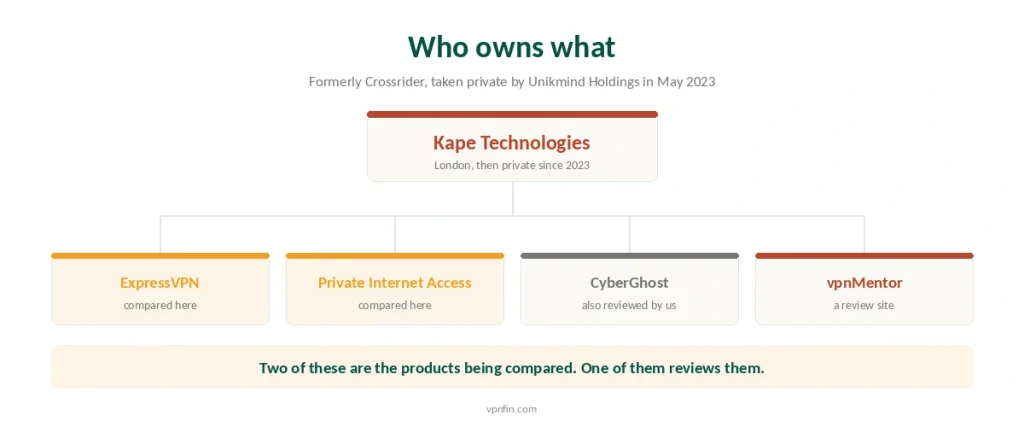
Most comparisons treat these two as competitors. They are not. Kape Technologies bought Private Internet Access, then bought ExpressVPN, and it owns CyberGhost as well.
So the question is not which company you trust. It is which product from one company suits you, and whether that arrangement bothers you at all.
The Short Answer
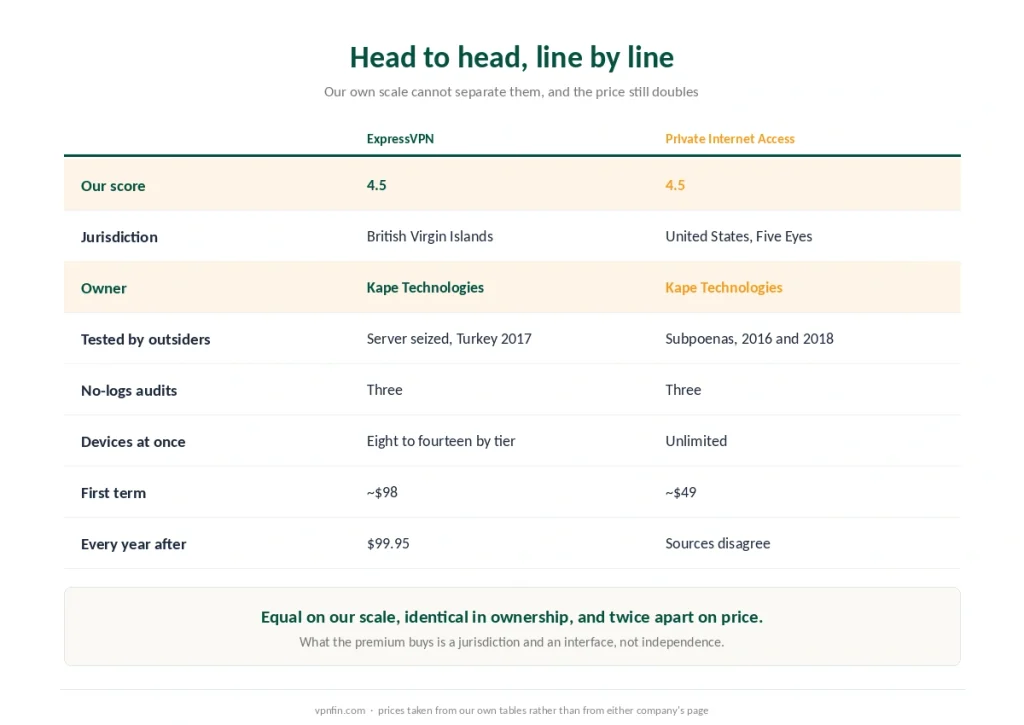
ExpressVPN is the polished one. British Virgin Islands base, TrustedServer infrastructure, a KPMG audit of that infrastructure in February 2025, and roughly twice the price.
Private Internet Access is the cheap one with the paperwork. Around two dollars a month, unlimited devices, open-source clients, and a no-logs policy tested in United States courts.
Both have been checked by something other than an accountant, which is rare. One had a server seized; the other answered two subpoenas.
The Owner Both Pages Skip
Worth establishing first, because it changes what the rest of the comparison means.
Kape acquired ExpressVPN on 13 September 2021 for $936 million. It had bought Private Internet Access earlier and CyberGhost before that.
The company used to be called Crossrider, and that business distributed adware before the rebrand. Kape left the London Stock Exchange in May 2023 when Teddy Sagi’s Unikmind Holdings took it private.
⚠️ The same group also owns vpnMentor, a large VPN review site, which discloses the relationship on its own pages. So a reader comparing ExpressVPN with PIA on some sites is reading about two products from a company that also owns the site.
None of that is evidence of a technical failure. Audits published since the acquisition found nothing wrong, and both products run their own infrastructure. It is a concentration question rather than a security one, and Mullvad is the obvious counterexample if independence is what you are buying. The whole map sits on its own page.
Both Have Been Tested by Somebody Else
This is the unusual part of the pairing, and it cuts both ways.
Turkish investigators seized an ExpressVPN server in 2017. They were investigating the assassination of the Russian ambassador Andrey Karlov, and they recovered nothing usable from the hardware. Turkish law aims at providers rather than users, which is how the server ended up in the case at all.
PIA answered two federal subpoenas, in a 2016 criminal case and again in June 2018, and produced nothing either time.
⚠️ Neither event was arranged by the company. That is what separates both of these from a scheduled audit, and it is why this pairing is stronger on evidence than most.
The audits differ in cadence rather than quality. ExpressVPN publishes work by KPMG, PwC and Cure53, including protocol audits of Lightway. PIA publishes Deloitte work. Our own table counts three no-logs audits each, and the wider totals both companies advertise include protocol and application reviews as well.
Price, and Why It Is Not Close
The gap is the largest in any pairing we have compared.
ExpressVPN costs about $98 for the first term and $99.95 a year after that. PIA costs roughly $49 for two years.
⚠️ PIA’s renewal figure is the one we still cannot confirm. Published sources give $57 a year in one place and $11.59 a month in another, so check the checkout page rather than any review — renewal pricing across the category is where the real money hides.
Nothing in the products explains a doubling. What a VPN costs over four years makes the gap starker still, and both sit under the same corporate roof.
| Provider | No-logs audits | Auditor | Jurisdiction |
|---|---|---|---|
| NordVPN | 6 | PwC, Deloitte | Panama |
| Surfshark | 2 | Deloitte | Netherlands (9 Eyes) |
| ExpressVPN | 3 | KPMG | British Virgin Islands, Kape-owned |
| CyberGhost | 3 | Deloitte | Romania, Kape-owned |
| PureVPN | 4 | KPMG | BVI, operated from Pakistan |
| IPVanish | 2 | Leviathan, Schellman | United States (Five Eyes), Ziff Davis-owned |
| Windscribe | 1 | Packetlabs, production infrastructure | Canada (Five Eyes); Greek case dismissed, no data to give |
| Proton VPN | 5 | Securitum | Switzerland, moving infrastructure to EU |
| Private Internet Access | 3 | Deloitte | United States (Five Eyes), Kape-owned |
| Mullvad | 10+ | Cure53, Assured AB | Sweden (14 Eyes) |
| TunnelBear | Annual since 2017 | Cure53 | Canada (Five Eyes), US parent |
| Norton VPN | 2 | VerSprite | United States (Five Eyes) |
| Hotspot Shield | 0 | protocol audited, policy not | United States (Five Eyes) |
| AirVPN | 0 | none — the client is open source instead | Italy (14 Eyes) |
| IVPN | 8, annual since inception | Cure53 | Gibraltar (status disputed) |
| Hide.me | 1 modern, in 2024 | Securitum, though one source names Altius IT | Malaysia (outside the alliances) |
| PrivadoVPN | 0 | none in six years of operation | Iceland (moved from Switzerland, 2026) |
| TorGuard | 0 | none; settled a lawsuit without disclosing records | United States (Five Eyes) |
| FastestVPN | 1, in 2023 | Altius IT | Cayman Islands (outside the alliances) |
| StrongVPN | 0 | none in over two decades | United States (Five Eyes), Ziff Davis-owned |
| VyprVPN | 1, in 2018 | Leviathan Security, before the 2023 sale | United States (Five Eyes), Certida-owned since 2023 |
| PrivateVPN | 0 | none; support says there is nothing to audit | Sweden (14 Eyes), ownership disputed |
| ZoogVPN | 0 | none; support describes one as planned | Greece (outside the alliances), run from Ukraine |
Jurisdiction and Infrastructure
Here the two genuinely diverge, and the difference is real rather than cosmetic.
ExpressVPN sits in the British Virgin Islands, outside every intelligence-sharing arrangement, with no mandatory retention.
PIA is American, based in Denver. The United States is a Five Eyes member, which is the strongest argument against it and the reason its court record matters so much.
Both run RAM-only servers. ExpressVPN calls its version TrustedServer; PIA runs the same principle without the branding.
⚠️ Neither arrangement removes the record entirely. What a VPN hides and what it does not applies to both, and jurisdiction decides who could ask rather than what exists.
Speed, Streaming and Devices
The practical layer, which decides most purchases.
ExpressVPN is the more consistent performer on streaming platforms, and Lightway is a genuinely good protocol. Our streaming guide treats platform access as a moving target, but ExpressVPN sits near the top of it.
PIA allows unlimited simultaneous connections. ExpressVPN allows eight to fourteen depending on the tier, which is generous but finite.
PIA ships open-source clients. Anyone can read the code rather than trust a description of it.
⚠️ ExpressVPN had a DNS leak bug in production for roughly twenty-one months, discovered and patched in 2024. It is fixed, and it belongs in an honest comparison.
Who Should Pick Which
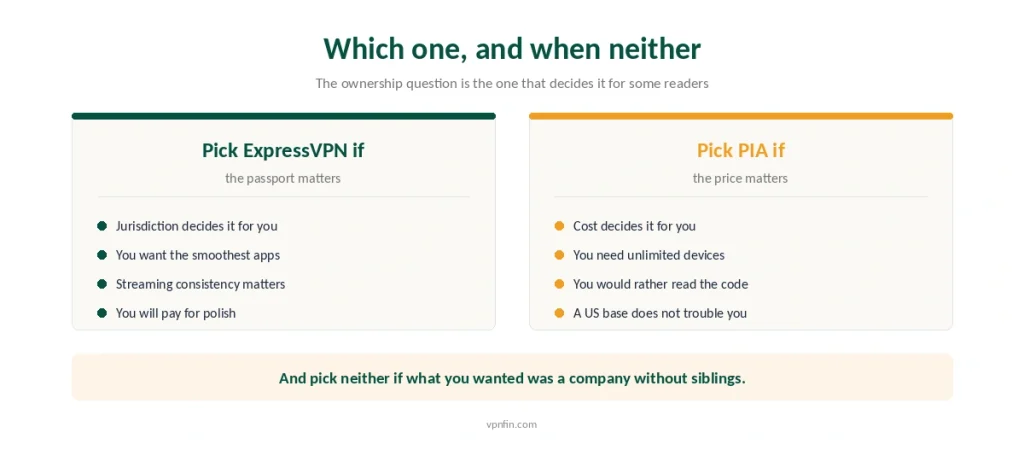
Choose ExpressVPN if jurisdiction and polish matter more than price. The BVI base is the strongest privacy argument in this pairing, and the apps are the easiest to live with.
Choose PIA if price and control matter more. Unlimited devices, open-source clients, and the lowest credible price we cover.
⚠️ Choose neither if the ownership question is the point. Our NordVPN comparison against PIA covers the alternative outside Kape, though NordVPN shares a parent with Surfshark, and Proton VPN is the one on our list with no corporate sibling at all.
How We Research
This comparison draws on VPN.com and Gizmodo for the 2017 Turkish server seizure and the KPMG audit of February 2025, on VPNVertex and vpnmasterpro for the Kape acquisition of 13 September 2021, the Crossrider history, the Unikmind buyout of May 2023 and the Daniel Gericke matter, on vpnMentor’s own disclosure for its shared ownership with ExpressVPN, CyberGhost and PIA, on Cloudwards for the audit firms involved, on CyberInsider and VPNpro for the 2016 and June 2018 PIA subpoenas, and on our own pricing tables for the figures quoted here. Where our table and an outside source disagree on a number, we use ours. Our full approach lives on the About Us page.
ExpressVPN vs PIA FAQ
They have the same owner. Kape Technologies bought PIA, then acquired ExpressVPN in September 2021 for $936 million, and it owns CyberGhost as well. Each product runs its own infrastructure and audit programme, but the corporate parent is shared.
ExpressVPN, if jurisdiction and app quality decide it: the British Virgin Islands sit outside every intelligence alliance. PIA, if price and control decide it: unlimited devices, open-source clients and roughly half the cost. Both have been tested outside a scheduled audit.
Turkish investigators seized one of its servers in 2017 during the inquiry into the assassination of ambassador Andrey Karlov. They recovered nothing usable. That is a real-world test rather than a commissioned one, and few providers have an equivalent.
That depends on which difference you are buying. The jurisdiction is genuinely stronger and the apps are easier. The infrastructure principle is the same on both, and the ownership is identical, so the premium buys polish and a passport rather than independence.
CyberGhost and Private Internet Access alongside ExpressVPN, and the review site vpnMentor, which discloses the relationship on its own pages. Kape was formerly Crossrider, and it was taken private by Unikmind Holdings in May 2023.
The Verdict
These are two products from one company, priced about two to one. ExpressVPN buys you a better jurisdiction and a smoother app. PIA buys you unlimited devices, open code and a great deal of change.
Both have been examined by someone who did not ask permission. A seized server in Turkey, and two subpoenas in the United States. Very few providers can say that at all.
The honest caveat is the ownership. If one company holding three major VPN brands and a large review site troubles you, this whole pairing is the wrong shortlist.