
Disclosure: VPNFin is reader-supported. If you buy a VPN through links on this page, we may earn a commission at no extra cost to you. This never affects our ratings — here’s how we research.
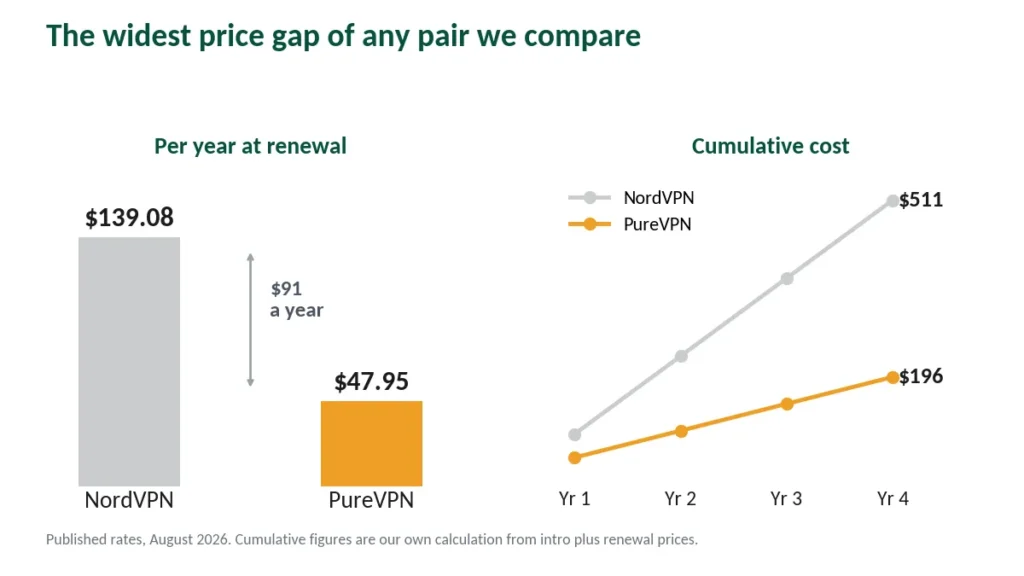
This comparison has the widest price gap of any we run. NordVPN renews at $139.08 a year, PureVPN at $47.95 — roughly a third of the cost, every year, indefinitely.
What that money buys is speed that stays consistent and a verification record with nothing awkward in it. What the saving costs you is speed that varies by a factor of five between servers, and a logging incident from 2017 that no amount of subsequent auditing erases.
Both facts are real. Which matters more depends on you.
The Short Answer
NordVPN if speed and record matter. It loses 2.9% of your connection in like-for-like testing, has six no-logs audits, and nothing in its history requires an explanation.
PureVPN if price matters, or if you need port forwarding — the only provider in our top five to offer it, though as a $0.99 add-on rather than an included feature. Renewal is a third of NordVPN’s, and it runs the most aggressive audit programme in the industry.
The thing that decides it for many people: PureVPN supplied connection logs to the FBI in 2017 while marketing a no-logs policy. That is on the record and we cover it in full below.
Head to Head
| NordVPN | PureVPN | |
|---|---|---|
| Speed loss | 2.9% | 12–67% depending on server |
| No-logs audits | 6 | 4 (KPMG) |
| Audit type | Scheduled | Always-on — unannounced |
| Jurisdiction | Panama | BVI, operated from Pakistan |
| Devices | 10 | 10, up to 50 paid |
| Port forwarding | No | Yes — $0.99/mo add-on |
| Renewal | $139.08/yr | $47.95/yr |
| Refund window | 30 days | 31 days |
| History | Clean | 2017 logging incident |
| Our rating | 4.8 | 4.1 |
Speed: Consistency Is the Real Difference
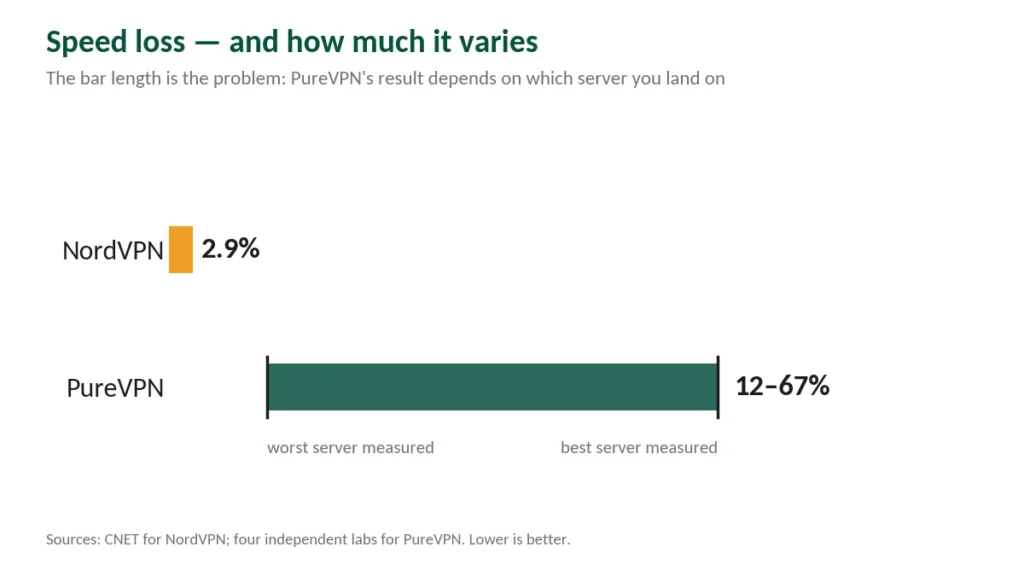
NordVPN lost 2.9% of baseline download speed in CNET’s testing — the best result in their lineup.
PureVPN is harder to summarise, because independent labs disagree wildly. One measured 65% retention on a gigabit line. Another recorded 67% on average. A third, testing on 500 Mbps, got under 12% from a US server. A fourth measured roughly 163 Mbps globally.
Those results are not contradictory — they describe the problem. PureVPN’s network varies sharply by individual server in a way better-provisioned networks do not. Two of those numbers describe a competent mid-tier VPN; one describes something barely usable.
What it means practically: with NordVPN you connect and it works. With PureVPN you may need to try three or four servers before finding one that performs. That is a real cost in time, and it never appears in a comparison table.
Full detail in our NordVPN review and our PureVPN review.
Winner: NordVPN, decisively.
Price: The Widest Gap We’ve Found
Intro pricing is close — around $3.09–3.49 a month for NordVPN Basic, about $2.15 for PureVPN Standard. Then the first term ends.
NordVPN renews at $139.08 a year, per its own checkout. PureVPN renews at $47.95 — about $4.00 a month.
That is $91 a year, every year. Over four years the difference reaches roughly $364 — more than double the entire four-year cost of PureVPN. Our cheap VPN guide sets out all five providers on this measure.
PureVPN also carries a 31-day refund window against NordVPN’s 30, and offers a paid add-on extending device limits to 50 — the only provider we rank with a route past its own cap.
⚠️ One restriction: PureVPN excludes cryptocurrency payments from its refund policy. Card, PayPal, Google Pay and Apple Pay qualify.
Winner: PureVPN, by a wide margin.
Privacy: Six Clean Audits Against One Unusual Programme
This section is more interesting than the counts suggest.
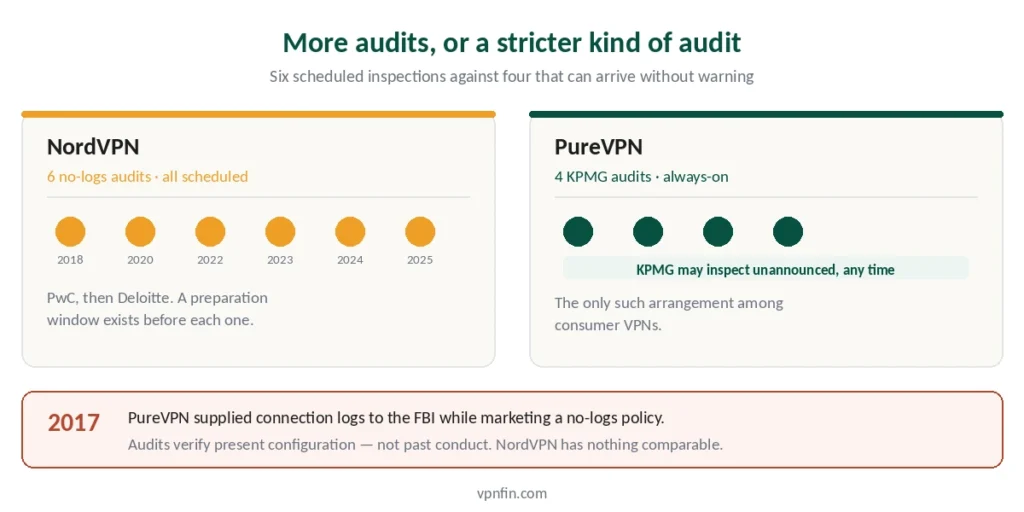
NordVPN has six no-logs audits — two by PricewaterhouseCoopers in 2018 and 2020, four by Deloitte through the end of 2025. The most recent examined standard, Double VPN, Onion Over VPN and obfuscated servers. Panama jurisdiction, outside every intelligence-sharing arrangement. The reports themselves are available to account holders rather than published, which is where Proton VPN takes a different approach.
PureVPN has four KPMG audits, the most recent completed in April 2024, plus an earlier Altius IT assessment in 2019. Set against Proton VPN’s five, the count matters less than how the inspections are scheduled. Neither provider publishes reports the way Proton VPN does — five years running, as open files.
But PureVPN does something no one else does. Its arrangement with KPMG is an always-on audit: the auditor may inspect the infrastructure unannounced, at any time. Every audit NordVPN publishes — and every audit anyone else publishes — is scheduled, which means a preparation window exists.
Four unannounced inspections and six scheduled ones are not straightforwardly comparable. The first is a stronger form of verification; the second is more of it.
| Provider | No-logs audits | Auditor | Jurisdiction |
|---|---|---|---|
| NordVPN | 6 | PwC, Deloitte | Panama |
| Surfshark | 2 | Deloitte | Netherlands (9 Eyes) |
| ExpressVPN | 3 | KPMG | British Virgin Islands, Kape-owned |
| CyberGhost | 3 | Deloitte | Romania, Kape-owned |
| PureVPN | 4 | KPMG | BVI, operated from Pakistan |
| IPVanish | 2 | Leviathan, Schellman | United States (Five Eyes), Ziff Davis-owned |
| Windscribe | 1 | Packetlabs, production infrastructure | Canada (Five Eyes); Greek case dismissed, no data to give |
| Proton VPN | 5 | Securitum | Switzerland, moving infrastructure to EU |
| Private Internet Access | 3 | Deloitte | United States (Five Eyes), Kape-owned |
| Mullvad | 10+ | Cure53, Assured AB | Sweden (14 Eyes) |
| TunnelBear | Annual since 2017 | Cure53 | Canada (Five Eyes), US parent |
| Norton VPN | 2 | VerSprite | United States (Five Eyes) |
| Hotspot Shield | 0 | protocol audited, policy not | United States (Five Eyes) |
| AirVPN | 0 | none — the client is open source instead | Italy (14 Eyes) |
| IVPN | 8, annual since inception | Cure53 | Gibraltar (status disputed) |
| Hide.me | 1 modern, in 2024 | Securitum, though one source names Altius IT | Malaysia (outside the alliances) |
| PrivadoVPN | 0 | none in six years of operation | Iceland (moved from Switzerland, 2026) |
| TorGuard | 0 | none; settled a lawsuit without disclosing records | United States (Five Eyes) |
| FastestVPN | 1, in 2023 | Altius IT | Cayman Islands (outside the alliances) |
| StrongVPN | 0 | none in over two decades | United States (Five Eyes), Ziff Davis-owned |
| VyprVPN | 1, in 2018 | Leviathan Security, before the 2023 sale | United States (Five Eyes), Certida-owned since 2023 |
| PrivateVPN | 0 | none; support says there is nothing to audit | Sweden (14 Eyes), ownership disputed |
| ZoogVPN | 0 | none; support describes one as planned | Greece (outside the alliances), run from Ukraine |
Jurisdiction favours NordVPN. Panama has no connection to any intelligence bloc. PureVPN is registered in the British Virgin Islands, which is also outside those arrangements — but its parent company operates from Pakistan, where data protection law is weak. Registration and operation are different things, and most comparisons mention only the first.
The 2017 Incident
No comparison of these two is honest without it.
In October 2017, PureVPN supplied connection logs to the FBI in a cyberstalking investigation. The logs contained timestamps linking a suspect’s home IP to the VPN addresses used in the harassment. At the time, PureVPN was marketing itself as a no-logs provider.
The problem was never the cooperation. It was that logs existed to hand over. The case became the standard example of a no-logs claim collapsing under scrutiny.
What changed since: Altius IT audited in 2019 and found nothing capable of identifying users. KPMG has audited four times. The parent company relocated from Hong Kong to the British Virgin Islands in 2021. The always-on arrangement is a direct structural answer to exactly this failure.
What hasn’t changed: it happened, and audits verify present configuration rather than past conduct. If that disqualifies PureVPN for you, that is a defensible position and we are not going to argue you out of it. NordVPN has nothing comparable in its history.
Winner: NordVPN on record, PureVPN on audit design.
Features Where They Split
PureVPN sells port forwarding as a $0.99 add-on — the only provider in our top five offering it at all. If you seed on private trackers, that single feature settles the comparison regardless of anything else here, as our torrenting guide explains. Outside the top five, PIA includes it without the surcharge.
It also offers multi-hop across 40+ country pairs and obfuscation for restricted networks.
NordVPN’s specialty servers have no PureVPN equivalent in kind: Double VPN and Onion Over VPN as distinct options, plus Meshnet linking up to 60 of your own devices. Threat Protection Pro blocks malware from the Plus tier upward.
Both allow 10 simultaneous connections. PureVPN alone sells an add-on raising that to 50.
Which Should You Buy?
Buy NordVPN if speed matters, you want a provider whose history requires no explanation, or you value Panama’s jurisdiction. It is our top-ranked provider for reasons that hold up under scrutiny.
Buy PureVPN if the $91 annual difference matters more than a five-fold speed variance, you need port forwarding, or you find the always-on audit a more convincing form of verification than a larger number of scheduled ones.
Buy neither if you want cheap and clean at once — CyberGhost renews at $56.94 with three Deloitte audits and no comparable history.
How We Research
This comparison draws on our full reviews of both providers, published audit records from PwC, Deloitte, KPMG and Altius IT, court reporting on the 2017 case, speed results from named independent labs, and renewal figures from each provider’s own checkout terms — cross-checked and verified at publication. Where speed results conflicted, as they did substantially for PureVPN, we present the full range and explain what we think causes it. Our full approach lives on the About Us page.
NordVPN vs PureVPN FAQ
NordVPN, and more importantly it is consistent. CNET measured a 2.9% average download loss for NordVPN. Independent labs recorded PureVPN anywhere from 12% to 67% retention depending on which server they connected to — that variance means finding a good server can take several attempts.
PureVPN renews at $47.95 a year against NordVPN’s $139.08, a difference of $91 annually. Budget positioning is deliberate: PureVPN competes on price while NordVPN competes on speed and verification depth. The saving is real, and so are the trade-offs in server consistency.
PureVPN supplied connection logs to the FBI in a cyberstalking investigation while marketing itself as a no-logs provider. The logs linked a suspect’s home IP to VPN addresses used in the harassment. Since then it has passed an Altius IT audit and four KPMG audits, and relocated to the British Virgin Islands.
PureVPN’s arrangement with KPMG allows unannounced inspections of its infrastructure at any time, rather than on scheduled dates. Every other major VPN — including NordVPN — uses scheduled audits, which give a preparation window. It is the most aggressive audit commitment in the industry and a direct answer to the 2017 failure.
PureVPN, as a paid add-on at $0.99 a month — and it is the only provider in our top five offering it at all. NordVPN declines to, treating it as a security risk and pointing to Meshnet instead. If you seed on private trackers and need healthy upload ratios, that narrows the choice to one within the top five.
Both allow 10 simultaneous connections. PureVPN additionally sells a Multi Login add-on extending that to 20, 30, 40 or 50 devices — the only provider we rank offering a paid route past its own limit. NordVPN’s Meshnet links up to 60 of your own devices, but that is a separate feature and does not raise the VPN connection cap.
The Verdict
NordVPN wins the comparison and ranks first in our top 5. Consistent speed, six audits, clean history, better jurisdiction on paper. Nothing PureVPN offers closes that gap on the merits.
But $91 a year is $91 a year. PureVPN at a third of the price with port forwarding and an unannounced-audit programme is a rational choice for someone who has read the 2017 section and decided the rebuild is credible.
The mistake would be picking PureVPN without knowing about 2017, or dismissing it without knowing about the always-on audit. Both facts belong in the decision.