
Disclosure: VPNFin is reader-supported. If you buy a VPN through links on this page, we may earn a commission at no extra cost to you. This never affects our ratings — here’s how we research.
On paper PureVPN wins more categories than you’d expect. It costs $31 a year less at renewal, has twice as many no-logs audits, runs the only unannounced-audit programme in the industry, and offers port forwarding that Surfshark doesn’t.
Then there’s 2017, when PureVPN supplied connection logs to the FBI while marketing itself as a no-logs provider. Surfshark has nothing comparable on its record.
This comparison is really about how much weight that one fact carries against everything else.
The Short Answer
Surfshark if you have more than ten devices, want consistent speeds, or prefer a provider whose history needs no explanation.
PureVPN if you need port forwarding, want the cheapest renewal of the two, or find an always-on audit more convincing than a scheduled one — and you’ve read the 2017 section below.
Head to Head
| Surfshark | PureVPN | |
|---|---|---|
| Devices | Unlimited | 10 (up to 50 paid) |
| No-logs audits | 2 (Deloitte) | 4 (KPMG) |
| Audit type | Scheduled | Always-on — unannounced |
| Speed loss | 21% | 12–67% by server |
| Jurisdiction | Netherlands (9 Eyes) | BVI, operated from Pakistan |
| Port forwarding | No | Yes |
| Renewal | ~$79/yr | $47.95/yr |
| Refund window | 30 days | 31 days |
| History | Clean | 2017 logging incident |
| Our rating | 4.6 | 4.1 |
Devices: Surfshark’s Structural Advantage
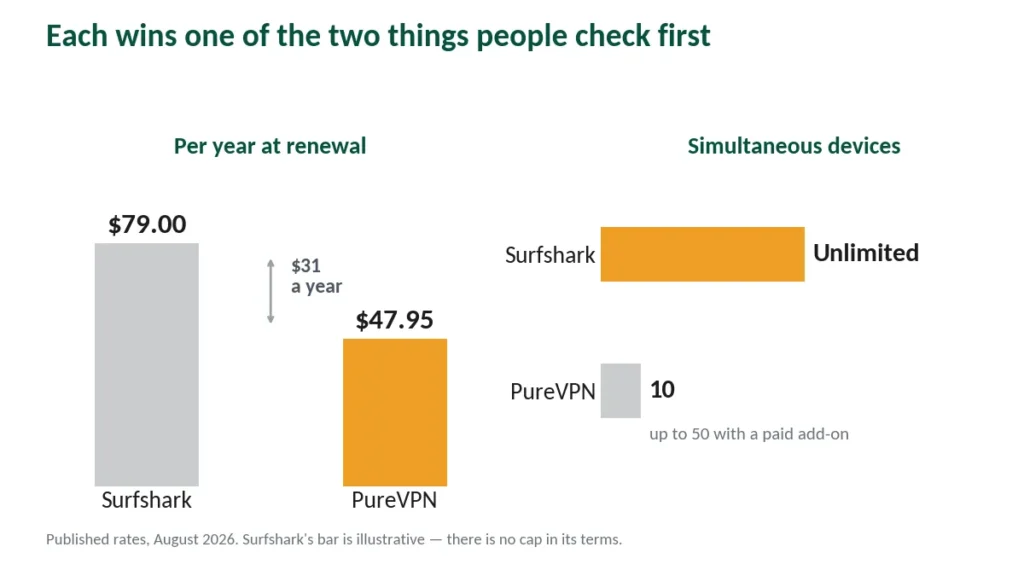
Surfshark allows unlimited simultaneous connections on every tier. No cap in the terms, no higher plan that adds more.
PureVPN allows 10, matching most of the market, and sells a Multi Login add-on extending that to 20, 30, 40 or 50 — the only provider we rank offering a paid route past its own limit.
Which is better depends on arithmetic. For a household of eight devices, Surfshark covers it at no extra cost. For a household of thirty, PureVPN’s add-on may still work out cheaper than Surfshark’s renewal, depending on what the add-on costs.
Still, for most people unlimited wins because it removes the calculation entirely.
Winner: Surfshark.
Price: PureVPN, and It Compounds
Intro pricing sits close — roughly $2.49 a month for Surfshark Starter, about $2.15 for PureVPN Standard. Both bill the full term upfront.
At renewal, Surfshark converts to around $79 a year. PureVPN renews at $47.95 — a difference of $31 annually, or about $124 over four years.
That said, neither is expensive by category standards. Our cheap VPN guide puts both against the rest of the field, where NordVPN renews at $139.08 and ExpressVPN at $99.95.
⚠️ One restriction on PureVPN’s refund: cryptocurrency payments are excluded from its 31-day guarantee. Card, PayPal, Google Pay and Apple Pay qualify.
Winner: PureVPN.
Audits: The Result That Surprises People
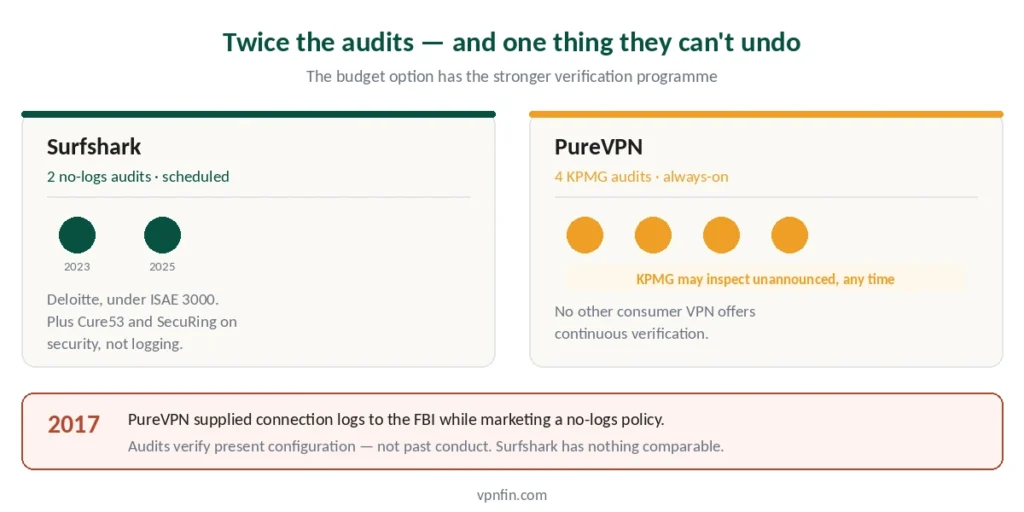
Surfshark has two no-logs assurance reports, both by Deloitte, in 2023 and June 2025 under the ISAE 3000 standard. It has commissioned other audits — Cure53 on browser extensions and infrastructure, SecuRing on infrastructure security in December 2025 — but those verify security posture rather than the logging claim.
PureVPN has four KPMG audits, the most recent completed in April 2024, plus an earlier Altius IT assessment in 2019.
And PureVPN’s arrangement is structurally different. Its KPMG engagement is always-on: the auditor may inspect the infrastructure unannounced, at any time. Every Surfshark audit — and every audit almost anyone publishes — is scheduled, with a preparation window built in.
Four unannounced inspections against two scheduled ones is not a close comparison on this measure.
| Provider | No-logs audits | Auditor | Jurisdiction |
|---|---|---|---|
| NordVPN | 6 | PwC, Deloitte | Panama |
| Surfshark | 2 | Deloitte | Netherlands (9 Eyes) |
| ExpressVPN | 3 | KPMG | British Virgin Islands, Kape-owned |
| CyberGhost | 3 | Deloitte | Romania, Kape-owned |
| PureVPN | 4 | KPMG | BVI, operated from Pakistan |
| IPVanish | 2 | Leviathan, Schellman | United States (Five Eyes), Ziff Davis-owned |
| Windscribe | 1 | Packetlabs, production infrastructure | Canada (Five Eyes); Greek case dismissed, no data to give |
| Proton VPN | 5 | Securitum | Switzerland, moving infrastructure to EU |
| Private Internet Access | 3 | Deloitte | United States (Five Eyes), Kape-owned |
| Mullvad | 10+ | Cure53, Assured AB | Sweden (14 Eyes) |
| TunnelBear | Annual since 2017 | Cure53 | Canada (Five Eyes), US parent |
| Norton VPN | 2 | VerSprite | United States (Five Eyes) |
| Hotspot Shield | 0 | protocol audited, policy not | United States (Five Eyes) |
| AirVPN | 0 | none — the client is open source instead | Italy (14 Eyes) |
| IVPN | 8, annual since inception | Cure53 | Gibraltar (status disputed) |
| Hide.me | 1 modern, in 2024 | Securitum, though one source names Altius IT | Malaysia (outside the alliances) |
| PrivadoVPN | 0 | none in six years of operation | Iceland (moved from Switzerland, 2026) |
| TorGuard | 0 | none; settled a lawsuit without disclosing records | United States (Five Eyes) |
| FastestVPN | 1, in 2023 | Altius IT | Cayman Islands (outside the alliances) |
| StrongVPN | 0 | none in over two decades | United States (Five Eyes), Ziff Davis-owned |
| VyprVPN | 1, in 2018 | Leviathan Security, before the 2023 sale | United States (Five Eyes), Certida-owned since 2023 |
| PrivateVPN | 0 | none; support says there is nothing to audit | Sweden (14 Eyes), ownership disputed |
| ZoogVPN | 0 | none; support describes one as planned | Greece (outside the alliances), run from Ukraine |
Jurisdiction cuts the other way, partially. Surfshark operates from the Netherlands, a 9 Eyes member, though Dutch law imposes no retention obligation on VPN providers. PureVPN is registered in the British Virgin Islands, outside those arrangements — but its parent GZ Systems operates from Pakistan, where data protection law is weak. Registration and operation are different things.
Winner: PureVPN on audit design, mixed on jurisdiction.
The 2017 Incident
Everything above has to be read against this.
In October 2017, PureVPN supplied connection logs to the FBI in a cyberstalking investigation. The logs contained timestamps linking a suspect’s home IP address to the VPN addresses used in the harassment campaign. At the time, PureVPN marketed itself as a no-logs provider.
The issue was never the cooperation with law enforcement. It was that logs existed at all. The case became the standard example of a no-logs claim collapsing under scrutiny.
What followed: Altius IT audited in 2019 and found nothing capable of identifying users. KPMG has audited four times since. The parent company relocated from Hong Kong to the British Virgin Islands in 2021. The always-on arrangement is a direct structural response to precisely this failure.
What remains true: audits verify present configuration, not past conduct. Surfshark has never had to explain anything comparable.
If that settles the question for you, it’s a defensible position and we won’t argue against it. Full detail in our PureVPN review and our Surfshark review.
Speed: Surfshark for Consistency
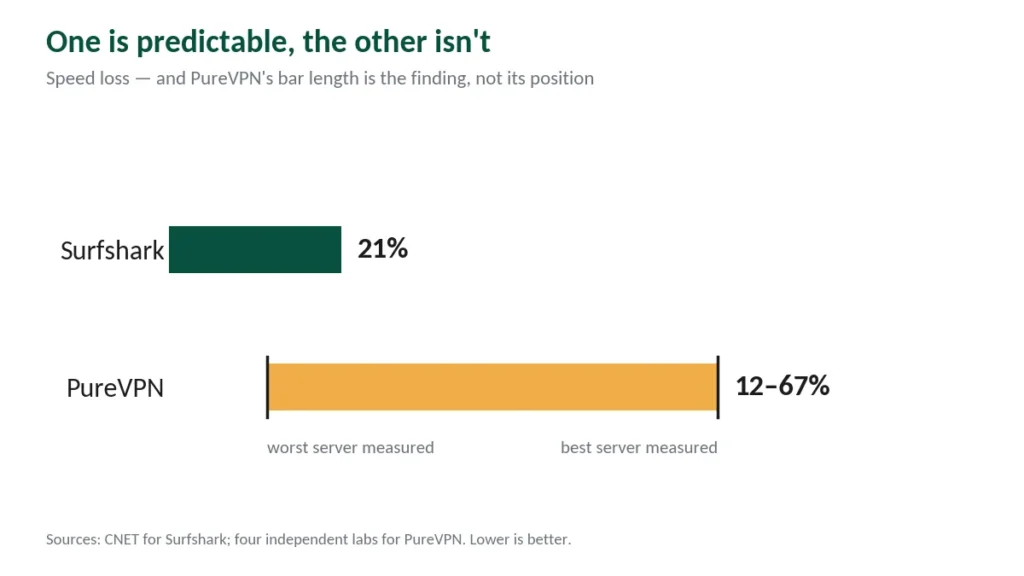
CNET measured a 21% average download loss for Surfshark — mid-field, and notably behind NordVPN’s 2.9% in the same round.
By contrast, PureVPN is harder to pin down. Independent labs recorded anywhere from 12% to 67% retention depending on the server tested. Two of those results describe a workable VPN; one describes something barely usable.
The variance is the finding. With Surfshark you get a predictable result. With PureVPN you may need to try several servers before landing on a good one — a real cost in time that no comparison table shows.
Winner: Surfshark.
Features Where They Split
PureVPN has port forwarding — the only provider in our top five that does. For anyone seeding on private trackers, that single feature decides this comparison regardless of everything else, as our torrenting guide explains. It also offers multi-hop across 40+ country pairs.
Surfshark puts everything in its cheapest tier: CleanWeb ad and tracker blocking, MultiHop double-routing, Bypasser split tunnelling, and Alternative ID for throwaway signup identities. P2P works across the entire network rather than on designated servers.
Meanwhile, on network size PureVPN runs 6,000+ servers across 80+ locations, Surfshark around 4,500 across 100 countries. Different shapes — PureVPN concentrates more servers, Surfshark spreads across more countries.
Which Should You Buy?
Buy Surfshark if device count matters, you want predictable speed, or the 2017 case disqualifies PureVPN for you. It ranks second in our top 5 against PureVPN’s fifth.
PureVPN makes sense if you need port forwarding, the $31 annual saving matters, or you consider four unannounced audits stronger evidence than two scheduled ones.
Neither fits if you want cheap with a clean record — CyberGhost renews at $56.94 with three Deloitte audits and nothing in its history requiring explanation.
How We Research
This comparison draws on our full reviews of both providers, published audit records from Deloitte, KPMG, Cure53, SecuRing and Altius IT, court reporting on the 2017 case, speed results from named independent labs, and renewal figures taken from each provider’s own checkout terms — cross-checked and verified at publication. Where speed results conflicted substantially, as they did for PureVPN, we present the full range and explain what causes it. Our full approach lives on the About Us page.
Surfshark vs PureVPN FAQ
PureVPN, at $47.95 a year against Surfshark’s roughly $79 — a difference of $31 annually, or about $124 over four years. Intro pricing is closer, at around $2.15 and $2.49 a month respectively. Note that PureVPN excludes cryptocurrency payments from its 31-day refund guarantee.
PureVPN, with four KPMG no-logs audits against Surfshark’s two Deloitte assurance reports. More importantly, PureVPN’s arrangement is always-on — KPMG may inspect unannounced at any time — while Surfshark’s are scheduled. Surfshark has commissioned additional Cure53 and SecuRing audits, but those examine security posture rather than logging.
PureVPN supplied connection logs to the FBI in a cyberstalking investigation while marketing itself as a no-logs provider. The logs linked a suspect’s home IP to VPN addresses used in the harassment. Since then it has passed an Altius IT audit and four KPMG audits, and relocated to the British Virgin Islands. Surfshark has no comparable incident.
Surfshark allows unlimited simultaneous connections on every tier. PureVPN allows 10, with a paid Multi Login add-on extending that to 20, 30, 40 or 50 — the only provider we rank offering a paid route past its own cap. For most households, unlimited removes the calculation entirely.
PureVPN, and it is the only provider in our top five that offers it. Surfshark does not. If you seed on private trackers and need healthy upload ratios, that single feature settles this comparison regardless of anything else.
Surfshark, and more importantly it is consistent. CNET measured 21% average download loss for Surfshark. Independent labs recorded PureVPN anywhere from 12% to 67% retention depending on the server — that variance means finding a good server can take several attempts.
The Verdict
Surfshark takes it, ranking second in our top 5 against PureVPN’s fifth. Unlimited devices, predictable speed and a clean record are three things you don’t have to think about again after buying.
But PureVPN wins more individual categories than its ranking suggests — cheaper renewal, twice the no-logs audits, an audit design nobody else matches, and the only port forwarding of the two.
The honest summary: if you need port forwarding, PureVPN is your answer here and the rest is detail. If you don’t, Surfshark asks fewer questions of you.