
Disclosure: VPNFin is reader-supported. If you buy a VPN through links on this page, we may earn a commission at no extra cost to you. This never affects our ratings — here’s how we research.
Indonesia doesn’t appear on lists of countries that ban VPNs. It also isn’t a place where the question is simple.
The regulatory framework — built on the ITE Law and Ministerial Regulation 5/2020 — requires platforms to register with the government, appoint local representatives, and remove flagged content within four to twenty-four hours. In July 2022 it blocked PayPal, Steam, Yahoo and Bing nationwide over registration failures.
And the same regulation classifies material that provides access to prohibited information — explicitly including guides to using a VPN — as prohibited content in its own right.
This guide explains the framework rather than working around it. That’s a deliberate choice, and the reason is above.
The Short Answer
VPN use isn’t criminalised, but the regulatory position is unsettled — officials have raised licensing requirements for providers since 2019 without clear enforcement mechanisms.
The blocking is extensive. Content deemed to breach public decency, gambling platforms, LGBTQ+ services and unregistered platforms have all been restricted.
Registered platforms answer to the government. Services that complied agreed to respond to data requests within 24 hours.
What the PSE Framework Requires
The rules apply to platforms, and they’re demanding.
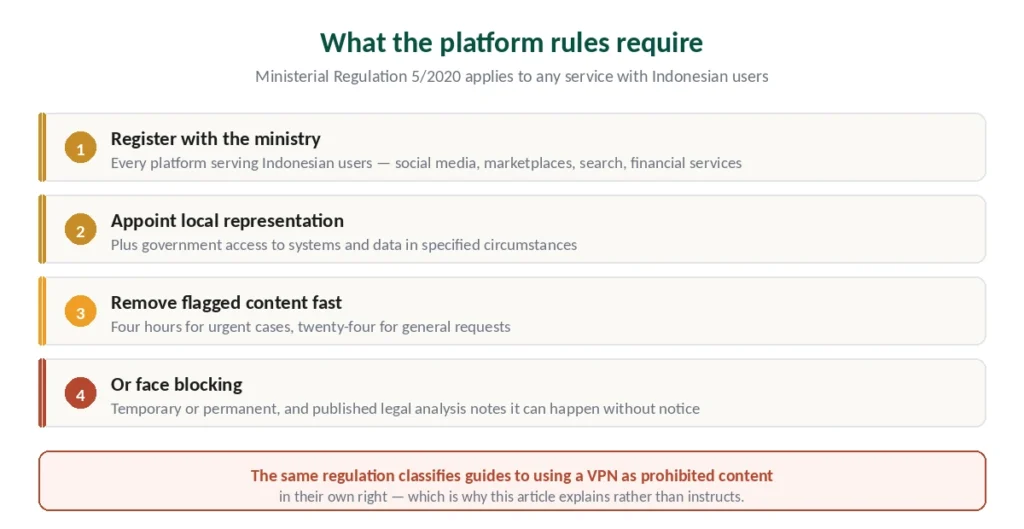
Registration is mandatory. Under Ministerial Regulation 5/2020, every Private Electronic System Operator serving Indonesian users must register with the ministry — now called Komdigi, formerly Kominfo. This covers social media, marketplaces, search engines, financial services and communications platforms.
Content removal runs to tight deadlines: four hours for content classified as urgent, twenty-four hours for general requests.
Local representation is required, along with government access to systems and data in specified circumstances.
Non-compliance means blocking. The ministry can restrict access temporarily or permanently, and published legal commentary notes this sometimes happens without prior notice.
July 2022: What Enforcement Looks Like
The clearest demonstration of how the framework operates in practice.
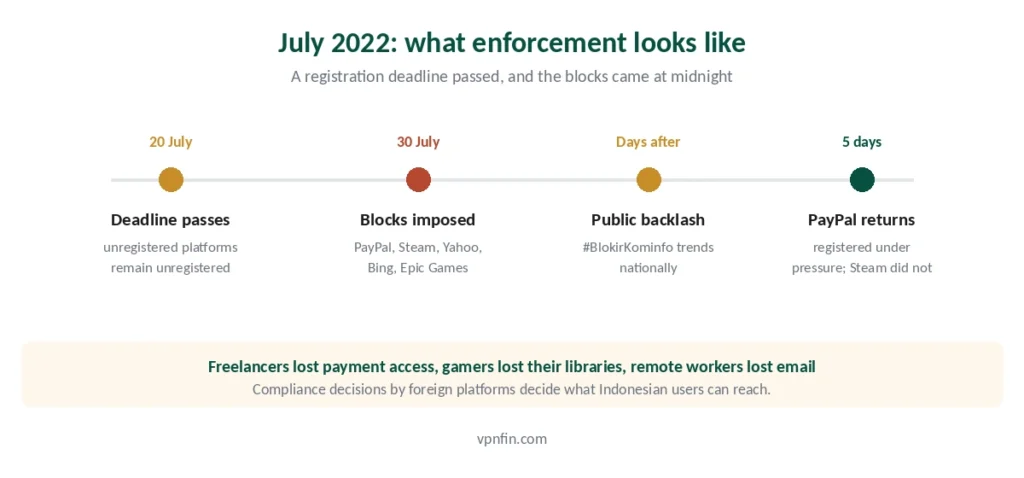
After a 20 July deadline, the ministry blocked access to several major unregistered platforms — PayPal, Steam, Yahoo, Bing, Epic Games and others among them.
The reaction was immediate. #BlokirKominfo trended nationally. Freelancers lost payment access, gamers lost their Steam libraries, remote workers lost email and search tools.
PayPal registered within five days — a process normally taking months — and access was restored.
Steam was restored within weeks, though reporting on exactly what its operator agreed to varies between sources.
What it demonstrated: the registration regime has enforcement teeth, and compliance decisions by foreign platforms directly affect what Indonesian users can reach.
The Position on VPNs Specifically
Less settled than either supporters or critics suggest.
No law criminalises personal use. Indonesia has among the highest VPN adoption rates globally, and using one is not itself an offence.
But officials have raised licensing. As early as 2019, the ministry stated it would block VPN providers operating without Indonesian licences, arguing they function like internet service providers. Published reporting at the time noted the enforcement mechanisms were unclear, and that remains largely true.
⚠️ And MR5 reaches further than most people realise. The regulation classifies content that provides access to prohibited information as prohibited itself — with a tutorial on using a VPN given as the explicit example. That’s why this article describes the framework rather than providing setup instructions.
The practical reading: using a VPN is not itself criminalised, but the regulatory environment is one where the tools and the instructions for them both sit under active government attention. What the rules require, and of whom sets out the registration framework in full, including the obligation registered operators take on.
What’s Actually Blocked
The scope is broad, and worth knowing regardless of your position on any of it.
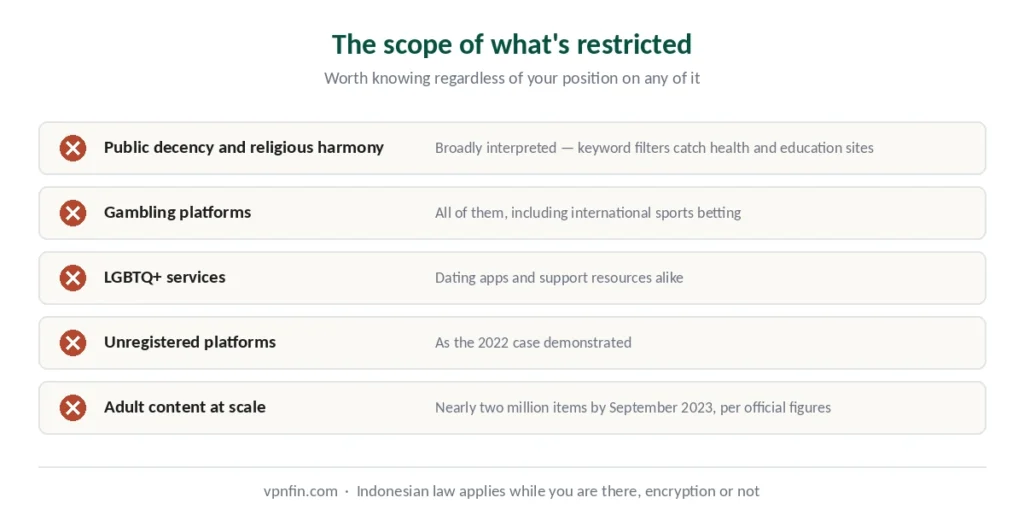
Content deemed contrary to public decency or religious harmony — a category published analysis describes as broadly interpreted, sometimes catching health and education sites through keyword filtering.
Gambling platforms, all of them, including international sports betting.
LGBTQ+ services, including dating apps and support resources. Indonesia has no national law criminalising homosexuality, though Aceh province enforces sharia.
Unregistered platforms, as the 2022 case demonstrated.
Adult content at scale — official figures cited nearly two million items blocked by September 2023.
What This Means Practically
For visitors and expats: your home services may be unreachable, and platforms that registered under PSE have agreed to respond to government data requests within 24 hours. A VPN changes what your ISP observes; it doesn’t change what a registered platform holds about an account you’re signed into — what a VPN actually hides covers that distinction.
For anyone travelling there: install and test before arrival, as with Turkey. Provider websites and app availability can change without notice.
On obfuscation: providers offering it handle restrictive networks better than those that don’t. That’s a technical observation rather than advice about any specific restriction.
⚠️ Indonesian law applies to you in Indonesia regardless of encryption, and the framework above is enforced actively. This article is not legal advice, and the position changes — verify current requirements before relying on anything here.
Which Provider, If You Need One
Standard considerations apply, with two that matter more here.
Jurisdiction outside Indonesia, since a provider incorporated elsewhere isn’t subject to PSE registration demands. All five we rank qualify — NordVPN from Panama, ExpressVPN from the British Virgin Islands, CyberGhost from Romania.
An audited no-logs policy, which is the only meaningful evidence that a provider holds nothing to hand over.
| Provider | No-logs audits | Auditor | Jurisdiction |
|---|---|---|---|
| NordVPN | 6 | PwC, Deloitte | Panama |
| Surfshark | 2 | Deloitte | Netherlands (9 Eyes) |
| ExpressVPN | 3 | KPMG | British Virgin Islands, Kape-owned |
| CyberGhost | 3 | Deloitte | Romania, Kape-owned |
| PureVPN | 4 | KPMG | BVI, operated from Pakistan |
| IPVanish | 2 | Leviathan, Schellman | United States (Five Eyes), Ziff Davis-owned |
| Windscribe | 1 | Packetlabs, production infrastructure | Canada (Five Eyes); Greek case dismissed, no data to give |
| Proton VPN | 5 | Securitum | Switzerland, moving infrastructure to EU |
| Private Internet Access | 3 | Deloitte | United States (Five Eyes), Kape-owned |
| Mullvad | 10+ | Cure53, Assured AB | Sweden (14 Eyes) |
| TunnelBear | Annual since 2017 | Cure53 | Canada (Five Eyes), US parent |
| Norton VPN | 2 | VerSprite | United States (Five Eyes) |
| Hotspot Shield | 0 | protocol audited, policy not | United States (Five Eyes) |
| AirVPN | 0 | none — the client is open source instead | Italy (14 Eyes) |
| IVPN | 8, annual since inception | Cure53 | Gibraltar (status disputed) |
| Hide.me | 1 modern, in 2024 | Securitum, though one source names Altius IT | Malaysia (outside the alliances) |
| PrivadoVPN | 0 | none in six years of operation | Iceland (moved from Switzerland, 2026) |
| TorGuard | 0 | none; settled a lawsuit without disclosing records | United States (Five Eyes) |
| FastestVPN | 1, in 2023 | Altius IT | Cayman Islands (outside the alliances) |
| StrongVPN | 0 | none in over two decades | United States (Five Eyes), Ziff Davis-owned |
| VyprVPN | 1, in 2018 | Leviathan Security, before the 2023 sale | United States (Five Eyes), Certida-owned since 2023 |
| PrivateVPN | 0 | none; support says there is nothing to audit | Sweden (14 Eyes), ownership disputed |
| ZoogVPN | 0 | none; support describes one as planned | Greece (outside the alliances), run from Ukraine |
Obfuscation, for the technical reasons above. Surfshark’s NoBorders activates automatically on restricted networks.
How We Research
This guide draws on published legal analysis of Indonesia’s ITE Law and Ministerial Regulation 5/2020, reporting from named sources including Coconuts Jakarta, Tech Against Terrorism and Indonesian legal practices, official Komdigi figures, and our own full reviews of the providers we rank — cross-checked and verified at publication. We describe the regulatory framework rather than methods of circumventing it, for reasons set out in the article. This is not legal advice and the position changes frequently. Our full approach lives on the About Us page.
Indonesia VPN FAQ
No law criminalises personal use, and Indonesia has among the highest VPN adoption rates globally. But the position is unsettled: since 2019 officials have stated that VPN providers should hold Indonesian licences or face blocking, arguing they function like internet service providers. Enforcement mechanisms have never been made clear.
Under Ministerial Regulation 5/2020, every platform serving Indonesian users must register with the ministry, appoint local representatives, and remove flagged content within four hours for urgent cases or twenty-four for general requests. Registered platforms also agreed to respond to government data requests within 24 hours.
After a registration deadline passed, the ministry blocked several major unregistered platforms including PayPal, Steam, Yahoo and Bing. The public reaction was immediate — #BlokirKominfo trended nationally. PayPal registered within five days and was restored; Steam’s operator declined the data-handover requirements.
Content deemed contrary to public decency or religious harmony, which published analysis describes as broadly interpreted. All gambling platforms. LGBTQ+ dating apps and support resources. Unregistered platforms. And adult content at scale — official figures cited nearly two million items blocked by September 2023.
Partly. It changes what your ISP can observe about where you go. It doesn’t change what a registered platform holds about an account you’re signed into — those services agreed to respond to government requests within 24 hours, and your login identifies you regardless of your IP address.
If you intend to use one, yes — as with any country where availability can change without notice. Provider websites and app store listings are not guaranteed to remain reachable. Note also that Indonesian law applies to you while you’re there, and this article isn’t legal advice.
The Short Version
Not banned, not settled. No law criminalises personal VPN use, but officials have raised licensing requirements for providers since 2019 without clear enforcement.
The platform rules have real teeth. PayPal, Steam, Yahoo and Bing were all blocked nationwide in 2022 over registration failures, and registered platforms answer government data requests within 24 hours.
And the framework reaches the instructions too. MR5 classifies guides to using a VPN as prohibited content — which is why this article explains the rules rather than routes around them.