
Disclosure: VPNFin is reader-supported. If you buy a VPN through links on this page, we may earn a commission at no extra cost to you. This never affects our ratings — here’s our full disclosure.
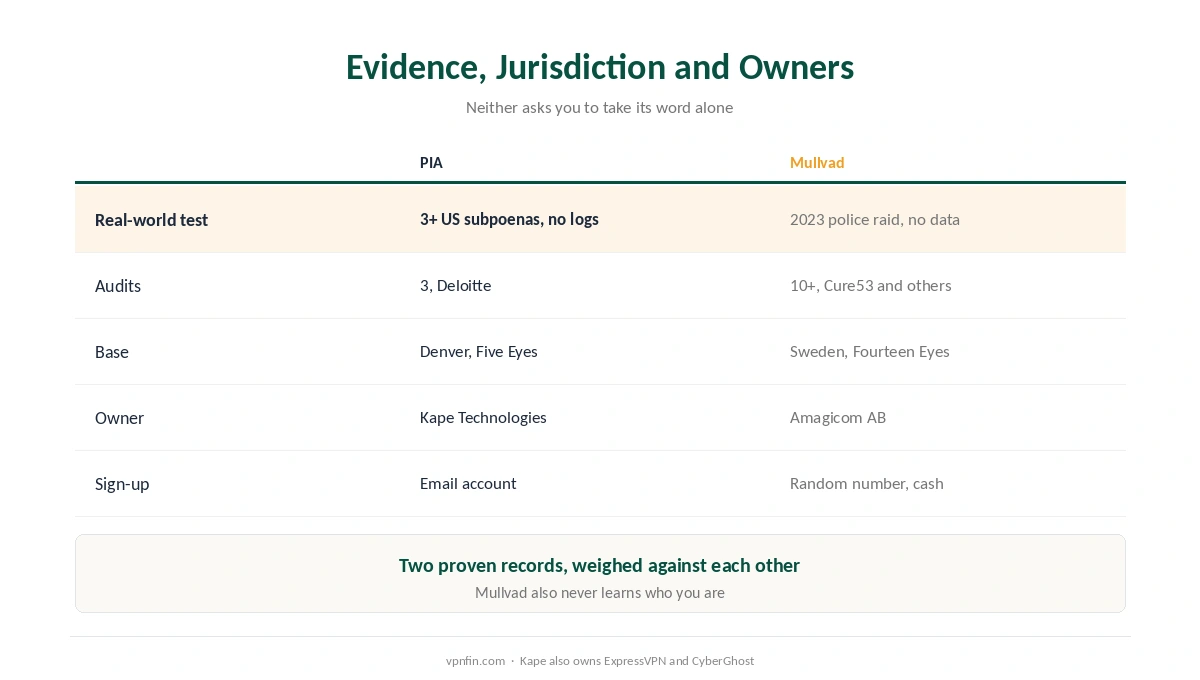
PIA vs Mullvad is a rare comparison: both providers have had their no-logs claims tested by the authorities, and both came through. US federal authorities have subpoenaed Private Internet Access at least three times, and it had no connection logs to hand over. In April 2023 Swedish police arrived at Mullvad with a search warrant and left with no customer data.
So neither asks you to take its word alone. The difference lies in everything around that record: how much each knows about you, how many devices you can connect, whether you can seed torrents, and how you pay.
PIA vs Mullvad: The Short Answer
Choose PIA over Mullvad for devices, port forwarding and price. It rates 4.5 in our rankings, sets no device limit, includes port forwarding and costs around $2.03 a month on its two-year plan. Our PIA review covers the court cases.
Choose Mullvad for anonymity. It asks for no email, accepts cash by post, and charges a flat €5 a month with no renewal jump. Our Mullvad review rates it 4.2.
Both are inside intelligence alliances, PIA in the United States and Mullvad in Sweden, and both answer that with a real-world test.
Two Real-World Tests
PIA, in US courts. Its subpoenas include an FBI request in a 2016 criminal case in Virginia. Each time, PIA had no connection logs to provide. Three Deloitte audits followed, and its apps are open source.
Mullvad, in its own office. Swedish police arrived with a warrant in 2023 and left without customer data, because the servers held none. Mullvad also has more than ten published audits, from firms including Cure53 and Assured AB.
⚠️ These are the strongest kinds of evidence a VPN can offer, because neither company could stage them. Our guide to legal demands on VPNs and our audit tracker put both in context.
| Provider | No-logs audits | Auditor | Jurisdiction |
|---|---|---|---|
| NordVPN | 6 | PwC, Deloitte | Panama |
| Surfshark | 2 | Deloitte | Netherlands (9 Eyes) |
| ExpressVPN | 3 | KPMG (28 security reports in total) | British Virgin Islands, Kape-owned |
| CyberGhost | 3 | Deloitte | Romania, Kape-owned |
| PureVPN | 4 | KPMG | BVI, operated from Pakistan |
| IPVanish | 2 | Leviathan, Schellman | United States (Five Eyes), Ziff Davis-owned |
| Windscribe | 1 | Packetlabs, production infrastructure | Canada (Five Eyes); Greek case dismissed, no data to give |
| Proton VPN | 5 | Securitum | Switzerland, moving infrastructure to EU |
| Private Internet Access | 3 | Deloitte | United States (Five Eyes), Kape-owned |
| Mullvad | 10+ | Cure53, Assured AB | Sweden (14 Eyes) |
| TunnelBear | Annual since 2017 | Cure53 | Canada (Five Eyes), US parent |
| Norton VPN | 2 | VerSprite | United States (Five Eyes) |
| Hotspot Shield | 0 | protocol audited, policy not | United States (Five Eyes) |
| AirVPN | 0 | none — the client is open source instead | Italy (14 Eyes) |
| IVPN | 8, annual since inception | Cure53 | Gibraltar (status disputed) |
| Hide.me | 1 modern, in 2024 | Securitum, though one source names Altius IT | Malaysia (outside the alliances) |
| PrivadoVPN | 0 | none in six years of operation | Iceland (moved from Switzerland, 2026) |
| TorGuard | 0 | none; settled a lawsuit without disclosing records | United States (Five Eyes) |
| FastestVPN | 1, in 2023 | Altius IT | Cayman Islands (outside the alliances) |
| StrongVPN | 0 | none in over two decades | United States (Five Eyes), Ziff Davis-owned |
| VyprVPN | 1, in 2018 | Leviathan Security, before the 2023 sale | United States (Five Eyes), Certida-owned since 2023 |
| PrivateVPN | 0 | none; support says there is nothing to audit | Sweden (14 Eyes), ownership disputed |
| ZoogVPN | 0 | none; support describes one as planned | Greece (outside the alliances), run from Ukraine |
| Malwarebytes Privacy VPN | 1, in 2026 | X41 D-Sec, white-box over two months | United States (Five Eyes), runs AzireVPN infrastructure |
| Astrill | 0 | — | Disputed: Seychelles or Liechtenstein |
Anonymity: What Each Knows About You
Mullvad knows almost nothing. You get a random account number, it requests no email, and it accepts cash sent by post. Even a successful search would find no customer identity to match.
PIA runs a normal account, tied to an email address, as our review describes. Its logs policy holds, but the company knows who its customers are. Our privacy guide explains why sign-up matters as much as logging.
Jurisdiction and Ownership
PIA operates from Denver, inside the Five Eyes, and belongs to Kape Technologies, which also owns ExpressVPN and CyberGhost. Mullvad operates from Sweden, inside the Fourteen Eyes, and belongs to Amagicom AB, which owns nothing else in the VPN market. Our ownership guide covers both.
PIA vs Mullvad on Price
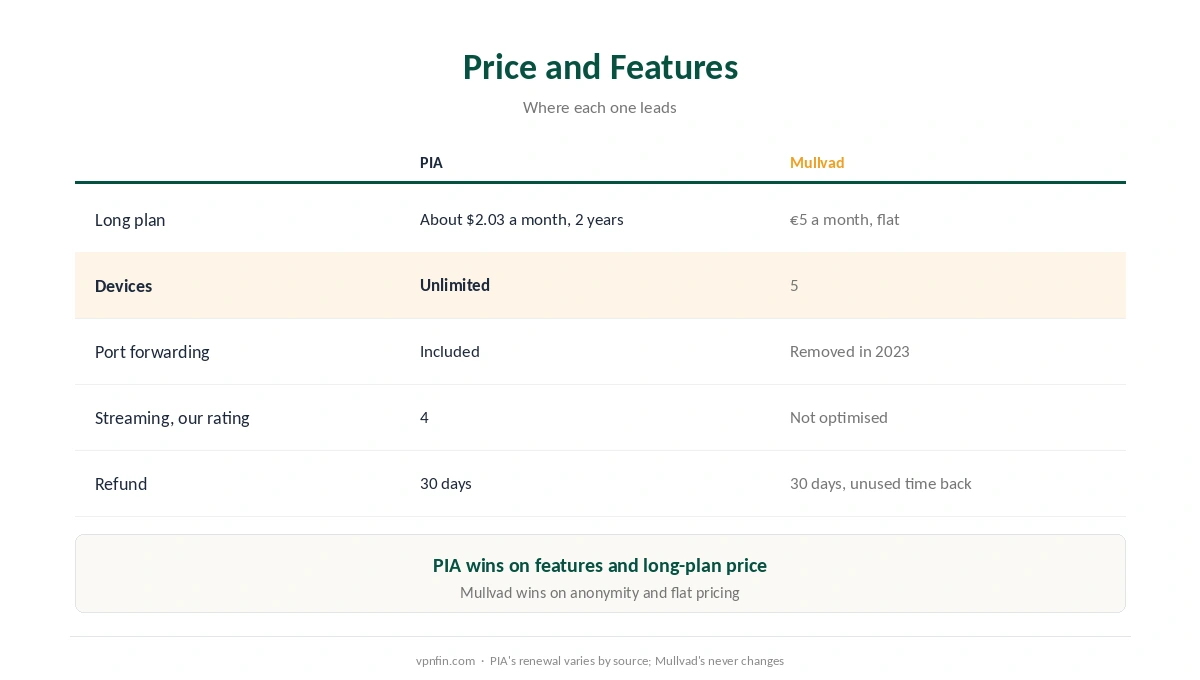
PIA costs around $2.03 a month on its two-year plan, about $49 upfront. Sources disagree on the renewal, so check the checkout page.
Mullvad charges €5 a month, about $5.40, and has done since 2009. There is no discount and no renewal jump; a year costs about $65. Our monthly pricing guide shows why that flat price wins for monthly payers, and our renewal price table compares both.
PIA vs Mullvad on Features
Devices: PIA sets no limit; Mullvad allows five. Our multi-device guide compares the options.
Port forwarding: PIA includes it. Mullvad removed it in July 2023, citing abuse. Our port forwarding guide lists who still offers it.
Streaming: PIA rates 4 in our review. Mullvad does not optimise for streaming, and our review scores it down for that.
Refunds: both give 30 days, and Mullvad returns unused time. Our refund guide covers each process.
What Each One Lacks
PIA lacks anonymity and a jurisdiction outside the Five Eyes. Its subpoena record answers the second point in practice, and its apps are open source, but the company still knows who you are.
Mullvad lacks devices, port forwarding and streaming. Five connections, no forwarded ports since 2023 and weak streaming are the price of its minimalism, and it offers no long-plan discount.
Neither lacks evidence. That is what makes PIA vs Mullvad unusual: most comparisons weigh a proven record against an unproven one, and this one weighs two proven records against each other. Our no-logs guide explains why that matters.
Which One
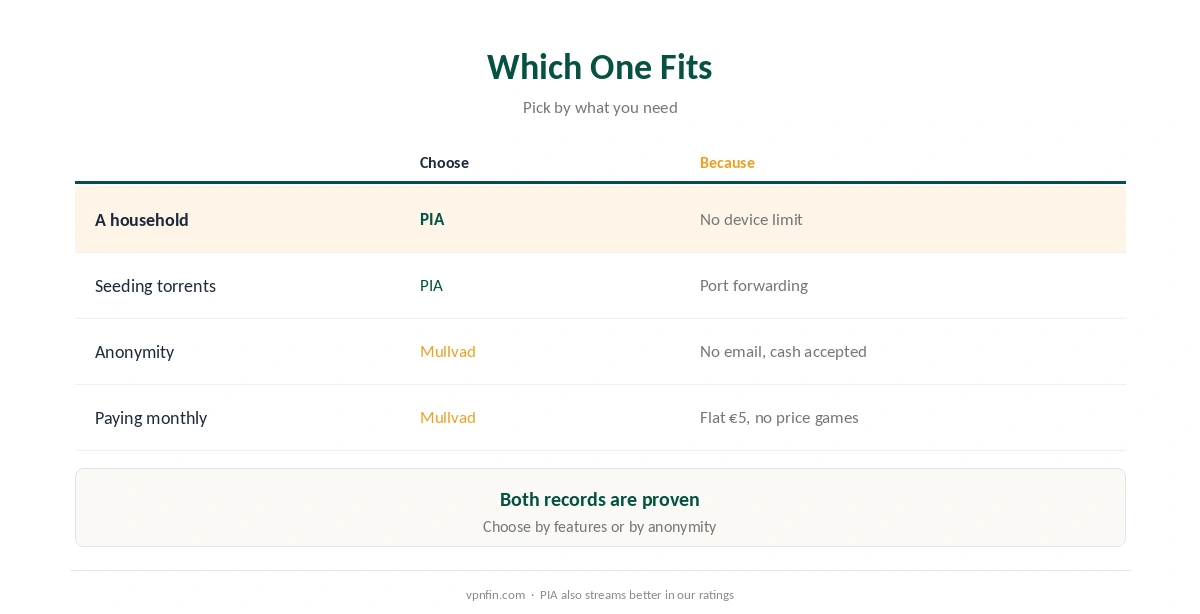
PIA for a household, for torrenting with port forwarding, for streaming, and for the lowest price on a long plan, with a court-tested record behind it.
Mullvad for anonymity, for monthly payment without price games, and for a provider that knows nothing about you. Proton VPN vs PIA and Mullvad vs Proton VPN set each against a third privacy-first rival.
How We Research
PIA’s subpoenas, audits, devices and pricing come from our PIA review and tables, and Mullvad’s raid, audits, sign-up, pricing and removal of port forwarding from our Mullvad review and tables. Prices are as recorded in our tables in September 2026, and Mullvad’s dollar figure converts its €5 price. We do not run our own tests. Our full approach lives on the About Us page.
PIA vs Mullvad FAQ
In PIA vs Mullvad, PIA wins on devices, port forwarding, streaming and long-plan price, rating 4.5 against 4.2. Mullvad wins on anonymity and simple, flat monthly pricing.
Both have been tested. PIA had no logs to give US federal authorities in at least three subpoena cases. Swedish police searched Mullvad in 2023 and found no customer data.
Mullvad. It asks for no email and accepts cash by post. PIA uses a normal email account.
No. Mullvad removed it in July 2023. PIA includes port forwarding on every plan.
On a two-year plan, PIA, at around $2.03 a month. Month to month, Mullvad’s flat €5 is far cheaper than most monthly plans.
The Verdict
PIA vs Mullvad is a choice between two proven records. PIA adds unlimited devices, port forwarding, streaming and a low long-plan price. Mullvad adds anonymity and a flat price that never moves.
If you need features, choose PIA. If you want the provider to know as little about you as possible, choose Mullvad.