
Disclosure: VPNFin is reader-supported. If you buy a VPN through links on this page, we may earn a commission at no extra cost to you. This never affects our ratings — here’s how we research.
We rank Surfshark second and CyberGhost fourth. Then we ran this comparison properly and found CyberGhost ahead on six of nine categories — more audits, a better jurisdiction, a cheaper renewal, a longer refund window, a bigger network, and the only genuine no-card trial in our top five. That is not a mistake in our rankings, and this Surfshark vs CyberGhost comparison explains why both things are true at once.
The Short Answer
Surfshark wins if you count devices. Unlimited simultaneous connections against CyberGhost’s seven is the single biggest structural difference, and for a large household it settles the question on its own.
CyberGhost wins almost everywhere else. Three no-logs audits to Surfshark’s two, Romania against a 9 Eyes jurisdiction, $56.94 a year at renewal against $79, and 45 days to change your mind instead of 30.
Head to Head
| Surfshark | CyberGhost | |
|---|---|---|
| Devices | Unlimited | 7 (router = 1) |
| No-logs audits | 2 (Deloitte) | 3 (Deloitte) |
| Jurisdiction | Netherlands (9 Eyes) | Romania (outside blocs) |
| Servers | ~4,500 | ~11,500 |
| Countries | 100 | 100 |
| Speed loss | 21% | 31–38% |
| Intro (2-year) | ~$2.49/mo | ~$2.19/mo |
| Renewal | ~$79/yr | $56.94/yr |
| Refund window | 30 days | 45 days |
| No-card trial | No | Yes (24 hrs desktop) |
| Our rating | 4.6 | 4.3 |
Devices: The Category That Decides Most Buyers
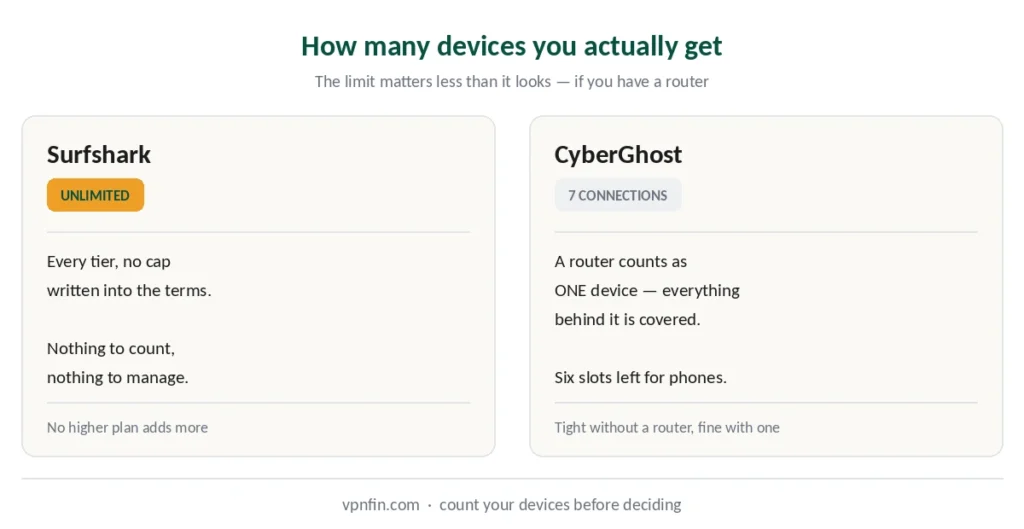
Surfshark allows unlimited simultaneous connections on every tier. No cap in the terms, no higher plan that adds more.
CyberGhost allows seven — the lowest limit among the major providers. But there is a detail almost no comparison mentions: a router connection counts as one device, and everything behind that router is covered without counting against the limit.
That changes the arithmetic considerably. A household with a VPN-capable router uses one of its seven slots for the TV, the console, the smart speakers and every laptop on the home network — leaving six for phones and devices that travel.
Without a router, seven is genuinely tight. Two people with a phone and laptop each, plus a tablet and a TV, is seven exactly.
| Provider | Simultaneous | Notes |
|---|---|---|
| NordVPN | 10 | — |
| Surfshark | Unlimited | no cap in terms |
| ExpressVPN | 10/12/14 | by tier |
| CyberGhost | 7 | router counts as one |
| PureVPN | 10 | up to 50 with paid add-on |
| IPVanish | Unlimited | no cap on any plan |
| Windscribe | Unlimited | including Build a Plan |
| Private Internet Access | Unlimited | no tier gating |
| Mullvad | 5 | no paid add-on |
| TunnelBear | Unlimited | no cap on any plan |
| Norton VPN | 5 | 10 on Ultimate, US only |
| Hotspot Shield | Disputed | sources give five and ten |
| IVPN | 5 | 10 on Pro Suite |
| PrivadoVPN | 10 | 1 on the free tier |
| StrongVPN | 12 | more than either market leader |
| PrivateVPN | 10 | free dedicated IP on one plan |
| VyprVPN | Disputed | sources give five and ten |
Winner: Surfshark, but by less than the raw numbers suggest.
Privacy: The Result That Surprised Us
Both are audited. The counts run the other way from the rankings.
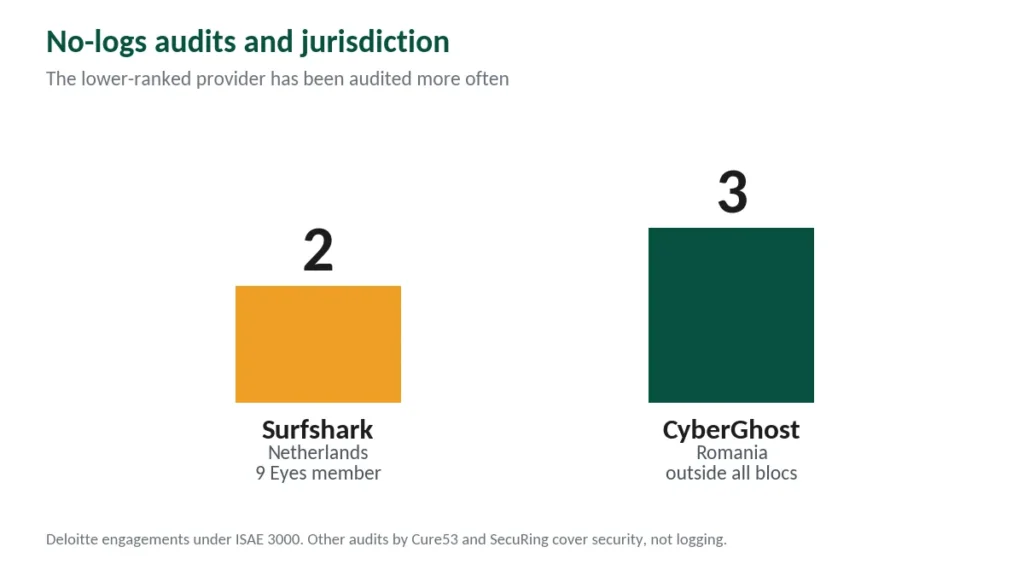
CyberGhost has three no-logs audits, all by Deloitte Audit Romania — 2022, 2024, and a third completed in 2025 under the ISAE 3000 (Revised) standard, covering VPN configuration, management systems and the token-based dedicated IP technology.
Surfshark has two, both Deloitte, in 2023 and June 2025, also under ISAE 3000. It has commissioned other audits — Cure53 on browser extensions and infrastructure, SecuRing on infrastructure security in December 2025 — but those verify security posture rather than the logging claim.
Jurisdiction favours CyberGhost more clearly. It operates from Romania, outside the 5, 9 and 14 Eyes arrangements, in a country that rejected the EU Data Retention Directive twice. Surfshark operates from the Netherlands, a 9 Eyes member. Dutch law imposes no retention obligation on VPN providers, so the practical exposure is limited — but the legal shelter is thinner.
CyberGhost also publishes quarterly transparency reports with actual numbers. In the first quarter of 2025 it recorded 105,332 DMCA complaints and three police requests, and complied with none.
Winner: CyberGhost.
Speed: Surfshark, Comfortably
CNET measured a 21% average download loss for Surfshark. Independent testers put CyberGhost at 31–38%, with the gap widening on long-distance routes.
Neither is fast by the standards of the category leaders — NordVPN loses 2.9% in the same CNET methodology. But both clear what streaming actually needs many times over: 4K requires 15 to 25 Mbps depending on platform, and a 34% loss on a 300 Mbps line still leaves around 200.
Where CyberGhost’s deficit shows: large file transfers, competitive gaming, and international routes. Where it doesn’t: anything you watch.
Winner: Surfshark.
Streaming: Different Philosophies
CyberGhost labels servers by platform. You pick Netflix, Disney+, Hulu, HBO Max or BBC iPlayer from a menu rather than guessing which city still works. Testers verified access across 16 Netflix libraries, and one reviewer unblocked six of eight platforms attempted — Peacock and DAZN were the failures.
Surfshark opens more regions. Roughly 30 Netflix catalogues, the most we found in our streaming guide, with officially supported access across the US, UK, Canada, Australia, Japan and more. Its unlimited-device policy also means nobody gets disconnected when a fourth person starts watching.
Winner: draw. CyberGhost is easier, Surfshark reaches further.
Price: CyberGhost, and Not Just on the Intro
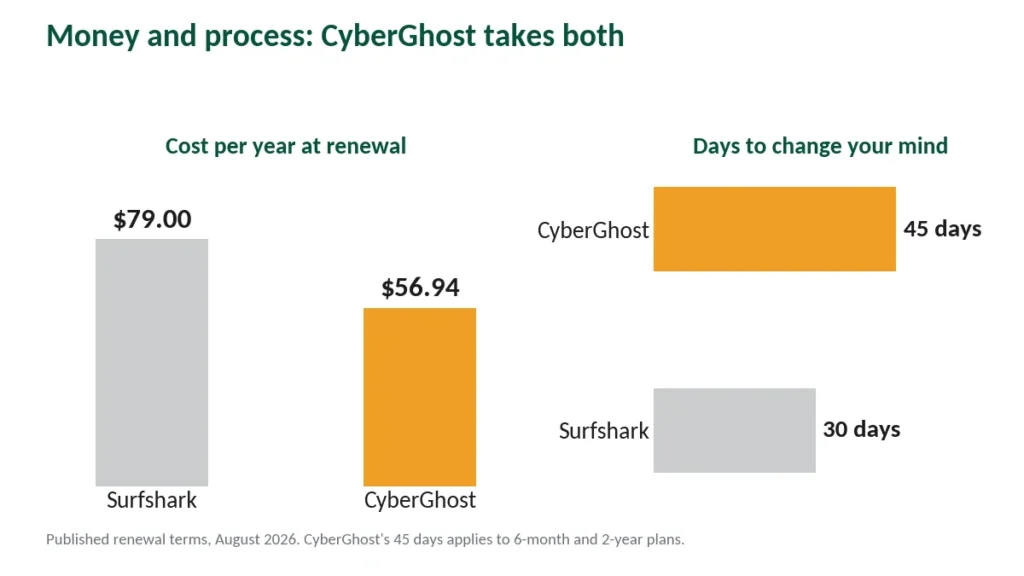
Intro pricing is close — roughly $2.19 a month for CyberGhost’s two-year plan against $2.49 for Surfshark Starter. Both bill upfront.
Renewal is where they separate. CyberGhost’s own checkout states the plan renews at $56.94 a year — the same total you paid upfront, simply charged annually instead of biennially. Surfshark converts to roughly $79 a year.
| Provider | Renewal price | Per month | Tier |
|---|---|---|---|
| NordVPN | $139.08/yr | ~$11.59 | Basic |
| Surfshark | ~$79/yr | ~$6.58 | Starter |
| ExpressVPN | $99.95/yr | ~$8.33 | Basic |
| CyberGhost | $56.94/yr | ~$4.75 | 2-year |
| PureVPN | $47.95/yr | ~$4.00 | Standard |
| IPVanish | $89.99/yr | ~$7.50 | Essential |
| Windscribe | ~$69/yr | ~$5.75 | Pro |
| Proton VPN | ~$83.88/yr | ~$6.99 | VPN Plus |
| Mullvad | ~$65/yr | ~$5.40 | flat, no tiers |
| Norton VPN | $79.99/yr | ~$6.67 | Standard |
| Hotspot Shield | ~$95.99/yr | ~$8.00 | Premium annual |
Then the refund terms. CyberGhost gives 45 days on six-month and two-year plans, the longest in the category. Surfshark gives 30. And CyberGhost offers something no other provider in our top five does: a 24-hour desktop trial requiring no payment card at all, plus three days on Android and seven on iOS through the app stores. Surfshark’s trial runs through the app stores only and needs a card on file — our free trial guide covers why that distinction matters. CyberGhost against the category leader is a different comparison entirely.
Winner: CyberGhost, decisively — and across four years it stays cheaper.
Features Where They Diverge
Surfshark puts everything in the cheapest tier: CleanWeb ad and tracker blocking, MultiHop double-routing, Bypasser split tunneling, and Alternative ID for generating throwaway signup identities. P2P works across the entire network.
CyberGhost sells one product with every VPN feature included, plus NoSpy servers housed in its own Romanian data centre with staff-only physical access — unusual at this price. P2P runs on dedicated servers across 80+ countries.
What CyberGhost lacks: multi-hop routing, port forwarding, and a built-in malware blocker in the standard subscription. The Windows Security Suite costs about a dollar a month extra.
Winner: Surfshark, on feature breadth per dollar.
Ownership: Neither Is Independent
Worth stating plainly, because both companies keep it quiet.
Surfshark merged with Nord Security in 2022 — the same group behind NordVPN. The brands operate separately, but the parent is shared.
CyberGhost was acquired by Kape Technologies in 2017, alongside ExpressVPN and Private Internet Access. Kape’s earlier corporate history has drawn scrutiny from privacy commentators.
So you are choosing between two brands owned by two large VPN conglomerates. Neither is the scrappy independent its marketing implies, and that applies to most of this market.
Why Our Rankings Say Something Different
CyberGhost wins six categories here and still sits below Surfshark in our top 5. That deserves an explanation rather than a shrug.
Our rankings weight speed and unique capability heavily, because those are the things you cannot work around. Unlimited devices is a category-defining feature that nothing else in this market matches. A 31–38% speed deficit is a real ceiling for anyone on fast fibre.
The categories CyberGhost wins are mostly about money and process — renewal price, refund length, trial terms, audit count. Enormously valuable if those are your priorities, but they don’t change what the product does.
Which is the honest version of what rankings are: a general ordering that cannot know your situation. This comparison can.
How We Research
This comparison draws on our full reviews of both providers, published Deloitte audit announcements, quarterly transparency reports, speed results from named independent labs, and renewal terms taken from each provider’s own checkout — cross-checked and verified at publication. Where sources conflicted, notably on CyberGhost’s server count, we say so rather than picking the flattering number. Our full approach lives on the About Us page.
Surfshark vs CyberGhost FAQ
Less than it sounds, because a router connection counts as a single device and everything behind that router is covered. With a VPN-capable router, one slot handles your whole home network. Without one, seven is tight for a busy household — two people with a phone and laptop each, plus a tablet and a TV, uses all seven.
CyberGhost, with three no-logs audits by Deloitte Audit Romania in 2022, 2024 and 2025. Surfshark has two, both Deloitte, in 2023 and June 2025. Surfshark has commissioned additional audits from Cure53 and SecuRing, but those examined security posture rather than the logging claim specifically.
CyberGhost, at $56.94 a year against Surfshark’s roughly $79. CyberGhost is unusual in charging the same total on renewal that you paid upfront — you simply pay it annually instead of every two years. Both enable auto-renewal by default.
CyberGhost does — 24 hours on Windows and macOS with no payment details at all, plus three days on Android and seven on iOS through the app stores. Surfshark’s seven-day trial runs through the app stores only and requires a payment method on file.
For privacy purposes, yes. Romania sits outside the 5, 9 and 14 Eyes intelligence-sharing arrangements and rejected the EU Data Retention Directive twice. The Netherlands is a 9 Eyes member, though Dutch law imposes no retention obligation on VPN providers and Surfshark runs RAM-only servers, which limits what could exist to hand over.
Neither. Surfshark merged with Nord Security in 2022, the group behind NordVPN. CyberGhost was acquired by Kape Technologies in 2017, alongside ExpressVPN and Private Internet Access. Both brands operate separately from their siblings, but consolidation is the norm in this market rather than the exception.
The Verdict
Choose Surfshark if you have more than seven devices and no VPN-capable router, or if speed on a fast connection matters. Full detail in our Surfshark review.
Choose CyberGhost if seven connections cover you — or you have a router, which effectively removes the limit — and you care about renewal price, refund length, audit depth or jurisdiction. Full detail in our CyberGhost review.
For most single users and couples, CyberGhost is the better buy on the numbers. For households, Surfshark wins on the one category that overrides everything else.