
Disclosure: VPNFin is reader-supported. If you buy a VPN through links on this page, we may earn a commission at no extra cost to you. This never affects our ratings — here’s how we research.
Hotspot Shield’s parent company published a press release in December 2024 listing the brands it owns. Two entries on that list sit oddly together: Hotspot Shield, and Comparitech — a website that reviews VPNs.
That is not an allegation. It is the company’s own announcement, repeated verbatim across the wire services.
The service itself is fast, sometimes remarkably so. It also has no independent audit of its no-logs policy, runs a closed protocol nobody outside the company can inspect, and has not published a transparency report since 2019. This Hotspot Shield review covers all of it.
Is Hotspot Shield Worth It in 2026?
For speed on nearby servers, yes. Its Catapult Hydra protocol is genuinely quick and the free tier is among the more usable free options.
For privacy, the answer is harder. No no-logs audit, US jurisdiction inside Five Eyes, servers that write to disk rather than running from RAM, and a documented history of tracking code in the free Android app. Around $7.99 a month on an annual plan, with a 45-day refund window.
Hotspot Shield at a Glance
Pros
- ✔ Catapult Hydra is fast, particularly on nearby and US East servers
- ✔ A free tier that is usable rather than a two-day trial in disguise
- ✔ 45-day money-back guarantee, level with CyberGhost and behind Norton VPN’s 60 days
- ✔ P2P permitted across the network
- ✔ Works reliably in restrictive networks
Cons
- ✖ No independent audit of the no-logs policy — the protocol has been audited, the policy has not
- ✖ US jurisdiction, inside the Five Eyes arrangement
- ✖ Catapult Hydra is proprietary and closed, so nobody outside the company can verify it
- ✖ No transparency report published since 2019
- ✖ Servers write to disk rather than running from RAM
- ✖ Parent company Point Wild also owns Comparitech, a VPN review site
- ✖ Published prices and device limits contradict each other across sources
Who Actually Owns It
Three reviews published in 2026 name three different owners. All three are wrong or stale, which tells you how quickly this changed.
The chain, in order. Hotspot Shield was founded in 2008 by AnchorFree. AnchorFree renamed itself Pango. Aura acquired the consumer VPN business around 2019. Pango then separated from Aura in September 2024, and in December 2024 merged with antivirus maker Total Security to form Point Wild.
Point Wild’s own press release lists its brands: Total AV, Hotspot Shield, UltraAV, Betternet, CyEx, Simpluris and Comparitech. The company reported roughly $600 million in annual revenue and an enterprise value of $1.7 billion.
⚠️ Comparitech is a VPN review publication. So the company selling you this VPN also owns a site that ranks VPNs. Published analysis of VPN ownership counts several parent companies in the same position.
This is a pattern rather than an outlier, and we have flagged it twice already. Kape Technologies owns ExpressVPN, CyberGhost and PIA alongside review sites; Ziff Davis owns IPVanish alongside several technology publications.
We have no such relationship, which is why we keep naming them. Mullvad, Proton VPN and Windscribe are the providers in our coverage with no parent company at all.
Point Wild is not the only parent in this position. Kape owns three VPNs and three review sites, Ziff Davis owns IPVanish alongside PCMag and CNET, and we mapped all of it on one page.
The Verification Gap
Here is the part that decides the rating.
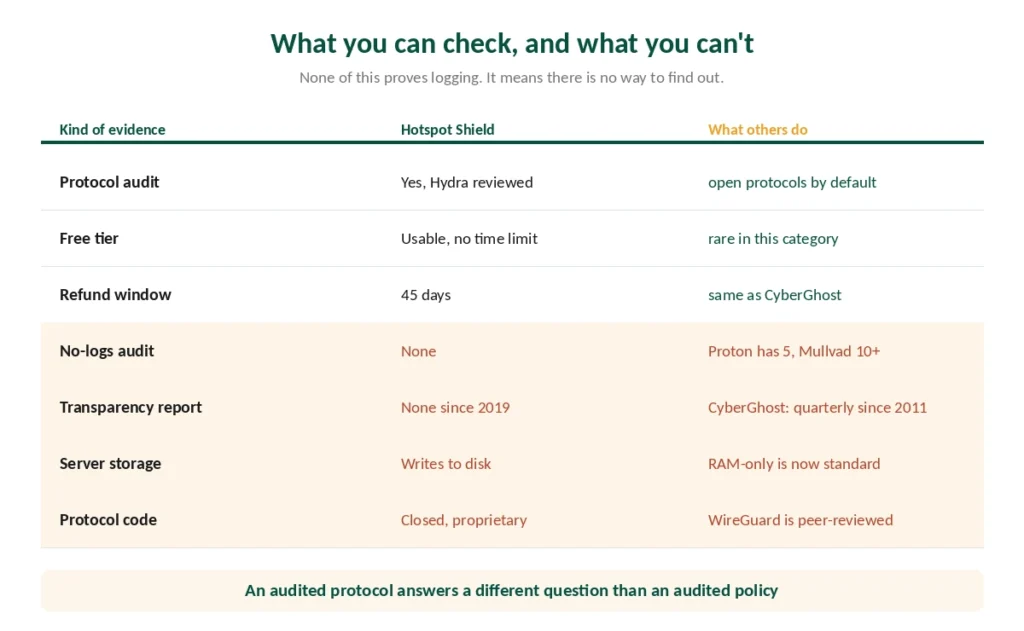
There is no independent audit of the no-logs policy. The proprietary Catapult Hydra protocol has been examined by outside parties, and the company points to that. Those are different things: one asks whether the tunnel is built correctly, the other asks whether the company keeps records of what goes through it.
No transparency report since 2019. Providers publish these to document legal requests received and what was handed over. CyberGhost has published quarterly since 2011; Hotspot Shield stopped seven years ago. TunnelBear has published an audit every year since 2017 without missing one.
Servers are not RAM-only. Data written to disk survives a reboot, and survives a seizure.
And Hydra is closed. WireGuard and OpenVPN are open source and reviewed by people with no commercial interest in the outcome. Hydra’s security properties rest on the company’s own account of them.
⚠️ None of this means Hotspot Shield is logging you. It means there is no mechanism by which you could find out. Compare that with Proton VPN’s five published annual audits or ExpressVPN’s record, whose exact size nobody can agree on, and the gap is not a matter of degree.
The 2016 and 2017 Findings
These come up in every discussion of Hotspot Shield, and they need context in both directions.
In 2016, a CSIRO study reported that the free Android app injected advertising and tracking code into user traffic.
In 2017, the Center for Democracy & Technology filed a 13-page complaint with the Federal Trade Commission, alleging undisclosed data sharing and traffic redirection. Its analysis of reverse-engineered code described more than five third-party tracking libraries and JavaScript injected via iframes for advertising purposes.
Context that matters. Both concerned the free product, both predate two changes of ownership, and no comparable finding has been published since. No reporting has alleged that Hotspot Shield sold or surrendered user logs.
⚠️ Context that also matters. The company answered those findings with new owners rather than with an audit. Nine years later, the fastest way to close that chapter would be an independent no-logs assessment, and there still is not one — PureVPN answered a worse incident by submitting to permanent third-party inspection.
Speed: The Genuine Strength
Catapult Hydra is fast, and on nearby servers it is very fast. Testing on a 250 Mbps line found Hotspot Shield among the quickest available on European and US East routes, with servers supporting gigabit throughput.
Consistency is the weakness. The same testing found results dropping noticeably on distant servers. When it is fast it is excellent; it is simply not fast everywhere, unlike NordVPN’s 2.9% average loss across CNET’s full test set — the two compared directly come down to everything except speed.
Coverage spans 80-plus countries, which is mid-sized for the category. Published server counts vary between sources, as they do for most providers here.
The Free Tier
This is a real product rather than a teaser, and it deserves a straight assessment.
No time limit, ad-supported, with access restricted to a handful of server locations and slower speeds than paid.
⚠️ The trade is data. Location data from free users may be used for ad targeting, per the provider’s own terms. That is the business model, disclosed rather than hidden — but it means the free tier is paid for in a currency other than money. Our free VPN guide covers which free tiers avoid that trade.
Pricing: The Least Consistent We Have Seen
Every provider has some price variation across sources. This one is different in kind.
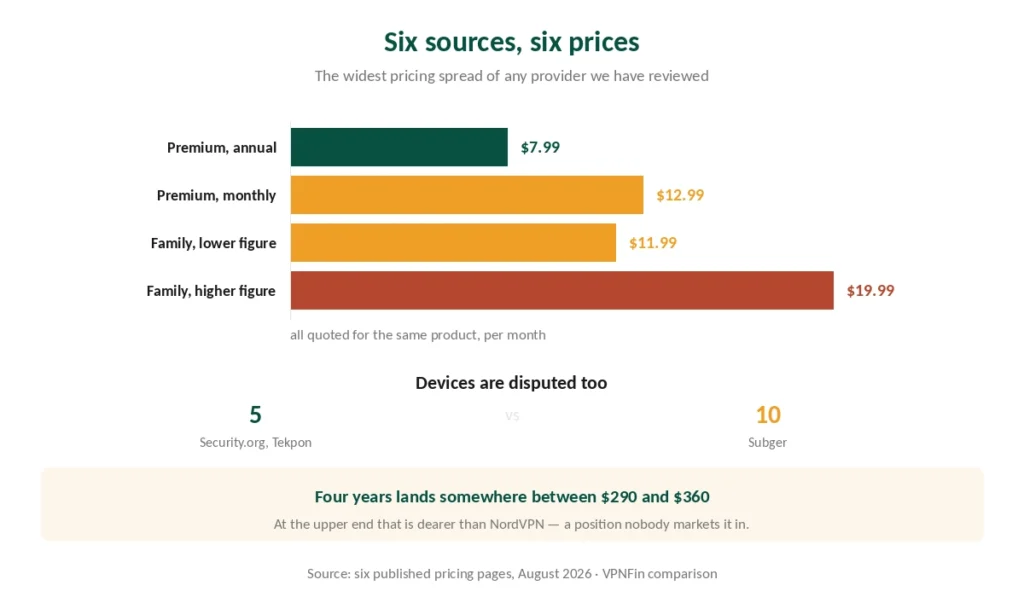
Published figures for the same Premium plan range from $7.99 to $12.99 a month. The family plan appears as $11.99 in one source and $19.99 in another. Device limits are given as five by some reviewers and ten by others.
What we can state with reasonable confidence: the annual plan works out near $7.99 a month, roughly $71.88 to $71.99 for the first year, with the regular annual rate reported at $95.99. Month-to-month is $12.99.
Four years therefore lands somewhere between $290 and $360 — which at the upper end would make it more expensive than NordVPN’s $335, a position nobody markets it in. Even the lower bound is more than Surfshark costs, which rates 4.6 against this one’s 3.4.
⚠️ Check the renewal figure at checkout rather than trusting any review, including this one. We could not resolve the spread, and we would rather say so than pick the flattering number.
The 45-day money-back guarantee is genuinely good, level with CyberGhost and behind Norton VPN’s sixty days, plus a seven-day trial.
Streaming, Torrenting and Features
Streaming works on dedicated US and UK servers that refresh addresses regularly, though published assessments describe it as inconsistent rather than reliable. Our streaming guide covers why snapshots go stale.
Torrenting is permitted across the network, without a separate server list to check.
The feature set is thin next to the mainstream: split tunnelling, a kill switch, a Chrome extension. No multi-hop, no port forwarding, no mesh networking.
What We Don’t Love
The audit gap is the whole problem. Every criticism above follows from it. A single independent no-logs assessment would change this review substantially, and it would cost the company a fraction of what it spends on marketing.
The ownership disclosure is buried. Point Wild announced its brand list openly, but you will not find it in the app or at checkout.
Prices that nobody can pin down are a bad sign in themselves. When six sources give six numbers, the pricing page is doing something other than informing you.
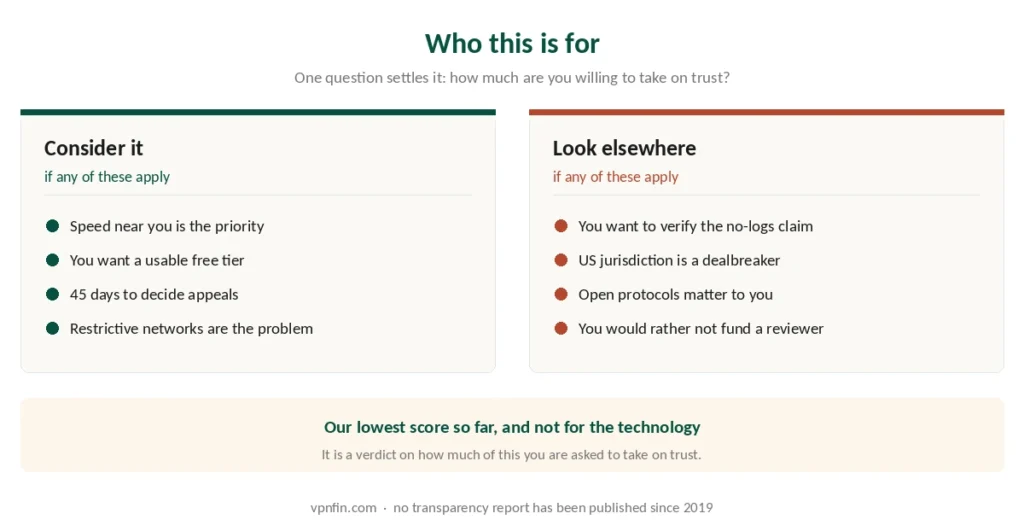
Our score is 3.4, the lowest we have given. It is not a verdict on the technology, which works well. It is a verdict on how much of this you are asked to take on trust.
How We Research
This review draws on Point Wild’s December 2024 merger announcement as published by PR Newswire and carried by the wire services, contemporaneous reporting on the 2016 CSIRO findings and the 2017 CDT complaint to the FTC, published speed testing from named reviewers, and pricing figures from multiple sources that we compared rather than averaged — cross-checked and verified at publication. We don’t run our own speed tests. Where sources conflicted, most severely on price and device limits, we publish the range and say plainly that we could not resolve it. Our full approach lives on the About Us page.
Hotspot Shield FAQ
Point Wild, since December 2024. The chain runs from AnchorFree to Pango, through Aura ownership, to a separation from Aura in September 2024 and a merger with antivirus maker Total Security. Point Wild’s own announcement lists its brands, which include Hotspot Shield and Comparitech, a VPN review website.
No. Its proprietary Catapult Hydra protocol has been examined by outside parties, but the no-logs policy itself has not been independently audited. The company has also not published a transparency report since 2019, so there is no public record of legal requests received or answered.
It works, and the trade is disclosed rather than hidden. The free tier is ad-supported, limited to a few server locations, and location data from free users may be used for ad targeting. In 2016 and 2017 researchers documented tracking code in the free Android app, though that predates two changes of ownership.
Published figures conflict more than for any provider we have reviewed. The annual plan works out near $7.99 a month, with a regular annual rate reported at $95.99 and a month-to-month price of $12.99. Family plans appear as $11.99 or $19.99 depending on the source. Check the figure at checkout.
Yes, on nearby servers. Its Catapult Hydra protocol performs very well on European and US East routes and supports gigabit throughput. Results drop noticeably on distant servers, so it is fast rather than consistently fast.
Hotspot Shield
The Verdict
The Catapult Hydra protocol is genuinely fast and the free tier is usable. There is no independent audit of the no-logs policy, no transparency report since 2019, and the parent company also owns a VPN review site.
Final Verdict: 3.4/5
Buy it if speed on nearby servers is the priority and you are comfortable taking the privacy claims on trust. The Hydra protocol is quick, the free tier is usable, and 45 days is a long time to change your mind.
Skip it if you want to verify anything. There is no no-logs audit, no transparency report since 2019, no open protocol and no RAM-only architecture. For roughly the same money, Proton VPN publishes five audits and Mullvad publishes more than ten.
And know who you are buying from. Point Wild owns this VPN and a website that reviews VPNs. That is disclosed in its own press release, and it is worth knowing before you read the next review of it.