
Disclosure: VPNFin is reader-supported. If you buy a VPN through links on this page, we may earn a commission at no extra cost to you. This never affects our ratings — here’s our full disclosure.
Hotspot Shield vs TunnelBear pairs two VPNs aimed at the same person: a beginner who wants a free tier and an app that needs no explaining. Both belong to large corporate parents, Point Wild and McAfee, and both operate from Five Eyes countries.
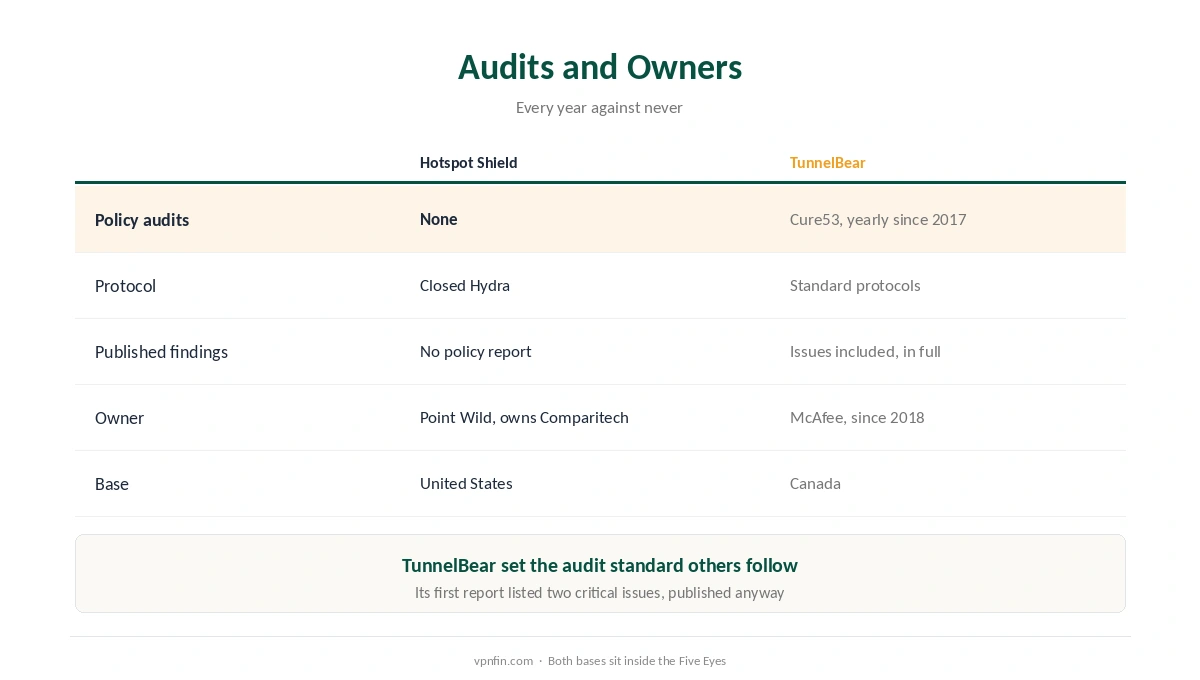
Their habits on verification are opposite. TunnelBear has published a Cure53 audit every year since 2017, including the first one that found two critical issues. Hotspot Shield has never had its no-logs policy audited and has published no transparency report since 2019.
Hotspot Shield vs TunnelBear: The Short Answer
Choose TunnelBear over Hotspot Shield for verified privacy, unlimited devices and a lower long-term price. It rates 4.0 in our TunnelBear review and costs about $160 over four years in our table.
Choose Hotspot Shield for speed and a refund window. It rates 3.4 in our Hotspot Shield review; its Catapult Hydra protocol is fast on nearby servers, and it gives 45 days to claim a refund.
Both offer a free tier. TunnelBear’s gives 2 GB a month; Hotspot Shield’s is usable but carries a history of tracking code in its Android app.
Audits: Every Year Against Never
TunnelBear commissioned Cure53 in 2016 and published the results in 2017, findings included. It has repeated the audit every year since, eight rounds by 2024, and our review credits it with setting the standard others now follow.
Hotspot Shield has no audit of its no-logs policy. Outside parties have examined its Catapult Hydra protocol, which tests the tunnel rather than whether records exist. The protocol is closed and its servers write to disk. Our audit tracker and our no-logs guide explain why the difference matters.
| Provider | No-logs audits | Auditor | Jurisdiction |
|---|---|---|---|
| NordVPN | 6 | PwC, Deloitte | Panama |
| Surfshark | 2 | Deloitte | Netherlands (9 Eyes) |
| ExpressVPN | 3 | KPMG (28 security reports in total) | British Virgin Islands, Kape-owned |
| CyberGhost | 3 | Deloitte | Romania, Kape-owned |
| PureVPN | 4 | KPMG | BVI, operated from Pakistan |
| IPVanish | 2 | Leviathan, Schellman | United States (Five Eyes), Ziff Davis-owned |
| Windscribe | 1 | Packetlabs, production infrastructure | Canada (Five Eyes); Greek case dismissed, no data to give |
| Proton VPN | 5 | Securitum | Switzerland, moving infrastructure to EU |
| Private Internet Access | 3 | Deloitte | United States (Five Eyes), Kape-owned |
| Mullvad | 10+ | Cure53, Assured AB | Sweden (14 Eyes) |
| TunnelBear | Annual since 2017 | Cure53 | Canada (Five Eyes), US parent |
| Norton VPN | 2 | VerSprite | United States (Five Eyes) |
| Hotspot Shield | 0 | protocol audited, policy not | United States (Five Eyes) |
| AirVPN | 0 | none — the client is open source instead | Italy (14 Eyes) |
| IVPN | 8, annual since inception | Cure53 | Gibraltar (status disputed) |
| Hide.me | 1 modern, in 2024 | Securitum, though one source names Altius IT | Malaysia (outside the alliances) |
| PrivadoVPN | 0 | none in six years of operation | Iceland (moved from Switzerland, 2026) |
| TorGuard | 0 | none; settled a lawsuit without disclosing records | United States (Five Eyes) |
| FastestVPN | 1, in 2023 | Altius IT | Cayman Islands (outside the alliances) |
| StrongVPN | 0 | none in over two decades | United States (Five Eyes), Ziff Davis-owned |
| VyprVPN | 1, in 2018 | Leviathan Security, before the 2023 sale | United States (Five Eyes), Certida-owned since 2023 |
| PrivateVPN | 0 | none; support says there is nothing to audit | Sweden (14 Eyes), ownership disputed |
| ZoogVPN | 0 | none; support describes one as planned | Greece (outside the alliances), run from Ukraine |
| Malwarebytes Privacy VPN | 1, in 2026 | X41 D-Sec, white-box over two months | United States (Five Eyes), runs AzireVPN infrastructure |
| Astrill | 0 | — | Disputed: Seychelles or Liechtenstein |
Owners and Jurisdiction
TunnelBear has belonged to McAfee since March 2018, with its team still in Toronto; Canada is a Five Eyes member. Hotspot Shield belongs to Point Wild, which also owns Betternet, UltraVPN and Comparitech, a VPN review site, and it operates from the United States.
Our reviews of each treat the parent as a structural concern rather than a documented problem. Our ownership guide maps both groups.
Hotspot Shield vs TunnelBear on Price
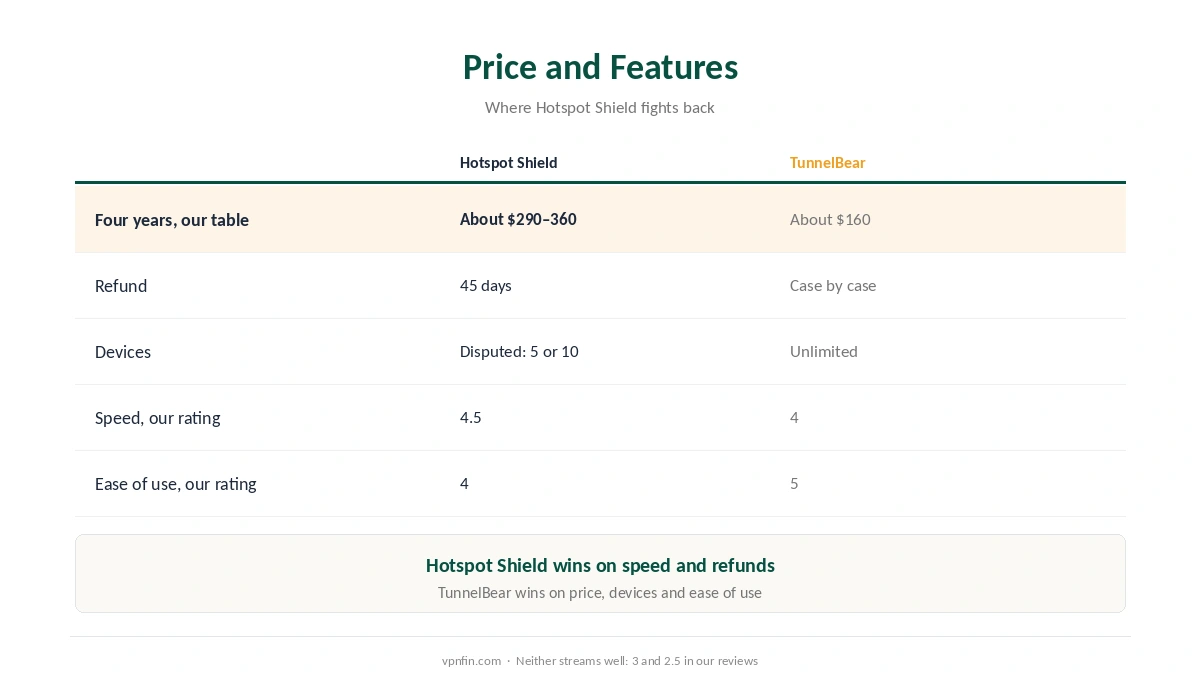
TunnelBear costs around $3.33 a month on its three-year plan, and our four-year table puts it near $160.
Hotspot Shield costs about $71.88 for its first year, then $95.99 a year, and our four-year table puts it between about $290 and $360. Our renewal price table compares both renewals.
| Provider | 4-year total |
|---|---|
| PureVPN | ~$142 |
| CyberGhost | ~$152–161 |
| TunnelBear | ~$160 |
| Surfshark | ~$205 |
| Proton VPN | ~$240 |
| Mullvad | ~$260 |
| ExpressVPN | ~$267 |
| Norton VPN | ~$280 |
| Hotspot Shield | ~$290–360 |
| NordVPN | ~$335 |
| Astrill | ~$600 |
⚠️ Refunds reverse the picture. Hotspot Shield gives 45 days. TunnelBear has no standard guarantee and considers refunds case by case, so use its free tier as the trial. Our refund guide covers both.
Free Tiers, Devices and Speed
Free tiers: TunnelBear gives 2 GB a month, no card needed. Our review calls Hotspot Shield’s free tier usable rather than a trial in disguise, but its free Android app has a documented history of tracking code. Our free VPN guide compares both with the free tiers we trust most.
Devices: TunnelBear allows unlimited simultaneous devices on paid plans. Sources disagree on Hotspot Shield’s limit, giving five and ten. Our multi-device guide compares the providers.
Speed and streaming: Hotspot Shield rates 4.5 for speed in our review and TunnelBear 4. Neither streams well, at 3 and 2.5 respectively. Our Netflix guide covers better options.
Ease of use: TunnelBear scores 5 in our review, Hotspot Shield 4. Both are good first VPNs to install.
Which One
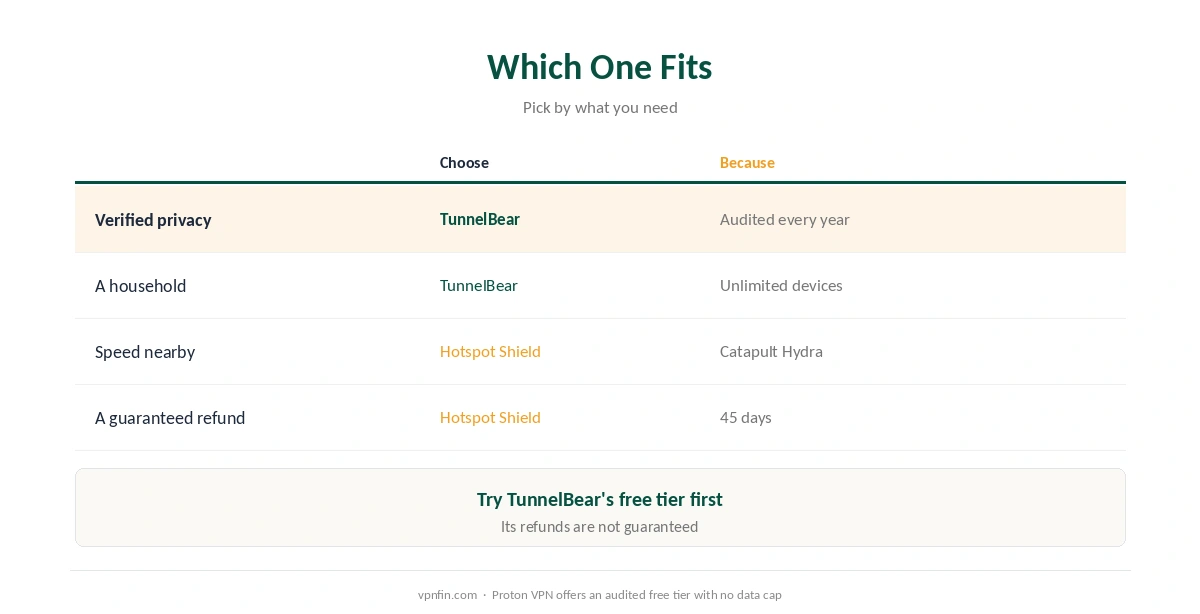
TunnelBear for a beginner who wants verified privacy, unlimited devices and a lower four-year cost, after testing the free tier.
Hotspot Shield if speed on nearby servers or a guaranteed 45-day refund matters more than verification. Proton VPN vs TunnelBear and Proton VPN vs Hotspot Shield set each against an audited free tier with no data cap.
How We Research
TunnelBear’s audit history, ownership, free tier, refund policy and pricing come from our TunnelBear review and tables, and Hotspot Shield’s ownership, audit gap, protocol, free tier and pricing from our Hotspot Shield review and tables. Ratings are the criterion scores from each review. Prices are as recorded in our tables in September 2026, so confirm them at checkout. We do not run our own tests. Our full approach lives on the About Us page.
Hotspot Shield vs TunnelBear FAQ
In Hotspot Shield vs TunnelBear, TunnelBear wins on audits, devices and four-year price, rating 4.0 against 3.4. Hotspot Shield wins on speed and its 45-day refund window.
TunnelBear has published a Cure53 audit every year since 2017. Hotspot Shield has never had its no-logs policy audited, only its protocol examined.
TunnelBear’s gives 2 GB a month under an audited policy. Hotspot Shield’s is usable, but its Android app has a documented history of tracking code.
TunnelBear over four years, at about $160 in our table against about $290 to $360 for Hotspot Shield, which renews at $95.99 a year.
Hotspot Shield gives 45 days. TunnelBear has no standard money-back guarantee and decides refunds case by case.
The Verdict
For most beginners, Hotspot Shield vs TunnelBear goes to TunnelBear. It is audited every year, allows unlimited devices, costs less over time, and has the friendliest app in the category.
Hotspot Shield is faster nearby and easier to refund. Try TunnelBear’s free tier first, and choose Hotspot Shield only if speed is the thing you cannot compromise on.