
Disclosure: VPNFin is reader-supported. If you buy a VPN through links on this page, we may earn a commission at no extra cost to you. This never affects our ratings — here’s our full disclosure.
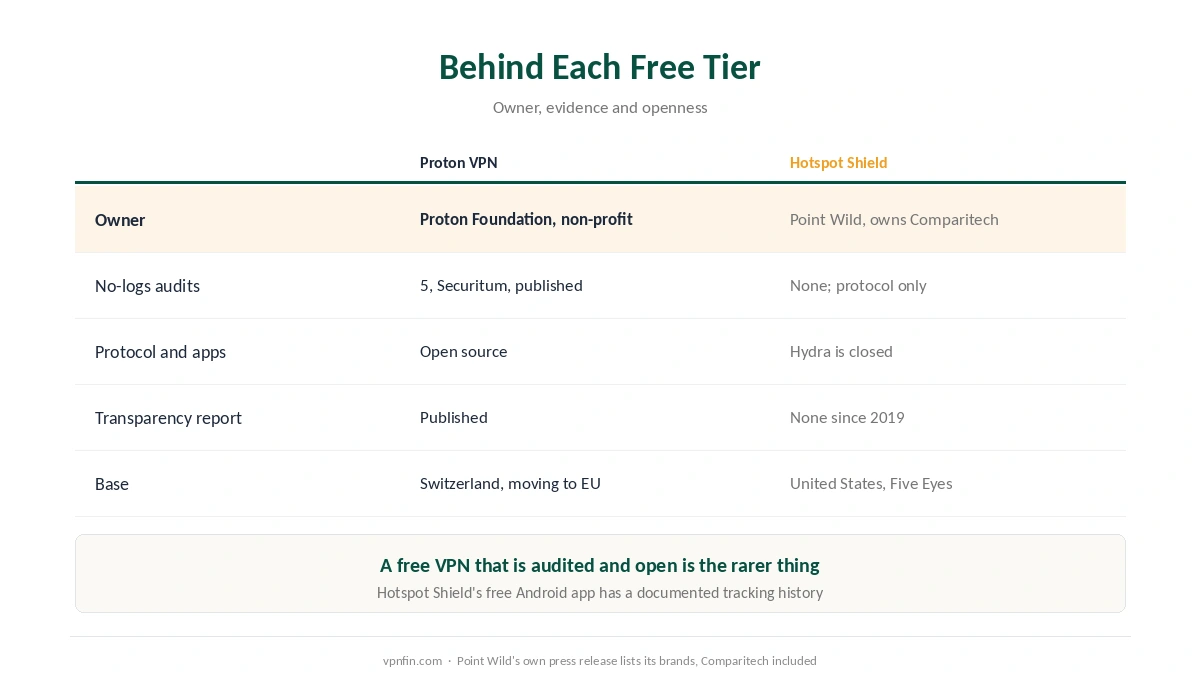
Proton VPN vs Hotspot Shield comes up because both give away a usable free tier. Who stands behind each free tier, however, could hardly differ more. Proton VPN belongs to the Proton Foundation, a non-profit. Hotspot Shield belongs to Point Wild, whose own December 2024 press release lists among its brands Comparitech, a website that reviews VPNs.
The evidence gap is just as wide. Proton has five consecutive no-logs audits, all published in full, and open-source apps. Hotspot Shield has no audit of its no-logs policy, a proprietary protocol nobody outside the company can inspect, and no transparency report since 2019. Its advantage is speed, and a longer refund window.
Proton VPN vs Hotspot Shield: The Short Answer
Choose Proton VPN for privacy and for a free tier you can trust. It rates 4.6 in our Proton VPN review, with a free plan that has no data cap and five published audits.
Choose Hotspot Shield only if raw speed on nearby servers matters most. It rates 3.4 in our Hotspot Shield review. Its Catapult Hydra protocol is fast, and it gives 45 days to claim a refund.
Over four years, Proton also costs less: about $240 in our table, against about $290 to $360 for Hotspot Shield.
Two Free Tiers, Two Business Models
Proton’s free plan has no data cap and needs no card. It runs on the same audited no-logs policy as the paid plans and funds itself by converting free users rather than monetising them. Our free VPN guide explains why that distinction matters.
Hotspot Shield’s free tier is usable, rather than a short trial in disguise, and our review credits it for that. It also records a documented history of tracking code in the free Android app, which is the risk every free VPN has to answer.
⚠️ If you only ever use the free version, Proton VPN vs Hotspot Shield is the comparison that matters most. A free VPN that is audited and open source is a rarer thing than a free VPN that is fast.
Ownership: A Non-Profit Against a Review-Site Owner
Proton VPN’s parent is the Proton Foundation, which owns nothing else in the VPN market.
Hotspot Shield’s parent is Point Wild, formed in December 2024 when Pango merged with Total Security. Its brand list includes Betternet, UltraVPN and Comparitech. So the company selling this VPN also owns a site that ranks VPNs. That is a disclosed fact, not an allegation, and Point Wild is not alone in the position. Our ownership guide maps the others.
Privacy: Audited and Open Against Closed and Unaudited
Proton VPN has five consecutive annual no-logs audits by Securitum, each report published in full on its audit page, and every app is open source. In July 2025 it announced it was moving most of its infrastructure from Switzerland into the EU.
Hotspot Shield has no audit of its no-logs policy. Outside parties have examined its Catapult Hydra protocol, but that tests the tunnel, not whether the company keeps records. The protocol is closed, its servers write to disk rather than running from RAM, and it operates from the United States, inside the Five Eyes. Our audit tracker and our no-logs guide explain why each point matters.
| Provider | No-logs audits | Auditor | Jurisdiction |
|---|---|---|---|
| NordVPN | 6 | PwC, Deloitte | Panama |
| Surfshark | 2 | Deloitte | Netherlands (9 Eyes) |
| ExpressVPN | 3 | KPMG (28 security reports in total) | British Virgin Islands, Kape-owned |
| CyberGhost | 3 | Deloitte | Romania, Kape-owned |
| PureVPN | 4 | KPMG | BVI, operated from Pakistan |
| IPVanish | 2 | Leviathan, Schellman | United States (Five Eyes), Ziff Davis-owned |
| Windscribe | 1 | Packetlabs, production infrastructure | Canada (Five Eyes); Greek case dismissed, no data to give |
| Proton VPN | 5 | Securitum | Switzerland, moving infrastructure to EU |
| Private Internet Access | 3 | Deloitte | United States (Five Eyes), Kape-owned |
| Mullvad | 10+ | Cure53, Assured AB | Sweden (14 Eyes) |
| TunnelBear | Annual since 2017 | Cure53 | Canada (Five Eyes), US parent |
| Norton VPN | 2 | VerSprite | United States (Five Eyes) |
| Hotspot Shield | 0 | protocol audited, policy not | United States (Five Eyes) |
| AirVPN | 0 | none — the client is open source instead | Italy (14 Eyes) |
| IVPN | 8, annual since inception | Cure53 | Gibraltar (status disputed) |
| Hide.me | 1 modern, in 2024 | Securitum, though one source names Altius IT | Malaysia (outside the alliances) |
| PrivadoVPN | 0 | none in six years of operation | Iceland (moved from Switzerland, 2026) |
| TorGuard | 0 | none; settled a lawsuit without disclosing records | United States (Five Eyes) |
| FastestVPN | 1, in 2023 | Altius IT | Cayman Islands (outside the alliances) |
| StrongVPN | 0 | none in over two decades | United States (Five Eyes), Ziff Davis-owned |
| VyprVPN | 1, in 2018 | Leviathan Security, before the 2023 sale | United States (Five Eyes), Certida-owned since 2023 |
| PrivateVPN | 0 | none; support says there is nothing to audit | Sweden (14 Eyes), ownership disputed |
| ZoogVPN | 0 | none; support describes one as planned | Greece (outside the alliances), run from Ukraine |
| Malwarebytes Privacy VPN | 1, in 2026 | X41 D-Sec, white-box over two months | United States (Five Eyes), runs AzireVPN infrastructure |
| Astrill | 0 | — | Disputed: Seychelles or Liechtenstein |
Price and Refunds
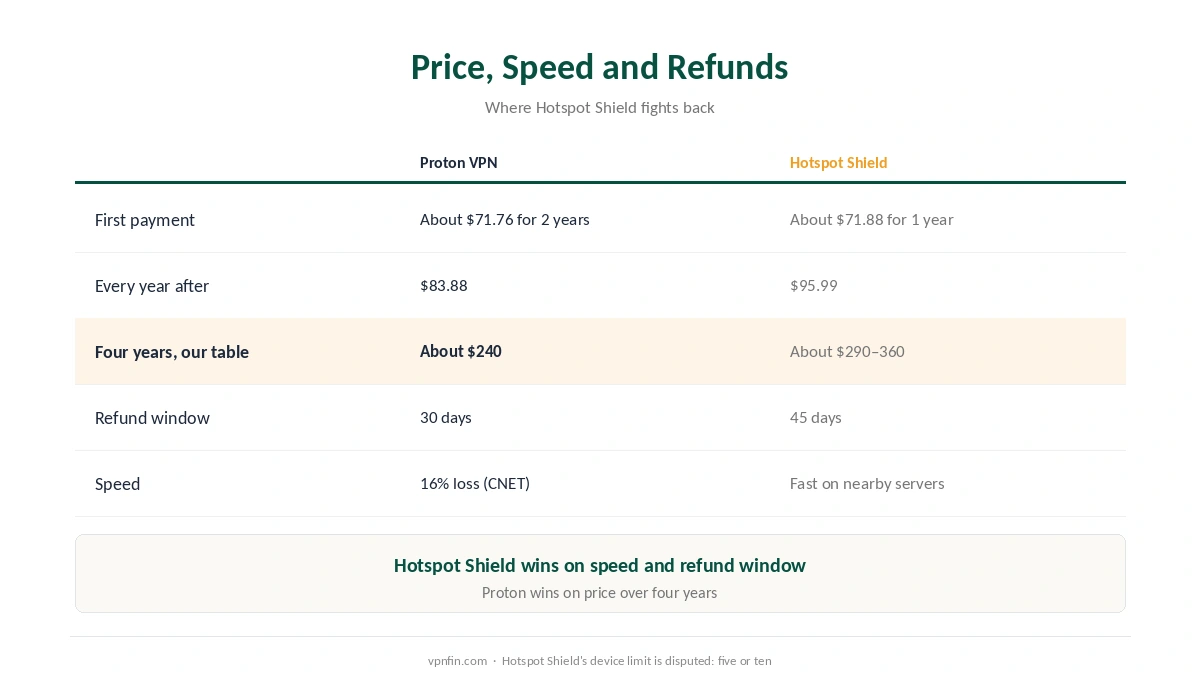
Proton VPN Plus costs about $2.99 a month on its two-year plan, around $71.76 upfront, then $83.88 a year.
Hotspot Shield costs about $71.88 for its first year, then $95.99 a year, according to our tables; published monthly prices range from $5.99 to $7.99 depending on the promotion. Our renewal price table compares both renewals.
Refunds favour Hotspot Shield: 45 days, against Proton’s 30. Our review notes that Proton prorates refunds in practice, so our refund guide is worth reading before you claim.
| Provider | First term | Every year after |
|---|---|---|
| Norton VPN | $39.99 (12 months) | $79.99 |
| Private Internet Access | ~$49 (24 months) | Sources disagree |
| CyberGhost | $56.94 (26 months) | $56.94 |
| PureVPN | $58.20 (27 months) | $47.95 |
| Mullvad | ~$65 (12 months) | ~$65 |
| Surfshark | ~$67 (27 months) | ~$79 |
| Proton VPN | ~$71.76 (24 months) | $83.88 |
| Hotspot Shield | ~$71.88 (12 months) | $95.99 |
| NordVPN | $94.23 (27 months) | $139.08 |
| ExpressVPN | ~$98 (28 months) | $99.95 |
| Astrill | $300 (24 months) | $300 every 2 years |
Speed, Streaming and Devices
Speed is Hotspot Shield’s genuine strength, particularly on nearby and US East servers, thanks to Catapult Hydra. CNET measured a 16% average loss with Proton VPN. Our speed guide explains what affects it.
Streaming favours Proton in our ratings, at 4.5 against 3.
Devices: Hotspot Shield’s limit is disputed, with sources giving five and ten. Check the figure for your plan at checkout. Our multi-device guide compares the providers.
Which One
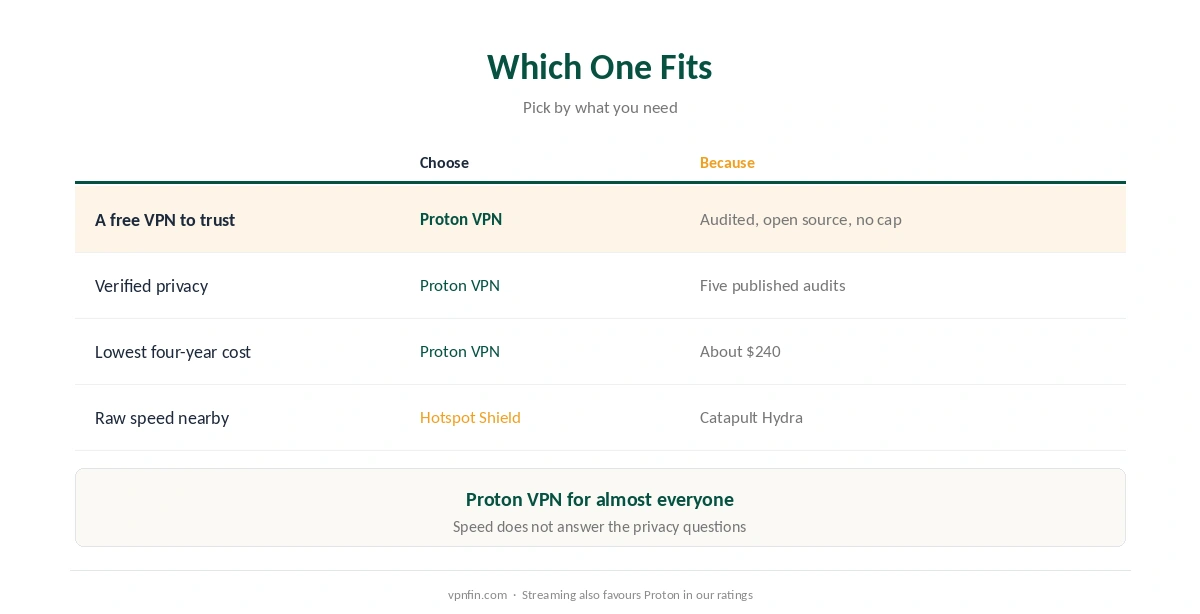
Proton VPN for almost everyone: better privacy evidence, a trustworthy free tier, stronger streaming and a lower four-year cost.
Hotspot Shield if speed on nearby servers is the single thing that matters, and you accept the verification gap. NordVPN against Hotspot Shield and Surfshark against Hotspot Shield set it against two fast providers from Nord Security.
How We Research
Proton VPN’s audits, free tier and pricing come from our Proton VPN review and tables, and Hotspot Shield’s ownership, audit gap, protocol, transparency reporting and pricing from our Hotspot Shield review and tables. Prices are as recorded in our tables in September 2026, so confirm them at checkout. The speed figure is CNET’s, via our speed table. We do not run our own tests. Our full approach lives on the About Us page.
Proton VPN vs Hotspot Shield FAQ
For privacy, streaming and value, yes. Proton VPN rates 4.6 against Hotspot Shield’s 3.4 in our reviews. Hotspot Shield’s advantages are speed on nearby servers and a 45-day refund window.
Proton VPN’s free plan has no data cap, needs no card, and runs under an audited no-logs policy with open-source apps. Hotspot Shield’s free tier is usable, but it has no policy audit and a documented history of tracking code in its free Android app.
Point Wild, formed in December 2024. Its own press release lists Hotspot Shield alongside Betternet, UltraVPN and Comparitech, a VPN review website.
Outside parties have examined its Catapult Hydra protocol, but nobody has audited its no-logs policy. Proton VPN has five consecutive audits by Securitum, published in full.
On nearby servers it often is, thanks to its Catapult Hydra protocol. CNET measured a 16% average loss with Proton VPN.
The Verdict
In Proton VPN vs Hotspot Shield, Proton VPN is the better choice, paid or free. It pairs published audits and open-source apps with a free tier that has no data cap, and costs less over four years.
Hotspot Shield is fast, and its 45-day refund is generous. But speed does not answer the questions about audits, ownership and transparency that a privacy tool needs to answer.