
Disclosure: VPNFin is reader-supported. If you buy a VPN through links on this page, we may earn a commission at no extra cost to you. This never affects our ratings — here’s our full disclosure.
Surfshark and Hide.me are both low-cost VPNs, and both leave the renewal price for you to check yourself. Surfshark lists it on a separate billing page, by location, and reserves the right to test it. Hide.me’s renewal is reported to stay at the signup rate, though one source says otherwise.
Beyond price, they differ on the questions privacy buyers care about. Surfshark operates from the Netherlands, inside the Nine Eyes, with two Deloitte reports behind it and a large corporate parent. Hide.me operates from Malaysia, outside every alliance, with an audit from 2024 and no parent at all.
Surfshark vs Hide.me: The Short Answer
Choose Surfshark over Hide.me for households and streaming. It rates 4.6 in our Surfshark review, sets no device limit, and opened the major Netflix libraries in this year’s tests.
Choose Hide.me for jurisdiction, a no-email free tier, or port forwarding. It rates 3.6 in our Hide.me review and costs around $2.69 a month on its 26-month plan.
Check both renewals at checkout. Neither provider prints it as plainly as it should.
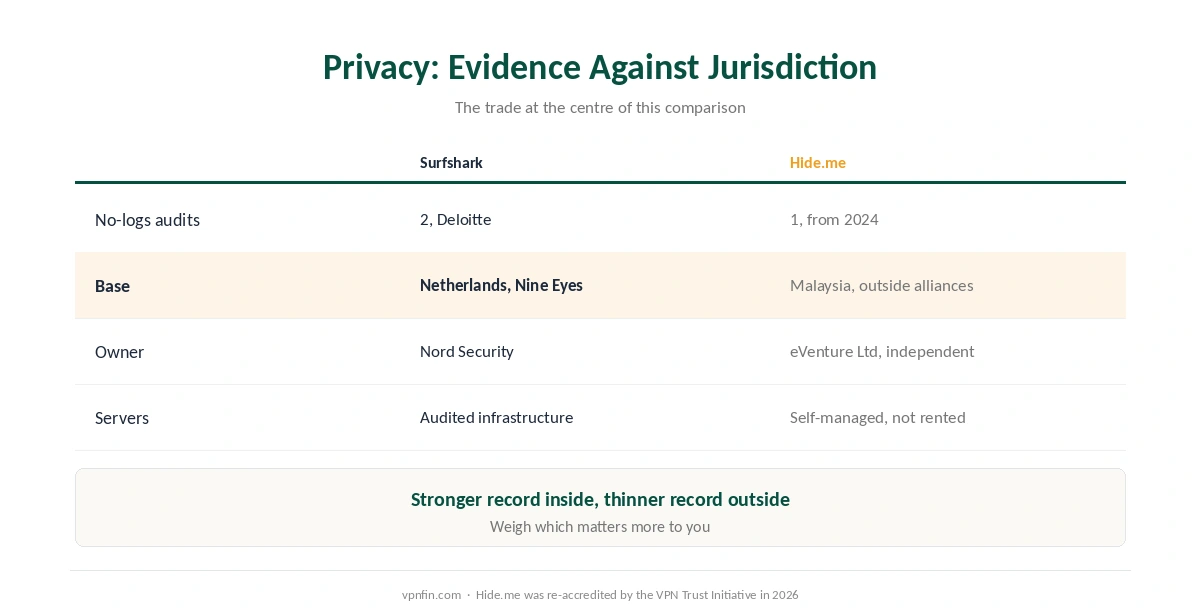
Privacy: Evidence Against Jurisdiction
Surfshark has two no-logs assurance reports by Deloitte, from 2023 and 2025, and Cure53 has reviewed its infrastructure. It belongs to Nord Security, which also owns NordVPN, and operates from the Netherlands, a Nine Eyes member.
Hide.me has one modern audit, from 2024, and the VPN Trust Initiative re-accredited it in 2026. eVenture Ltd has run it from Labuan, Malaysia, since 2012, and it belongs to no group. Its servers are self-managed rather than rented.
⚠️ So the trade is clear. Surfshark has the stronger audit record but sits inside an alliance; Hide.me sits outside every alliance but has a thinner record. Our audit tracker and our ownership guide help you weigh the two.
| Provider | No-logs audits | Auditor | Jurisdiction |
|---|---|---|---|
| NordVPN | 6 | PwC, Deloitte | Panama |
| Surfshark | 2 | Deloitte | Netherlands (9 Eyes) |
| ExpressVPN | 3 | KPMG (28 security reports in total) | British Virgin Islands, Kape-owned |
| CyberGhost | 3 | Deloitte | Romania, Kape-owned |
| PureVPN | 4 | KPMG | BVI, operated from Pakistan |
| IPVanish | 2 | Leviathan, Schellman | United States (Five Eyes), Ziff Davis-owned |
| Windscribe | 1 | Packetlabs, production infrastructure | Canada (Five Eyes); Greek case dismissed, no data to give |
| Proton VPN | 5 | Securitum | Switzerland, moving infrastructure to EU |
| Private Internet Access | 3 | Deloitte | United States (Five Eyes), Kape-owned |
| Mullvad | 10+ | Cure53, Assured AB | Sweden (14 Eyes) |
| TunnelBear | Annual since 2017 | Cure53 | Canada (Five Eyes), US parent |
| Norton VPN | 2 | VerSprite | United States (Five Eyes) |
| Hotspot Shield | 0 | protocol audited, policy not | United States (Five Eyes) |
| AirVPN | 0 | none — the client is open source instead | Italy (14 Eyes) |
| IVPN | 8, annual since inception | Cure53 | Gibraltar (status disputed) |
| Hide.me | 1 modern, in 2024 | Securitum, though one source names Altius IT | Malaysia (outside the alliances) |
| PrivadoVPN | 0 | none in six years of operation | Iceland (moved from Switzerland, 2026) |
| TorGuard | 0 | none; settled a lawsuit without disclosing records | United States (Five Eyes) |
| FastestVPN | 1, in 2023 | Altius IT | Cayman Islands (outside the alliances) |
| StrongVPN | 0 | none in over two decades | United States (Five Eyes), Ziff Davis-owned |
| VyprVPN | 1, in 2018 | Leviathan Security, before the 2023 sale | United States (Five Eyes), Certida-owned since 2023 |
| PrivateVPN | 0 | none; support says there is nothing to audit | Sweden (14 Eyes), ownership disputed |
| ZoogVPN | 0 | none; support describes one as planned | Greece (outside the alliances), run from Ukraine |
| Malwarebytes Privacy VPN | 1, in 2026 | X41 D-Sec, white-box over two months | United States (Five Eyes), runs AzireVPN infrastructure |
| Astrill | 0 | — | Disputed: Seychelles or Liechtenstein |
Price, and Two Renewals to Check
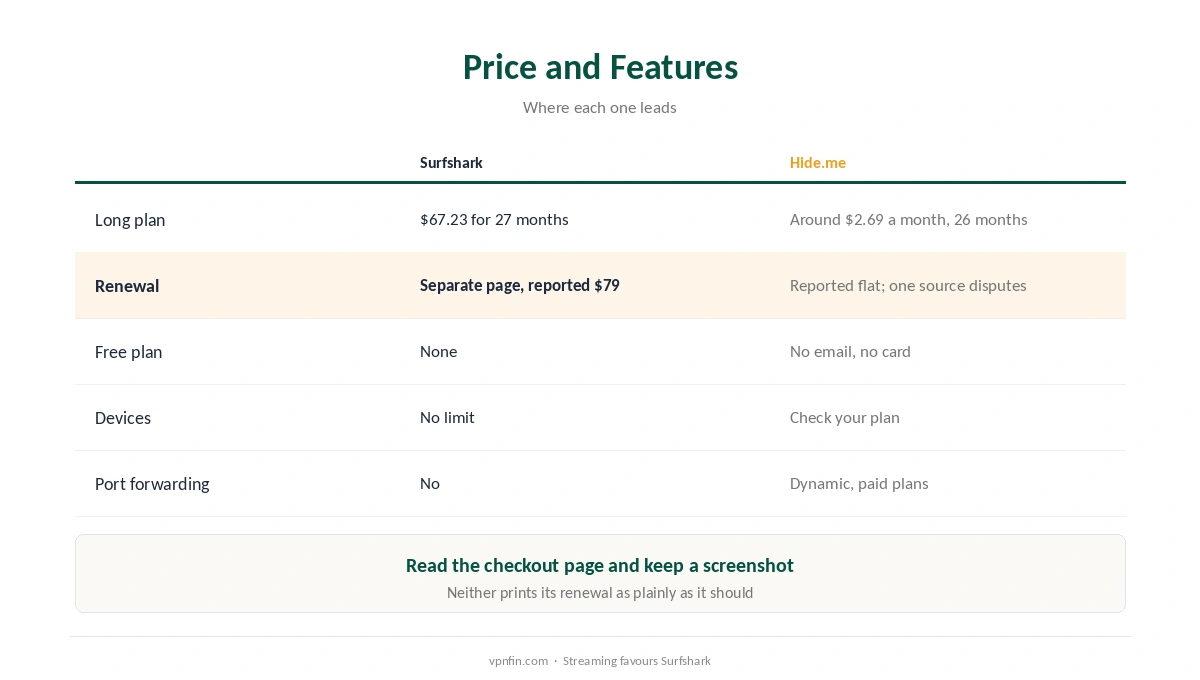
Surfshark Starter costs $67.23 for its first 27 months. Reviewers report $79 a year after that, but Surfshark lists renewals on a separate billing page by location, and says they may be A/B tested. Our Surfshark price page explains where to find it.
Hide.me costs around $2.69 a month on its 26-month plan. Its renewal is reported to stay at that rate, which would be unusual; one source, however, describes auto-renewals billing higher. Our renewal price table shows why a flat renewal matters.
⚠️ In both cases, read the checkout page and keep a screenshot. It is the only record of the price on offer.
The Free Tier
Hide.me offers a free plan with no email and no card, and its kill switch is on by default. Its data limit is disputed: our review found four published answers, from a 10 GB cap to unlimited data. Surfshark has no free plan. Our free VPN guide compares Hide.me’s free tier with the others worth trusting.
Features and Everyday Use
Devices: Surfshark sets no limit, which suits a family. Our multi-device guide compares the options.
Port forwarding: Hide.me includes dynamic port forwarding on paid plans; Surfshark offers none. Our port forwarding guide explains why that matters for seeding.
Streaming: Surfshark opened the major Netflix libraries in 2026 tests, as our Surfshark and Netflix page records. Hide.me streams on paid plans only, and our review calls it not the strongest in the category.
Ease of use: Surfshark designs its apps for general users. Hide.me is technical, with wide protocol choice and multihop, and rewards people who enjoy settings pages.
What Each One Lacks
Surfshark lacks port forwarding and a jurisdiction outside the alliances. Its Deloitte reports answer part of that concern, but the Dutch base remains.
Hide.me lacks a deep audit record and polished apps. A single audit from 2024 is a snapshot rather than a sequence, and its interface suits technical users best. Its streaming is also weaker. ExpressVPN vs Hide.me covers the same choice from another angle.
Both lack a plainly printed renewal. For a provider that does print one under every price, our NordVPN pricing page shows what that looks like.
Which One
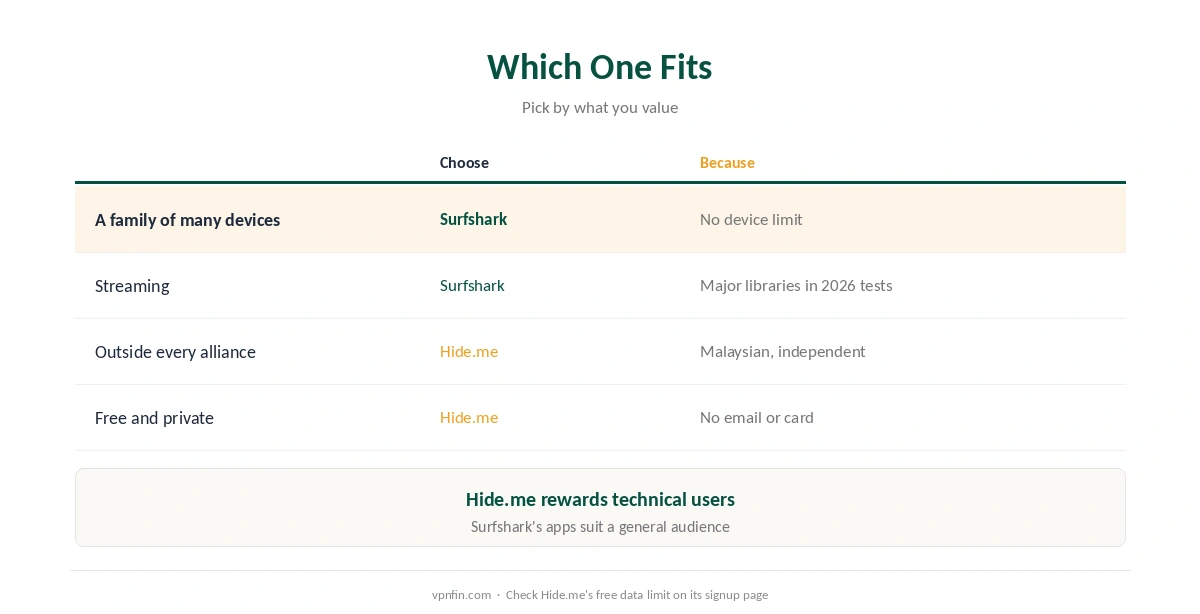
Surfshark for households, streaming and easy apps, with audits behind it.
Hide.me for a provider outside every alliance, a private free tier, or port forwarding, if you are comfortable with a technical interface. NordVPN against Hide.me covers Surfshark’s sibling in the same comparison, and our kill switch guide explains why Hide.me’s default setting matters.
How We Research
Surfshark’s first-term price comes from its pricing page, read on 25 September 2026, and its reported renewal from Security.org and VPNOverview. Our Surfshark review and tables supplied its audits, devices and streaming results. Hide.me’s audit, ownership, free-tier dispute, price and features come from our Hide.me review, which names its sources. We do not run our own tests. Our full approach lives on the About Us page.
Surfshark vs Hide.me FAQ
For households, streaming and ease of use, yes. Surfshark rates 4.6 against Hide.me’s 3.6 in our reviews. Hide.me’s strengths are its Malaysian base, a no-email free tier and port forwarding.
Hide.me, at around $2.69 a month on its 26-month plan, reportedly renewing at the same rate. Surfshark Starter costs $67.23 for 27 months, then a reported $79 a year.
Yes, with no email or card and the kill switch on by default. Its data limit is disputed across sources, so check the signup page. Surfshark has no free plan.
It depends on what you weigh. Surfshark has two Deloitte reports but operates from the Netherlands, in the Nine Eyes. Hide.me has an audit from 2024 and operates from Malaysia, outside every alliance.
Hide.me includes dynamic port forwarding on paid plans. Surfshark does not offer it.
The Verdict
In Surfshark vs Hide.me, Surfshark is the easier, better-audited choice for a household. Its unlimited devices, streaming results and simple apps suit a family.
Hide.me suits people who put jurisdiction and independence first, or who want a free tier that asks for nothing. Whichever you choose, check the renewal at checkout, because neither provider makes it as clear as it should.