
Disclosure: VPNFin is reader-supported. If you buy a VPN through links on this page, we may earn a commission at no extra cost to you. This never affects our ratings — here’s our full disclosure.
Proton VPN vs TunnelBear is a comparison between the provider that invented the public VPN audit and one of the providers that made it routine. TunnelBear hired Cure53 in 2016, published the findings in full in 2017, and has repeated the audit every year since. Proton VPN now publishes an annual Securitum no-logs audit of its own, five years running.
Both also offer a free tier with no card, which is why beginners compare them. The differences sit in the details: how much the free tier allows, who owns each company, whether you can get a refund, and how well each one streams.
Proton VPN vs TunnelBear: The Short Answer
Choose Proton VPN over TunnelBear for the free tier, streaming and a refund. Proton’s free plan has no data cap. Its streaming rates 4.5 in our Proton VPN review, and paid plans carry a 30-day refund.
Choose TunnelBear for simplicity, unlimited devices and a lower long-term price. It rates 4.0 in our TunnelBear review, has the friendliest interface in the category, and costs about $160 over four years in our table.
Both have strong audit records. TunnelBear’s is the longest unbroken run; Proton’s is the one checked specifically against its no-logs claim every year.
Audits: The Pioneer and the Regular
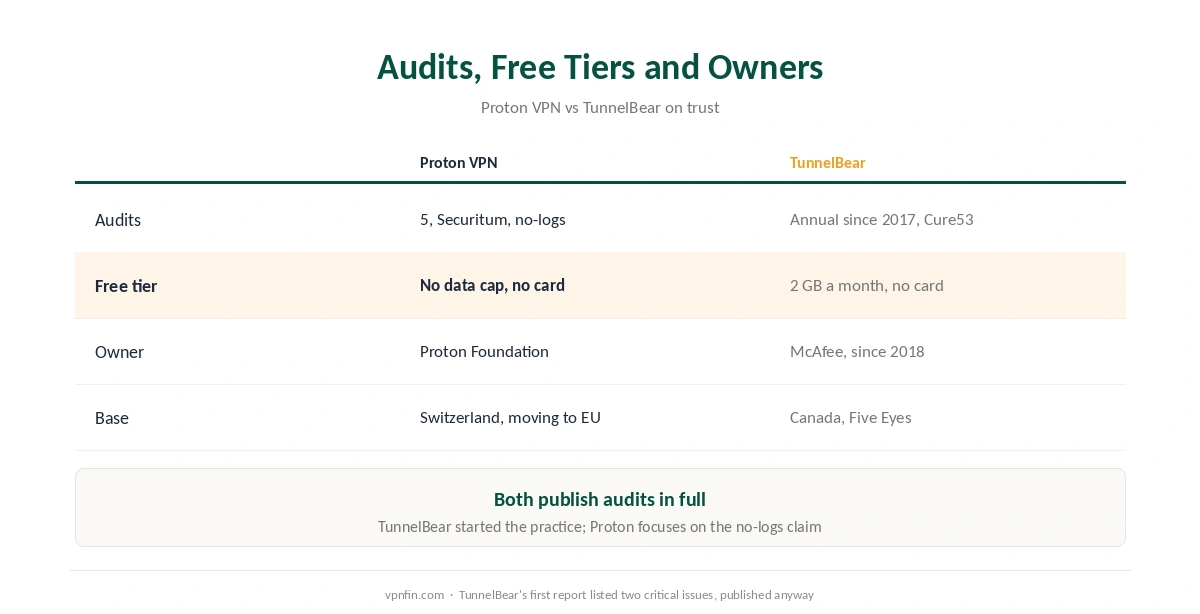
TunnelBear’s first Cure53 report did not flatter it. It listed two critical and five high-rated issues, all later fixed. The company published it anyway. By 2024 it had completed its eighth annual audit, and auditors described steady improvement year on year.
Proton VPN’s Securitum audits focus on the no-logs claim itself, and Proton publishes each report in full on its audit page, alongside open-source apps on every platform. Our audit tracker sets both records against the rest of the market.
| Provider | No-logs audits | Auditor | Jurisdiction |
|---|---|---|---|
| NordVPN | 6 | PwC, Deloitte | Panama |
| Surfshark | 2 | Deloitte | Netherlands (9 Eyes) |
| ExpressVPN | 3 | KPMG (28 security reports in total) | British Virgin Islands, Kape-owned |
| CyberGhost | 3 | Deloitte | Romania, Kape-owned |
| PureVPN | 4 | KPMG | BVI, operated from Pakistan |
| IPVanish | 2 | Leviathan, Schellman | United States (Five Eyes), Ziff Davis-owned |
| Windscribe | 1 | Packetlabs, production infrastructure | Canada (Five Eyes); Greek case dismissed, no data to give |
| Proton VPN | 5 | Securitum | Switzerland, moving infrastructure to EU |
| Private Internet Access | 3 | Deloitte | United States (Five Eyes), Kape-owned |
| Mullvad | 10+ | Cure53, Assured AB | Sweden (14 Eyes) |
| TunnelBear | Annual since 2017 | Cure53 | Canada (Five Eyes), US parent |
| Norton VPN | 2 | VerSprite | United States (Five Eyes) |
| Hotspot Shield | 0 | protocol audited, policy not | United States (Five Eyes) |
| AirVPN | 0 | none — the client is open source instead | Italy (14 Eyes) |
| IVPN | 8, annual since inception | Cure53 | Gibraltar (status disputed) |
| Hide.me | 1 modern, in 2024 | Securitum, though one source names Altius IT | Malaysia (outside the alliances) |
| PrivadoVPN | 0 | none in six years of operation | Iceland (moved from Switzerland, 2026) |
| TorGuard | 0 | none; settled a lawsuit without disclosing records | United States (Five Eyes) |
| FastestVPN | 1, in 2023 | Altius IT | Cayman Islands (outside the alliances) |
| StrongVPN | 0 | none in over two decades | United States (Five Eyes), Ziff Davis-owned |
| VyprVPN | 1, in 2018 | Leviathan Security, before the 2023 sale | United States (Five Eyes), Certida-owned since 2023 |
| PrivateVPN | 0 | none; support says there is nothing to audit | Sweden (14 Eyes), ownership disputed |
| ZoogVPN | 0 | none; support describes one as planned | Greece (outside the alliances), run from Ukraine |
| Malwarebytes Privacy VPN | 1, in 2026 | X41 D-Sec, white-box over two months | United States (Five Eyes), runs AzireVPN infrastructure |
| Astrill | 0 | — | Disputed: Seychelles or Liechtenstein |
Free Tiers Compared
Proton VPN’s free plan has no data cap, needs no card and runs under the same audited policy as the paid plans. That makes it the stronger free option for everyday use.
TunnelBear’s free plan allows 2 GB a month, also without a card. That is enough for occasional travel or a public Wi-Fi session, not for regular use. Our free VPN guide compares both with the other free tiers worth trusting.
Ownership and Jurisdiction
TunnelBear has belonged to McAfee since March 2018. Its team stayed in Toronto and its audit programme survived the acquisition intact. The parent, however, is a publicly traded US company, and Canada sits in the Five Eyes. Our review stresses that nothing has gone wrong in eight years; the concern is structural.
Proton VPN belongs to the Proton Foundation, a non-profit, and in July 2025 announced it was moving most of its infrastructure from Switzerland into the EU. Our ownership guide covers both parents.
Price and Refunds
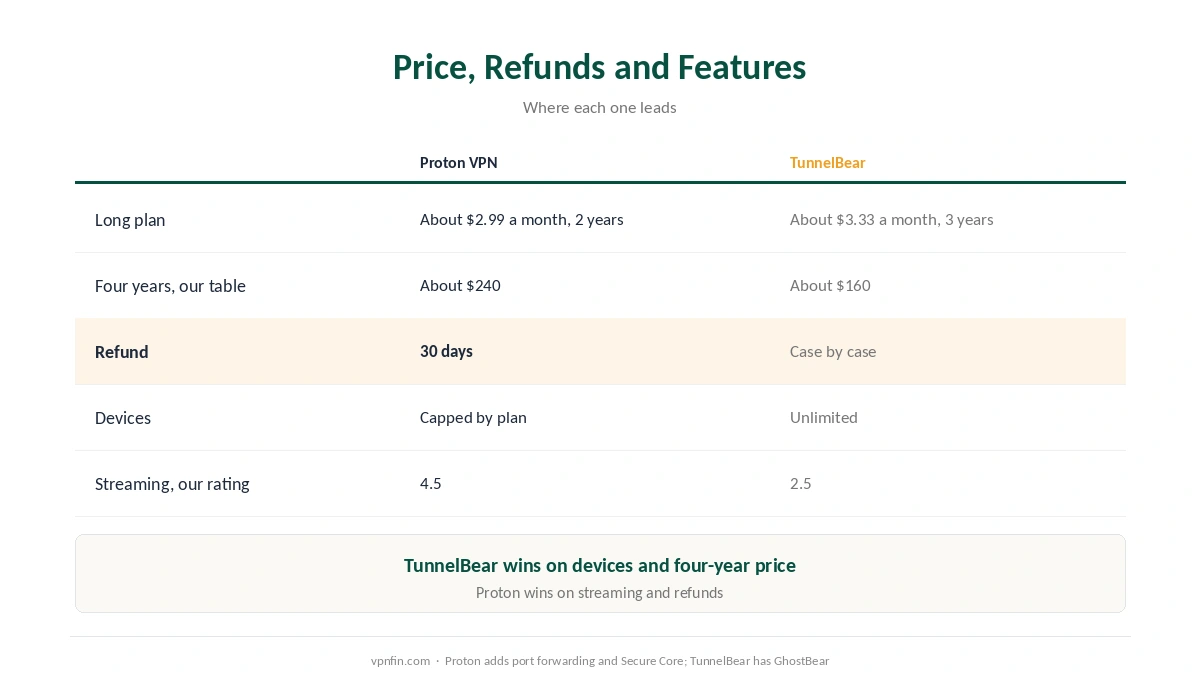
Proton VPN Plus costs about $2.99 a month on its two-year plan, then $83.88 a year, and our four-year table puts it near $240.
TunnelBear costs around $3.33 a month on its three-year plan, and our four-year table puts it near $160.
⚠️ TunnelBear has no standard money-back guarantee. Refunds are considered case by case, so try the free tier before paying. Proton gives 30 days, prorated in practice. Our refund guide explains both.
| Provider | 4-year total |
|---|---|
| PureVPN | ~$142 |
| CyberGhost | ~$152–161 |
| TunnelBear | ~$160 |
| Surfshark | ~$205 |
| Proton VPN | ~$240 |
| Mullvad | ~$260 |
| ExpressVPN | ~$267 |
| Norton VPN | ~$280 |
| Hotspot Shield | ~$290–360 |
| NordVPN | ~$335 |
| Astrill | ~$600 |
Streaming, Devices and Features
Streaming favours Proton VPN clearly. Our reviews rate it 4.5 against TunnelBear’s 2.5, and TunnelBear frequently fails with Netflix. Our Netflix guide covers the options.
Devices favour TunnelBear. It allows unlimited simultaneous devices on every paid plan, while Proton caps connections by tier. Our multi-device guide compares the limits.
Features favour Proton. It offers port forwarding on paid plans and Secure Core multi-hop routing; TunnelBear offers neither port forwarding nor a dedicated IP, though its GhostBear mode helps on restrictive networks. Our port forwarding guide lists who offers it, our double VPN guide explains Secure Core’s approach, and our obfuscation guide covers GhostBear’s.
Which One
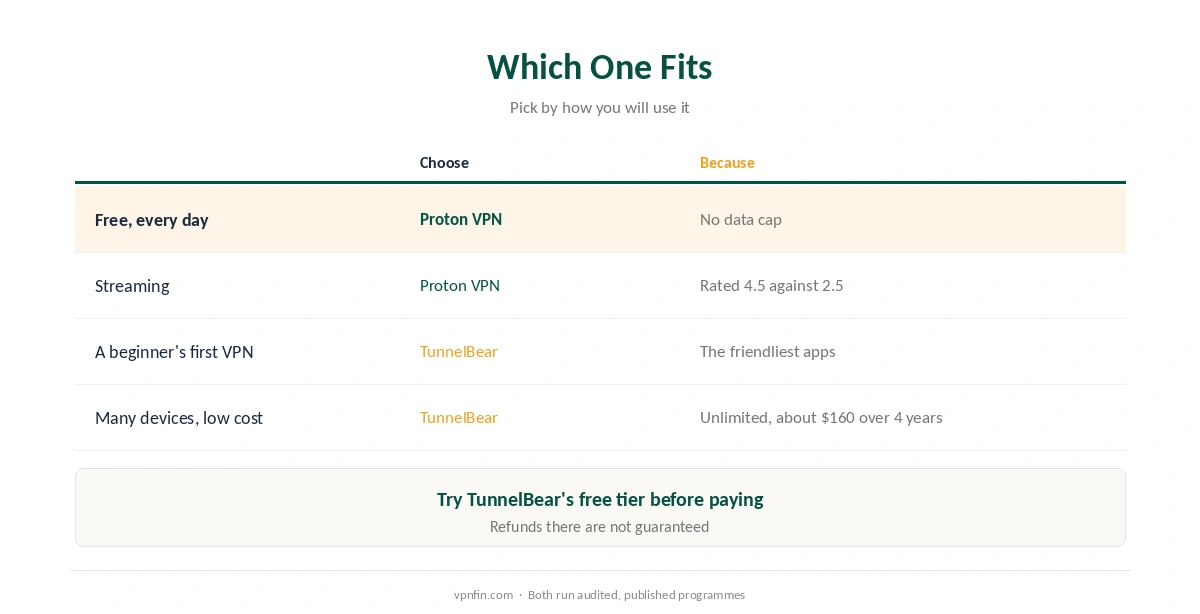
Proton VPN for a free tier you can use daily, better streaming, a refund window and a non-profit owner.
TunnelBear for a beginner who values simplicity, a household that needs unlimited devices, and a lower four-year cost, bought after testing the free tier. Mullvad against Proton VPN and NordVPN against TunnelBear cover other angles.
How We Research
Proton VPN’s audits, free tier and pricing come from our Proton VPN review and tables, and TunnelBear’s audit history, ownership, free tier, refund policy and pricing from our TunnelBear review and tables. Prices are as recorded in our tables in September 2026, so confirm them at checkout. We do not run our own tests. Our full approach lives on the About Us page.
Proton VPN vs TunnelBear FAQ
In Proton VPN vs TunnelBear, Proton wins on its free tier, streaming and refunds, and rates 4.6 against 4.0 in our reviews. TunnelBear wins on simplicity, unlimited devices and four-year price.
Proton VPN’s free plan has no data cap. TunnelBear’s allows 2 GB a month. Neither needs a card, and both run under audited policies.
McAfee, since March 2018. The team remains in Toronto and the annual audits continue. Proton VPN belongs to the Proton Foundation, a non-profit.
Not as a standard guarantee; it considers refunds case by case. Proton VPN offers 30 days, prorated in practice.
TunnelBear, with annual Cure53 audits since 2017. Proton VPN has five consecutive Securitum no-logs audits, all published in full.
The Verdict
For free use, streaming and refunds, Proton VPN vs TunnelBear goes to Proton VPN. Its free tier has no data cap, it streams far better, and it offers a refund.
TunnelBear remains a fine choice for beginners and large households, with the longest audit record in the category and the friendliest apps. Try its free tier first, because refunds are not guaranteed.