
Disclosure: VPNFin is reader-supported. If you buy a VPN through links on this page, we may earn a commission at no extra cost to you. This never affects our ratings — here’s our full disclosure.
The first PureVPN cost is $58.20, for 27 months of the two-year Standard plan. It then renews at $47.95 a year. That makes the second bill smaller than the first, which is not true of NordVPN, ExpressVPN, Surfshark or CyberGhost.
The monthly rate still rises, from $2.15 to $4.00, which is 1.9× after 27 months. Still, the renewal undercuts all four of those brands. The caveats sit elsewhere: in the term you choose, in the add-ons, and in the company’s history.
PureVPN Cost: The Short Answer
Standard costs $58.20 for 27 months, then $47.95 a year. Plus costs $73.80, then $69.95 a year. Max costs $95.85, then $84.95 a year. All three allow ten devices and carry a 31-day refund.
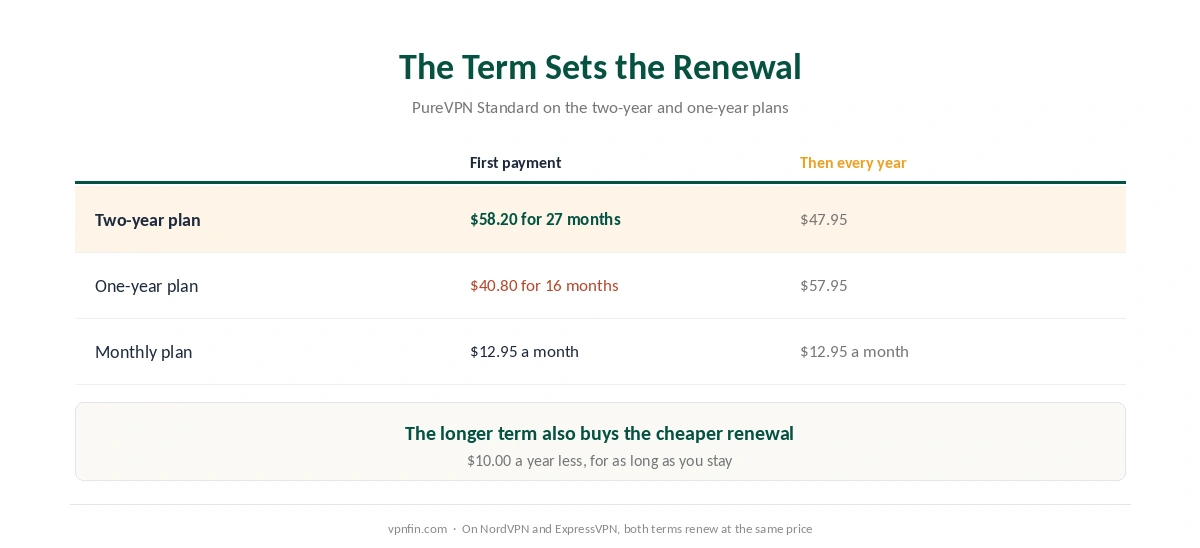
The one-year plan renews higher. Standard on the one-year plan costs $40.80 for 16 months, then $57.95 a year, which is $10.00 more than the two-year plan’s renewal. So the term you pick sets your renewal for as long as you stay.
Over four years the two-year Standard plan comes to $154.10, less than CyberGhost, Surfshark, ExpressVPN or NordVPN on the same basis. Our PureVPN review rates the product 4.1, and explains where the lower price shows.
Every Plan, Every Term, and What Each Renews At
These are the figures PureVPN’s order page showed in US dollars on 25 September 2026. Tax is added at checkout where it applies, and again at renewal.
| Plan and term | First payment | Then |
|---|---|---|
| Standard, 2 years | $58.20 for 27 months | $47.95 a year |
| Standard, 1 year | $40.80 for 16 months | $57.95 a year |
| Standard, monthly | $12.95 | $12.95 a month |
| Plus, 2 years | $73.80 for 27 months | $69.95 a year |
| Plus, 1 year | $72.80 for 16 months | $69.95 a year |
| Max, 2 years | $95.85 for 27 months | $84.95 a year |
| Max, 1 year | $88.80 for 16 months | $89.95 a year |
Month to month, Plus costs $17.95 and Max $19.95. Every long term includes bonus months: three on the two-year plans and four on the one-year plans.
A Renewal That Depends on the Term
At PureVPN, the renewal belongs to the term rather than the plan. On NordVPN and ExpressVPN, a one-year and a two-year customer renew at the same yearly price. At PureVPN, the two-year Standard customer renews at $47.95, while the one-year customer renews at $57.95.
That changes the usual advice. Elsewhere, the longer term buys a longer discount. Here it also buys a cheaper renewal, every year you stay. Our NordVPN pricing page and our ExpressVPN pricing page show the other model.
The rise itself is modest. Standard goes from $2.15 to $4.00 a month, which is 1.9× after 27 months on the two-year plan. On the one-year plan it goes from $2.55 to $4.83, which is 1.9× after 16 months. Plus rises 2.1× and Max 2.0× after 27 months.
⚠️ The discount is again measured against monthly billing. The struck-out price is the $12.95 monthly rate, which gives 83% off. Measured against the renewal, 27 months would cost $107.89, so the saving is 46%.
Four Years on Each Entry Plan
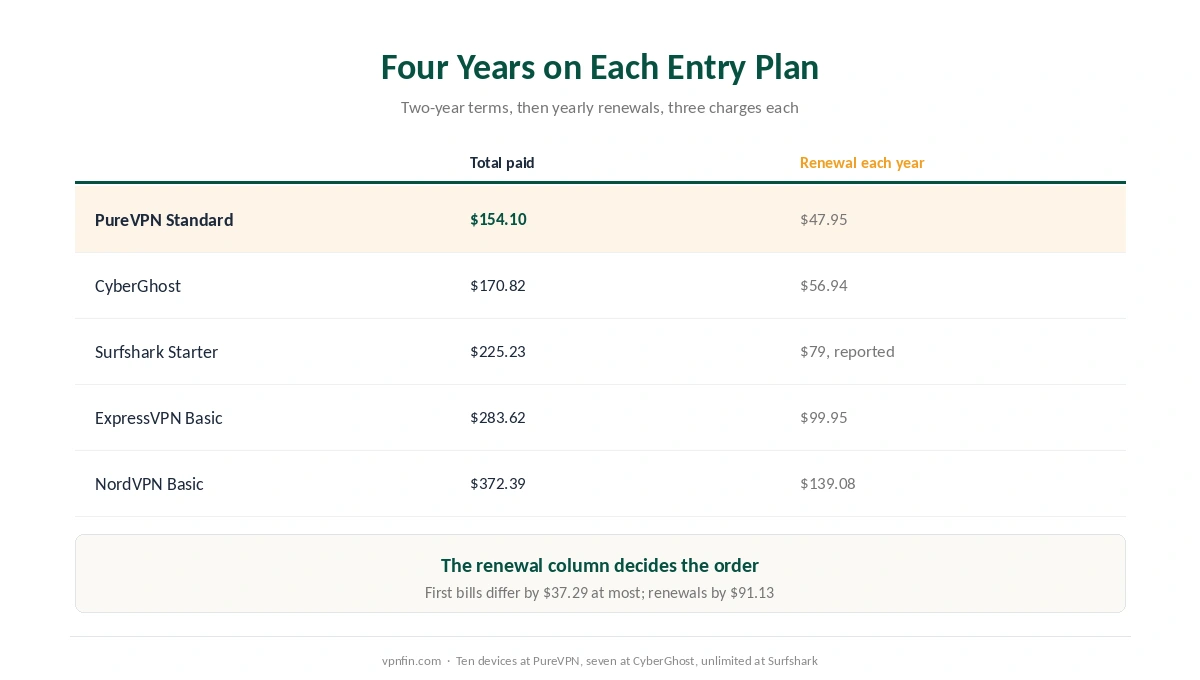
Here is what leaves your account over four years on the two-year entry plan of each brand we have priced, counted charge by charge.
PureVPN Standard: $154.10 in three charges — $58.20, then $47.95 twice, covering 51 months.
CyberGhost: $170.82. Our CyberGhost cost page explains why its flat bill still hides a rise.
Surfshark Starter: $225.23, using its reported renewal, which our Surfshark price page covers.
ExpressVPN Basic: $283.62. NordVPN Basic: $372.39.
Those four rivals come from two companies. Kape Technologies owns ExpressVPN and CyberGhost, while Nord Security owns NordVPN and Surfshark, so the spread above is partly a spread within each group.
PureVPN’s one-year route costs $214.65 over the same period, and month to month costs $621.60. Prorated to exactly 48 months, the two-year plan comes to about $142, the figure our four-year table uses.
Which Term to Choose
For three months or less, pay monthly. Three months of Standard cost $38.85, just under the one-year plan’s $40.80. From the fourth month the monthly route costs more.
For up to 16 months, the one-year plan is cheapest, since its $40.80 covers 16 months. Beyond that, however, it renews at $57.95, and two years on the one-year route cost $98.75.
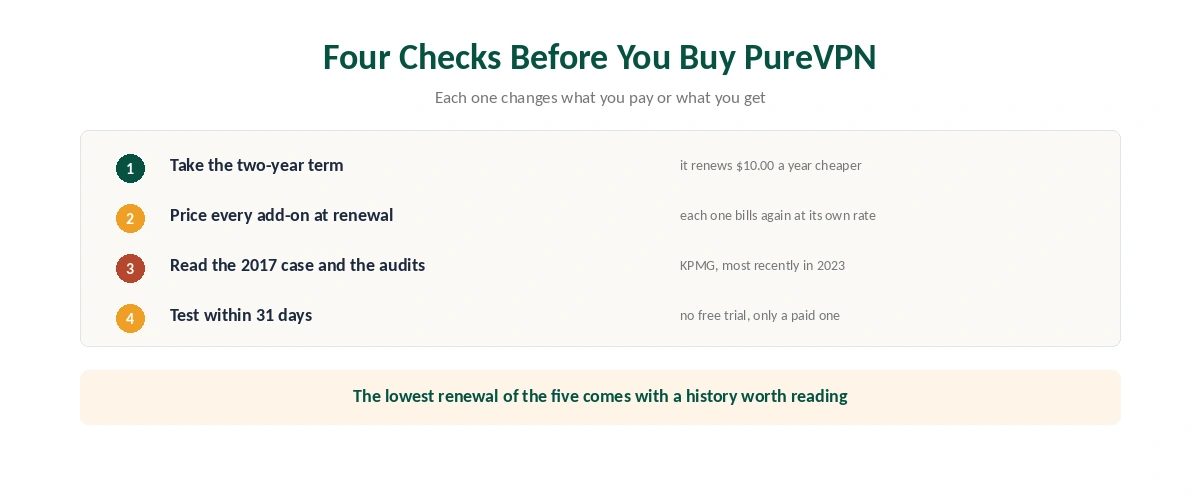
For anything longer, the two-year plan wins. It costs $17.40 more than the one-year plan up front, covers 27 months, and renews $10.00 a year cheaper for as long as you stay. In short, the two-year plan pays for itself within the first renewal.
Standard, Plus or Max: What Each Step Up Buys
All three plans run the same VPN with the same ten-device limit and a tracker blocker. The difference is the other PureVPN products bundled in.
Plus adds a password manager. On the two-year plan it costs $15.60 more than Standard over 27 months, and $22.00 a year more at renewal.
Max adds data removal from broker sites, dark web monitoring, and a 3 GB eSIM valid for 30 days. It costs $22.05 more than Plus over the first term and $15.00 a year more after it.
⚠️ Check the one-year Max renewal before choosing it. At $89.95 a year it renews above its own $88.80 first payment, and $5.00 above the two-year Max renewal. That makes it the one PureVPN plan whose second bill is higher than its first.
Add-Ons That Change the Price
Ten devices is the base limit. PureVPN sells a multi-login add-on in blocks of ten, up to fifty devices, which our multi-device guide sets against unlimited plans elsewhere.
Port forwarding is an add-on too, sold on its own or bundled with a dedicated IP. For torrenting that matters, and our torrenting guide lists which providers include it. A dedicated IP is also sold separately, and a residential IP service covers the US and UK only.
Each add-on renews with the plan. So the $47.95 renewal applies to the VPN alone. Anything you add at checkout is billed again at its own rate.
The Caveats Behind the Price
The 2017 case. PureVPN handed connection logs to the FBI in a cyberstalking investigation while it marketed itself as a no-logs service. Our review, linked above, covers the case and what changed afterwards.
The audits since. KPMG has assessed PureVPN’s no-logs claim four times, most recently in April 2024 according to our PureVPN review; one published review dates the latest public report to 2023. Our audit tracker sets that record against the other providers, as does the table below.
| Provider | No-logs audits | Auditor | Jurisdiction |
|---|---|---|---|
| NordVPN | 6 | PwC, Deloitte | Panama |
| Surfshark | 2 | Deloitte | Netherlands (9 Eyes) |
| ExpressVPN | 3 | KPMG (28 security reports in total) | British Virgin Islands, Kape-owned |
| CyberGhost | 3 | Deloitte | Romania, Kape-owned |
| PureVPN | 4 | KPMG | BVI, operated from Pakistan |
| IPVanish | 2 | Leviathan, Schellman | United States (Five Eyes), Ziff Davis-owned |
| Windscribe | 1 | Packetlabs, production infrastructure | Canada (Five Eyes); Greek case dismissed, no data to give |
| Proton VPN | 5 | Securitum | Switzerland, moving infrastructure to EU |
| Private Internet Access | 3 | Deloitte | United States (Five Eyes), Kape-owned |
| Mullvad | 10+ | Cure53, Assured AB | Sweden (14 Eyes) |
| TunnelBear | Annual since 2017 | Cure53 | Canada (Five Eyes), US parent |
| Norton VPN | 2 | VerSprite | United States (Five Eyes) |
| Hotspot Shield | 0 | protocol audited, policy not | United States (Five Eyes) |
| AirVPN | 0 | none — the client is open source instead | Italy (14 Eyes) |
| IVPN | 8, annual since inception | Cure53 | Gibraltar (status disputed) |
| Hide.me | 1 modern, in 2024 | Securitum, though one source names Altius IT | Malaysia (outside the alliances) |
| PrivadoVPN | 0 | none in six years of operation | Iceland (moved from Switzerland, 2026) |
| TorGuard | 0 | none; settled a lawsuit without disclosing records | United States (Five Eyes) |
| FastestVPN | 1, in 2023 | Altius IT | Cayman Islands (outside the alliances) |
| StrongVPN | 0 | none in over two decades | United States (Five Eyes), Ziff Davis-owned |
| VyprVPN | 1, in 2018 | Leviathan Security, before the 2023 sale | United States (Five Eyes), Certida-owned since 2023 |
| PrivateVPN | 0 | none; support says there is nothing to audit | Sweden (14 Eyes), ownership disputed |
| ZoogVPN | 0 | none; support describes one as planned | Greece (outside the alliances), run from Ukraine |
| Malwarebytes Privacy VPN | 1, in 2026 | X41 D-Sec, white-box over two months | United States (Five Eyes), runs AzireVPN infrastructure |
| Astrill | 0 | — | Disputed: Seychelles or Liechtenstein |
The ownership. PureVPN belongs to Gaditek, which also ran Ivacy until it was absorbed in 2024, as our ownership guide and our Ivacy review explain. The company is registered in the British Virgin Islands and operated from Pakistan.
Refunds and Trials
The refund window is 31 days on every plan, including the monthly one. That is a day longer than NordVPN, Surfshark and ExpressVPN, and two weeks shorter than CyberGhost on its long plans. Our refund guide covers how to claim it.
There is no free trial. PureVPN offers a seven-day paid trial instead, so the 31-day refund is the practical way to test it.
Who Should Pay for PureVPN
Buyers who plan to stay for years. The two-year renewal undercuts every brand named above, and it stays below the first bill.
Anyone who needs port forwarding. It costs extra, but PureVPN sells it, which NordVPN and Surfshark do not.
Budget buyers comparing on four-year cost. Our cheap VPN guide sets PureVPN against the other low-cost options.
Who Should Look Elsewhere
Privacy-first buyers. The 2017 case and an audit record last updated in public in 2023 or 2024, depending on the source are real costs, whatever the price. NordVPN against PureVPN and Surfshark against PureVPN set the trade-off out.
Anyone who wants the audit trail at the lowest price. FastestVPN against PureVPN compares two low-cost providers with very different audit records.
How We Research
Every PureVPN price here comes from its order page in US dollars, read on 25 September 2026, including the renewal line under each plan and the renewal terms above the payment form. The audit history comes from our audit table and from published reviews, named where used. Other providers’ prices come from our own pricing pages, and ownership, device limits and refund windows from our tables. The per-month rates, the multipliers, the four-year totals and the discount recalculated against the renewal are our own arithmetic. Tax is extra, and prices can vary by country. We do not run our own tests. Our full approach lives on the About Us page.
PureVPN Cost FAQ
$2.15 a month on the two-year Standard plan, paid upfront as $58.20 for 27 months. The one-year plan works out at $2.55 a month, and month to month Standard costs $12.95.
It depends on the term. Standard renews at $47.95 a year after the two-year plan and $57.95 after the one-year plan. Plus renews at $69.95, and Max at $84.95 or $89.95.
At renewal, yes. PureVPN Standard renews at $47.95 a year, against $56.94 for CyberGhost and a reported $79 for Surfshark. Over four years on two-year plans it costs $154.10.
Ten on every plan. A paid multi-login add-on raises the limit in blocks of ten, up to fifty devices.
A 31-day money-back guarantee on every plan, including monthly. There is no free trial, only a seven-day paid trial.
The Verdict
PureVPN costs $58.20 for your first 27 months on Standard, then $47.95 a year. The second bill is smaller than the first, and the renewal undercuts CyberGhost, Surfshark, ExpressVPN and NordVPN.
Buy the two-year term, because the one-year plan locks in a renewal $10.00 higher. Then weigh the price against the 2017 case and the audit record, which our review covers in full.