
Disclosure: VPNFin is reader-supported. If you buy a VPN through links on this page, we may earn a commission at no extra cost to you. This never affects our ratings — here’s our full disclosure.
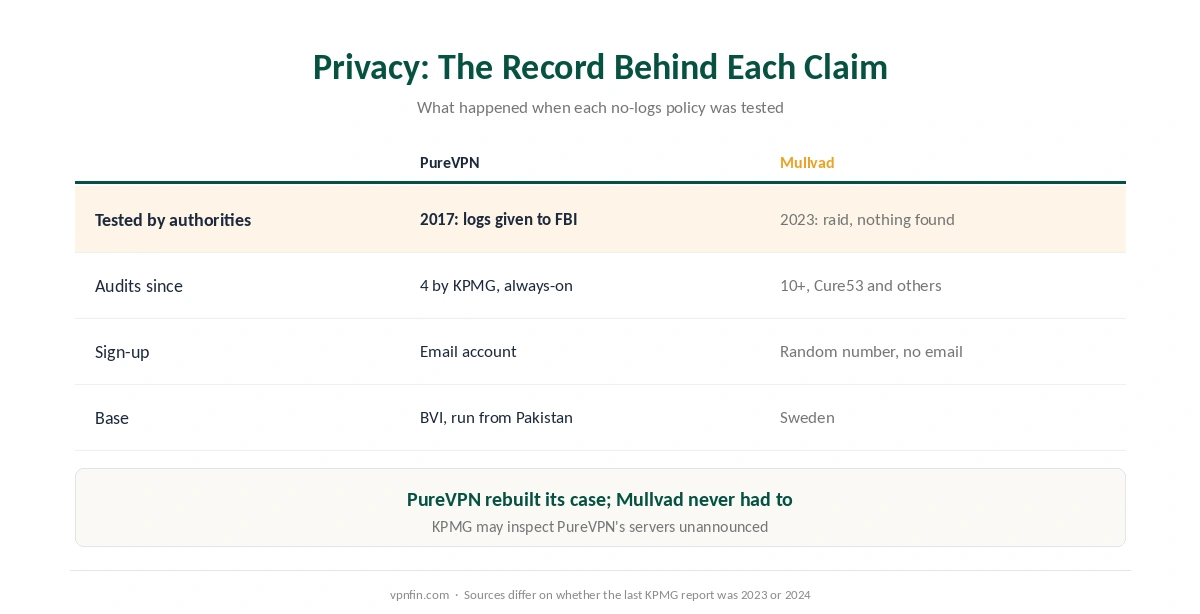
PureVPN and Mullvad have both had their no-logs claims tested by the authorities, and the results were opposite. In 2017 PureVPN handed connection records to the FBI in a cyberstalking case, while it was marketing itself as a no-logs service. In April 2023 Swedish police arrived at Mullvad with a search warrant and left with nothing.
Everything else follows from those two events. PureVPN has since rebuilt its case with four KPMG assessments, and now renews at $47.95 a year, below CyberGhost’s $56.94. Mullvad charges a flat €5 a month, asks for no email, and has more than ten published audits. This page sets the two side by side.
PureVPN vs Mullvad: The Short Answer
Choose PureVPN for price and features. Its two-year Standard plan costs $58.20 for 27 months, then $47.95 a year, with ten devices and a 31-day refund. Our PureVPN review rates it 4.1.
Choose Mullvad for privacy you can check. It costs about $5.40 a month with no discounts, allows five devices, and asks for nothing but a random account number. Our Mullvad review rates it 4.2.
Month to month, Mullvad is less than half the price. On a two-year plan, PureVPN costs far less over four years.
Two Tests, Two Outcomes
PureVPN, 2017. Records PureVPN supplied helped the FBI identify a suspect in a cyberstalking case, at a time when PureVPN described itself as keeping no logs. Our review covers what the company changed afterwards, including four no-logs assessments by KPMG, the most recent completed in April 2024. One other published review dates the latest public report to 2023.
Mullvad, 2023. Swedish police arrived with a search warrant in April and left without any customer data, because Mullvad’s servers held none to take. It is the kind of practical test a no-logs policy rarely gets.
⚠️ Neither event is the whole story. A company can change after a failure, and a single raid is one test. Still, if privacy is the reason you are buying, the direction of the evidence is hard to ignore. Our audit tracker sets both records against every other provider.
What PureVPN Changed After 2017
It invited an auditor in permanently. PureVPN’s arrangement with KPMG is what it calls an always-on audit: the auditor may inspect the infrastructure unannounced, at any time, rather than on a scheduled date. Our review treats that as a structural answer to the 2017 failure.
It collected outside checks. An Altius IT audit in 2019 came first, followed by the four KPMG assessments. In 2021 the parent company also moved its registration from Hong Kong to the British Virgin Islands.
Mullvad had no failure to answer. Its audits, published in full, were checks on a record that had never broken, and the 2023 raid confirmed it in practice.
What Each Costs
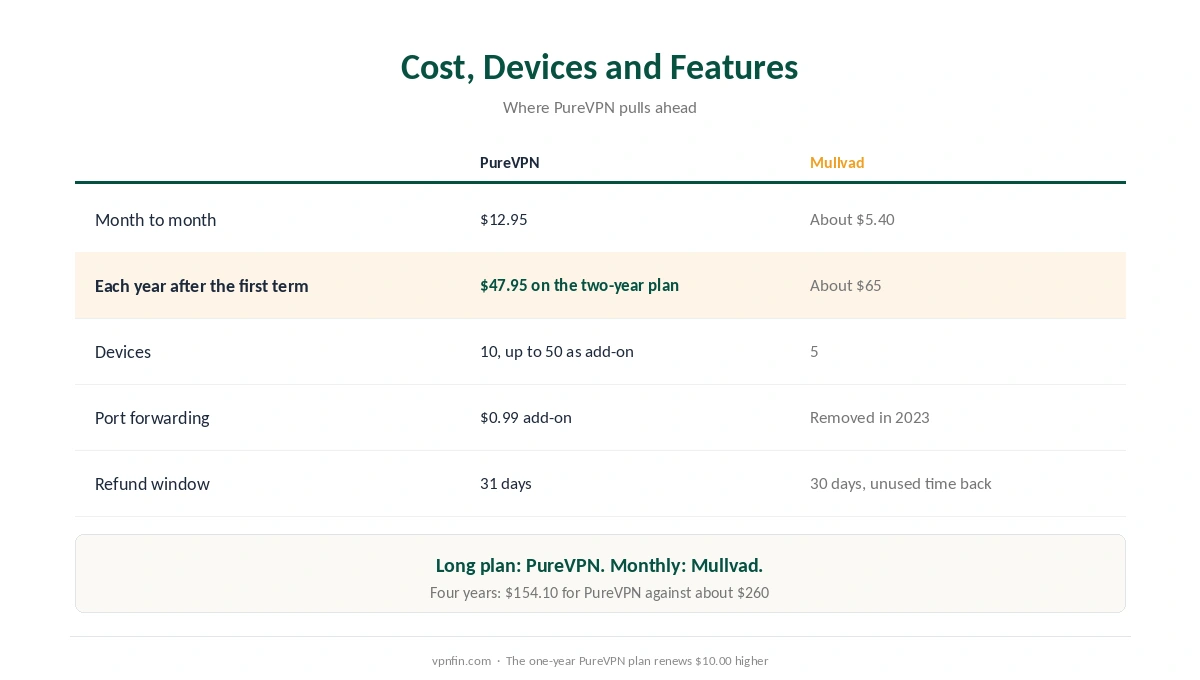
PureVPN charges $58.20 for its first 27 months on the two-year Standard plan, then $47.95 a year. The one-year plan renews higher, at $57.95, and month to month costs $12.95. Our PureVPN cost page explains why the term you choose sets your renewal.
Mullvad charges €5 a month, about $5.40, and has done since 2009. There is nothing to renew and nothing to cancel before a price jump, so a year costs about $65.
Over four years, PureVPN’s two-year route comes to $154.10 in three charges, and Mullvad to about $260. The renewal gap alone is about $17 a year in PureVPN’s favour. Paid monthly, however, the order reverses completely, as our monthly pricing guide shows.
| Provider | Renewal price | Per month | Tier |
|---|---|---|---|
| NordVPN | $139.08/yr | ~$11.59 | Basic |
| Surfshark | ~$79/yr | ~$6.58 | Starter |
| ExpressVPN | $99.95/yr | ~$8.33 | Basic |
| CyberGhost | $56.94/yr | ~$4.75 | 2-year |
| PureVPN | $47.95/yr | ~$4.00 | Standard, 2-year (1-year renews $57.95) |
| IPVanish | $89.99/yr | ~$7.50 | Essential |
| Windscribe | ~$69/yr | ~$5.75 | Pro |
| Proton VPN | ~$83.88/yr | ~$6.99 | VPN Plus |
| Mullvad | ~$65/yr | ~$5.40 | flat, no tiers |
| Norton VPN | $79.99/yr | ~$6.67 | Standard |
| Hotspot Shield | ~$95.99/yr | ~$8.00 | Premium annual |
| Astrill | $300 every 2 yrs | ~$12.50 | 2-year, same at renewal |
Privacy and Sign-Up
Mullvad knows almost nothing about you. You get a random account number, no email is requested, and you can pay in cash by post. Our privacy guide explains why that matters more than any feature.
PureVPN runs a normal account. You sign up with an email and pay by card, PayPal or cryptocurrency. That is standard for the industry, but it means the company knows who its customers are.
Jurisdiction cuts both ways. PureVPN is registered in the British Virgin Islands and operated from Pakistan. Mullvad is based in Sweden, part of the Fourteen Eyes group, where the 2023 raid showed what a warrant actually found.
| Provider | No-logs audits | Auditor | Jurisdiction |
|---|---|---|---|
| NordVPN | 6 | PwC, Deloitte | Panama |
| Surfshark | 2 | Deloitte | Netherlands (9 Eyes) |
| ExpressVPN | 3 | KPMG (28 security reports in total) | British Virgin Islands, Kape-owned |
| CyberGhost | 3 | Deloitte | Romania, Kape-owned |
| PureVPN | 4 | KPMG | BVI, operated from Pakistan |
| IPVanish | 2 | Leviathan, Schellman | United States (Five Eyes), Ziff Davis-owned |
| Windscribe | 1 | Packetlabs, production infrastructure | Canada (Five Eyes); Greek case dismissed, no data to give |
| Proton VPN | 5 | Securitum | Switzerland, moving infrastructure to EU |
| Private Internet Access | 3 | Deloitte | United States (Five Eyes), Kape-owned |
| Mullvad | 10+ | Cure53, Assured AB | Sweden (14 Eyes) |
| TunnelBear | Annual since 2017 | Cure53 | Canada (Five Eyes), US parent |
| Norton VPN | 2 | VerSprite | United States (Five Eyes) |
| Hotspot Shield | 0 | protocol audited, policy not | United States (Five Eyes) |
| AirVPN | 0 | none — the client is open source instead | Italy (14 Eyes) |
| IVPN | 8, annual since inception | Cure53 | Gibraltar (status disputed) |
| Hide.me | 1 modern, in 2024 | Securitum, though one source names Altius IT | Malaysia (outside the alliances) |
| PrivadoVPN | 0 | none in six years of operation | Iceland (moved from Switzerland, 2026) |
| TorGuard | 0 | none; settled a lawsuit without disclosing records | United States (Five Eyes) |
| FastestVPN | 1, in 2023 | Altius IT | Cayman Islands (outside the alliances) |
| StrongVPN | 0 | none in over two decades | United States (Five Eyes), Ziff Davis-owned |
| VyprVPN | 1, in 2018 | Leviathan Security, before the 2023 sale | United States (Five Eyes), Certida-owned since 2023 |
| PrivateVPN | 0 | none; support says there is nothing to audit | Sweden (14 Eyes), ownership disputed |
| ZoogVPN | 0 | none; support describes one as planned | Greece (outside the alliances), run from Ukraine |
| Malwarebytes Privacy VPN | 1, in 2026 | X41 D-Sec, white-box over two months | United States (Five Eyes), runs AzireVPN infrastructure |
| Astrill | 0 | — | Disputed: Seychelles or Liechtenstein |
Ownership
PureVPN belongs to Gaditek, which also ran Ivacy until it was absorbed into PureVPN in 2024, as our Ivacy review records. Mullvad belongs to Amagicom AB, which owns nothing else in the VPN market. Our ownership guide maps both.
Features: Where PureVPN Pulls Ahead
Devices: PureVPN allows ten, and sells more in blocks of ten up to fifty. Mullvad allows five and sells no more. Our multi-device guide compares the limits.
Port forwarding: PureVPN sells it as a $0.99 monthly add-on, while Mullvad removed it in 2023. Our port forwarding guide lists who still offers it, and our torrenting guide explains who needs it.
Streaming: PureVPN supports it, while Mullvad does not optimise for it and our review scores it down for that.
Refunds: PureVPN gives 31 days on every plan. Mullvad gives 30 and returns unused time. Our refund guide covers both.
Which One
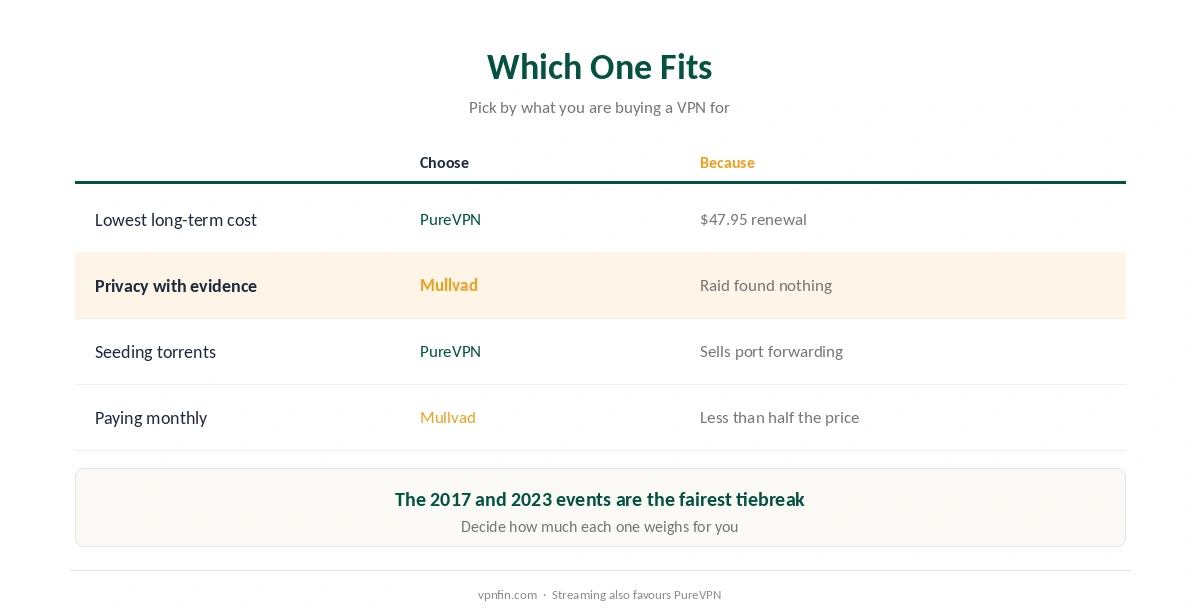
PureVPN if you want the lowest long-term cost, ten devices, port forwarding for seeding, or streaming. Buy the two-year term, because the one-year plan renews $10.00 higher.
Mullvad if privacy is the purchase, if you want to pay month to month, or if you would rather not give an email address. CyberGhost against Mullvad and PureVPN against Proton VPN set each against another rival.
For a wider view, our cheap VPN guide ranks the low-cost options on four-year cost.
How We Research
PureVPN’s prices come from its order page, checked on 25 September 2026, and Mullvad’s from its flat €5 price, converted to dollars. Our own tables and our PureVPN and Mullvad reviews supplied the audit counts, device limits, refund windows, ownership and the 2017 and 2023 events. The four-year totals count the charges each plan makes over 48 months. We do not run our own tests. Our full approach lives on the About Us page.
PureVPN vs Mullvad FAQ
On a two-year plan, PureVPN: $58.20 for 27 months, then $47.95 a year, against about $65 a year for Mullvad. Month to month, Mullvad’s €5 is far cheaper than PureVPN’s $12.95.
On the evidence, yes. Mullvad asks for no email, accepts cash, has more than ten published audits, and a 2023 police raid found nothing. PureVPN handed records to the FBI in 2017, though it has since had four KPMG assessments.
It says it does not, and KPMG has assessed that claim four times since the 2017 case, most recently in April 2024 according to our review. KPMG may also inspect its servers unannounced.
PureVPN, with ten, expandable to fifty through a paid add-on. Mullvad allows five and sells no more.
PureVPN, because it sells port forwarding as an add-on, which helps with seeding. Mullvad removed port forwarding in 2023.
The Verdict
PureVPN and Mullvad sell different things. PureVPN sells low cost and features, with a renewal smaller than its first bill. Mullvad sells privacy with evidence behind it, at a flat price that never moves.
So choose PureVPN if cost and features lead, and Mullvad if privacy does. The events of 2017 and 2023 are the fairest way to decide which of those matters more to you.