
Disclosure: VPNFin is reader-supported. If you buy a VPN through links on this page, we may earn a commission at no extra cost to you. This never affects our ratings — here’s our full disclosure.
CyberGhost and Mullvad sit at opposite ends of the VPN market. CyberGhost is a mainstream streaming VPN owned by Kape Technologies, sold on a long discount with an account tied to your email. Mullvad is an independent Swedish service that charges €5 a month, never discounts, and does not want your email at all.
The surprise is the price. After its first term, CyberGhost renews at $56.94 a year, which is about $8 less than a year of Mullvad. So the choice is not cheap against expensive. It is streaming and a long refund window against privacy you can verify.
CyberGhost vs Mullvad: The Short Answer
Choose CyberGhost for streaming and value on a long plan. It rates 4.3 in our CyberGhost review, covers seven devices, and gives 45 days to claim a refund on its longer plans.
Choose Mullvad for privacy you can check. It rates 4.2 in our Mullvad review, has more than ten published audits, and asks for no email. It is weaker for streaming and allows five devices.
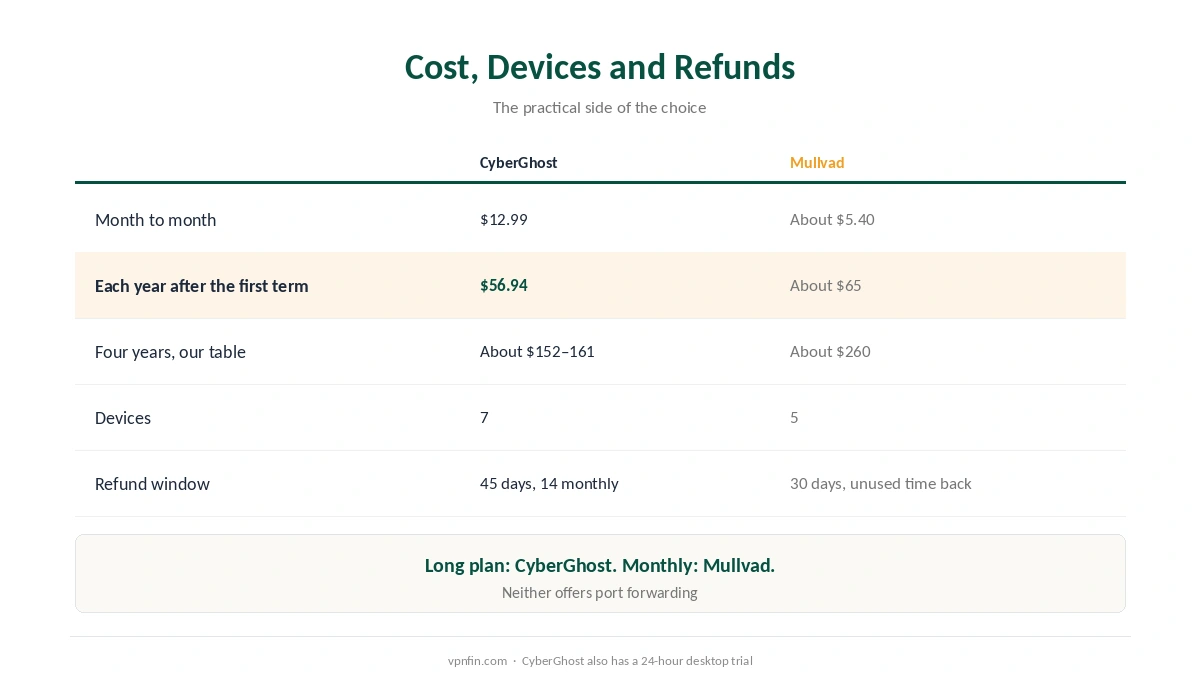
Month to month, Mullvad costs less than half as much. About $5.40 against CyberGhost’s $12.99. On a two-year plan the order flips.
What Each Costs
CyberGhost charges $56.94 for its first 26 months, then $56.94 every year. The bill never changes, although the second one covers 12 months rather than 26. Our CyberGhost cost page explains that in full.
Mullvad charges €5 a month, about $5.40, and has done so since 2009. There is no long plan, no promotional price and no renewal jump, so a year costs about $65.
Over four years, our table puts CyberGhost at about $152 to $161 and Mullvad at about $260. Month to month, however, CyberGhost costs $12.99, and Mullvad wins easily; our monthly pricing guide covers that case.
| Provider | 4-year total |
|---|---|
| PureVPN | ~$142 |
| CyberGhost | ~$152–161 |
| TunnelBear | ~$160 |
| Surfshark | ~$205 |
| Proton VPN | ~$240 |
| Mullvad | ~$260 |
| ExpressVPN | ~$267 |
| Norton VPN | ~$280 |
| Hotspot Shield | ~$290–360 |
| NordVPN | ~$335 |
| Astrill | ~$600 |
Privacy: What Each Can Prove
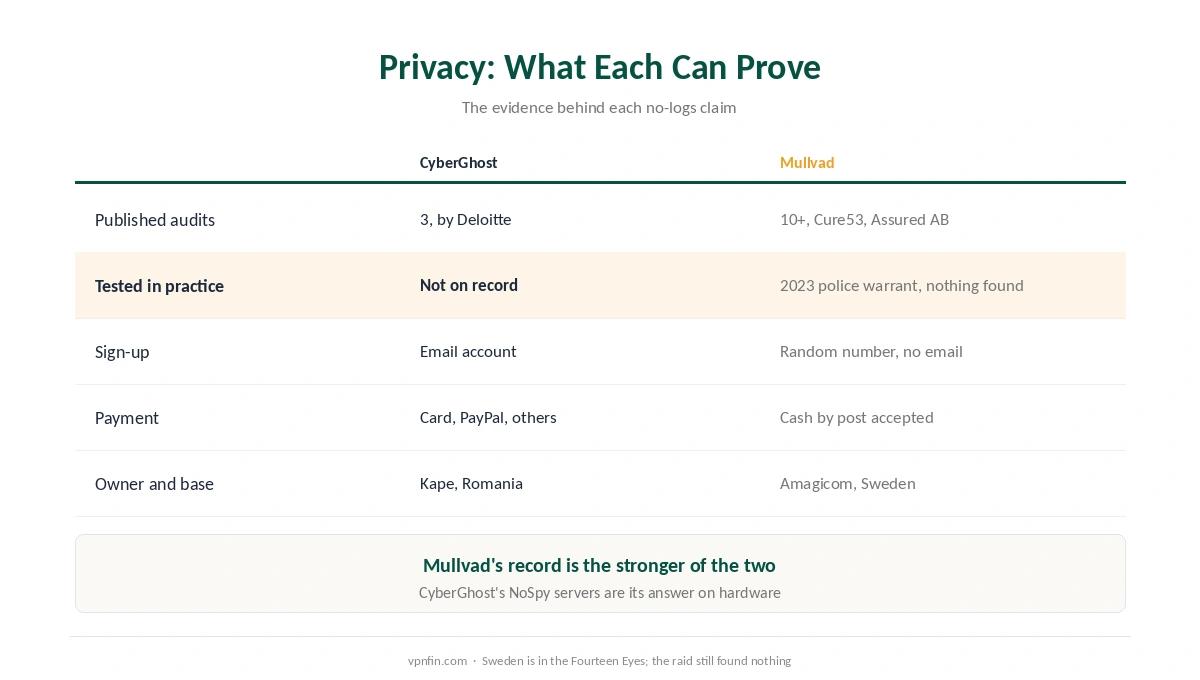
Mullvad’s record is the stronger of the two. It has more than ten published audits, from firms including Cure53 and Assured AB. In April 2023 Swedish police arrived with a search warrant and left with nothing, because there was nothing to take.
CyberGhost has three published no-logs audits by Deloitte. Its NoSpy servers sit in its own Romanian data centre, with physical access limited to staff. That is a genuine strength, but it is a claim about hardware rather than a test like Mullvad’s raid. Our audit tracker sets both records against the rest.
| Provider | No-logs audits | Auditor | Jurisdiction |
|---|---|---|---|
| NordVPN | 6 | PwC, Deloitte | Panama |
| Surfshark | 2 | Deloitte | Netherlands (9 Eyes) |
| ExpressVPN | 3 | KPMG (28 security reports in total) | British Virgin Islands, Kape-owned |
| CyberGhost | 3 | Deloitte | Romania, Kape-owned |
| PureVPN | 4 | KPMG | BVI, operated from Pakistan |
| IPVanish | 2 | Leviathan, Schellman | United States (Five Eyes), Ziff Davis-owned |
| Windscribe | 1 | Packetlabs, production infrastructure | Canada (Five Eyes); Greek case dismissed, no data to give |
| Proton VPN | 5 | Securitum | Switzerland, moving infrastructure to EU |
| Private Internet Access | 3 | Deloitte | United States (Five Eyes), Kape-owned |
| Mullvad | 10+ | Cure53, Assured AB | Sweden (14 Eyes) |
| TunnelBear | Annual since 2017 | Cure53 | Canada (Five Eyes), US parent |
| Norton VPN | 2 | VerSprite | United States (Five Eyes) |
| Hotspot Shield | 0 | protocol audited, policy not | United States (Five Eyes) |
| AirVPN | 0 | none — the client is open source instead | Italy (14 Eyes) |
| IVPN | 8, annual since inception | Cure53 | Gibraltar (status disputed) |
| Hide.me | 1 modern, in 2024 | Securitum, though one source names Altius IT | Malaysia (outside the alliances) |
| PrivadoVPN | 0 | none in six years of operation | Iceland (moved from Switzerland, 2026) |
| TorGuard | 0 | none; settled a lawsuit without disclosing records | United States (Five Eyes) |
| FastestVPN | 1, in 2023 | Altius IT | Cayman Islands (outside the alliances) |
| StrongVPN | 0 | none in over two decades | United States (Five Eyes), Ziff Davis-owned |
| VyprVPN | 1, in 2018 | Leviathan Security, before the 2023 sale | United States (Five Eyes), Certida-owned since 2023 |
| PrivateVPN | 0 | none; support says there is nothing to audit | Sweden (14 Eyes), ownership disputed |
| ZoogVPN | 0 | none; support describes one as planned | Greece (outside the alliances), run from Ukraine |
| Malwarebytes Privacy VPN | 1, in 2026 | X41 D-Sec, white-box over two months | United States (Five Eyes), runs AzireVPN infrastructure |
| Astrill | 0 | — | Disputed: Seychelles or Liechtenstein |
Sign-up is where they differ most. Mullvad gives you a random account number and accepts cash by post, so it never needs to know who you are. CyberGhost uses a normal email account and card payment. Our privacy guide explains why that matters more than any feature list.
What Each Makes You Give Up
With CyberGhost, you give up anonymity. Your account is tied to an email address and usually a card, so the provider knows who its customer is even if it keeps no record of what you do. Its transparency report, linked from its own site, is the place to see how often legal requests arrive.
With Mullvad, you give up convenience. Our review lists the cost plainly: five devices, around 700 servers, no reliable streaming and no browser extensions. Nor are there discounts to make that easier to accept, since €5 is what everyone pays.
With both, you give up port forwarding. That matters only if you seed torrents or host something at home, and it is covered below.
Ownership and Jurisdiction
CyberGhost belongs to Kape Technologies, which also owns ExpressVPN and Private Internet Access. It is based in Romania. Mullvad belongs to Amagicom AB, which owns nothing else in the VPN market, and is based in Sweden, a member of the Fourteen Eyes intelligence-sharing group.
Neither fact decides the question alone. Sweden’s membership is real, yet Mullvad’s raid showed what a warrant actually found there. Our ownership guide and our no-logs guide cover both sides.
Streaming
This is CyberGhost’s side of the comparison. Our review rates it well for streaming, which is why it earns its 4.3. Mullvad, by contrast, is explicit that it does not optimise for streaming, and our review scores it down for that alone.
If Netflix or other catalogues are the main reason you are buying, the choice is simple, and our Netflix guide covers which libraries are worth the effort.
Devices, Refunds and Trials
Devices: CyberGhost allows seven, Mullvad five, and neither sells more. For larger households, our multi-device guide compares the options.
Refunds: CyberGhost gives 45 days on its six-month and two-year plans, and 14 on its monthly plan. Mullvad gives 30 days and returns unused time if you cancel. Our refund guide covers both processes.
Trials: CyberGhost offers a 24-hour desktop trial without payment details, while Mullvad offers none, as our free trial guide records.
Port forwarding: neither. Mullvad removed it in 2023, and CyberGhost never offered it, so our port forwarding guide lists who still does.
Which One
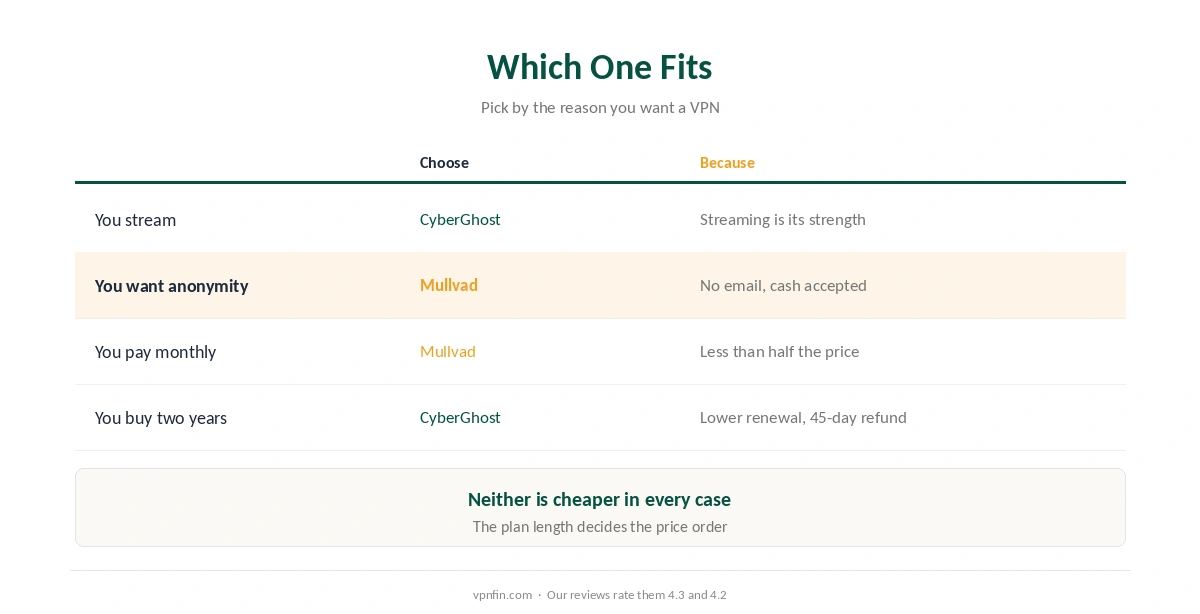
CyberGhost if you stream, want seven devices, and will buy the two-year plan. Its renewal undercuts Mullvad’s flat price, and the 45 days give you time to test it properly.
Mullvad if privacy is the reason you want a VPN, if you prefer paying month to month, or if you would rather not hand over an email address. Mullvad against NordVPN and CyberGhost against PIA show how each fares against a closer rival.
How We Research
Our own tables and our CyberGhost and Mullvad reviews supplied the prices, audit counts, device limits, refund windows and ownership. We checked CyberGhost’s prices on its checkout page on 25 September 2026. The four-year totals use our standard method: longest term at the promotional rate, then renewal, to 48 months. Mullvad’s dollar figures convert its €5 price. We do not run our own tests. Our full approach lives on the About Us page.
CyberGhost vs Mullvad FAQ
It depends on the plan. On a two-year plan CyberGhost costs $56.94 for 26 months and then $56.94 a year, less than Mullvad’s roughly $65 a year. Month to month, Mullvad’s €5 is far cheaper than CyberGhost’s $12.99.
On the evidence, yes. Mullvad has more than ten published audits, asks for no email, accepts cash, and a 2023 police search found nothing. CyberGhost has three Deloitte audits and uses a normal email account.
CyberGhost. Streaming is one of its strengths, and our review rates it accordingly. Mullvad does not optimise for streaming, and our review scores it down for that.
CyberGhost allows seven simultaneous devices and Mullvad allows five. Neither sells extra connections as an add-on.
CyberGhost gives 45 days on its longer plans and 14 on monthly. Mullvad gives 30 days and returns unused time, which is simpler if you pay monthly.
The Verdict
CyberGhost and Mullvad answer different questions. CyberGhost is the better buy for streaming on a long plan, and its renewal is lower than Mullvad’s flat price. Mullvad is the better buy for privacy you can verify and for paying month to month.
So pick by the reason you want a VPN, not by the headline price. For most streamers that is CyberGhost; for anyone who wants to stay anonymous, it is Mullvad.