
Disclosure: VPNFin is reader-supported. If you buy a VPN through links on this page, we may earn a commission at no extra cost to you. This never affects our ratings — here’s our full disclosure.
A reviewer asked PrivateVPN whether its servers run from RAM. The answer, as reported, was no. ExpressVPN made the opposite choice years ago: every server runs its TrustedServer system from RAM and reloads a clean operating system on each reboot, so nothing written during a session survives it. That one design choice frames ExpressVPN vs PrivateVPN.
That one architectural difference explains most of this comparison. ExpressVPN backs its no-logs claim with 28 published security reports and a server seizure that recovered nothing. PrivateVPN backs its claim with its word, and answers with price, port forwarding and a free dedicated IP.
ExpressVPN vs PrivateVPN: The Short Answer
Choose ExpressVPN for evidence and polish. It rates 4.5 in our ExpressVPN review, runs RAM-only servers, and works reliably with streaming services and on Fire TV.
Choose PrivateVPN for price and torrenting extras, if you accept an unaudited provider. It rates 3.2 in our PrivateVPN review, costs around $2 a month on its three-year plan, and includes port forwarding.
Both give a dedicated IP at no extra charge on one plan: ExpressVPN on Pro, PrivateVPN on one of its own tiers.
Servers: RAM Against Disk
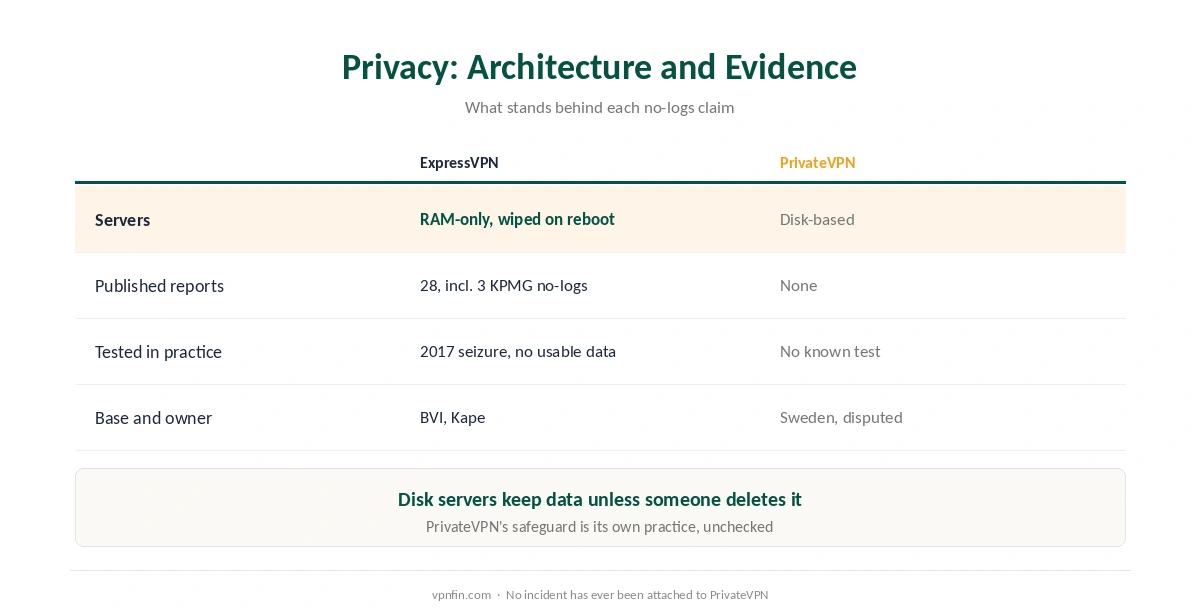
RAM-only servers keep nothing across a reboot. ExpressVPN’s TrustedServer design wipes each machine on restart, and the whole network runs this way. In 2017 Turkish authorities seized one of its servers and recovered no usable data.
Disk-based servers retain data by design unless the operator deletes it. That does not mean PrivateVPN keeps logs, and no incident has ever been attached to it. It means the only safeguard is the company’s own practice, which no outsider has checked. Our no-logs guide explains why architecture matters.
Audits and Ownership
ExpressVPN lists 28 published third-party security reports, including three no-logs assessments by KPMG. It belongs to Kape Technologies, which also owns CyberGhost and PIA, and is based in the British Virgin Islands.
PrivateVPN has no audit in seventeen years. Its support reportedly said there was nothing to audit since it keeps no logs. It operates from Sweden, inside the Fourteen Eyes, and sources disagree on whether it is independent or owned by the hosting group Miss Group. Our audit tracker and our ownership guide cover both.
| Provider | No-logs audits | Auditor | Jurisdiction |
|---|---|---|---|
| NordVPN | 6 | PwC, Deloitte | Panama |
| Surfshark | 2 | Deloitte | Netherlands (9 Eyes) |
| ExpressVPN | 3 | KPMG (28 security reports in total) | British Virgin Islands, Kape-owned |
| CyberGhost | 3 | Deloitte | Romania, Kape-owned |
| PureVPN | 4 | KPMG | BVI, operated from Pakistan |
| IPVanish | 2 | Leviathan, Schellman | United States (Five Eyes), Ziff Davis-owned |
| Windscribe | 1 | Packetlabs, production infrastructure | Canada (Five Eyes); Greek case dismissed, no data to give |
| Proton VPN | 5 | Securitum | Switzerland, moving infrastructure to EU |
| Private Internet Access | 3 | Deloitte | United States (Five Eyes), Kape-owned |
| Mullvad | 10+ | Cure53, Assured AB | Sweden (14 Eyes) |
| TunnelBear | Annual since 2017 | Cure53 | Canada (Five Eyes), US parent |
| Norton VPN | 2 | VerSprite | United States (Five Eyes) |
| Hotspot Shield | 0 | protocol audited, policy not | United States (Five Eyes) |
| AirVPN | 0 | none — the client is open source instead | Italy (14 Eyes) |
| IVPN | 8, annual since inception | Cure53 | Gibraltar (status disputed) |
| Hide.me | 1 modern, in 2024 | Securitum, though one source names Altius IT | Malaysia (outside the alliances) |
| PrivadoVPN | 0 | none in six years of operation | Iceland (moved from Switzerland, 2026) |
| TorGuard | 0 | none; settled a lawsuit without disclosing records | United States (Five Eyes) |
| FastestVPN | 1, in 2023 | Altius IT | Cayman Islands (outside the alliances) |
| StrongVPN | 0 | none in over two decades | United States (Five Eyes), Ziff Davis-owned |
| VyprVPN | 1, in 2018 | Leviathan Security, before the 2023 sale | United States (Five Eyes), Certida-owned since 2023 |
| PrivateVPN | 0 | none; support says there is nothing to audit | Sweden (14 Eyes), ownership disputed |
| ZoogVPN | 0 | none; support describes one as planned | Greece (outside the alliances), run from Ukraine |
| Malwarebytes Privacy VPN | 1, in 2026 | X41 D-Sec, white-box over two months | United States (Five Eyes), runs AzireVPN infrastructure |
| Astrill | 0 | — | Disputed: Seychelles or Liechtenstein |
Price
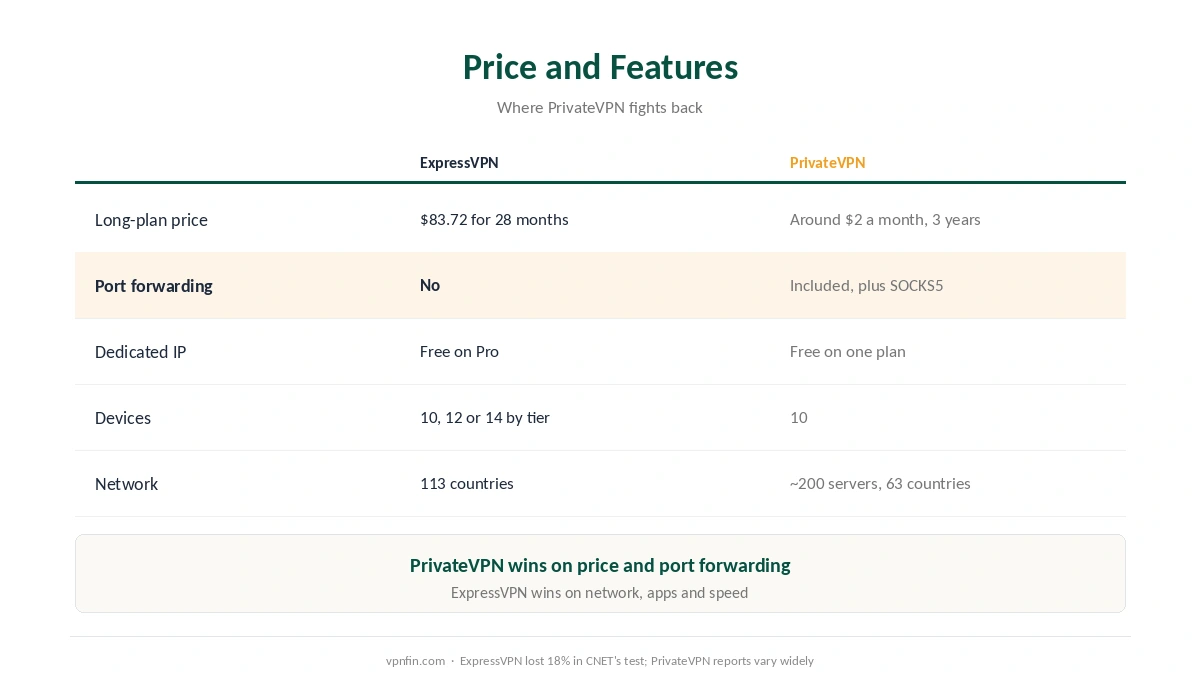
ExpressVPN Basic costs $83.72 for 28 months on the current offer, then $99.95 a year. Pro, which includes the dedicated IP, costs more. Our ExpressVPN pricing page explains the tiers.
PrivateVPN costs around $2 a month on its three-year plan, well under ExpressVPN’s current $2.99 first-term rate. Check PrivateVPN’s renewal at checkout before committing to three years, since the renewal decides the total.
Features
Port forwarding: PrivateVPN includes it, with SOCKS5; ExpressVPN does not offer it on its VPN servers. Our port forwarding guide explains why that matters for seeding.
Dedicated IP: free on ExpressVPN Pro and on one PrivateVPN plan. Our dedicated IP guide explains when a fixed address helps, and why it works against anonymity.
Devices: ExpressVPN allows 10, 12 or 14 by tier; PrivateVPN allows ten.
Network and speed: PrivateVPN runs around 200 servers in 63 countries, and its speed reports vary widely. CNET measured an 18% average loss with ExpressVPN, whose servers cover 113 countries.
Streaming: both are strong in published reports. ExpressVPN worked with the major Netflix libraries in every 2026 test we found, as our ExpressVPN and Netflix page records, and reviewers report PrivateVPN working with Netflix, iPlayer, Disney+ and Prime Video.
Apps and Support
ExpressVPN’s apps are among its strengths, and it now runs on both Fire TV systems, as our Fire Stick guide explains. PrivateVPN’s interface draws consistent criticism as dated, and its live chat is not staffed around the clock.
What Each One Lacks
ExpressVPN lacks port forwarding and a low renewal. Basic renews at $99.95 a year, and the dedicated IP needs the pricier Pro tier.
PrivateVPN lacks an audit, RAM-only servers and scale. Its ownership is disputed, its network is small, and its speed reports vary widely. Our review also lists more source conflicts for it than for any other provider we have covered.
Both sit on different sides of the jurisdiction question. ExpressVPN’s British Virgin Islands base is outside the alliances; PrivateVPN’s Swedish base is inside them, and PrivateVPN against Mullvad shows what an audited Swedish provider looks like.
Which One
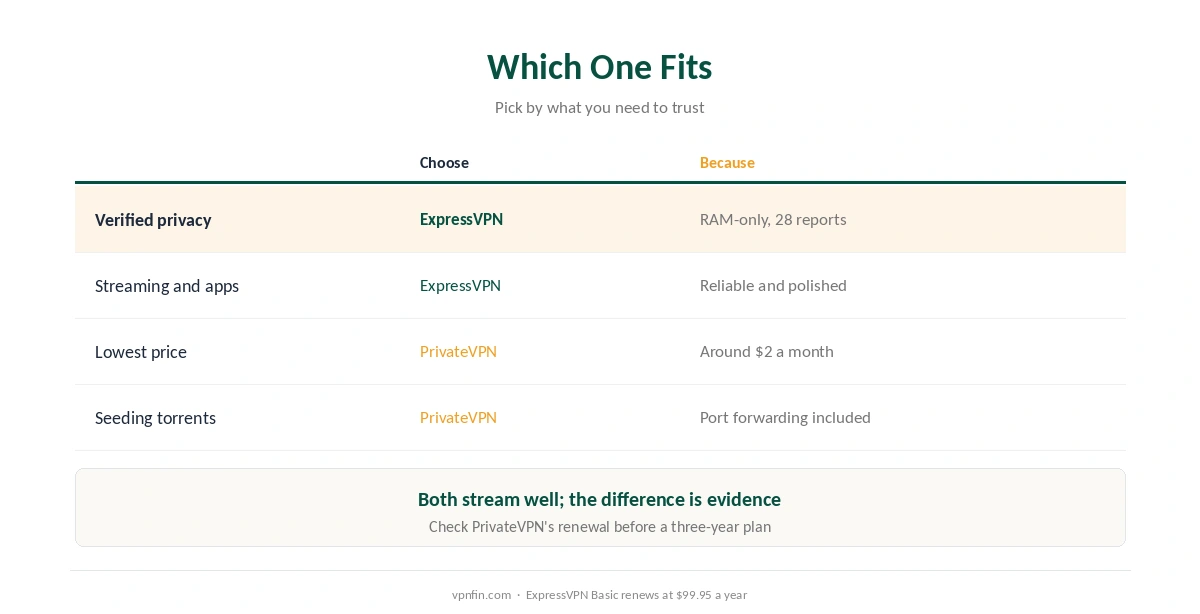
ExpressVPN if you want RAM-only servers, published verification, polished apps and reliable streaming, and will pay a renewal for them.
PrivateVPN for the lowest price and port forwarding, bought knowing its no-logs claim rests on its word and on disk-based servers. NordVPN against PrivateVPN and Surfshark against PrivateVPN, both Nord Security brands against it, cover the alternatives.
How We Research
ExpressVPN’s current price comes from its pricing page, read on 25 September 2026, and its reports, TrustedServer design, seizure and devices from our ExpressVPN review and tables. PrivateVPN’s support answers, price, features, network and ownership dispute come from our PrivateVPN review, which names its sources. The speed figure is CNET’s, via our speed table. We do not run our own tests. Our full approach lives on the About Us page.
ExpressVPN vs PrivateVPN FAQ
For verified privacy, apps and streaming, yes. ExpressVPN rates 4.5 against PrivateVPN’s 3.2 in our reviews. PrivateVPN’s advantages are price and port forwarding.
No. Its support reportedly confirmed its servers are disk-based. ExpressVPN runs every server from RAM, which wipes data on each reboot.
PrivateVPN, at around $2 a month on its three-year plan. ExpressVPN Basic costs $83.72 for 28 months on the current offer, then $99.95 a year.
Yes, at no extra charge on one plan each: ExpressVPN on its Pro tier and PrivateVPN on one of its own plans.
Not on its VPN servers. PrivateVPN includes port forwarding with SOCKS5 support.
The Verdict
ExpressVPN is the better VPN for privacy, apps and streaming. RAM-only servers, published reports and a seizure that found nothing give its claim a foundation PrivateVPN cannot match.
PrivateVPN remains a capable budget option for streaming and torrenting, with port forwarding and a free dedicated IP. Choose it with its disk-based servers and missing audit in view.