
Disclosure: VPNFin is reader-supported. If you buy a VPN through links on this page, we may earn a commission at no extra cost to you. This never affects our ratings — here’s our full disclosure.
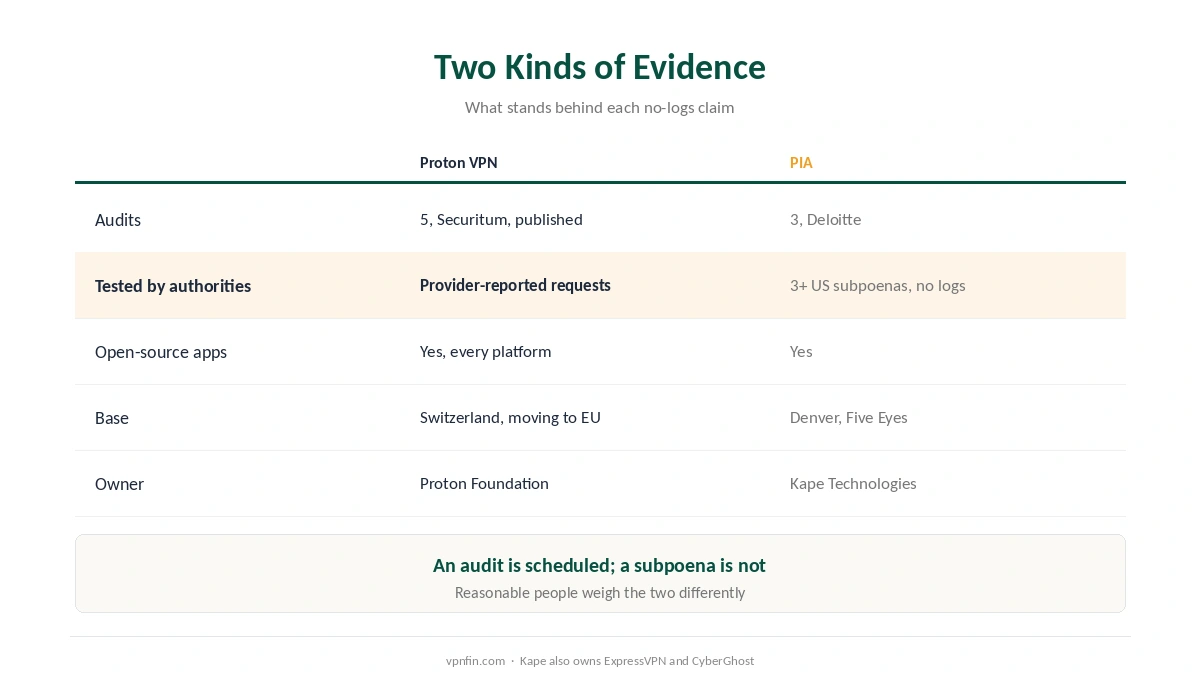
Proton VPN vs PIA is a contest between two ways of proving a no-logs claim, made in two different places. Proton VPN makes it in published documents: five consecutive annual no-logs audits by Securitum, every report downloadable, and every app open source. PIA makes it in court: US federal authorities have subpoenaed it at least three times, including an FBI request in a 2016 case in Virginia, and each time there were no connection logs to hand over.
Both approaches carry weight, and few providers can claim either. The two also share open-source apps and port forwarding. They part company on jurisdiction, ownership, devices and the free tier.
Proton VPN vs PIA: The Short Answer
In Proton VPN vs PIA, choose Proton VPN for published verification and a free tier. It rates 4.6 in our Proton VPN review, with five published audits and a free plan without a data cap.
Choose PIA for unlimited devices and the lowest price. It rates 4.5 in our rankings, costs around $2.03 a month on its two-year plan, and its no-logs claim has been tested by subpoena. Our PIA review covers the cases.
Jurisdiction favours Proton. PIA is based in Denver, inside the Five Eyes; Proton is Swiss, though it is moving most of its infrastructure into the EU.
Two Kinds of Evidence
Proton VPN: audits in the open. Securitum has audited its no-logs claim every year for five years, and Proton publishes each report without an account or NDA on its audit page. Its apps are open source on every platform, so anyone can inspect what they do. Our audit tracker sets that record against the rest.
PIA: records that were not there. PIA has faced at least three US federal subpoenas, and in each case it had no connection logs to provide. Three Deloitte audits followed, and its apps are open source too. Our PIA review notes that only Proton matches it on both open code and published audits among providers we cover.
⚠️ Reasonable people weigh these differently. A subpoena is an adversarial test that a company cannot stage; an audit is a scheduled check of a chosen window. Proton also reports its own volume of legal requests, but that figure is a provider claim rather than court records anyone can count. Our guide to legal demands on VPNs explains both.
| Provider | No-logs audits | Auditor | Jurisdiction |
|---|---|---|---|
| NordVPN | 6 | PwC, Deloitte | Panama |
| Surfshark | 2 | Deloitte | Netherlands (9 Eyes) |
| ExpressVPN | 3 | KPMG (28 security reports in total) | British Virgin Islands, Kape-owned |
| CyberGhost | 3 | Deloitte | Romania, Kape-owned |
| PureVPN | 4 | KPMG | BVI, operated from Pakistan |
| IPVanish | 2 | Leviathan, Schellman | United States (Five Eyes), Ziff Davis-owned |
| Windscribe | 1 | Packetlabs, production infrastructure | Canada (Five Eyes); Greek case dismissed, no data to give |
| Proton VPN | 5 | Securitum | Switzerland, moving infrastructure to EU |
| Private Internet Access | 3 | Deloitte | United States (Five Eyes), Kape-owned |
| Mullvad | 10+ | Cure53, Assured AB | Sweden (14 Eyes) |
| TunnelBear | Annual since 2017 | Cure53 | Canada (Five Eyes), US parent |
| Norton VPN | 2 | VerSprite | United States (Five Eyes) |
| Hotspot Shield | 0 | protocol audited, policy not | United States (Five Eyes) |
| AirVPN | 0 | none — the client is open source instead | Italy (14 Eyes) |
| IVPN | 8, annual since inception | Cure53 | Gibraltar (status disputed) |
| Hide.me | 1 modern, in 2024 | Securitum, though one source names Altius IT | Malaysia (outside the alliances) |
| PrivadoVPN | 0 | none in six years of operation | Iceland (moved from Switzerland, 2026) |
| TorGuard | 0 | none; settled a lawsuit without disclosing records | United States (Five Eyes) |
| FastestVPN | 1, in 2023 | Altius IT | Cayman Islands (outside the alliances) |
| StrongVPN | 0 | none in over two decades | United States (Five Eyes), Ziff Davis-owned |
| VyprVPN | 1, in 2018 | Leviathan Security, before the 2023 sale | United States (Five Eyes), Certida-owned since 2023 |
| PrivateVPN | 0 | none; support says there is nothing to audit | Sweden (14 Eyes), ownership disputed |
| ZoogVPN | 0 | none; support describes one as planned | Greece (outside the alliances), run from Ukraine |
| Malwarebytes Privacy VPN | 1, in 2026 | X41 D-Sec, white-box over two months | United States (Five Eyes), runs AzireVPN infrastructure |
| Astrill | 0 | — | Disputed: Seychelles or Liechtenstein |
Jurisdiction and Ownership
Proton VPN built its reputation on Swiss law. In July 2025 it announced it was moving most of its physical infrastructure out of Switzerland, because of a proposed surveillance ordinance, and our review explains what that means for users. Its parent is the Proton Foundation, a non-profit that owns nothing else in the VPN market.
PIA operates from Denver, Colorado, inside the Five Eyes, with no legal barrier to compelled assistance. It belongs to Kape Technologies, which also owns ExpressVPN and CyberGhost. The subpoena record is PIA’s answer to its jurisdiction; our ownership guide covers Kape.
Price
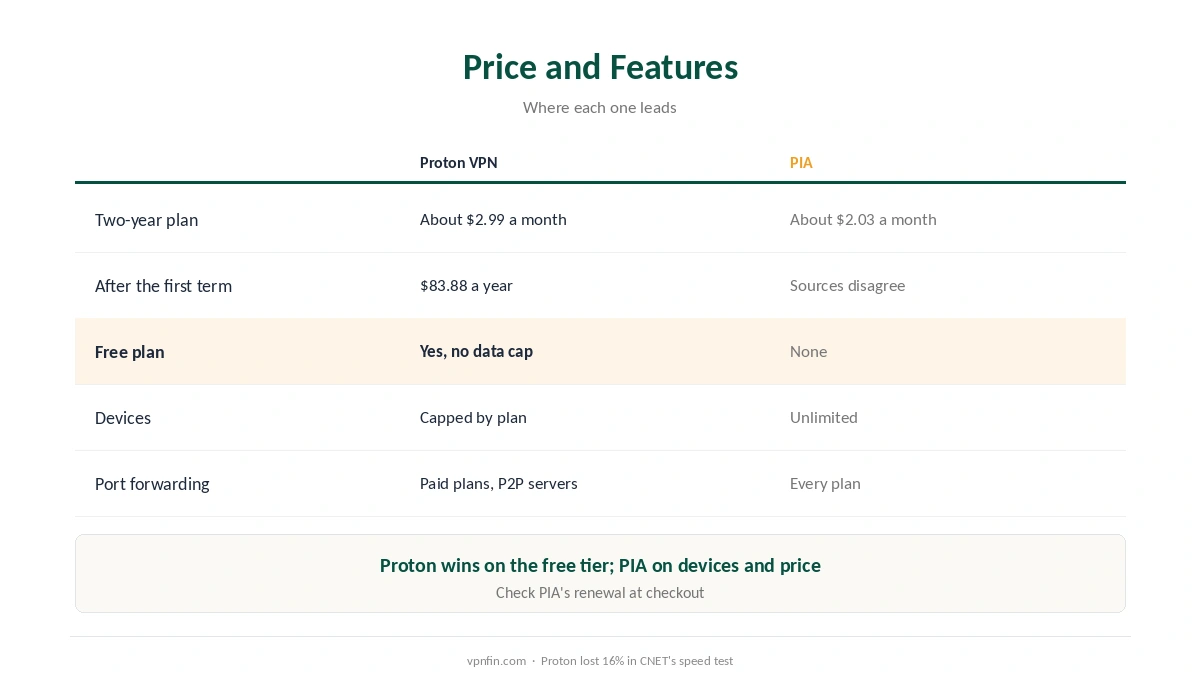
Proton VPN Plus costs about $2.99 a month on its two-year plan, around $71.76 upfront, then $83.88 a year. Our four-year table puts it near $240.
PIA costs around $2.03 a month on its two-year plan, about $49 upfront. Sources disagree on what it renews at, so check the checkout page before paying. Our renewal price table compares both.
| Provider | First term | Every year after |
|---|---|---|
| Norton VPN | $39.99 (12 months) | $79.99 |
| Private Internet Access | ~$49 (24 months) | Sources disagree |
| CyberGhost | $56.94 (26 months) | $56.94 |
| PureVPN | $58.20 (27 months) | $47.95 |
| Mullvad | ~$65 (12 months) | ~$65 |
| Surfshark | ~$67 (27 months) | ~$79 |
| Proton VPN | ~$71.76 (24 months) | $83.88 |
| Hotspot Shield | ~$71.88 (12 months) | $95.99 |
| NordVPN | $94.23 (27 months) | $139.08 |
| ExpressVPN | ~$98 (28 months) | $99.95 |
| Astrill | $300 (24 months) | $300 every 2 years |
Free Tier, Devices and Port Forwarding
Free tier: Proton’s free plan has no data cap and needs no card; PIA has no free plan. Our free VPN guide explains why Proton’s free tier is one of the few worth trusting.
Devices: PIA sets no limit on any plan. Proton caps simultaneous connections on its paid tiers, so check the figure for the plan you choose. Our multi-device guide compares the limits.
Port forwarding: both offer it. PIA includes it on every plan; Proton offers it on paid plans, through P2P servers, in its Windows and Linux apps. Our port forwarding guide explains the details, and our torrenting guide covers seeding.
Speed and Streaming
CNET measured a 16% average download loss with Proton VPN. Our reviews rate Proton’s streaming slightly higher than PIA’s, at 4.5 against 4, though access on any provider changes over time.
Which One
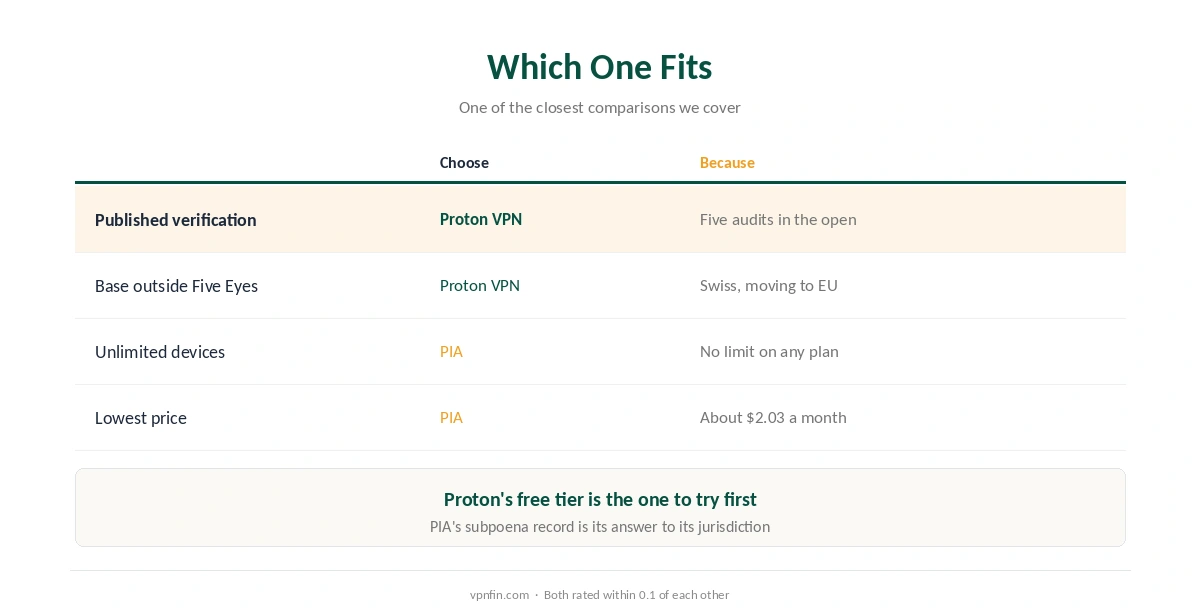
Proton VPN if published, repeatable verification and a non-US base matter most, or if you want a free tier you can trust. Mullvad against Proton VPN compares it with another privacy-first option.
PIA if you want unlimited devices and the lowest price, and you find a subpoena record more persuasive than an audit. NordVPN against PIA and ExpressVPN against PIA cover other trade-offs.
How We Research
Proton VPN’s audits, jurisdiction change, free tier and pricing come from our Proton VPN review and tables, and PIA’s subpoenas, Deloitte audits, devices and pricing from our PIA review and tables. Prices are as recorded in our tables in September 2026, so confirm them at checkout. The speed figure is CNET’s, via our speed table, and the ratings come from our top-five table. We do not run our own tests. Our full approach lives on the About Us page.
Proton VPN vs PIA FAQ
They are close: 4.6 against 4.5 in our rankings. Proton leads on published audits, jurisdiction and its free tier. PIA leads on devices and price, and its no-logs claim has been tested by US subpoenas.
It has been tested. US federal authorities have subpoenaed PIA at least three times, and each time it had no connection logs to provide. It has also had three Deloitte audits.
Yes, with no data cap and no card required. PIA has no free plan.
PIA, at around $2.03 a month on its two-year plan. Proton VPN Plus costs about $2.99 a month on the same term, then $83.88 a year.
Yes. PIA includes it on every plan. Proton offers it on paid plans through P2P servers, in its Windows and Linux apps.
The Verdict
Proton VPN vs PIA is one of the closest comparisons we cover. On one side sit published audits, a Swiss foundation and a trustworthy free tier. PIA offers unlimited devices, a lower price and a no-logs claim that has survived federal subpoenas.
Choose Proton if you want verification in the open and a base outside the Five Eyes. Choose PIA if devices and price matter more, and a courtroom record reassures you as much as an audit.